





How does Hitachi Energy’s $1 billion U.S. manufacturing push aim to support surging AI data center electricity needs?
Hitachi Energy, a wholly owned subsidiary of Hitachi, Ltd., has unveiled a landmark investment plan of more than $1 billion USD to strengthen America’s grid infrastructure at a time when artificial intelligence (AI) and industrial electrification are driving record demand for reliable power. The centerpiece of this initiative is a $457 million USD state-of-the-art power transformer facility in South Boston, Virginia, which will become the largest of its kind in the United States. Additional expansions will take place across existing sites nationwide, collectively creating thousands of high-paying jobs and reinforcing local supply chains.
The investment comes against the backdrop of President Donald Trump’s administration’s AI Action Plan and energy dominance agenda, which emphasize secure, affordable, and domestically produced energy as essential for U.S. competitiveness. Federal and state leaders—including Energy Secretary Chris Wright, Secretary of the Interior Doug Burgum, and Virginia Governor Glenn Youngkin—framed Hitachi’s decision as a strategic breakthrough for both AI infrastructure and economic reindustrialization.
Why is Virginia at the center of Hitachi’s plan to manufacture power transformers for the American grid?
The Virginia plant is designed to address one of the U.S. grid’s most pressing bottlenecks: limited domestic production of large power transformers. These devices are critical to transmitting high-voltage electricity from power plants and renewable generation hubs to AI data centers, industrial sites, and population centers. Today, the U.S. imports a significant share of its transformers from overseas—a dependency viewed as a security and reliability risk by policymakers and utilities alike.
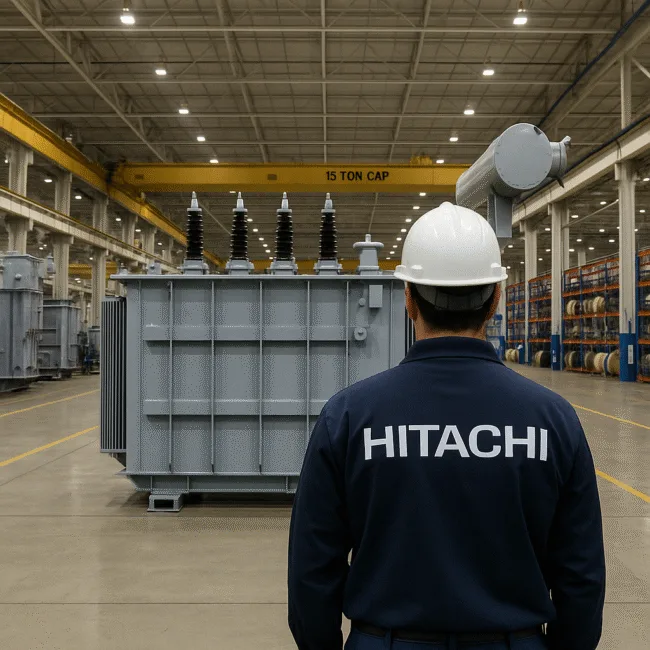
Hitachi’s decision to locate its largest U.S. investment in South Boston reflects both Virginia’s pro-business policies and the region’s skilled manufacturing base. Governor Glenn Youngkin underscored that the project will deliver more than 825 jobs to Southside Virginia and be complemented by a new workforce housing development supported by the Virginia Workforce Housing Investment Program. Senators Mark Warner and Tim Kaine echoed that the project strengthens both regional economies and national energy resilience, praising Virginia’s combination of talent, infrastructure, and innovation.
What makes Hitachi Energy’s investment different from past manufacturing expansions in the U.S. electrical sector?
Industry observers highlight the size and scope of Hitachi Energy’s plan as unprecedented. The $1 billion allocation is among the largest single commitments by a private-sector player in the U.S. electrical equipment industry. Analysts say the move signals a structural shift: rather than incremental upgrades, Hitachi is betting on vertically integrated, U.S.-based manufacturing to meet the exponential rise in demand from AI, electric vehicles, and renewable integration.
The Virginia facility will join Hitachi’s existing network of transformer production and service sites but stand out as a flagship hub with scale unmatched in the domestic market. By positioning itself as the leading supplier of grid infrastructure, Hitachi Energy aims to reduce the reliance of utilities and hyperscalers on imported transformers while accelerating delivery timelines for critical projects.
Institutional investors view this as a hedge against global supply chain risks and a potential growth driver for Hitachi’s North American revenues. With the AI economy consuming unprecedented amounts of power, analysts suggest that transformer supply constraints are poised to become as critical as semiconductor bottlenecks in determining economic competitiveness.
How does this $1 billion investment align with U.S. federal energy and AI industrial policies?
The Trump administration’s White House AI Action Plan links digital infrastructure with energy capacity, arguing that leadership in artificial intelligence requires parallel leadership in reliable, affordable power. Federal officials describe the Hitachi announcement as a textbook example of how private-sector capital is being mobilized to advance this dual agenda.
Chris Wright, the U.S. Energy Secretary, noted that America’s push to “win the AI race” depends on energy reliability, while Interior Secretary Doug Burgum emphasized that AI data centers represent the next wave of U.S. industrial expansion. Jarrod Agen, Executive Director of the White House National Energy Dominance Council, framed transformer production as essential to national security and global competitiveness.
Analysts interpret this policy context as favorable for manufacturers like Hitachi Energy, which stand to benefit from tax incentives, workforce programs, and expedited permitting linked to national energy resilience. For institutional investors, the administration’s support signals a stable environment for capital-intensive projects in the electrification and AI infrastructure ecosystem.
What role will Hitachi’s global expertise play in shaping the U.S. grid modernization agenda?
Toshiaki Tokunaga, President and CEO of Hitachi, Ltd., emphasized that the U.S. is a key market and that the investment reflects the group’s global strategy to balance soaring electricity demand with decarbonization. Hitachi Energy’s CEO Andreas Schierenbeck added that transformers are a “linchpin technology” for winning the AI race, arguing that bottlenecks in transformer supply represent one of the greatest risks to America’s economic trajectory.
With more than 50,000 employees worldwide and operations in 140 countries, Hitachi Energy brings global scale to U.S. projects. The Virginia facility is part of a broader $9 billion USD global expansion program that spans R&D, engineering, and manufacturing to address reliability, security, and resilience challenges across the energy system. For institutional stakeholders, this global commitment signals both financial strength and a long-term approach to securing market share in advanced grid technologies.
What do institutional and investor perspectives suggest about the impact of this move on Hitachi and the wider U.S. manufacturing base?
Analysts generally see the $1 billion program as a bullish signal for both Hitachi and U.S.-based electrification. On one hand, the Virginia facility positions Hitachi Energy as the market leader in high-voltage transformers, securing long-term contracts with utilities, industrial players, and hyperscale data center operators. On the other, the company’s integration of IT, operational technology, and advanced product lines aligns well with institutional priorities for smart, cyber-resilient infrastructure.
The stock market reaction to Hitachi Ltd. (TYO: 6501) has been cautiously optimistic, with investors focusing on whether margins can remain resilient amid the high upfront costs of manufacturing expansion. Institutional commentary suggests that as long as demand from AI data centers and renewable integration continues to grow, Hitachi Energy’s U.S. strategy could serve as a model for how industrial giants capture value in the era of energy-driven AI scaling.
What is the long-term outlook for Hitachi Energy’s role in powering the U.S. economy?
Looking forward, the key metrics to watch will include job creation milestones, production ramp-up timelines, and integration of the Virginia facility into the broader supply chain. Institutional investors will also monitor how successfully Hitachi Energy leverages its global R&D capabilities to bring advanced transformer technologies—such as digital monitoring and predictive maintenance—into the U.S. market.
Analysts predict that domestic manufacturing of critical equipment like transformers will increasingly be treated as a strategic priority akin to semiconductors. If Hitachi Energy’s expansion succeeds, it could catalyze a broader reshoring trend in grid infrastructure, encouraging other multinationals and U.S. incumbents to scale local production. For policymakers, the project offers a tangible example of how industrial investment can simultaneously deliver on AI competitiveness, energy security, and job creation.
Discover more from Business-News-Today.com
Subscribe to get the latest posts sent to your email.


