



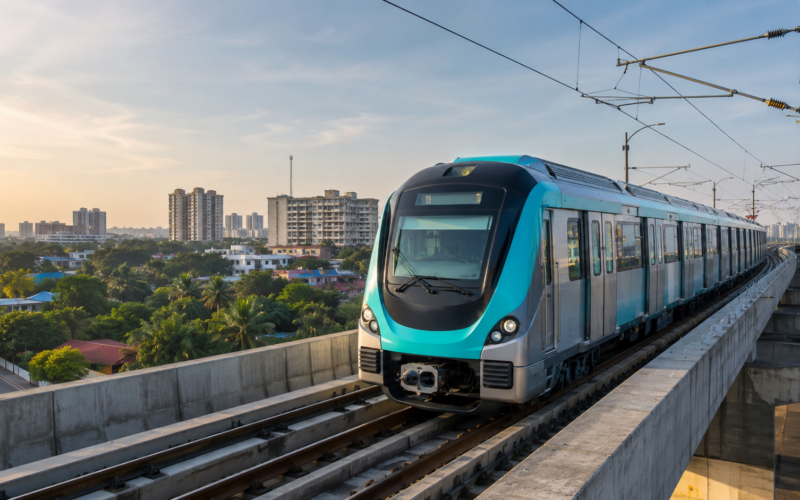
Siemens Limited (NSE: SIEMENS; BSE: 500550) has secured a ₹91.65 crore telecommunications contract from Kochi Metro Rail Limited for the second phase of the city’s metro network. The contract, formally awarded on May 20, 2026, covers the design, manufacture, supply, installation, testing and commissioning of the telecommunications system required for the Phase II corridor. Although the order represents only a small addition to Siemens Limited’s ₹45,033 crore backlog, it places the company inside a strategically important urban rail project connecting central Ernakulam with Kakkanad’s technology, administrative and industrial districts. The central question is therefore not whether the contract materially changes Siemens Limited’s near-term financial position, but whether effective system integration can strengthen its position in India’s expanding metro infrastructure market.
What exactly will Siemens Limited deliver under the ₹91.65 crore Kochi Metro Phase II contract?
Kochi Metro Rail Limited’s published contract register values the telecommunications package awarded to Siemens Limited at ₹91,64,99,999.70. The scope includes design, manufacturing, supply, installation, testing and commissioning, making it a complete systems-delivery responsibility rather than a simple equipment order.
The award register does not publicly break down the package into individual telecommunications subsystems. That distinction matters because metro telecommunications commonly support multiple operational functions, but the specific equipment, software architecture, maintenance terms and subsystem configuration applicable to Siemens Limited should not be assumed beyond the published contract description.
What is clear is that telecommunications sit near the operational heart of a modern metro railway. Civil structures, tracks and traction systems create the physical corridor, but communications infrastructure helps connect stations, control facilities, trains, operational personnel and passenger-facing systems into a coordinated network.
This makes the Siemens Limited package operationally more important than its percentage of project spending might initially suggest. A telecommunications contract may be smaller than a viaduct, station or electrification package, yet delays in installation, interface testing or final integration can affect the commissioning sequence of the entire line.
The commercial value will also be recognised over the project execution period rather than immediately. Siemens Limited must complete design reviews, equipment supply, installation and system testing before the full contract value can translate into reported revenue and cash flow.
Why does the Siemens contract matter for the 11.2-kilometre Kakkanad metro corridor?
Kochi Metro Phase II is planned as an 11.2-kilometre corridor with 11 stations, extending the network from JLN Stadium to Infopark through Kakkanad. The alignment is intended to connect central Ernakulam with major employment, education, administrative and industrial locations including Infopark, SmartCity, the Ernakulam district headquarters, Cochin Special Economic Zone, KINFRA and Rajagiri Vidyapeetham.
The corridor therefore addresses a different travel pattern from a conventional city-centre metro extension. Kakkanad combines large technology campuses, government offices, educational institutions, residential communities and industrial activity, creating concentrated weekday commuter demand alongside wider urban mobility requirements.
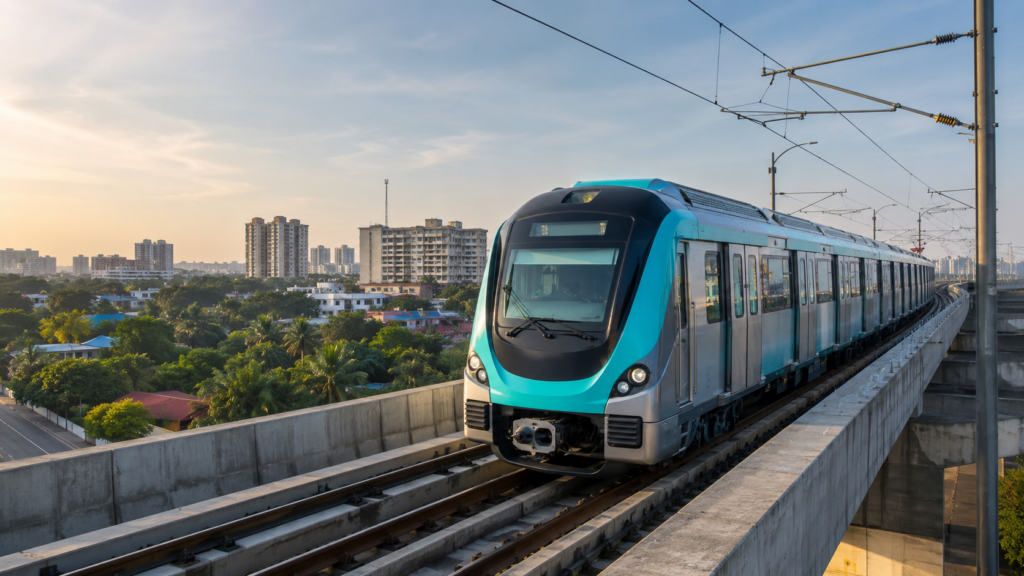
Kochi Metro Rail Limited has also positioned Phase II as part of a multimodal network that can connect with buses, the Kochi Water Metro and other last-mile transport systems. Telecommunications infrastructure becomes particularly significant in such a setting because passenger information, operational coordination and network reliability must function across a corridor serving several different travel markets.
The project’s strategic value extends beyond ridership alone. Reliable metro connectivity can influence commuting costs, employment accessibility, commercial development and investor interest around station areas. Kakkanad’s existing role as an information technology and administrative hub means that transport reliability can become part of the region’s wider competitiveness.
However, the economic case will ultimately depend on execution. Infrastructure demand can be visible years before passengers receive a functioning service. The Siemens Limited award is consequently one part of a much larger sequence involving civil construction, track work, electrification, station development, rolling-stock coordination, testing and safety approvals.
How does the Siemens order fit within Kochi Metro Phase II’s ₹1,957 crore project structure?
The approved detailed project report places the total completion cost of Kochi Metro Phase II at ₹1,957.05 crore. The funding structure includes equity contributions from the Government of India and the Government of Kerala, subordinate debt components, land and rehabilitation expenditure, state taxes, financing costs and a large loan component from bilateral or multilateral institutions.
The Siemens Limited telecommunications package represents approximately 4.7% of the approved total project cost. That percentage should not be interpreted as Siemens Limited’s share of the complete technology opportunity, because separate packages cover traction electrification, tracks, stations, civil structures and other systems.
Kochi Metro Rail Limited’s award register also shows that Texmaco Rail and Engineering Limited received a ₹130.22 crore contract for ballastless track and associated works between JLN Stadium and Infopark. Kalpataru Projects International Limited received a ₹223.59 crore package covering third-rail traction electrification, traction and auxiliary substations and associated supervisory control and data acquisition systems.
Together, these three published awards amount to approximately ₹445.46 crore, equivalent to around 22.8% of the Phase II project’s approved cost. This does not represent the full value already committed by Kochi Metro Rail Limited, but it illustrates how the corridor is progressing through specialised packages rather than through a single turnkey construction contract.
That procurement model can encourage specialist participation and competitive pricing. It also increases interface-management requirements. Track, traction, telecommunications, station and civil contractors must deliver systems that operate together under a common commissioning timetable.
For Siemens Limited, the practical risk lies at these interfaces. The telecommunications system must be designed around station layouts, power availability, equipment-room readiness, control-centre requirements and the eventual operating configuration of the corridor. Delays elsewhere can therefore affect Siemens Limited’s installation schedule even when its own engineering work remains on track.
Why is a ₹91.65 crore order strategically relevant to Siemens Limited despite its small financial size?
The Kochi Metro order is not financially transformative for Siemens Limited. At ₹91.65 crore, it represents only about 0.2% of the company’s ₹45,033 crore order backlog reported for the period ended March 31, 2026. It is also small compared with the ₹6,731 crore of new orders booked during the January to March quarter.
The strategic relevance comes from market positioning rather than immediate scale. Urban rail contracts create reference projects, implementation experience and customer relationships that can support future bids across signalling, telecommunications, electrification and integrated mobility systems.
Siemens Limited has already demonstrated its ability to win substantially larger transport-system contracts. In July 2025, the company disclosed two orders worth approximately ₹773 crore for signalling and telecommunications technologies for Nagpur Metro Phase II. It was also part of a consortium selected for signalling and telecommunications work on the Mumbai to Ahmedabad high-speed rail project, with Siemens Limited’s share valued at approximately ₹1,230 crore.
Compared with those projects, Kochi Metro Phase II is a smaller contract. Nevertheless, repeated wins across different metro authorities can improve Siemens Limited’s utilisation of engineering talent, procurement systems and project-management capabilities.
The contract also arrives during a period of organisational consolidation. Siemens Limited’s board has approved the proposed amalgamation of Siemens Rail Automation Private Limited into the listed company, subject to the required approvals. The restructuring could simplify the way rail automation capabilities are housed within the wider Siemens Limited organisation, although the Kochi contract’s execution does not depend solely on completion of that transaction.
Strategically, the order strengthens continuity. Large rail contracts provide backlog scale, while smaller metro packages can help maintain project flow and expand the company’s installed base across Indian cities.
What do Siemens Limited’s latest results reveal about order growth and execution pressure?
Siemens Limited reported revenue of ₹4,618 crore for the January to March 2026 quarter, an increase of 14.6% from the comparable period. New orders rose 32.6% to ₹6,731 crore, while the order backlog increased 9.3% to ₹45,033 crore. Profit after tax stood at ₹355 crore.
The growth figures indicate that demand is not the company’s immediate problem. The more important issue is converting a growing backlog into profitable revenue while managing commodity costs, foreign-exchange movements and project-delivery schedules.
Profit from operations declined by 15% during the quarter despite the revenue increase. Siemens Limited attributed the pressure to higher commodity prices and depreciation of the Indian rupee. Management also indicated that domestic demand remained supported by public and private-sector ordering, while acknowledging the need to monitor economic conditions and their potential impact on capital expenditure.
This creates a useful lens for assessing the Kochi contract. The order contributes to future revenue visibility, but backlog growth alone does not guarantee margin expansion. Engineering hours, imported components, equipment costs, currency exposure, contractual escalation clauses and site readiness can all influence project profitability.
CRISIL Ratings observed in July 2026 that Siemens Limited’s order book had expanded to about ₹45,000 crore and highlighted continuing opportunities in metro systems, signalling, electrification and propulsion. The rating agency also noted that the backlog had grown substantially over the preceding three years, providing medium-term execution visibility.
The positive interpretation is that Siemens Limited has substantial demand visibility across Indian infrastructure and industrial capital expenditure. The more cautious interpretation is that a larger order book increases the importance of disciplined delivery, working-capital management and cost control.
Has the Kochi Metro contract materially changed sentiment toward Siemens Limited shares?
Siemens Limited shares closed at ₹3,686.30 on the National Stock Exchange of India on July 23, 2026, rising approximately 1% during the session. The stock gained roughly 0.8% across the five trading sessions from July 17, while remaining broadly unchanged from its June 23 closing level.
The share price was about 6.4% below its 52-week high of ₹3,937.30 and approximately 30.4% above its 52-week low of ₹2,826. The company’s market capitalisation was around ₹1.31 lakh crore based on recent market data.
There is no clear basis for attributing the July 23 share-price increase to the Kochi Metro contract. The formal award date was May 20, meaning the information does not represent a newly secured July order even though it has attracted fresh media attention.
This timing distinction is important for investors. A contract should not be described as an immediate market catalyst merely because it has recently been highlighted by a news platform. The underlying economic event is the May award, while the July development is primarily renewed visibility around the contract.
The order is also too small relative to Siemens Limited’s backlog and market value to justify a major standalone valuation change. Its relevance lies in reinforcing the company’s metro and rail execution credentials rather than materially altering earnings expectations.
Current sentiment appears constructive but measured. The share price remains near the upper portion of its annual range, reflecting confidence in India’s industrial and infrastructure investment cycle. At the same time, the valuation leaves limited room for persistent execution problems or margin disappointments.
What execution risks could determine whether the Kochi Metro telecom package stays on schedule?
The largest risk is coordination across multiple packages. Telecommunications installation cannot be completed independently of station construction, equipment-room readiness, traction power availability, track access and control-centre integration.
Urban rail projects also operate within constrained construction environments. Traffic management, utility relocation, land access, regulatory clearances and contractor sequencing can influence the availability of individual work fronts. Siemens Limited may therefore face schedule pressure created by dependencies outside its direct contractual scope.
System testing is another critical stage. Equipment may perform correctly in isolation while still requiring substantial interface work before the complete network can be commissioned. The final test is not whether individual devices have been installed, but whether the entire telecommunications environment functions reliably under normal operations, emergencies and degraded operating conditions.
Commercial discipline will matter as well. Project contracts frequently require milestone-based billing, performance guarantees and retention amounts. Delays can postpone cash conversion even where the underlying order remains secure.
Kochi Metro Rail Limited must consequently manage the corridor as an integrated programme rather than a collection of separate contracts. The Siemens Limited package will create strategic value only when it works with the track, traction, stations and other operating systems as a unified railway.
What milestones will show whether Siemens Limited and Kochi Metro Rail Limited are delivering successfully?
The next meaningful indicators will emerge from execution rather than from additional publicity around the award. These include completion of detailed system design, approval of technical submissions, manufacturing and delivery of equipment, readiness of station and control facilities, installation progress and commencement of integrated testing.
For Siemens Limited, timely revenue recognition without disproportionate cost escalation would demonstrate disciplined execution. For Kochi Metro Rail Limited, synchronisation between telecommunications, electrification, track and civil contractors will be the more important programme-level measure.
The contract strengthens Siemens Limited’s participation in India’s metro expansion and gives Kochi Metro Rail Limited an experienced rail-technology contractor for a vital systems package. What has improved is the corridor’s procurement visibility, with major track, traction and telecommunications packages now carrying identified contractors.
What remains unresolved is the timing and efficiency of full corridor integration. The investment case for Siemens Limited will not change materially because of one ₹91.65 crore contract, but successful delivery can reinforce its credentials for larger urban mobility opportunities. The decisive proof point will be whether the telecommunications system reaches integrated testing in step with the rest of Kochi Metro Phase II rather than becoming another well-awarded package waiting for adjacent works to catch up.
What are the key takeaways from Siemens Limited’s Kochi Metro Phase II order?
- Kochi Metro Rail Limited awarded Siemens Limited a ₹91.65 crore telecommunications contract on May 20, 2026.
- The contract covers design, manufacture, supply, installation, testing and commissioning for the Phase II telecommunications system.
- Kochi Metro Phase II will run for 11.2 kilometres with 11 stations between JLN Stadium and Infopark through Kakkanad.
- The corridor has an approved completion cost of ₹1,957.05 crore, placing the Siemens Limited package at approximately 4.7% of total project cost.
- Siemens Limited’s order is strategically relevant to its urban rail portfolio but represents only around 0.2% of its ₹45,033 crore backlog.
- The order complements separate Phase II contracts awarded to Texmaco Rail and Engineering Limited for track work and Kalpataru Projects International Limited for traction electrification.
- Siemens Limited’s latest results show strong order and revenue growth, but operating profit remains exposed to commodity costs and currency movements.
- Siemens Limited shares closed at ₹3,686.30 on July 23, around 6.4% below their 52-week high and broadly unchanged over the preceding month.
- The July market movement should not be presented as a direct reaction to the Kochi contract because the formal award occurred in May.
- Integrated testing and coordination with civil, track, station and traction contractors will provide the clearest evidence of successful execution.
Share this:
Discover more from Business-News-Today.com
Subscribe to get the latest posts sent to your email.