


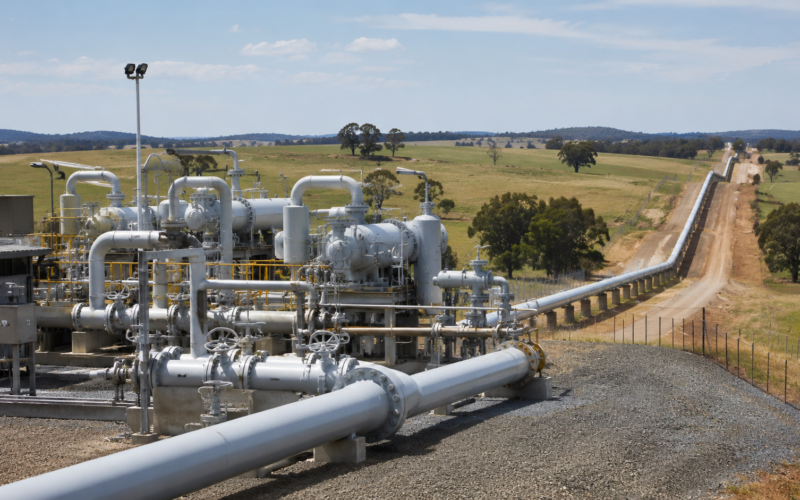
APA Group (ASX: APA) has received Australian Energy Regulator approval for a A$212.7 million expansion of Victoria’s South West Pipeline, clearing the company to begin work on two compressor stations designed to lift peak transport capacity from 523 terajoules a day to 615 terajoules a day. The regulator also approved A$31.1 million of early works that preserve the option to undertake larger pipeline duplication projects later, taking the total approved capital expenditure to A$243.8 million. The investment will enter the Victorian Transmission System’s Regulated Asset Base, allowing APA Group to recover an approved return, depreciation and associated costs through future pipeline tariffs. The strategic benefit is a relatively predictable infrastructure return within APA Group’s approximately A$3 billion organic growth programme. The central tension is whether compression can be delivered before winter 2029 with sufficient reliability while avoiding the additional time and substantially higher cost associated with duplicating sections of the pipeline.
The project will add compressor stations at Pirron Yallock and Stonehaven, allowing additional gas from the Otway Basin and Lochard Energy’s Iona Underground Gas Storage facility near Port Campbell to move through the Victorian Transmission System towards Melbourne. APA Group expects to begin procurement of the compression units by the end of July 2026, while engineering, land access and regulatory approvals progress in parallel. The compressors are scheduled to enter operation before winter 2029, when the Australian Energy Market Operator expects Victoria to begin experiencing peak-day gas supply shortfalls without additional pipeline capacity.
Why does the Australian Energy Regulator’s decision materially improve APA Group’s investment certainty?
The regulatory decision does more than permit construction. APA Group submitted the proposal under Rule 80 of the National Gas Rules, which allows a regulated pipeline operator to obtain an advance determination on capital expenditure during an existing regulatory period. The Australian Energy Regulator’s determination is binding on the regulator and confirms that the approved expenditure satisfies the relevant capital criteria.
Once the project enters the regulated capital base, APA Group can recover the approved rate of return, depreciation and other recognised costs through pipeline tariffs. That structure materially lowers commercial uncertainty compared with an unregulated development that depends on signing enough customers at negotiated prices before construction.
The project therefore fits APA Group’s traditional infrastructure model. Capital is committed to a long-lived network asset, the regulator determines the recoverable expenditure and the company earns a return over the asset’s regulated life. The precise earnings contribution will depend on the applicable regulated return, commissioning date and future access arrangement, but the regulatory ruling removes one of the most important barriers to investment.
The approval also strengthens the quality of APA Group’s organic development pipeline. The A$212.7 million compression project represents approximately 7% of the company’s A$3 billion FY26 to FY28 organic growth programme. Including the A$31.1 million of early works takes the approved South West Pipeline-related expenditure to just over 8% of that programme.
For investors, this is not the sort of project that should create an immediate earnings jump. The financial attraction comes from adding another regulated asset capable of generating infrastructure returns over a long operating period. The main value driver is not the construction announcement itself, but timely commissioning and inclusion of the completed investment in regulated tariffs.
How much additional gas capacity will the South West Pipeline expansion deliver by 2029?
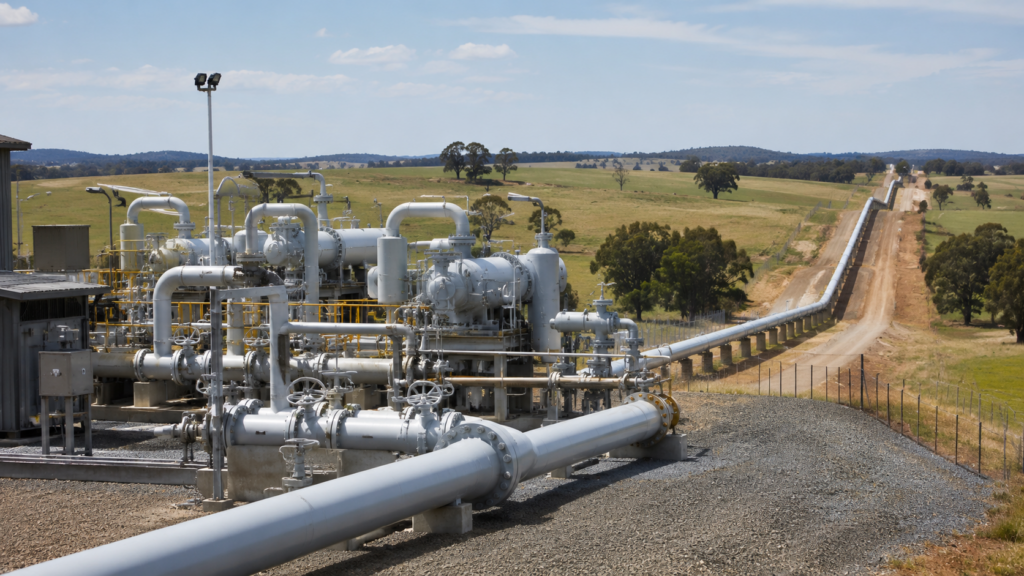
The compression programme is designed to raise South West Pipeline capacity by 92 terajoules a day, from 523 terajoules a day to 615 terajoules a day. That represents an increase of approximately 17.6%. The Australian Energy Regulator said the expanded pipeline should provide sufficient capacity to meet a forecast requirement of about 600 terajoules a day during peak periods in 2029.
The additional capacity is closely linked to expansion at the Iona Underground Gas Storage facility. Lochard Energy is increasing Iona’s maximum daily supply capacity to 615 terajoules a day in 2027, supported by a long-term agreement with Snowy Hydro. Existing South West Pipeline capacity would be insufficient to move all of that potential supply towards Melbourne during periods of high demand.
This highlights the project’s practical purpose. Victoria may have gas in storage, but stored gas only supports the market if transmission infrastructure can move it quickly enough to power stations, businesses and distribution networks when demand rises.
The project addresses peak-day availability rather than reversing the broader decline in residential and commercial gas consumption. The Australian Energy Regulator noted that household and business gas demand is expected to fall as electrification progresses. However, winter peak demand is expected to remain elevated because gas-powered generation will increasingly support the electricity system as coal-fired generation retires.
The resulting infrastructure challenge is slightly counterintuitive. Victoria can consume less gas annually while still requiring greater pipeline and storage deliverability on a small number of critical days. The value of the expansion therefore lies in flexibility and system reliability rather than continuous utilisation at maximum capacity.
Why did the regulator approve compression when AEMO considered pipeline looping more reliable?
APA Group evaluated three principal options: two compressor stations, partial duplication of 88 kilometres of the South West Pipeline and full duplication of its 144-kilometre length. The Australian Energy Market Operator considered partial looping technically preferable because duplicated pipe would provide greater reliability, more linepack and a clearer pathway towards further capacity expansion.
Compression nevertheless had one decisive advantage. APA Group said the compressor solution could be operating before winter 2029, whereas either looping alternative could not be completed until at least 2030. The Australian Energy Regulator concluded that the consequences of leaving the projected 2029 shortfall unaddressed outweighed the technical disadvantages of compression.
APA Group has also said the adopted compression solution is almost 40% cheaper than partial looping for comparable capacity and approximately 60% cheaper than full looping. Those are company comparisons, but the regulator separately assessed the proposed expenditure as prudent and efficient.
The reliability issue has not disappeared. The Stonehaven site will initially operate with one new compressor, and performance will be reviewed after 12 months. If a second Stonehaven compressor is considered necessary, APA Group has estimated an additional installation cost of A$82 million. That possible expenditure is not part of the current approved compression project and should not be treated as committed capital.
APA Group will construct an additional compressor footprint at Stonehaven for A$1.7 million, allowing a replacement or additional unit to be installed more quickly if required. This contingency improves resilience but does not make compression operationally equivalent to a duplicated pipeline.
The project is therefore a timing-led compromise. Looping may provide a stronger long-term engineering solution, but compression is the option judged capable of meeting the immediate 2029 deadline.
Why did the AER approve another A$31.1 million before a future looping project is selected?
The Australian Energy Regulator approved A$16 million of early works for possible future South West Pipeline looping and A$15.1 million for possible duplication of the Brooklyn-Lara Pipeline. The expenditure will support preliminary design, environmental studies, cultural heritage assessment, landowner engagement and approval processes.
This does not amount to approval for either future construction project. It maintains optionality while Victoria’s post-2029 gas supply pathway becomes clearer.
Several supply routes remain under consideration. Additional Queensland gas could move south through interconnected pipelines, Iona storage could expand further, liquefied natural gas could enter near Geelong, or imported gas could reach Victoria through the proposed Port Kembla Energy Terminal and existing eastern pipelines. Different supply outcomes would require different transmission investments.
The Australian Energy Regulator acknowledged that some early work could become redundant if the market selects a route that does not require one of the contemplated looping projects. It nevertheless considered the expenditure prudent because environmental approvals, land access and engineering studies have long lead times, while the cost of being unprepared for further supply declines could be substantial.
This is strategically important for APA Group. The company is not only securing approval for one compressor project. It is positioning the Victorian Transmission System to respond more quickly when governments, producers, storage operators and gas buyers determine the next supply configuration.
The early works also give APA Group a stronger position in the next Victorian Transmission System access arrangement. APA Group is expected to submit its 2028 to 2032 proposal in December 2026, with the Australian Energy Regulator’s final decision expected in December 2027.
Can APA Group fund the Victorian pipeline expansion without compromising distributions?
APA Group said the project would be financed through existing balance-sheet capacity. That position is supported by its latest reported operating performance, although the company is simultaneously funding several major growth projects.
For the six months ended 31 December 2025, APA Group reported underlying earnings before interest, tax, depreciation and amortisation of A$1.092 billion, up 7.6%. Free cash flow increased to A$556 million, while statutory net profit rose to A$95 million. The underlying earnings margin improved by 2.8 percentage points to 77.3%.
APA Group maintained FY26 underlying earnings guidance of A$2.12 billion to A$2.20 billion and said it expected to exceed the midpoint. It also reaffirmed distribution guidance of A$0.58 per security, representing a 1.8% increase from FY25.
The company’s funding position also benefited from a revised S&P Global Ratings threshold that APA Group said created more than A$1 billion of additional balance-sheet capacity while retaining its BBB stable credit rating. The wider organic growth pipeline is expected to be funded through balance-sheet capacity and the Distribution Reinvestment Plan.
The South West Pipeline programme is therefore financially manageable in isolation. The more relevant risk is cumulative capital intensity. APA Group is already investing in the East Coast Gas Grid, electricity generation, battery storage and other infrastructure projects.
The compression project’s expenditure profile is also front-loaded before commissioning. APA Group expects to spend A$32.2 million during 2026, A$61.4 million in 2027, A$83.3 million in 2028 and A$35.8 million in 2029. Procurement and construction account for most of the A$212.7 million cost.
That schedule means cash leaves the business before the completed project begins contributing regulated revenue. APA Group’s existing earnings and funding headroom reduce this timing risk, but project discipline remains important across the broader portfolio.
What could still delay the South West Pipeline project despite the favourable AER ruling?
The Australian Energy Regulator has approved the capital expenditure, but APA Group still requires land access, detailed engineering and project-specific approvals before construction and commissioning can be completed.
The regulator’s assessment identified potential requirements including a pipeline licence alteration, a Cultural Heritage Management Plan and approvals under Victoria’s Environment Protection Act. The precise environmental licensing pathway will depend partly on the detailed emissions assessment.
Compressor procurement is the first major delivery test. APA Group has targeted the end of July 2026 for beginning that process, reflecting the long lead time associated with large compression units. Delayed equipment orders could compress the construction and commissioning timetable as the winter 2029 deadline approaches.
Execution risk will peak during 2028, when the approved expenditure profile includes A$53 million of construction spending. Commissioning expenditure then increases during 2029. That sequence leaves limited room for material delays if the system must be available before winter.
Reliability must also be demonstrated after start-up. Compression depends on mechanical equipment that requires fuel, maintenance and operational availability. The additional Stonehaven footprint improves contingency planning, but actual performance will determine whether a further compressor is needed.
The project’s strategic importance could support cooperation among APA Group, the Australian Energy Market Operator and the Victorian Government. It does not remove construction, approval or supply-chain risk.
What does the APA share-price reaction suggest about expectations for regulated growth?
APA Group securities traded around A$10.28 during the afternoon of 17 July 2026, up approximately 2.1% for the session. The move coincided with publication of the Australian Energy Regulator’s decision, although broader market conditions and other company developments may also have influenced trading.
At that intraday price, APA Group’s market capitalisation was approximately A$13.6 billion. The securities were about 3.3% above their 10 July close of A$9.95, but roughly 1.3% below the A$10.42 close recorded on 17 June. The available 52-week range was A$8.18 to A$11.10.
The response appears proportionate to the announcement. A A$243.8 million regulated programme is strategically useful and financially visible, but it remains modest relative to APA Group’s existing asset base, earnings and market value.
The project supports the company’s growth and distribution narrative rather than radically changing it. Investors are likely to place greater weight on whether APA Group delivers its full A$3 billion pipeline within budget while maintaining credit metrics and distribution growth.
The approval improves regulatory certainty and strengthens APA Group’s exposure to Victorian energy-security investment. What remains unresolved is execution timing, compressor reliability and how efficiently the company manages a growing capital programme.
The decisive proof point will be procurement of the compressor units, followed by on-budget construction and commissioning before winter 2029 without weakening APA Group’s balance sheet or distribution commitments.
Key takeaways from APA Group’s South West Pipeline expansion approval
- The Australian Energy Regulator approved A$212.7 million for APA Group to expand Victoria’s South West Pipeline using two compressor stations.
- Another A$31.1 million was approved for early work on possible future looping of the South West Pipeline and Brooklyn-Lara Pipeline.
- Total approved capital expenditure is A$243.8 million, although the immediate compression expansion is commonly described as a A$213 million project.
- Capacity is expected to increase by 92 terajoules a day, from 523 terajoules a day to 615 terajoules a day.
- APA Group plans to install compressor stations at Pirron Yallock and Stonehaven before winter 2029.
- The project will enter the Victorian Transmission System Regulated Asset Base, allowing approved costs and returns to be recovered through tariffs.
- The Australian Energy Market Operator considered pipeline looping more reliable and expandable, but compression was approved because it could be delivered before the projected 2029 shortfall.
- APA Group expects to begin compressor procurement by the end of July 2026 and fund the development from existing balance-sheet capacity.
- The project forms part of APA Group’s approximately A$3 billion FY26 to FY28 organic growth programme.
- The principal evidence required is timely procurement, approval progress, budget control and reliable commissioning before winter 2029.
Share this:
Discover more from Business-News-Today.com
Subscribe to get the latest posts sent to your email.