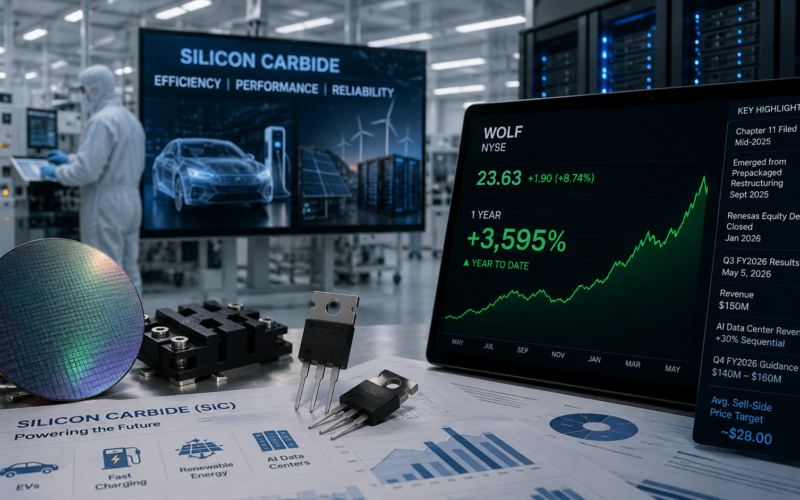
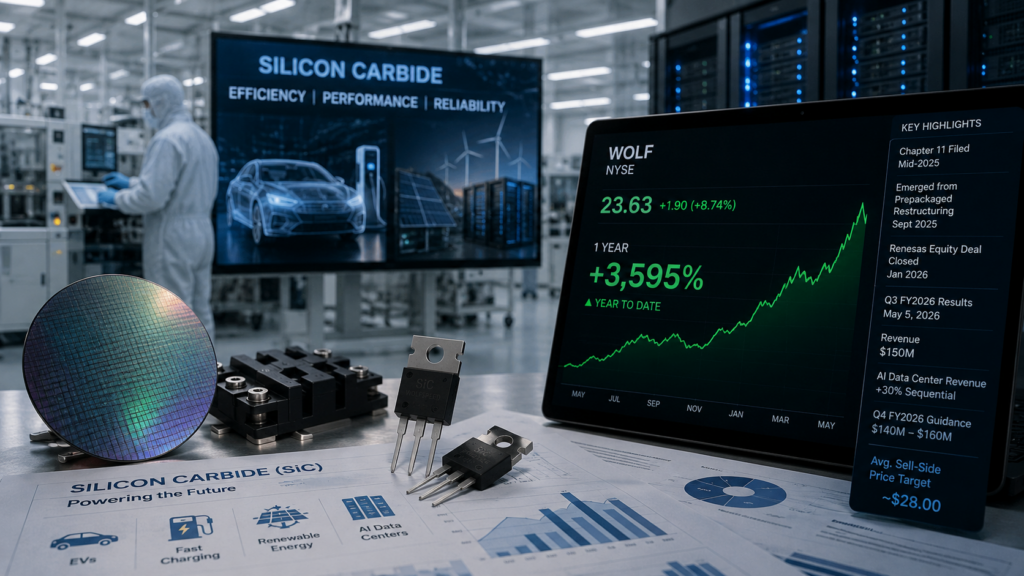
Wolfspeed (NYSE: WOLF) is the Durham, North Carolina-based silicon carbide pioneer that filed Chapter 11 in mid-2025, emerged through a prepackaged restructuring in late September 2025, and has since become one of the most violent retail trading stories on the NYSE. The stock has gained roughly 3,595 percent over the trailing twelve months, ranking number one in the 52-week price change across the US market, while still trading well above the average sell-side price target of approximately USD 28. The CFIUS-cleared Renesas equity deal closed in January 2026, the Q3 fiscal 2026 print on 5 May 2026 delivered USD 150 million in revenue alongside a 30 percent sequential lift in AI data center revenue, and the Q4 fiscal 2026 guidance range of USD 140 million to USD 160 million implies stability into the year-end print. For a retail investor landing on WOLF from a power semiconductor or AI infrastructure feed, the question is whether the post-restructuring company can deliver the manufacturing transition cleanly enough to justify the rally that has already happened.
What does Wolfspeed actually do as silicon carbide pivots from EV to AI data center demand?
Wolfspeed is a vertically integrated silicon carbide power semiconductor company, with operations spanning silicon carbide substrate growth, epitaxy, wafer fabrication, packaging, and final test. The product portfolio covers silicon carbide material sold to other semiconductor companies, power modules sold to industrial and automotive customers, discrete power devices used across inverters and power supplies, and power die products that go into a wide range of downstream applications. The vertical integration is the structural moat. Few companies in the world grow their own silicon carbide boules at scale, and Wolfspeed is one of the very few that combines substrate supply with device manufacturing.
The end-market mix has shifted decisively over the last twelve months. The original investment thesis through 2022 and 2023 was that silicon carbide would ride the electric vehicle adoption curve, with EV traction inverters as the largest growth driver. That thesis encountered the EV demand cooling that has been visible across the entire automotive supply chain, which is a meaningful part of why Q3 fiscal 2026 revenue of USD 150 million was down 19 percent year over year. What has emerged on the other side is AI data center demand for silicon carbide in high-power-density power supplies and conversion stages, where Q3 fiscal 2026 AI data center revenue grew 30 percent sequentially.
The risk inside the business is that Wolfspeed is still operating with negative gross margins as the underutilisation from the 150-millimetre to 200-millimetre wafer transition flows through the cost structure. GAAP gross margin was negative 27 percent and non-GAAP gross margin was negative 21 percent in Q3 fiscal 2026, with the bridge to positive margins dependent on absorbing fixed costs across higher production volumes. The AI pivot is real, but the financial profile of the business will take several quarters of clean manufacturing execution to actually reflect that pivot.
Why did the Chapter 11 emergence and Renesas equity deal reset the WOLF capital structure?
Wolfspeed filed for Chapter 11 protection in mid-2025 under a prepackaged restructuring agreement with its lender group, and the court entered an order confirming the plan that resulted in emergence in late September 2025. The mechanics of the restructuring reduced total debt, extended maturities, and lowered annual cash interest expense significantly, with the company entering fresh-start accounting on the effective date and recording assets and liabilities at estimated fair values. Pre-petition shareholders received a 2.0 percent equity recovery in the post-emergence capital structure.
The CFIUS clearance of the equity issuance to Renesas Electronics America Inc. on 30 January 2026 was the final regulatory milestone in executing the restructuring. Renesas’s equity investment cemented a long-standing supply relationship between the two companies, with Renesas as a major customer of Wolfspeed’s silicon carbide power devices for industrial and automotive applications. A Renesas executive joined the Wolfspeed Board of Directors as part of the agreement, alongside the broader board refresh that brought Anthony M. Abate in as Chairman succeeding Tom Werner, and added Mike Bokan, Eric Musser, Hong Q. Hou, and Aris Bolisay as directors pending certain regulatory approvals.
The implication for retail investors is that the post-restructuring Wolfspeed is structurally a different business from the pre-restructuring company. The capital structure is meaningfully lighter, the customer base has reaffirmed commitments, and the operational mandate is to execute the manufacturing transition. The 2.0 percent equity recovery for pre-petition shareholders also means the current public float reflects the post-restructuring share count, with the legacy equity functionally cancelled. The Q3 fiscal 2026 announcement of a USD 476 million debt refinancing completion further strengthens the balance sheet position.
How did Q3 FY2026 deliver flat revenue alongside a 30 percent sequential AI data center jump?
The Q3 fiscal 2026 print reported on 5 May 2026 delivered headline revenue of USD 150 million, in line with prior guidance but down 19 percent year on year. The headline number masks a meaningful underlying shift in the revenue mix. AI data center silicon carbide revenue grew 30 percent quarter on quarter, while the EV and broader automotive line continued to soften in line with the broader market. Industrial and renewable applications held steady against the prior-year quarter.
The profitability lines were difficult. GAAP net loss came in at approximately USD 120 million to USD 128 million, with GAAP gross margin at negative 27 percent and non-GAAP gross margin at negative 21 percent. Adjusted EBITDA was negative USD 62 million, with operating cash flow at negative USD 84 million. EPS missed expectations at approximately negative USD 3.05. The bridge to better margins runs through the 150-millimetre to 200-millimetre wafer transition, with underutilisation suppressing margin as the new lines ramp.
The forward guidance for Q4 fiscal 2026 of USD 140 million to USD 160 million in revenue implies sequential stability, with execution at the top end of the range being the variable the market is most focused on. The implication for retail investors is that the operational story is genuinely improving on the AI data center line and stable on the rest of the business, but the visible improvement at the consolidated level remains constrained by the manufacturing transition. The next two to four quarters of execution will determine whether the post-emergence operating model produces the positive gross margin transition that the share price now implies.
What does the 200mm wafer and 300mm substrate transition mean for forward gross margin?
The wafer transition is the single most important operational variable for Wolfspeed through fiscal 2027 and fiscal 2028. Silicon carbide manufacturing has historically been done on 150-millimetre wafers, which are smaller and less cost-efficient than the 200-millimetre wafers that the broader silicon industry uses. Wolfspeed has been actively transitioning to 200-millimetre silicon carbide production at the Mohawk Valley fab in New York and at additional capacity, with the cost reduction per device on 200-millimetre wafers running into the high double-digit percentage range relative to 150-millimetre.
The 300-millimetre substrate platform represents the next-generation step beyond 200-millimetre, where Wolfspeed has continued to advance development. The company has positioned itself as a first mover on 300-millimetre silicon carbide substrates, which would meaningfully extend the cost advantage over competitors. The technical and operational hurdles for 300-millimetre silicon carbide are higher than for 200-millimetre, but the long-term margin profile of a company running at scale on 300-millimetre would be structurally different from the current operating model.
The risk inside the transition is the period of underutilisation as new capacity ramps and old capacity is wound down. The negative gross margins in Q3 fiscal 2026 are largely a function of this transition rather than a function of product or pricing issues. The forward question is how quickly the 200-millimetre capacity reaches utilisation rates that absorb fixed costs and flip gross margin positive, with the consensus base case implying that this occurs sometime through fiscal 2027.
How does the TOLT portfolio and 10 kV SiC MOSFET launch expand the Wolfspeed product moat?
The next-generation TOLT portfolio was launched alongside the Q3 fiscal 2026 reporting cycle as part of a broader product roadmap acceleration. TOLT, which stands for Top-of-Land Topology, is a new packaging architecture for power devices designed to improve thermal performance, reduce package inductance, and enable higher power density in the end-application. The portfolio targets the power conversion stages in AI data centers, industrial drives, renewable energy inverters, and EV traction applications.
The introduction of the first commercially available 10 kilovolt silicon carbide power MOSFET is a separate technical milestone with significant strategic value. Ten kilovolt-rated power semiconductors enable medium-voltage power conversion in applications such as solid-state transformers, grid-scale renewable interconnects, and high-power industrial systems where silicon-based devices cannot operate efficiently. Wolfspeed’s first-mover position in 10 kV silicon carbide MOSFETs creates a multi-year competitive lead in a niche but high-value segment.
The risk for retail investors is that the moat created by these product introductions depends on commercial adoption rather than on technical capability alone. Power semiconductor design wins typically run on long qualification cycles, where the end-customer evaluates the device over multiple years before committing to a production volume. The TOLT and 10 kV launches set the stage for future revenue acceleration, but the visible revenue contribution from these new platforms will not show up materially in the financials until fiscal 2027 and fiscal 2028.
Why does the new Asia leadership hire matter for the WOLF growth pipeline through 2027?
In May 2026, Wolfspeed announced an Asia-focused leadership hire to anchor the company’s silicon carbide strategy in Japan, Korea, and key ASEAN markets, with the appointment effective 1 June 2026. The hire reflects a deliberate strategic emphasis on Asia as the geography where the largest concentration of silicon carbide adoption is currently happening, particularly across Japanese and Korean automotive customers, ASEAN-based industrial customers, and the broader Asian AI data center supply chain.
Wolfspeed simultaneously announced new legal and government affairs leaders, plus a new communications leader. The cumulative signal is of a company gearing up for larger regulatory, government, and capital markets battles. The legal and government affairs roles will support engagement with US CHIPS Act funding, export control regimes, and the regulatory layer around international expansion. The communications role supports investor relations and broader stakeholder messaging during the post-emergence rebuild period.
The implication for retail investors is that the operational mandate of the post-restructuring company is genuinely focused on the commercial and regulatory execution required to convert the silicon carbide thesis into recognised revenue. The risk is that international expansion in power semiconductors is structurally slow, with customer qualification, regulatory clearance, and local production presence each requiring multi-year investments. The Asia leadership build-out is the right strategic move, but the visible revenue impact will lag the announcement by quarters or years.
How does the stock trading above analyst targets frame the WOLF risk reward setup right now?
The Wolfspeed share price has decoupled significantly from the average sell-side price target. The stock last traded around USD 55 in late May 2026 against an average analyst target of approximately USD 28, which implies the market is pricing the stock at roughly twice the consensus 12-month fair value. The 1-year stock return of plus 3,595 percent ranks number one across the entire US market for the 52-week period, which is a function of the extreme dislocation that occurred during the Chapter 11 process and the subsequent recovery.
The reason the gap between price and consensus target is so wide is that the bull case and the bear case are running on different definitions of value. The bull case extrapolates the AI data center revenue acceleration, assumes the 200-millimetre wafer transition reaches utilisation, projects fiscal 2027 gross margin positive, and arrives at a multi-billion-dollar revenue run rate that justifies the current market capitalisation of approximately USD 3.2 billion. The bear case anchors on the current negative gross margins, the EV market softness, the execution risk inside the manufacturing transition, and the historical pattern in capital-intensive semiconductor businesses where ramps take longer than the bull case implies.
The implication for retail investors is that WOLF is now structurally a momentum stock with operational improvements layered underneath. The Q4 fiscal 2026 print expected in August will be the next discrete test of whether the AI data center acceleration continues and whether the wafer transition is on schedule. A clean print at the top end of guidance could pull the analyst targets higher, while any disappointment on the manufacturing or revenue execution could trigger a sharp drawdown given the gap between the current quote and the fundamental anchors.
What are retail investors on X, Reddit and Stocktwits actually saying about WOLF today?
Retail conversation on WOLF has been one of the most active inside the power semiconductor and AI infrastructure communities through 2026. The Chapter 11 emergence story, the 3,595 percent trailing twelve-month return, and the AI data center revenue acceleration have produced exactly the kind of three-part narrative that retail communities respond to. Cashtag threads on X frame WOLF as a generational silicon carbide story where the prior leverage has been cleared and the AI revenue ramp is now structural.
On Reddit and Stocktwits the conversation has been split. The bullish posts anchor on the TOLT and 10 kV product launches, the Renesas relationship, the AI data center growth rate, and the 200-millimetre wafer transition as a multi-year cost reduction story. The cautious posts focus on the gap between the share price and analyst targets, the negative gross margins, the historical pattern of silicon carbide companies missing on manufacturing timing, and the EV market softness that continues to weigh on the largest portion of historical revenue.
The implication for a retail investor framing a position is that WOLF is genuinely a high-volatility story with a binary forward setup. The stock can extend further if the Q4 print delivers and the AI data center line accelerates, and it can compress materially if the wafer transition slips or the EV line deteriorates further. Position sizing for a stock that has moved from approximately USD 24.70 to USD 66.93 and back to USD 55 in a span of weeks is the practical question rather than the directional view.
Key takeaways for WOLF retail investors weighing the post-Chapter 11 silicon carbide setup
- Wolfspeed emerged from Chapter 11 in late September 2025 with reduced total debt, extended maturities, and lower annual cash interest expense, followed by CFIUS clearance for the Renesas equity issuance on 30 January 2026
- Q3 fiscal 2026 revenue of USD 150 million was in line with guidance but down 19 percent year on year, with AI data center revenue growing 30 percent sequentially as the EV market remained soft
- Q4 fiscal 2026 guidance of USD 140 million to USD 160 million implies sequential stability, with the print expected in August 2026
- GAAP gross margin at negative 27 percent and non-GAAP gross margin at negative 21 percent in Q3 reflect the underutilisation associated with the 150-millimetre to 200-millimetre wafer transition
- The TOLT portfolio launch and the first commercially available 10 kV silicon carbide power MOSFET represent meaningful product moat expansion, with revenue contribution lagging into fiscal 2027 and fiscal 2028
- The Asia-focused leadership hire effective 1 June 2026, alongside new legal, government affairs, and communications leaders, signals a company preparing for larger regulatory and capital markets engagement
- The share price near USD 55 trades roughly twice the average analyst price target of USD 28, after a 3,595 percent trailing twelve-month return that ranks number one in the US market
Share this:
Discover more from Business-News-Today.com
Subscribe to get the latest posts sent to your email.