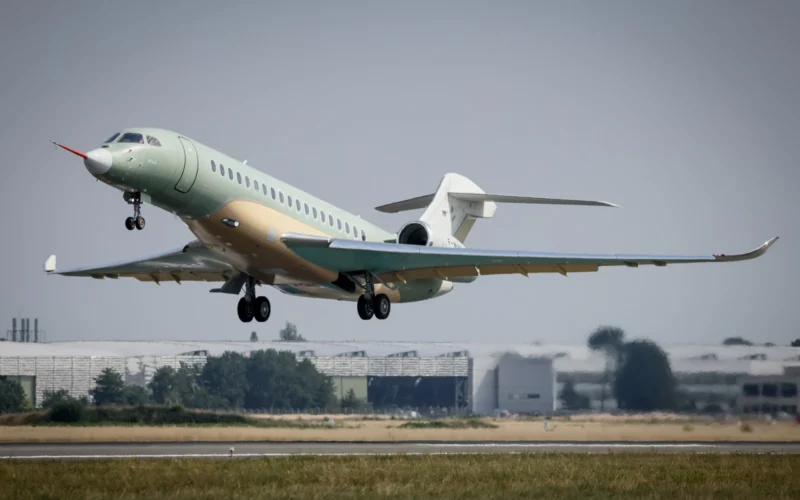
Dassault Aviation SA (Euronext Paris: AM) has completed the maiden flight of its Falcon 10X ultra-long-range business jet, moving the delayed flagship into formal flight testing. The prototype flew for two hours and 30 minutes from Bordeaux-Mérignac on 19 June 2026, reaching 40,000 feet and Mach 0.82 during initial systems and handling checks. The milestone removes one major layer of development risk but leaves certification, production ramp-up, engine maturity and customer delivery timing unresolved. Strategically, the Falcon 10X is Dassault Aviation’s bid to challenge Bombardier and Gulfstream at the highest-value end of business aviation while diversifying an earnings profile increasingly supported by Rafale defence demand.
Why does the Falcon 10X maiden flight matter for Dassault Aviation’s civil aerospace strategy?
A maiden flight does not generate an aircraft delivery or immediate revenue, but it transforms the nature of a development programme. Dassault Aviation has moved from designing, assembling and ground-testing the Falcon 10X to gathering real-world aerodynamic, systems and engine data needed to support certification.
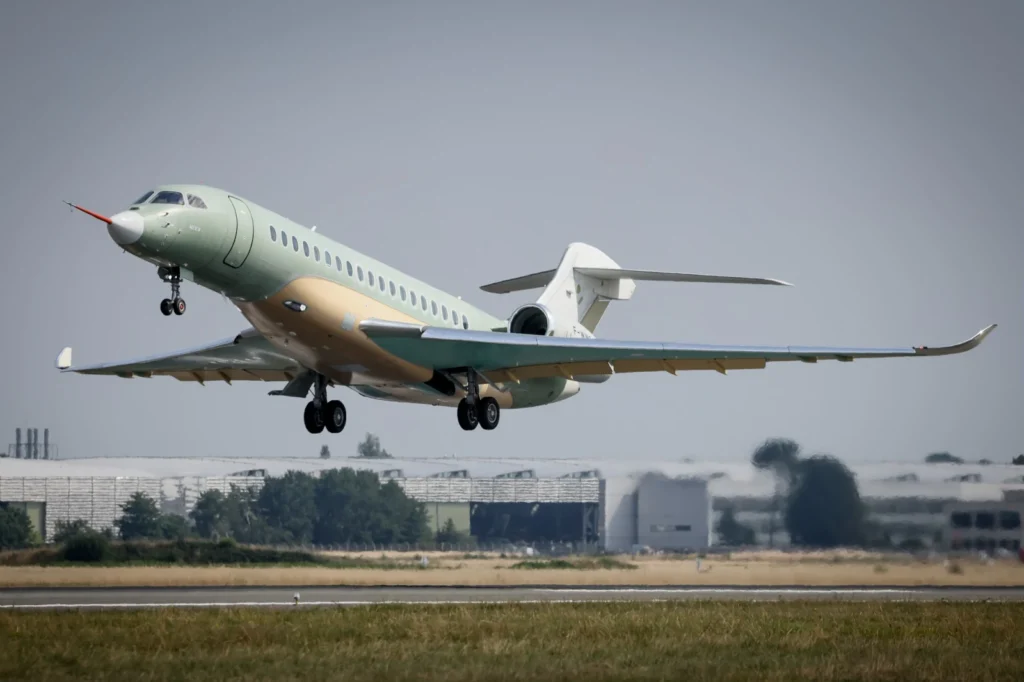
The first prototype departed from runway 23 at Bordeaux-Mérignac at 11:10 a.m. The pilots initially assessed aircraft handling and systems at 15,000 feet before retracting the landing gear and movable surfaces, climbing to 40,000 feet and accelerating to Mach 0.82. The aircraft landed at 1:40 p.m. after completing the planned flight profile.
The successful flight matters because the Falcon 10X is a clean-sheet aircraft rather than a derivative of an existing Falcon. Dassault Aviation has developed a new fuselage, composite wing, flight deck, digital flight-control architecture and production system around the aircraft. That increases the potential performance and commercial reward, but it also creates more opportunities for technical problems to emerge during testing.
Dassault Aviation is using the Falcon 10X to enter the top tier of the business jet market, where aircraft can command prices of roughly $80 million and customers expect intercontinental range, residential cabin space, advanced avionics and high dispatch reliability. A credible flagship can influence perceptions of the entire Falcon family, supporting pricing and customer confidence across smaller aircraft.
The strategic need is clear. Dassault Aviation’s defence business has expanded strongly through Rafale orders, but the company does not want its commercial identity or future earnings to become dependent almost entirely on military programmes. The Falcon 10X gives the civil division a potential growth platform at the most profitable end of business aviation.
What did the first Falcon 10X flight prove and what remains before commercial service?
The maiden flight provided early evidence that the aircraft’s core systems, handling characteristics and propulsion package can operate together under real flight conditions. Reaching 40,000 feet and Mach 0.82 on the first sortie also gave engineers useful data across a meaningful portion of the operating envelope.
However, the flight campaign will need to test the aircraft under far more demanding conditions. Dassault Aviation must validate performance at different weights, speeds, altitudes and temperatures while assessing engine behaviour, flight controls, braking, pressurisation, avionics, ice protection and emergency systems.
A second test aircraft is nearing completion and is expected to join the programme. A third aircraft will be equipped with a full interior and used primarily to test cabin systems, functionality and reliability.
This multi-aircraft approach allows Dassault Aviation to divide the certification workload. One aircraft can focus on aerodynamic and performance testing while another examines systems and the third assesses the passenger environment and operational reliability. The approach can accelerate data collection, but only when aircraft availability and engineering resources remain closely coordinated.
Certification authorities will require evidence that the Falcon 10X performs safely across its entire approved operating envelope, not merely that the prototype flew as expected on its first mission. Unexpected software behaviour, component failures or performance gaps could require redesigns and additional testing.
The programme must also move from a certification configuration to a repeatable production standard. An aircraft can perform well during testing while remaining difficult or expensive to manufacture at commercial volumes. Dassault Aviation must therefore prove both aeronautical performance and industrial maturity.
Can the Falcon 10X compete with Bombardier Global 8000 and Gulfstream G800 aircraft?
The Falcon 10X enters a market in which its two principal competitors already possess significant momentum. Bombardier’s Global 8000 entered service in December 2025, while Gulfstream has established a strong position with the G700 and G800 family.
Bombardier markets the Global 8000 with an 8,000-nautical-mile range and a maximum speed of Mach 0.95. Gulfstream advertises the G800 with a range of up to 8,200 nautical miles at Mach 0.85. The Falcon 10X targets 7,500 nautical miles at Mach 0.85 and a maximum operating speed of Mach 0.925.
Dassault Aviation is therefore not attempting to win solely through the largest range number or the highest advertised speed. Its competitive proposition is centred on cabin dimensions, operating flexibility, safety technology and the integration of fighter-derived flight controls.
The Falcon 10X cabin is designed to measure 6 feet 8 inches in height, 9 feet 1 inch in width and nearly 54 feet in length. Cabin volume is expected to reach approximately 2,780 cubic feet, giving owners the ability to create multiple living areas, private suites, meeting spaces or a bedroom equipped with a full-size bed.
Cabin width may become Dassault Aviation’s strongest commercial differentiator. Ultra-long-range journeys can exceed 12 hours, making usable space, passenger movement, noise and cabin altitude increasingly important. A few additional inches sound modest on a specification sheet but can materially change the passenger experience over an intercontinental flight.
Bombardier and Gulfstream possess larger recent delivery volumes and established fleets at the top of the market. Dassault Aviation must therefore persuade customers that cabin advantages and flight-control technology compensate for entering the competitive cycle later.
The late arrival also presents an opportunity. Dassault Aviation can observe how rival aircraft perform in service and position the Falcon 10X around gaps identified by operators. The awkward part is that competitors can continue improving their own products while Dassault Aviation completes testing.
How does fighter aircraft engineering shape the Falcon 10X investment case?
Dassault Aviation’s civil and defence activities share engineering capabilities in aerodynamics, simulation, flight controls and advanced manufacturing. The Falcon 10X brings several technologies associated with military aircraft into a civil business jet designed for two-pilot operations.
Its digital flight-control system is intended to provide protection against unusual aircraft attitudes and reduce pilot workload during demanding situations. The proposed automatic recovery function would allow pilots to command the aircraft back toward stable flight using a dedicated control if spatial disorientation occurs.
The Smart Throttle system is designed to manage engine power and lateral trim if one engine loses power, reducing the workload associated with maintaining directional control. Dassault Aviation is also integrating dual head-up displays and combined enhanced and synthetic vision.
These systems can improve safety and reduce crew workload, but they also increase software complexity. Certification authorities must examine not only whether the systems work but whether they fail safely when sensors, computers or data inputs become unreliable.
Dassault Aviation’s military engineering base provides another strategic advantage because research, simulation tools and technical talent can support both Rafale and Falcon programmes. Investment in advanced flight controls or digital design can potentially generate benefits across multiple aircraft families.
The model also carries an allocation risk. Strong defence demand requires engineering and production resources at the same time that the Falcon 10X needs intensive testing and industrial preparation. Dassault Aviation must prevent the commercial programme from losing priority as governments seek faster Rafale deliveries.
The company’s dual expertise is therefore valuable only when management can prevent one side of the business from crowding out the other. Fighter DNA looks excellent in a brochure, but flight-test engineers and production specialists still have only 24 hours in a day.
Why is the Rolls-Royce Pearl 10X engine critical to performance and delivery timing?
The Falcon 10X is powered by two Rolls-Royce Pearl 10X engines, each designed to produce more than 18,000 pounds of thrust. The aircraft is the first clean-sheet Dassault Aviation business jet to use Rolls-Royce propulsion.
Engine performance will influence range, fuel burn, take-off capability, noise and maintenance costs. These factors affect both the aircraft’s certification and its lifetime economics for operators.
The propulsion partnership gives Dassault Aviation access to the Pearl engine family and Rolls-Royce’s global support capabilities. It also introduces dependence on a new engine variant being developed in parallel with the aircraft.
Any engine durability, software or certification problem could slow the entire Falcon 10X programme. Aircraft manufacturers cannot easily substitute a different engine after the airframe and systems have been optimised around one propulsion architecture.
Rolls-Royce must therefore demonstrate that the Pearl 10X can deliver the required thrust efficiently while meeting reliability and maintenance expectations. Performance during the expanding flight-test campaign will help engineers verify real-world temperatures, vibration, fuel consumption and response across different phases of flight.
The partnership could become commercially important for Rolls-Royce if the Falcon 10X secures a substantial order book. Business aviation engines generate long-term aftermarket revenue through maintenance, parts and service agreements, extending the financial value well beyond initial deliveries.
For Dassault Aviation, however, supplier quality matters more than supplier prestige. The Falcon 10X must enter service with a mature propulsion system because high-value customers are not particularly interested in financing an extended field-testing programme after accepting their aircraft.
What does the Falcon 10X mean for Dassault Aviation’s factories and supply chain?
Dassault Aviation has invested in facilities specifically designed for the Falcon 10X, including a composite wing operation in Anglet and a new final assembly hall at Bordeaux-Mérignac. These investments mean the programme’s economics depend on more than achieving certification.
The company must convert specialised infrastructure into an efficient production system. Low initial volumes can leave expensive facilities underused, while an overly aggressive ramp-up can create quality problems and supplier bottlenecks.
The composite wing is particularly important. Dassault Aviation selected a high-aspect-ratio carbon-fibre design to support aerodynamic efficiency and long-range performance. Producing large composite structures consistently requires tightly controlled manufacturing, inspection and repair processes.
Supply-chain execution remains a material risk across aerospace. Dassault Aviation delivered 37 Falcon aircraft in 2025, below its target of 40, despite improving from 31 deliveries in 2024. The shortfall demonstrates that rising demand does not automatically produce completed aircraft.
The company has indicated that lessons from supply problems affecting the Falcon 6X will inform the Falcon 10X ramp-up. That experience should improve planning, but the Falcon 10X contains a different combination of structures, engines and systems.
Dassault Aviation must secure adequate capacity from suppliers without locking itself into excessive inventory or unfavourable commercial terms. Smaller aerospace suppliers may require financial support, advance commitments or production investment before they can increase output.
The programme’s success will consequently be measured by production rhythm as much as technical performance. The first aircraft can be built with exceptional attention. Shareholder value depends on whether aircraft number 20 and aircraft number 50 can be built predictably.
How does the Falcon 10X milestone fit within Dassault Aviation’s Rafale-led financial strength?
Dassault Aviation entered the Falcon 10X flight campaign from a position of considerable financial strength. The company reported 2025 revenue of €7.42 billion, adjusted operating income of €635 million and adjusted net income of €1.06 billion.
Defence generated €4.65 billion of revenue, while Falcon operations contributed €2.78 billion. The civil business therefore remains financially significant even though Rafale programmes account for the larger share of group sales.
Dassault Aviation ended 2025 with available cash of approximately €9.4 billion and an order backlog of €46.6 billion. The backlog included 220 Rafale aircraft and 73 Falcon business jets.
That balance sheet gives the company the ability to absorb development expenditure and temporary programme delays without threatening liquidity. It also means investors may tolerate a longer certification period when management can demonstrate disciplined engineering progress.
The imbalance within the backlog remains important. Rafale orders provide strong revenue visibility, but they can make Falcon performance appear less critical to near-term group earnings. Management must resist allowing defence success to conceal weak civil execution.
For 2026, Dassault Aviation is targeting revenue of around €8.5 billion, supported by planned deliveries of 28 Rafale fighters and 40 Falcon aircraft. The Falcon 10X is unlikely to make a meaningful delivery contribution to that guidance, making the maiden flight primarily a future-value milestone.
The aircraft could become more important later in the decade as the existing Rafale backlog converts into revenue. A successful Falcon 10X would broaden the earnings base and give Dassault Aviation a premium civil platform capable of generating aircraft sales, maintenance and customer-support revenue.
Why did Euronext shares react modestly to the Falcon 10X maiden flight?
Dassault Aviation shares traded around €303 to €304 on 19 June 2026, rising by less than 1% after the maiden-flight announcement. The measured reaction suggests investors viewed the flight as an expected development rather than an immediate earnings surprise.
The stock had gained approximately 1.5% over five trading days and around 8.2% over one month. It remained within a 52-week range of approximately €260.60 to €361.80, with a market capitalisation close to €23.6 billion.
The maiden flight reduces technical uncertainty, but it does not establish certification timing, customer deliveries or programme profitability. Investors therefore have limited reason to assign the full potential value of the Falcon 10X after one successful sortie.
Dassault Aviation’s valuation is also heavily influenced by Rafale orders, European defence budgets, export campaigns and the company’s cash position. The civil jet milestone must compete for investor attention with a defence backlog that is several times larger than the Falcon backlog.
The modest response should not be interpreted as disappointment. Development milestones are valuable because they prevent negative scenarios rather than generating instant revenue. A cancelled or failed flight would have attracted considerably more market attention.
The larger valuation catalyst may arrive when Dassault Aviation provides clearer certification timing, discloses stronger Falcon 10X order momentum or demonstrates that production aircraft are advancing alongside the test fleet.
Investors should also watch whether the programme raises research and development spending or capital expenditure. A technically successful aircraft can still produce weak returns when development costs, delays and low production volumes absorb the commercial margin.
What execution risks should investors monitor during the Falcon 10X flight campaign?
The first risk is certification duration. Clean-sheet aircraft programmes frequently encounter issues that require software revisions, component changes or additional testing. Even technically manageable findings can extend schedules when regulators require new evidence.
The second risk is supplier readiness. Engines, avionics, landing gear, cabin systems and composite structures must arrive at the required quality and rate. A delay in one critical component can prevent an otherwise complete aircraft from entering testing or delivery.
The third risk is competitive timing. Bombardier and Gulfstream already have aircraft operating or available in the same high-end market. Customers needing immediate capacity may be unwilling to wait for the Falcon 10X.
The fourth risk is demand transparency. Dassault Aviation does not disclose detailed Falcon 10X order numbers, making it difficult to estimate production requirements and programme break-even economics.
The fifth risk is pricing discipline. A late entrant may be tempted to use discounts or favourable support packages to win customers from established competitors. That could build a fleet more quickly but weaken margins and residual values.
The sixth risk is production execution. Dassault Aviation missed its 2025 Falcon delivery target despite improving output, showing that supply constraints remain relevant before the Falcon 10X enters the factory rhythm.
The final risk is management attention. Dassault Aviation is simultaneously expanding Rafale output, managing export programmes, investing in future combat technologies and developing civil aircraft. Financial strength reduces the capital risk, but it does not eliminate organisational complexity.
What are the key takeaways from the Falcon 10X maiden flight and AM stock outlook?
- Dassault Aviation completed the Falcon 10X maiden flight on 19 June 2026, formally launching the flight-test campaign.
- The prototype flew for two hours and 30 minutes, reached 40,000 feet and accelerated to Mach 0.82.
- A second test aircraft is nearing completion, while a third will focus on cabin systems and operational reliability.
- The Falcon 10X targets 7,500 nautical miles of range and a maximum operating speed of Mach 0.925.
- Cabin size, flexible interior layouts and fighter-derived flight controls form the core competitive proposition.
- Bombardier and Gulfstream already possess strong positions in ultra-long-range business aviation, increasing execution pressure.
- Rolls-Royce Pearl 10X engine performance will be critical to certification, efficiency and delivery timing.
- Dassault Aviation’s €9.4 billion cash position and €46.6 billion backlog provide substantial programme resilience.
- AM shares reacted modestly because the first flight reduces development risk without producing immediate earnings.
- Future valuation catalysts include certification progress, order visibility, production readiness and evidence of profitable deliveries.
Share this:
Discover more from Business-News-Today.com
Subscribe to get the latest posts sent to your email.