


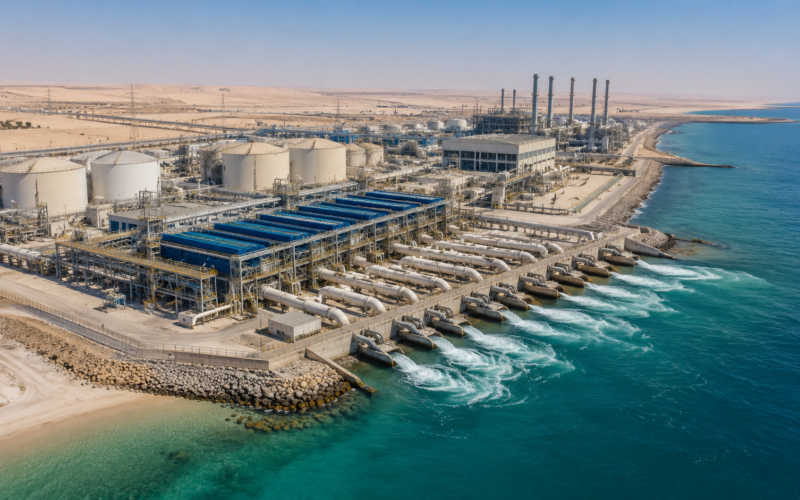
VA Tech Wabag Limited (NSE: WABAG) has secured a design, build and operate contract for the Doha Seawater Reverse Osmosis Desalination Plant with Recarbonation System, Stage II, from Kuwait’s Ministry of Electricity, Water and Renewable Energy. The project covers a 60 million imperial gallons per day facility, equivalent to approximately 272 million litres per day, with construction and commissioning scheduled over 36 months followed by five years of operations and maintenance. VA Tech Wabag Limited will lead an unincorporated joint venture with Heavy Engineering Industries and Shipbuilding Company K.S.C. for project execution. The award marks VA Tech Wabag Limited’s first entry into Kuwait and strengthens its position in a Gulf market where desalination is essential infrastructure rather than discretionary capital spending. WABAG shares closed 8.89% higher at ₹1,983.60 on June 19 after touching a fresh 52-week high of ₹2,009.70.
Why does VA Tech Wabag’s first Kuwait desalination contract matter strategically?
The immediate significance is geographical. VA Tech Wabag Limited already has a substantial presence across Saudi Arabia, Bahrain and the United Arab Emirates, but Kuwait adds another sovereign-backed Gulf market to its operating footprint. Entering a new country through a large public infrastructure contract can create follow-on opportunities because water authorities generally place considerable weight on local execution records, operating reliability and experience with regional water conditions.
The second significance is project scale. VA Tech Wabag Limited classifies international contracts worth more than $150 million as mega orders. The precise contract value has not been disclosed beyond that threshold, but even the minimum implied size makes the project material relative to the company’s annual revenue base.
The third strategic benefit comes from the contract format. VA Tech Wabag Limited is not simply supplying equipment or completing a limited engineering package. The company will participate across design, engineering, procurement, construction, commissioning and subsequent operations and maintenance, giving it exposure to a larger portion of the infrastructure lifecycle.
That wider scope can support stronger customer relationships and longer revenue visibility. It can also demonstrate that VA Tech Wabag Limited is capable of delivering a major desalination asset as an integrated water technology partner rather than operating only as a construction contractor.
Kuwait is also strategically relevant because water supply is closely linked to energy policy, public expenditure and national resilience. A successful project can position VA Tech Wabag Limited for future desalination expansions, plant upgrades, renewable-energy integration and long-term operating contracts within the country.
How will the 272 MLD Doha SWRO project affect VA Tech Wabag’s revenue visibility?
The engineering, procurement and construction phase is scheduled to run for 36 months. Revenue from that component should therefore be recognised progressively as design, procurement, construction and commissioning milestones are completed, rather than appearing as a single financial-year contribution.
The project could provide a meaningful revenue stream during the next three years, but the exact contribution attributable to VA Tech Wabag Limited remains uncertain. The order will be executed through an unincorporated joint venture led by VA Tech Wabag Limited, and the exchange disclosure does not specify the economic division between VA Tech Wabag Limited and Heavy Engineering Industries and Shipbuilding Company.
That missing detail is important. The headline contract size represents the joint venture award, not necessarily the portion that will flow through VA Tech Wabag Limited’s consolidated revenue. Investors should avoid assuming that the entire $150 million-plus value belongs to WABAG unless the company later discloses the work-share arrangement.
The five-year operations and maintenance period provides an additional revenue tail after construction. Operations and maintenance contracts usually produce steadier revenue than engineering contracts because service payments are distributed over the operating period and linked to plant availability, water quality and performance obligations.
The combination of construction and operating revenue fits VA Tech Wabag Limited’s strategy of increasing lifecycle participation. Engineering work provides scale, while operations and maintenance can produce recurring income, customer continuity and a deeper understanding of plant performance.
The order should also be viewed alongside VA Tech Wabag Limited’s FY2026 order backlog of approximately ₹17,235 crore. That backlog already represented more than four times FY2026 revenue, giving the company significant medium-term visibility before adding the latest Kuwait project.
Why is the five-year operations and maintenance mandate more valuable than a conventional EPC order?
A conventional engineering, procurement and construction project ends after commissioning and the completion of warranty obligations. A design, build and operate contract keeps the contractor involved after the plant begins supplying water, changing both the revenue profile and the allocation of operational risk.
For VA Tech Wabag Limited, the operations and maintenance period creates a recurring service opportunity. It can generate predictable revenue, improve customer retention and allow the company to demonstrate the reliability of its engineering choices under real operating conditions.
The arrangement can also improve the strategic quality of the order book. VA Tech Wabag Limited ended FY2026 with approximately ₹6,346 crore of operations and maintenance backlog, indicating that recurring service contracts are becoming a larger component of the business.
This matters because engineering revenue can fluctuate depending on order awards, construction schedules and customer approvals. A larger operations and maintenance portfolio can reduce some of that volatility, although it cannot eliminate the cyclicality of major project activity.
Long-term operating responsibility also raises the cost of poor execution. Engineering shortcuts, weak equipment selection or inadequate commissioning can create maintenance expenses for years after construction is completed. The design phase must therefore balance capital cost with energy consumption, membrane life, chemical use, maintenance access and plant availability.
The five-year mandate gives VA Tech Wabag Limited an incentive to optimise lifecycle economics rather than focusing exclusively on initial construction costs. That alignment can improve customer value, but it also means the company retains exposure to operational underperformance after the plant is commissioned.
How could solar integration and reverse osmosis technology influence project economics?
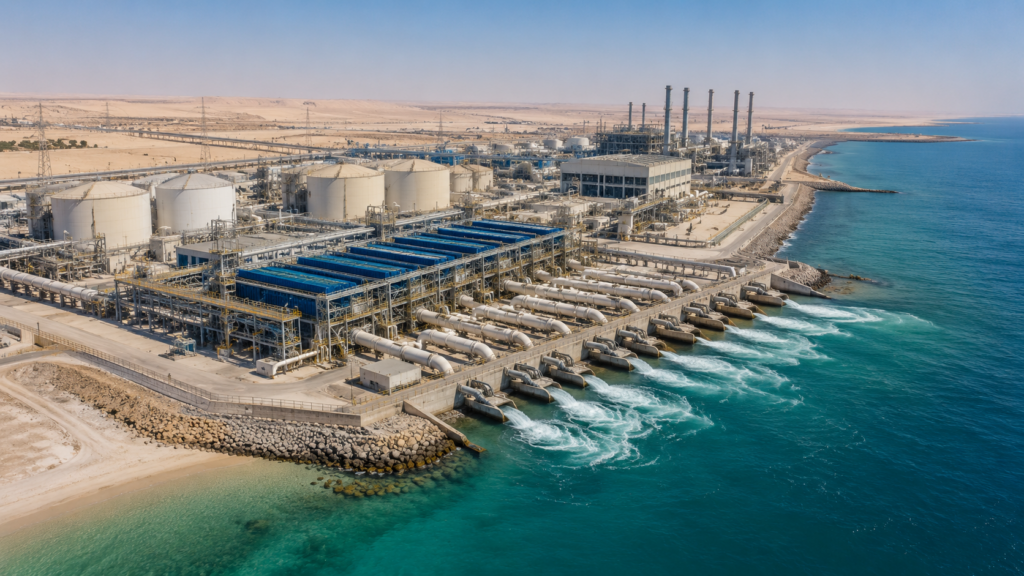
The Doha project will use seawater reverse osmosis technology, which forces seawater through membranes to separate salts and impurities. The plant will also include a recarbonation system to condition the treated water before it enters the potable water network.
Reverse osmosis plants require substantial electricity because seawater must be pressurised before membrane separation. Energy consumption is therefore one of the largest operating-cost variables in a desalination plant and a major determinant of the price of delivered water.
The inclusion of solar photovoltaic systems is strategically relevant because it can partially offset conventional electricity consumption. The filing does not disclose the planned solar capacity or the proportion of plant demand it will meet, so the economic benefit cannot yet be quantified.
Even partial renewable-energy integration may reduce exposure to fuel costs and strengthen the project’s environmental profile. It can also provide VA Tech Wabag Limited with an operating reference for future tenders that include both water and clean-energy requirements.
However, solar generation will not eliminate the plant’s dependence on grid electricity. A 272 million-litres-per-day facility requires continuous operation, while solar output varies by time of day and weather conditions. The project will need to integrate renewable generation without compromising water production or system reliability.
The broader industry implication is that future desalination tenders are likely to focus increasingly on energy efficiency, emissions reduction and total lifecycle cost. Companies able to combine process engineering, membrane optimisation, energy recovery and renewable integration may hold an advantage over contractors competing mainly on construction price.
Can VA Tech Wabag protect margins while executing another large Gulf project?
VA Tech Wabag Limited reported FY2026 revenue of approximately ₹3,944 crore, an increase of nearly 20%, while profit after tax rose about 25% to approximately ₹370 crore. Earnings before interest, tax, depreciation and amortisation increased to around ₹477 crore, although the EBITDA margin moderated to approximately 12.1%.
The financial profile shows strong growth but also illustrates why contract quality matters. Large engineering projects can accelerate revenue, yet margins depend on bid pricing, procurement discipline, currency management, construction productivity and the ability to control changes in project scope.
The Kuwait contract may benefit from sovereign backing and the presence of a local joint venture partner. Heavy Engineering Industries and Shipbuilding Company can contribute local procurement knowledge, regulatory familiarity, workforce access and execution capabilities that reduce some market-entry risk.
The joint venture structure can also distribute capital requirements and project liabilities. However, shared execution introduces coordination risk, particularly where responsibilities, procurement packages and performance guarantees are divided between partners.
Foreign-exchange exposure will be another consideration. Revenue and costs may arise in different currencies, while equipment could be sourced from India, Europe, the Gulf or other manufacturing markets. Currency movements can either protect or erode margins depending on contract terms and hedging.
VA Tech Wabag Limited must also manage the working-capital demands created by a growing international backlog. Major projects often require procurement and contractor mobilisation before corresponding customer payments are received. Strong reported profits will create less shareholder value if receivables and inventory absorb a disproportionate amount of cash.
What does the Kuwait order signal about competition in the Gulf desalination market?
The Gulf desalination market attracts global engineering groups, specialised water companies, infrastructure developers and regional contractors. Competition is based not only on construction cost but also on energy consumption, financing structures, operating performance and the credibility of long-term maintenance commitments.
VA Tech Wabag Limited’s Kuwait entry signals that an Indian water technology company can compete for large sovereign projects against established international participants. The company’s advantage lies in combining engineering experience, a lower-cost operating base and a growing portfolio of desalination references.
Its regional project pipeline has expanded through wins in Saudi Arabia, Bahrain, the United Arab Emirates and now Kuwait. Geographic clustering can create efficiency because engineering teams, suppliers and regional management can support multiple projects within the Gulf Cooperation Council.
The Kuwait project also increases competitive pressure on companies that offer only isolated parts of the water value chain. Customers seeking a single party to design, construct and operate a plant may prefer contractors with integrated lifecycle capabilities.
However, VA Tech Wabag Limited’s expansion should not be mistaken for market dominance. Gulf water authorities can negotiate aggressively because multiple global contractors compete for a limited number of major tenders. Winning orders at inadequate margins would create revenue without an acceptable return on capital.
The strategic objective should therefore be selective growth. VA Tech Wabag Limited needs contracts that expand its reference base and recurring revenue while preserving margins, cash conversion and balance-sheet discipline.
Why did WABAG shares surge nearly 9% and reach a fresh 52-week high?
WABAG shares closed at ₹1,983.60 on June 19, up 8.89% from the previous close of ₹1,821.80. The stock touched ₹2,009.70 during the session, establishing a new 52-week high against a 52-week low of ₹1,033.
The market reaction reflects the combined impact of the Kuwait contract, recent order momentum and stronger FY2026 earnings. The stock gained approximately 25.72% over one week and 42.58% over one month, indicating that the rerating began before the latest announcement.
The Kuwait contract reinforced the market’s expectation that VA Tech Wabag Limited can sustain international order inflows and convert its Gulf presence into a larger growth platform. The five-year operating component may also have supported sentiment because it adds revenue visibility beyond the 36-month construction period.
At the June 19 close, the company’s market capitalisation was approximately ₹12,355 crore. The stock traded at roughly 33 times trailing earnings, a valuation that reflects expectations of sustained growth rather than the economics of a conventional construction company.
That valuation creates a more demanding execution environment. Investors are already paying for order-book conversion, margin stability, international expansion and a growing operations and maintenance business. Delays, cost overruns or weak cash flow could therefore produce a sharper reaction than they might have when the stock traded closer to its annual low.
The short-term price movement appears directionally aligned with the strategic significance of the order, but the magnitude of the monthly rally suggests that optimism is no longer scarce. The market has moved from questioning whether growth will arrive to asking how quickly and profitably it can be delivered.
What execution risks could prevent the Kuwait desalination project from meeting expectations?
The most immediate risk is contract execution. A 272 million-litres-per-day desalination facility requires complex engineering across intake systems, pretreatment, membrane processes, energy recovery, post-treatment, water transmission and supporting power infrastructure.
Delays in approvals, site access, equipment delivery or subcontractor mobilisation could affect the 36-month schedule. The joint venture must also coordinate with the ministry, local authorities, suppliers and construction teams while managing technical interfaces between project packages.
Procurement risk is particularly relevant for membranes, pumps, pressure equipment, electrical systems and specialised treatment components. Supply-chain delays or price increases could affect project economics if the contract does not provide adequate escalation protection.
Performance guarantees represent another risk. Desalination contracts typically require specific water quality, capacity, energy efficiency and availability levels. Failure to meet those standards can trigger rectification costs, penalties or delayed customer acceptance.
The operations phase introduces a separate set of obligations. Membrane replacement, chemical consumption, equipment reliability and energy use must remain within expected parameters for five years. Conditions that appear manageable during commissioning can become expensive when repeated across daily operations.
There is also a disclosure risk for investors. The absence of a stated joint venture revenue share makes it difficult to calculate the project’s contribution to VA Tech Wabag Limited. Greater clarity on work allocation, margins and payment structure would help the market assess economic value more accurately.
What should investors monitor as VA Tech Wabag moves from order win to execution?
The first milestone will be project mobilisation. Investors should watch for confirmation that engineering, site preparation, procurement and local execution have started without material delay.
The second area is VA Tech Wabag Limited’s share of the joint venture. Disclosure of the company’s work allocation would allow investors to estimate revenue contribution, working-capital requirements and potential profitability more reliably.
Quarterly order-book movement will also matter. The market should distinguish between gross order additions, revenue recognised during execution and any revisions caused by scope changes or project delays.
Cash conversion may become more important than reported revenue growth. VA Tech Wabag Limited has a large backlog and several international projects entering execution, which can increase receivables and mobilisation requirements even when accounting profitability remains strong.
Investors should also track the operations and maintenance mix. A rising contribution from recurring service contracts could support steadier margins and reduce dependence on continuous engineering order wins.
The expert assessment is that the Kuwait project is strategically stronger than an ordinary order announcement. It gives VA Tech Wabag Limited a new Gulf market, a major desalination reference and five years of post-construction involvement. The remaining question is not whether the order is important, but whether WABAG can convert a rapidly expanding backlog into cash, margins and returns that match a stock already trading near record levels.
Key takeaways on what the Kuwait desalination order means for WABAG and the water sector
- VA Tech Wabag Limited has secured its first Kuwait contract through a WABAG-led joint venture.
- The 272 MLD Doha seawater reverse osmosis facility will be constructed over 36 months and operated for five years.
- The project is classified as a mega international order, confirming a total contract value above $150 million.
- VA Tech Wabag Limited’s exact share of the joint venture contract has not been disclosed, limiting near-term revenue estimates.
- The operations and maintenance component improves long-term visibility while exposing WABAG to plant-performance obligations.
- Solar photovoltaic integration could reduce part of the facility’s conventional energy demand, although the planned capacity remains undisclosed.
- The contract deepens VA Tech Wabag Limited’s Gulf footprint across Saudi Arabia, Bahrain, the United Arab Emirates and Kuwait.
- WABAG shares gained 8.89% on June 19 and have risen approximately 42.58% over one month.
- The stock’s valuation now assumes strong order conversion, margin discipline and cash generation across a rapidly growing backlog.
- The project’s ultimate shareholder value will depend on joint venture economics, execution quality and working-capital control.
Share this:
Discover more from Business-News-Today.com
Subscribe to get the latest posts sent to your email.