


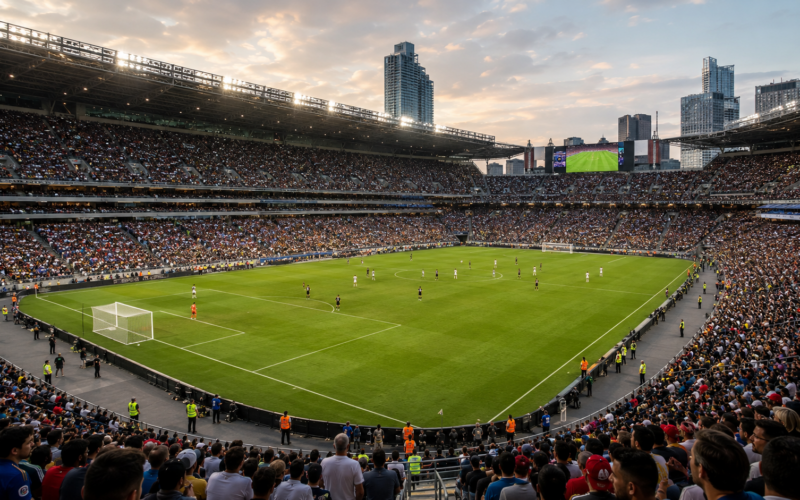
Ghana beat Panama 1-0 at Toronto Stadium on June 17, 2026 local time, June 18 in India, as Caleb Yirenkyi scored in the fifth minute of stoppage time to settle a tense FIFA World Cup 2026 Group L opener. Brandon Thomas-Asante created the decisive moment with a rapid counterattack and low pass across the penalty area, allowing Yirenkyi to score his first competitive international goal and move the Black Stars level with England on three points.
The victory came after Panama controlled much of the opening phase and forced Ghana goalkeeper Lawrence Ati-Zigi into important saves before an injury ended his match at half-time. Substitute goalkeeper Benjamin Asare protected the clean sheet during a more open second half, while Ghana gradually found greater attacking rhythm through Antoine Semenyo, Jordan Ayew and Thomas-Asante.
Ghana now sit second in Group L behind England on goal difference after Thomas Tuchel’s side beat Croatia 4-2. Panama begin the tournament without a point despite producing several promising moments and will face immediate pressure when they meet Croatia in their second group fixture.
Ghana vs Panama FIFA World Cup 2026 match scorecard
How did Caleb Yirenkyi turn a difficult Ghana performance into a dramatic victory?
Yirenkyi decided a match that appeared destined to finish goalless. Ghana had struggled to create clear chances for long periods, while Panama’s defensive organisation repeatedly frustrated the Black Stars around the penalty area.
The breakthrough began with Thomas-Asante carrying the ball forward during a rapid counterattack. Panama had committed players ahead of the ball while searching for a late winner, leaving space for Ghana to attack directly.
Thomas-Asante entered the left side of the penalty area and delivered a precise low ball across the six-yard area. Panama’s defenders failed to clear, and Yirenkyi arrived at the far side to finish from close range in the 95th minute.
The timing transformed the meaning of the performance. A draw would have left Ghana needing a victory against either England or Croatia to strengthen their qualification prospects. The late goal instead gave them three points and the opportunity to approach their next two fixtures with greater tactical flexibility.
Yirenkyi’s contribution was especially notable because he had been booked during the opening period and spent much of the match performing defensive and midfield duties. His willingness to continue the late counterattack placed him in the position required to score.
The goal was his first in a competitive international match and immediately became one of Ghana’s most important recent World Cup moments.
Why did Panama control the early stages without converting pressure into a goal?
Panama began with greater intensity and created the first major opportunity after only two minutes. Amir Murillo supplied Cecilio Waterman, whose first-time effort forced Ati-Zigi into a diving save.
The chance established Panama’s early pattern. They moved the ball forward purposefully, attacked Ghana’s defensive channels and attempted to exploit uncertainty created by the absence of Thomas Partey, who was unavailable after being refused entry into Canada.
Ati-Zigi became Ghana’s most important first-half player. He claimed crosses confidently, protected his penalty area and made the interventions required while Ghana failed to register an attempt on Panama’s goal during the opening half.
Panama’s problem was that the promising build-up rarely produced a composed final action. Their movement initially created space, but passes and crosses became less accurate as the match progressed.
Cristian Martínez had one of Panama’s best second-half openings when he reached a difficult angle inside the area. His attempt struck the side-netting rather than testing the substitute goalkeeper.
Panama also appealed for a penalty after Martínez went down inside the box under pressure from Opoku. The referee judged that the contact was insufficient and allowed play to continue.
The rejected appeal added to Panama’s frustration, but the wider issue remained finishing. Thomas Christiansen’s side created enough territory and promising situations to threaten Ghana, yet they could not turn that work into a shot capable of beating either goalkeeper.
How important was Lawrence Ati-Zigi before his injury changed Ghana’s plans?
Ati-Zigi’s first-half performance prevented Panama from converting their strongest period into a lead. His early save from Waterman was particularly important because conceding after two minutes would have forced Ghana to abandon their patient approach.
The goalkeeper also commanded the penalty area during several Panama attacks. His handling reduced the number of second-ball opportunities available to Waterman, José Luis Rodríguez and Édgar Bárcenas.
Ati-Zigi was injured during a collision near the end of the first half and received treatment before the interval. He did not return for the second half, leaving Benjamin Asare to take responsibility during a match that was beginning to open.
The substitution could have unsettled Ghana, especially because Asare entered without the benefit of a gradual warm-up or early touches. Instead, the replacement goalkeeper remained composed and dealt with the limited but significant pressure Panama generated after half-time.
His final intervention came deep into stoppage time after Panama sent goalkeeper Orlando Mosquera forward for a set piece. Ismael Díaz eventually directed a header toward goal, but Asare secured the ball despite contact and a confrontation involving Panama midfielder Carlos Harvey.
The clean sheet therefore belonged to both Ghana goalkeepers. Ati-Zigi kept the team level during Panama’s strongest phase, while Asare protected the result after the match became more unpredictable.
Why did Ghana improve after half-time despite losing their starting goalkeeper?
Ghana became more dangerous once the second half began because their attacking players occupied more effective positions. Semenyo moved away from an isolated wide role and began receiving the ball closer to central areas, where he could carry possession directly at Panama’s defenders.
Thomas-Asante also became increasingly influential. His movement stretched Panama’s defensive line and provided Ghana with a route into the penalty area without relying entirely on slower possession.
Jordan Ayew came close to converting a Thomas-Asante delivery during Ghana’s best period before the winner. Jiovany Ramos intervened at the far post and diverted the ball away before Ayew could finish.
Jonas Adjetey also produced a dangerous header that forced Mosquera into an important save. Ghana were still not creating chances consistently, but they were beginning to ask more difficult questions.
Panama’s press gradually weakened, allowing Ghana more time to build attacks and position players around the edge of the penalty area. The Central American side had been sharper during the opening half-hour but became increasingly wasteful when trying to progress through midfield.
Ghana’s substitutions added energy and helped maintain pressure during the final stages. Thomas-Asante’s running eventually created the winning goal, while Yirenkyi’s late arrival demonstrated the value of committing midfielders forward.
The improvement was not dramatic, but it was sufficient. Ghana moved from surviving the match to controlling enough of the second half to create the decisive late opportunity.
What did Thomas Partey’s absence reveal about Ghana’s midfield depth?
Ghana entered the match without Partey after the midfielder’s Canadian visa application and subsequent appeal were rejected. His absence removed one of the team’s most experienced midfield organisers and placed greater responsibility on Yirenkyi and Elisha Owusu.
The effect was visible during the first half. Ghana struggled to control possession and frequently lost the ball before establishing attacking rhythm. Panama were able to play through midfield with greater confidence and reach Ghana’s defensive line quickly.
Yirenkyi and Owusu worked hard defensively, but the team lacked Partey’s passing range and ability to slow the match when pressure increased.
Ghana eventually adapted by playing more directly. Semenyo, Ayew and Thomas-Asante became the primary routes forward, reducing the need for extended midfield possession.
The late victory prevented Partey’s absence from becoming the dominant post-match story. However, the England fixture will demand greater midfield control, and Ghana will hope to have the experienced midfielder available when the teams meet in Boston.
England’s central players, including Jude Bellingham and Declan Rice, will punish loose possession more effectively than Panama. Ghana’s ability to protect the ball and manage transitions will therefore be one of the defining questions in their second match.
What does Ghana’s victory mean for the FIFA World Cup 2026 Group L table?
Ghana’s win completed the opening round of Group L fixtures. England lead the section after beating Croatia 4-2, while Ghana sit second because their one-goal victory produced a smaller goal difference.
FIFA World Cup 2026 Group L points table
| Team | Played | Won | Drawn | Lost | Goals for | Goals against | Goal difference | Points |
|---|---|---|---|---|---|---|---|---|
| England | 1 | 1 | 0 | 0 | 4 | 2 | +2 | 3 |
| Ghana | 1 | 1 | 0 | 0 | 1 | 0 | +1 | 3 |
| Panama | 1 | 0 | 0 | 1 | 0 | 1 | -1 | 0 |
| Croatia | 1 | 0 | 0 | 1 | 2 | 4 | -2 | 0 |
Ghana next face England in Boston on June 23. Both teams have three points, meaning victory for either side would put them in a powerful position to qualify for the Round of 32.
A draw would also be highly valuable for Ghana because four points and a positive goal difference may be enough to progress under the expanded tournament format.
Panama face Croatia in Toronto on the same day. Both teams begin that match without a point, making it a practical elimination contest even if the expanded format leaves mathematical possibilities available.
Panama’s performance against Ghana suggests they can trouble Croatia, especially if they recreate their early intensity. However, they must improve the final pass and finish chances before Croatia’s technical quality takes control.
Why does Ghana’s late FIFA World Cup 2026 victory matter beyond the three points?
The result gives Ghana a foundation that seemed unlikely during the first half. Panama created the better early chances, Ghana lost their starting goalkeeper and the Black Stars struggled to generate attacking momentum.
Winning despite those problems demonstrates tournament resilience. Ghana did not produce a complete performance, but they remained competitive long enough for one late transition to decide the match.
The victory also strengthens Africa’s early tournament narrative. Morocco held Brazil, Ivory Coast defeated Ecuador and Ghana have now opened with three points. These results reflect growing tactical discipline and attacking confidence among several African representatives.
For Panama, the defeat is especially painful because the team was minutes away from earning its first men’s World Cup point. Their 2018 campaign ended with three defeats, and Yirenkyi’s goal extended that wait in the cruellest possible way.
The editorial view is that Ghana should celebrate the result while recognising the scale of improvement required against England. The Black Stars will not be able to surrender midfield control or depend on repeated goalkeeper saves against a team containing Kane, Bellingham and Saka.
Panama, meanwhile, should avoid allowing the stoppage-time defeat to erase the positives. Their early performance proved they can compete. The next challenge is learning how to convert competitive football into points.
Key takeaways from Ghana vs Panama at FIFA World Cup 2026
- Ghana beat Panama 1-0 at Toronto Stadium on June 17, 2026, after Caleb Yirenkyi scored in the fifth minute of stoppage time.
- Brandon Thomas-Asante created the winning goal with a rapid counterattack and precise low delivery across the penalty area.
- Yirenkyi’s winner was his first competitive international goal and moved Ghana level with England on three Group L points.
- Panama controlled much of the opening phase, but goalkeeper Lawrence Ati-Zigi made important saves before leaving the match injured at half-time.
- Benjamin Asare replaced Ati-Zigi and preserved Ghana’s clean sheet during a more open second half.
- Panama had a penalty appeal rejected after Cristian Martínez went down under pressure from Jerome Opoku.
- Ghana played without Thomas Partey after the midfielder was denied entry into Canada.
- England lead Group L on goal difference after beating Croatia 4-2, while Ghana sit second with three points and a +1 goal difference.
- Ghana next face England in Boston, while Panama meet Croatia in a high-pressure match between the group’s opening-round losers.
Share this:
Discover more from Business-News-Today.com
Subscribe to get the latest posts sent to your email.