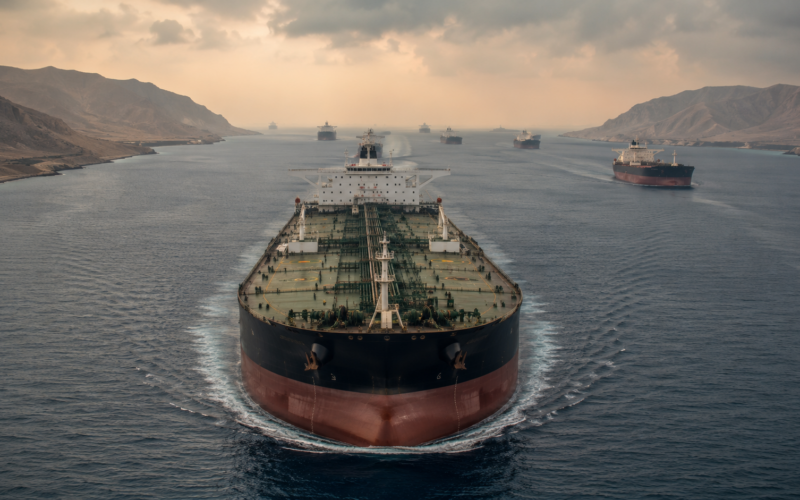
Oil shipping has roared into one of its most lucrative booms in decades, and tanker owners are responding by ordering new ships at a record pace. Shipowners have placed orders for 262 new oil supertankers at shipyards around the world this year, surpassing the previous peak set in October 2008, according to Clarkson Research. The surge is driven by the Iran war, which began in late February and has effectively closed the Strait of Hormuz, the chokepoint through which roughly a fifth of the world’s oil flows. The disruption has doubled freight rates from pre-conflict levels and, at its peak, sent daily earnings for the largest vessels above 400,000 dollars, generating enormous profits for tanker operators. Listed owners such as Frontline plc (NYSE: FRO) have become an unlikely haven for investors amid the broader market turmoil. Yet the very order wave that signals the industry’s confidence is reviving its oldest fear, voiced at the recent Posidonia shipping gathering in Athens, that ordering ships at the top of the cycle sows the seeds of the next glut.
Why have supertanker orders surged to a record above the 2008 peak?
The order book has exploded to a historic high. According to Clarkson Research, shipowners have committed to 262 new very large crude carriers, exceeding the record set in October 2008, a clear signal that owners expect strong demand for oil transportation to persist. Such a wave of orders reflects both current profitability and confidence about the years ahead.
The driver is the windfall from soaring freight rates. The Iran war has disrupted cargo flows and tightened the effective supply of available vessels, doubling shipping rates from pre-conflict levels and at times pushing daily earnings to several hundred thousand dollars per ship. Flush with cash from these record rates, owners have the financial firepower and the incentive to invest in new tonnage.
The timing echoes a familiar pattern. The last time orders reached this level was October 2008, at the peak of the previous shipping boom, a comparison that carries a cautionary undertone given what followed. The record order book demonstrates how quickly a geopolitical shock can transform a cyclical industry’s fortunes, turning a steady, often-overlooked business into a high-profit, high-attention sector almost overnight.
How has the Iran war and the Strait of Hormuz sent freight rates to all-time highs?
The conflict struck at the heart of global oil logistics. The Strait of Hormuz connects the Persian Gulf to the open ocean and carries roughly a fifth of the world’s oil and a large share of its liquefied natural gas, and the war has rendered it effectively impassable, with vessels diverting, idling in nearby waters, or demanding enormous premiums to transit. This disruption to the world’s most important oil shipping lane is the root cause of the rate surge.
The freight numbers reached unprecedented levels. The benchmark rate for a supertanker carrying crude from the Middle East to China hit an all-time high above 423,000 dollars per day earlier in the conflict, after Iran’s closure of the strait, while global average supertanker rates climbed to their highest level since at least 2008. United States government data showed Middle East to Asia rates at their highest since records began in 2005.
Insurance and rerouting amplified the spike. Major marine war risk insurers stopped providing coverage for vessels operating in the Persian Gulf, dramatically raising the cost and risk of transiting the region, while ships forced onto longer alternative routes consumed more capacity and tightened available supply further. Each of these factors compounded the others, producing one of the most dramatic freight rate surges the industry has seen and handing tanker owners extraordinary earnings.
Why are tanker owners ordering so many new ships now, and why does the aging fleet matter?
Record profits are the immediate catalyst for ordering. With daily rates at or near all-time highs, tanker owners are generating exceptional cash flow, and history shows that owners tend to order new ships when earnings are strongest, using current profits to fund future capacity. The boom has given them both the means and the motivation to expand their fleets.
An aging fleet adds a structural reason to build. The average age of the supertanker fleet is now the highest since 1998, meaning a large share of vessels is approaching the end of its useful life and will need replacement regardless of the war. This fleet-renewal need provides a longer-term justification for ordering that exists independently of the current geopolitical spike.
A previously thin order book also encouraged catch-up. Before this surge, the orderbook for new vessels had been historically low, which had constrained supply growth and contributed to the tight market and high rates. Owners ordering now are partly responding to years of underinvestment, though the scale of the current wave raises the question of whether the industry is overcorrecting from shortage toward eventual surplus.
How are listed tanker owners like Frontline positioned and valued in the boom?
The boom has lifted publicly traded tanker companies. Frontline, one of the largest and most prominent listed tanker owners, operates a modern fleet of dozens of vessels including very large crude carriers, Suezmax, and Aframax tankers, with a market capitalization around 7.8 billion dollars. As a pure-play crude tanker operator, it is highly leveraged to the surge in freight rates.
The valuations look modest relative to the earnings power. Frontline trades at a price-to-earnings ratio under 9, which some view as undervalued compared with historical averages, and the company carries a solid financial profile with low bankruptcy risk. The low multiple reflects the market’s awareness that tanker earnings are cyclical and that current sky-high rates may not last, a discount typical of boom-time shipping stocks.
Tanker stocks have served as a market haven. During bouts of broader equity weakness, shares of tanker owners including Frontline and peers rose sharply, emerging as a hedge and a refuge because their earnings are tied to oil logistics rather than the technology and growth themes driving the wider market. For investors, the sector offers exposure to the geopolitical disruption and oil-flow dynamics that move independently of, and sometimes opposite to, the rest of the market.
Why does the order wave raise fears of a future oversupply glut?
The central concern is classic shipping cyclicality. The 262 new vessels will be delivered over the next two to three years, and if the Iran war ends and the Strait of Hormuz reopens before or as those ships arrive, the market could swing from acute shortage to significant oversupply, collapsing the very rates that justified the orders. This dynamic was a prominent worry at the recent Posidonia shipping conference in Athens.
The 2008 parallel is instructive. The previous record for orders was set in October 2008, just before a wave of new deliveries combined with weak demand to depress tanker rates for years, a cautionary tale that ordering at the peak of a boom often precedes a painful downturn. The industry’s history is littered with cycles where high rates triggered overbuilding that then crushed profitability.
Long-term demand adds another layer of risk. Beyond the cyclical concern, participants flagged the prospect of declining long-term oil demand as the energy transition advances, which could leave the industry with too many ships chasing shrinking cargo volumes over time. The combination of near-term oversupply risk and structural demand uncertainty makes the record order book a double-edged signal, reflecting both today’s prosperity and tomorrow’s potential glut.
What risks should investors weigh in the volatile, cyclical tanker market?
The first risk is the abrupt end of the war premium. The current boom rests heavily on the disruption to the Strait of Hormuz, and a ceasefire or reopening of the strait could send freight rates tumbling quickly, as the war premium that has driven earnings would evaporate. Tanker rates are notoriously volatile and can fall as fast as they rise.
The second risk is the oversupply created by the boom itself. The record orders mean a large influx of new vessels is coming, and if that supply arrives as demand normalizes, the market could face years of depressed rates, echoing the aftermath of 2008. The very confidence reflected in the order book could undermine future returns, a paradox inherent to cyclical industries.
The third consideration is the inherent volatility of the sector. None of this is investment advice, and tanker stocks like Frontline offer leveraged exposure to a genuine, geopolitically driven boom with currently strong earnings and modest valuations. But the tanker market is among the most cyclical and unpredictable corners of the global economy, sensitive to war, oil production, and demand shifts, and investors drawn by today’s extraordinary rates must weigh the real possibility that the conditions powering those rates reverse, leaving a market reshaped by the very ships being ordered now. The boom is real, but so is the cycle that historically follows it.
Key takeaways on the record supertanker order boom
- Shipowners have ordered a record 262 new oil supertankers in 2026, surpassing the previous peak set in October 2008, according to Clarkson Research.
- The boom is driven by the Iran war, which has effectively closed the Strait of Hormuz, carrying roughly a fifth of global oil.
- Freight rates doubled from pre-conflict levels, with the Middle East to China benchmark hitting an all-time high above 423,000 dollars per day.
- Insurers dropping war risk coverage and vessels rerouting tightened effective supply, amplifying the rate surge.
- Owners are ordering ships because record profits provide cash, the fleet is the oldest since 1998, and the prior orderbook was historically low.
- Frontline, a leading listed tanker owner, trades at under 9 times earnings with a market capitalization near 7.8 billion dollars.
- Tanker stocks have acted as a haven, rising during broader market weakness because their earnings track oil logistics.
- Industry voices at the Posidonia conference warned the order wave could create oversupply when the ships deliver in two to three years.
- The 2008 parallel is cautionary, as the last order record preceded years of depressed rates, and long-term oil demand decline adds risk.
- A ceasefire or Hormuz reopening could collapse rates quickly, making the cyclical, volatile tanker market a high-risk, high-reward bet.
Share this:
Discover more from Business-News-Today.com
Subscribe to get the latest posts sent to your email.