


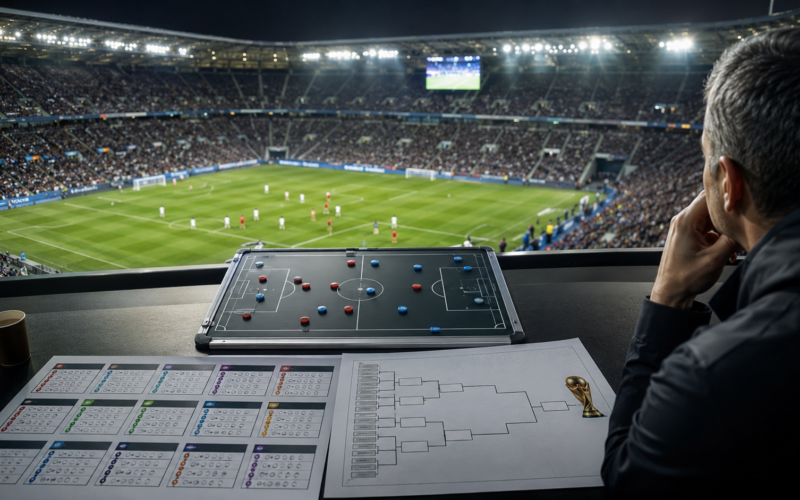
The FIFA World Cup 2026 will introduce the biggest format change in the modern history of the men’s tournament, expanding from 32 teams to 48 teams and replacing the familiar eight-group structure with 12 groups of four. The expanded format will also add a new round of 32, meaning the eventual winner will need to play eight matches from the group stage to the final instead of seven.
The tournament will be staged across the United States, Canada and Mexico from June 11 to July 19, 2026. FIFA World Cup 2026 will feature 104 matches, making it the largest men’s World Cup by both participating teams and match count. The change is designed to bring more national teams into the tournament, widen global representation and create more fixtures across the three host countries.
The basic structure is clear. Forty-eight teams will be split into 12 groups of four teams each. Every team will play three group-stage matches. The top two teams in each group will qualify automatically for the knockout stage. The eight best third-placed teams will also advance, creating a 32-team knockout bracket.
That change will reshape how fans follow the tournament. It will no longer be enough to track group winners and runners-up. Supporters will also need to monitor third-placed teams across all 12 groups, compare points and goal difference, and understand how those rankings affect the round of 32. For teams, the format creates more routes to survival but also a longer and more demanding road to the title.
How is the FIFA World Cup 2026 format different from the previous 32-team structure?
The previous men’s FIFA World Cup format used 32 teams divided into eight groups of four. The top two teams from each group advanced directly to the round of 16. From that point, the tournament followed a straight knockout format through the quarter-finals, semi-finals, third-place match and final.
FIFA World Cup 2026 changes that model by adding 16 more teams and four more groups. Instead of eight groups, the tournament will have 12 groups. Instead of 64 matches, the tournament will have 104 matches. Instead of moving directly from the group stage to the round of 16, the tournament will first move into a round of 32.
The shift is not just a numerical expansion. It changes the tournament’s competitive logic. In the 32-team structure, finishing third in a group meant immediate elimination. In the 2026 format, finishing third may still be enough to reach the knockout stage if a team ranks among the eight best third-placed teams.
That means more teams will remain alive until the final group-stage matchday. A team with one win and one draw, or even a team with a narrow goal-difference position, may still have a realistic route to the knockout stage. The final group matches will therefore carry more cross-group significance because results in one group can affect the qualification hopes of teams in another group.
The format also increases the workload for title contenders. A team that reaches the final will play eight matches instead of seven. That extra match may appear small on paper, but it matters in a tournament played across a wide geographic area with different climates, travel distances and recovery windows.
Why did FIFA move to 12 groups of four instead of 16 groups of three?
The 48-team tournament was initially associated with a possible 16-group format, with three teams in each group. That model would have produced a different structure, but it also raised sporting concerns because three-team groups can create fairness issues when one team has completed its matches before the other two meet.
A three-team group can leave the final group fixture with unusual incentives. If two teams know the exact result that allows both to progress, the structure can create concerns about competitive integrity. Four-team groups reduce that risk because all teams play three matches and the final round of group games can be scheduled with greater balance.
The 12 groups of four format preserves the familiar round-robin rhythm. Each team plays three opponents. Fans can compare teams across a fuller group sample. Coaches can adjust after the first and second matches. Broadcasters and organisers also get a longer and more predictable group-stage calendar.
The trade-off is that the tournament becomes larger. A 12-group structure produces more matches, a longer competition and an additional knockout round. That increases commercial inventory and global representation, but it also adds pressure on players, squads, host cities and viewers trying to track the full tournament.
For football authorities, the format is a compromise between expansion and competitive clarity. It widens the tournament without adopting three-team groups, but it creates new complexity through the best third-placed team system and the round of 32 bracket.
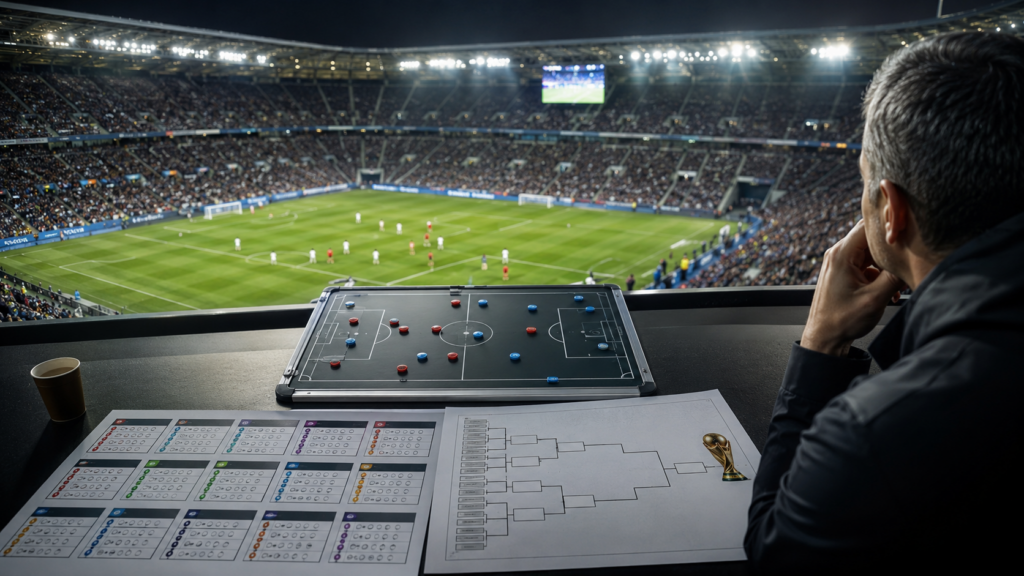
How will teams qualify from the FIFA World Cup 2026 group stage?
Each FIFA World Cup 2026 group will include four teams. Every team will play three matches, facing each of the other teams in its group once. Teams will receive three points for a win, one point for a draw and no points for a defeat.
The top two teams in each of the 12 groups will qualify automatically for the knockout stage. That accounts for 24 teams. The remaining eight knockout places will go to the best third-placed teams across the 12 groups.
This means 32 of the 48 teams will advance beyond the group stage. Sixteen teams will be eliminated after the group stage. That ratio is very different from the 32-team format, where half the field advanced and half the field went home after the group stage.
The best third-placed team system will make the points table more complicated. A team finishing third in Group A will not only be compared with the teams in Group A. It will also be compared with third-placed teams from Group B through Group L. Points will be the first major separator, followed by tie-breaking criteria such as goal difference and goals scored.
The practical result is that fans will need two standings views. The first is the normal group table. The second is a separate ranking of third-placed teams. That ranking may decide whether a team’s campaign continues into the round of 32 or ends after three matches.
How will the best third-placed teams be decided at FIFA World Cup 2026?
The eight best third-placed teams will be determined by comparing the third-placed finishers from all 12 groups. The most important measure will be points earned during the group stage. A third-placed team with four points will usually be in a stronger position than a third-placed team with three points, although final qualification will depend on results across all groups.
If teams are level on points, goal difference becomes critical. Goal difference is calculated by subtracting goals conceded from goals scored. A team that loses heavily in one match may damage its qualification hopes even if it wins another match. A team that keeps its defeats narrow may stay alive in the third-placed team ranking.
Goals scored can also matter because attacking output may separate teams with equal points and goal difference. Disciplinary records and other tie-breaking steps may also become relevant if teams remain level after the main statistical comparisons.
This system changes how teams approach group matches. A late goal in a match that is already lost may still matter because it can improve goal difference or goals scored. A team leading by one goal may continue attacking because a larger win can strengthen its position. A team already unlikely to finish in the top two may still fight for every goal because third place may remain valuable.
For supporters, this creates more drama but also more complexity. The final group-stage days will require constant updates because qualification positions can change quickly when matches in different groups affect the ranking of third-placed teams.
What does the new round of 32 mean for the FIFA World Cup 2026 knockout stage?
The round of 32 is the biggest visible change in the knockout phase. In previous 32-team editions, the knockout stage began with 16 teams. In 2026, it will begin with 32 teams, meaning more countries will experience at least one elimination match.
The round of 32 will include group winners, group runners-up and the eight best third-placed teams. From that point, the tournament becomes single elimination. A defeat ends a team’s campaign. A win sends the team into the round of 16.
The new round adds one more pressure match for title contenders. Teams that might previously have entered the round of 16 after three group matches will now need to survive an extra knockout fixture before reaching that stage. That increases the chance of upsets because a single poor performance, injury issue, red card or penalty shootout can eliminate a favourite earlier than expected.
The round of 32 also gives more teams a chance to reach the knockout stage narrative. Countries that rarely progress deep into the World Cup may be able to target third place and then attempt an upset in a one-off knockout match. That could broaden the emotional reach of the tournament and give more national audiences a reason to stay engaged.
The cost is a longer path to the final. Teams will need to manage fatigue, suspensions, squad depth and tactical risk across eight matches if they go all the way. Coaches may need to rotate more aggressively during the group stage, especially if qualification is secured early.
How could the 48-team format affect competitive balance and match intensity?
The expanded FIFA World Cup 2026 format could increase global representation while also raising questions about competitive balance. More national teams will have access to the tournament, which can help football development, fan inclusion and regional visibility. At the same time, the wider field may create more matches between teams with large differences in ranking, depth and tournament experience.
The group-stage structure may soften the risk of immediate elimination because 32 of 48 teams will advance. That could keep more teams alive longer, but it may also reduce the severity of early group-stage setbacks. A strong team may survive one poor result more easily than in the 32-team format.
The best third-placed team system may keep final group matches meaningful for more teams. Even a team sitting third can still have a route into the round of 32. However, cross-group comparisons can create uneven pressure because teams playing later may know exactly what result they need, while teams playing earlier may have to wait for other results.
The added knockout round may restore intensity after the group stage. Once the round of 32 begins, every match becomes elimination football. That means the tournament may shift from a wider, more forgiving group stage to a longer and more punishing knockout stage.
For teams with deep squads, the format may be manageable. For smaller teams, the extra travel, recovery pressure and squad depth demands may become more difficult. FIFA World Cup 2026 will therefore test not only football quality but also tournament management.
Why will the FIFA World Cup 2026 format make points tables and tie-breakers more important?
The FIFA World Cup 2026 points tables will be more important because qualification will no longer be limited to the top two positions in each group. Third place can also lead to the knockout stage, but only if the team performs better than at least four other third-placed teams.
That means fans will have to follow both group standings and the third-placed ranking. A team may finish third and still celebrate qualification. Another team may finish third and be eliminated. The difference may come down to goal difference, goals scored or disciplinary records.
Tie-breakers will also affect how teams approach matches. A narrow defeat may be much better than a heavy defeat. A late consolation goal may become valuable. A second or third goal in a victory may matter beyond the immediate match result. Yellow cards and red cards may also carry consequences if disciplinary records are needed to separate teams.
The final group-stage matches will therefore be filled with live permutations. A goal in one city may change the qualification position of a team in another city. A draw in one group may help a third-placed team elsewhere. A heavy defeat may push a team below the qualification line even if it has the same number of points as another third-placed side.
For casual fans, this can be confusing. For tournament drama, it can be powerful. FIFA World Cup 2026 will make live standings, clear explanations and updated qualification scenarios essential parts of following the competition.
What does the expanded FIFA World Cup 2026 format mean for host countries and global audiences?
The expanded format gives the United States, Canada and Mexico a larger event than any previous men’s World Cup. More matches mean more host-city activity, more fan movement, more broadcast windows and more local operational demands. The tournament will involve 16 host cities, creating a continent-scale event rather than a compact national competition.
For global audiences, the format increases the number of national teams with direct emotional investment. More countries in the tournament means more national media coverage, more diaspora engagement and more casual viewers drawn into the competition. That is one of the main public-interest effects of expansion.
For host cities, the format increases the number of matchdays and visitor flows. The group stage alone will involve 72 matches, followed by 32 knockout fixtures. Cities hosting major teams, knockout matches or high-demand fixtures may see stronger pressure on transport, policing, accommodation and fan zones.
For broadcasters, the schedule creates more live content and more regional audience opportunities. More teams mean more national markets with a direct reason to watch. More matches mean more programming inventory. The challenge is making the tournament easy to follow despite the larger fixture list and multiple time zones.
The success of the format will be judged on several fronts. It must deliver competitive matches, manageable logistics, clear qualification pathways and strong fan engagement. If the expanded format produces meaningful group-stage drama and a compelling knockout phase, it could become the new long-term model for the men’s World Cup.
What are the key takeaways from the FIFA World Cup 2026 format and the new round of 32?
- FIFA World Cup 2026 will expand the men’s tournament from 32 teams to 48 teams, creating the largest World Cup field in history and increasing the total number of matches to 104.
- The tournament will use 12 groups of four teams, replacing the previous eight-group structure while preserving the familiar round-robin model in which each team plays three group-stage matches.
- The top two teams from each of the 12 groups will qualify automatically for the knockout stage, while the eight best third-placed teams will also advance.
- The new round of 32 means the knockout stage will begin with 32 teams instead of 16, giving more countries an elimination-stage opportunity and adding one more match for title contenders.
- The eventual FIFA World Cup 2026 winner will need to play eight matches from the group stage to the final, increasing the importance of squad depth, player recovery and tactical rotation.
- The best third-placed team system will make goal difference, goals scored and tie-breaking criteria more important because teams finishing third must be compared across all 12 groups.
- The expanded format could keep more teams alive deeper into the group stage, but it may also make the tournament harder for casual fans to follow without clear points tables and qualification explainers.
- FIFA World Cup 2026 will test whether a larger tournament can increase global representation, broadcast inventory and national audience engagement while preserving competitive intensity and clarity.
Share this:
Discover more from Business-News-Today.com
Subscribe to get the latest posts sent to your email.