


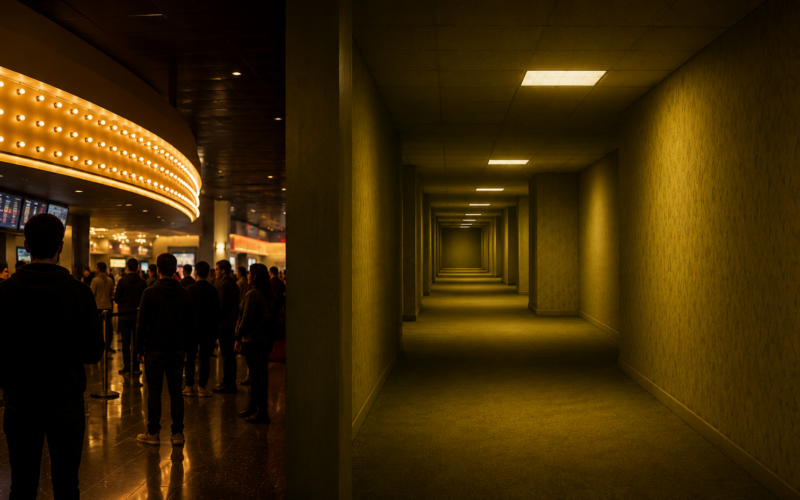
A24’s Backrooms opened with an estimated $81 million in North America, giving the independent studio its biggest domestic debut and turning an internet-born horror property into the weekend’s defining box office event. The film, directed by 20-year-old Kane Parsons and rooted in the viral “Backrooms” online horror mythology, also reached about $118 million worldwide in its first frame. For the film industry, the result matters because it shows that low-budget, digitally native horror can compete directly with expensive franchise filmmaking when the audience relationship is already built online. For exhibitors, studios, and investors watching theatrical demand, Backrooms is less a one-off jump scare and more a signal that Gen Z discovery habits are now powerful enough to move box office economics.
Why does Backrooms’ $81 million opening matter for A24 and the wider theatrical market?
The immediate significance of Backrooms is that it changes the scale conversation around A24. The studio has built its identity on prestige cinema, filmmaker-led marketing, and culturally sharp releases, but an $81 million domestic opening pushes that model into territory normally associated with larger franchise distributors. That does not mean A24 suddenly becomes a traditional studio machine, but it does mean its brand can now support event-level openings when the concept, online audience, and theatrical timing align.
The result also strengthens the argument that horror remains one of the most efficient theatrical genres. A film with a reported production budget of about $10 million does not need superhero-level grosses to become commercially meaningful. At $81 million domestic and $118 million global out of the gate, Backrooms offers the kind of risk-reward profile that makes studio finance teams pay attention. In plain English, this is the sort of movie that makes accountants briefly feel emotions.
The wider box office implication is more interesting than the headline number. Theatrical attendance has been uneven in recent years, with studios relying heavily on sequels, superhero properties, animation, and established brands to pull audiences back into cinemas. Backrooms suggests that internet-native intellectual property can create its own urgency, especially when younger audiences feel that the film belongs to a culture they discovered rather than a franchise they inherited.
How did Kane Parsons turn a viral online horror concept into a mainstream box office event?
Kane Parsons’ role is central to the commercial narrative because Backrooms did not arrive from the usual studio development pipeline. The filmmaker built recognition through YouTube-driven horror, where atmosphere, mystery, and community interpretation mattered as much as plot mechanics. That gave the film a pre-existing language with its target audience before the first ticket was sold.
The Backrooms mythology is also unusually well-suited to theatrical horror. It is visually simple, emotionally unsettling, and flexible enough to travel across memes, videos, short-form edits, reaction content, and fan theories. That gives the property a marketing advantage because audiences are not merely being told what the film is. They are bringing years of internet context into the theater with them.
That creator-to-cinema pathway could become one of Hollywood’s most closely watched talent funnels. Studios have long tried to convert social media personalities into movie stars, often with mixed results. Backrooms points to a more durable model: instead of hiring creators only for visibility, studios can back creators who already understand pacing, mood, audience participation, and platform-native storytelling. The difference matters. One is celebrity packaging. The other is cultural product development.
What does the Backrooms box office surge reveal about Gen Z moviegoers and horror demand?
The Backrooms opening reinforces a point Hollywood sometimes learns, forgets, and then relearns at great expense: younger audiences still go to theaters when the film feels like an event that cannot be reduced to background streaming content. Horror has an advantage here because audience reaction is part of the product. Fear, silence, laughter, and collective tension all work better in a crowded room than on a laptop beside 14 open tabs.
Gen Z demand also appears to be less dependent on traditional star power than earlier studio models assumed. For Backrooms, the draw was the concept, the online mythology, and the authenticity of the creator behind it. That does not make actors irrelevant, but it shifts the hierarchy. In digitally native horror, the world may matter more than the cast, and the fan theory may carry more marketing value than a glossy campaign.
This matters for studios because audience acquisition costs can look very different when a fan base is already active. If a property has years of organic traction, the marketing campaign does not need to explain the entire premise from scratch. It needs to convert curiosity into urgency. That is a major distinction in a market where promotional spending can become almost as risky as production spending.
Why are low-budget horror films becoming more valuable than some expensive franchises?
The comparison between Backrooms and big-budget franchise films is unavoidable because the weekend highlighted a gap between cost and cultural momentum. Large franchises still matter, but they increasingly face audience fatigue, high production costs, and heavy expectations. A franchise film that opens strongly but drops sharply can still generate revenue, but it also raises questions about long-term brand health.
Low-budget horror operates with a different financial logic. When production costs are controlled, the break-even threshold is lower, creative risk can be higher, and upside can be enormous if the concept catches fire. Backrooms fits neatly into that pattern, but with a digital twist. The film was not merely a low-budget horror release. It was a low-budget horror release with internet-native awareness built into its DNA.
That is why the success of Backrooms should worry traditional studios more than a normal indie breakout would. The issue is not that every YouTube horror concept will become a theatrical hit. Most will not. The issue is that a new sourcing model for theatrical intellectual property is becoming visible. Instead of mining only books, comics, games, legacy franchises, and remakes, studios may increasingly mine digital folklore, creator-led universes, and platform-native subcultures.
Can A24 convert the Backrooms breakout into a repeatable studio strategy?
The harder question is whether A24 can repeat this outcome without diluting what made it work. Backrooms benefits from a rare alignment of low budget, creator credibility, viral mythology, genre efficiency, and theatrical timing. Those elements are difficult to manufacture. If studios chase the format too aggressively, they risk turning internet horror into another overprocessed content lane.
For A24, the strategic opportunity is to scale selectively. The studio does not need to become a franchise factory to benefit from the Backrooms result. It can use the opening as proof that creator-led genre projects deserve larger distribution ambition when online demand signals are unusually strong. That could help A24 negotiate better release windows, secure stronger exhibitor support, and attract filmmakers who want cultural credibility without surrendering theatrical upside.
The risk is that commercial success changes expectations. A24’s brand has long benefited from the perception that it backs distinct creative voices. If Backrooms becomes the excuse to overextend into trend-chasing internet properties, the studio could weaken the very trust that helped make the film feel credible. The smarter move would be disciplined expansion, not a stampede into every creepy hallway the internet can find.
What does Backrooms mean for Hollywood’s next wave of creator-led films?
The most important long-term implication is that Hollywood may need to rethink how it identifies early-stage audience demand. Traditional development still leans heavily on recognizable intellectual property, executive relationships, talent packages, and existing media rights. Backrooms shows that online communities can function as a live testing ground for tone, mythology, and emotional response before a feature film is greenlit.
That does not eliminate execution risk. A viral concept can collapse when stretched into a feature-length narrative. Internet popularity can be noisy, shallow, or difficult to monetize. Younger audiences can also move quickly, which means studios may find themselves arriving late to trends they barely understand. The lesson from Backrooms is not that viral equals valuable. The lesson is that durable online mythology, when paired with disciplined production and authentic creative leadership, can become theatrical currency.
For the broader industry, this may accelerate competition for creators who can build worlds rather than simply gather followers. Platforms such as YouTube and TikTok are no longer just marketing channels. They are development ecosystems. The next major horror, thriller, or science fiction breakout may already be sitting inside a playlist, comment thread, or fan-edited lore map.
Key takeaways on what Backrooms’ box office opening means for A24, Hollywood and theaters
- A24’s Backrooms has turned a viral internet horror property into a major theatrical event, proving that digitally native concepts can deliver blockbuster-scale openings when online awareness converts into cinema attendance.
- The reported $81 million North American opening and $118 million global debut create a powerful financial story because the film’s production budget was far below typical franchise tentpole levels.
- Kane Parsons’ success highlights a new creator pipeline for Hollywood, where online filmmakers with proven world-building ability may become more valuable than conventional social media celebrity alone.
- The result strengthens horror’s position as one of the most attractive theatrical genres because modest budgets, high audience engagement, and strong communal viewing dynamics can produce outsized returns.
- Gen Z turnout appears to be a core part of the Backrooms story, suggesting younger audiences remain willing to visit theaters when a film feels culturally native to their online lives.
- Traditional franchises face a sharper comparison after this weekend because expensive branded films must now compete not only with each other, but also with low-cost internet-born properties that feel fresher to younger audiences.
- A24 gains strategic leverage from the opening, but the studio’s next challenge is to expand its genre ambitions without weakening its reputation for selective, filmmaker-led releases.
- The wider studio system is likely to study YouTube horror, TikTok-native storytelling, and digital folklore more seriously as potential sources of future theatrical intellectual property.
- The main risk is overcorrection, as Hollywood could flood the market with poorly adapted viral concepts that lack the atmosphere, timing, or audience trust that helped Backrooms break out.
- For exhibitors, Backrooms is encouraging because it shows that theatrical surges can still come from unexpected places, especially when young audiences treat a film as a shared cultural moment rather than just another release.
Share this:
Discover more from Business-News-Today.com
Subscribe to get the latest posts sent to your email.