




Iperionx Limited (ASX: IPX) closed up 2.09 per cent at A$5.38 in today’s ASX session, continuing the steady accumulation that has followed the company’s April 27 March 2026 quarterly report. The dual-listed titanium critical minerals and advanced materials group confirmed in that quarterly that its Virginia Titanium Manufacturing Campus has transitioned to continuous 24/7 operations, marking the move from commissioning into continuous commercial production. HAMR powder output reached approximately 4.2 metric tons in March 2026, equivalent to roughly 50 tpa annualised, with management targeting around 200 tpa run-rate production by end-CY2026 and 1,400 tpa following the IBAS-funded expansion. The next confirmed catalyst is the 200 tpa production milestone, scheduled for December 31, 2026. For ASX retail investors, today’s bounce reinforces the structural narrative: Iperionx is one of the few publicly traded names positioned to benefit directly from US Department of War (DoW) funding aimed at reshoring titanium supply away from Chinese dependence.
What does Iperionx do and why is the HAMR titanium technology differentiated against Kroll-based supply chains?
Iperionx Limited is an American titanium critical minerals and advanced materials company with a dual ASX and Nasdaq listing. The company holds a 100 per cent interest in the Titan Critical Minerals Project in Tennessee, which contains the largest JORC resource of titanium, rare earth elements, silica sand, and zircon in the United States. Iperionx also operates the Virginia Titanium Manufacturing Campus, where it produces titanium metal powders from titanium scrap using its proprietary Hydrogen Assisted Metallothermic Reduction (HAMR) and Hydrogen Sintering and Phase Transformation (HSPT) technologies. The company is headquartered at 129 West Trade Street in Charlotte, North Carolina, and was formerly known as Hyperion Metals Limited before its February 2022 rebrand.
The differentiation against the established Kroll process titanium supply chain is structural and strategic. The Kroll process, developed in the 1940s, remains the dominant industrial route for primary titanium production globally but is energy-intensive, batch-based, carbon-heavy, and concentrated in offshore manufacturing capacity. Iperionx’s HAMR technology produces titanium from 100 per cent recycled feedstock through a continuous process that is materially more energy-efficient. The HSPT technology enables sintering and forging of titanium components at lower temperatures and shorter cycle times than conventional manufacturing. Together, the two technologies create a domestic US scrap-to-part titanium platform that is positioned as the strategic alternative to imported primary metal.
The risk inside the technology differentiation thesis is execution. Scaling from pilot to commercial production introduces operational complexity that is fundamentally different from laboratory or demonstration-scale work. Each new equipment commissioning, each batch consistency challenge, and each customer qualification introduces potential delay. The 4.2 metric tons of HAMR powder output in March 2026 is a meaningful milestone but represents the early-stage ramp rate. Throughput is expected to build as the product mix shifts toward higher-volume angular powders and powder-to-part manufacturing, but the timeline and consistency of that ramp remain the central execution variables.
Why are Iperionx shares climbing today and what is driving the US Government titanium reshoring tailwind?
Today’s 2.09 per cent close reflects continued positive sentiment around the titanium reshoring thesis and the operational momentum at the Virginia campus. Iperionx shares are up approximately 32 per cent over the past month and 57.6 per cent over the past 12 months on the Nasdaq listing, against a Nasdaq closing price of US$33.82 on May 5, 2026. The ASX-listed CDI tracks the underlying Nasdaq line with currency adjustment.
The underlying narrative driver is the US Government’s structural commitment to reshoring titanium production. By 2023, the United States had become 100 per cent reliant on imported titanium sponge, the raw material essential for fighter jets, commercial aircraft, and defence systems. China now controls roughly 67 per cent of global titanium sponge production, up from 40 per cent in 2018. That dependency has been classified as a national security risk, and the Pentagon has channelled significant funding toward domestic production solutions through ARPA-E grants, Defense Production Act Title III awards, IBAS funding, and SBIR Phase III contracts.
The risk for retail investors entering today is valuation. The Iperionx market cap of approximately US$1.1 billion against current production of roughly 50 tpa annualised is pricing in significant ramp execution. Morningstar’s price target of US$28.00 sits below the current Nasdaq close of US$33.82, indicating sell-side caution on near-term valuation. The path to positive EBITDA, which management projects by year-end 2026 as the Virginia facility approaches its 1,400 tpa target, depends on hitting production milestones on schedule.
How does the US$47.1 million IBAS award and US$99 million SBIR Phase III contract reshape the funding profile?
Iperionx has secured a layered package of US Government funding that materially de-risks the capital expenditure trajectory. The US$47.1 million IBAS (Industrial Base Analysis and Sustainment) award from the US Department of War supports the expansion of the Virginia campus to 1,400 tpa titanium powder capacity. The SBIR Phase III IDIQ (Indefinite Delivery, Indefinite Quantity) contract pathway provides a contracting mechanism worth up to US$99 million, with task orders being issued progressively. The first US Army task order under the Phase III contract was secured in mid-2025 and was followed by additional task orders.
The financial structure matters for retail investors. As of March 31, 2026, Iperionx held US$48.2 million in quarter-end cash, with US$42.1 million in obligated reimbursable US Government funding sitting alongside that cash position. The company also received 290 metric tons of titanium scrap feedstock at no cost from the US Government, equivalent to approximately 1.5 years of feedstock supply. The combined funding and feedstock package reduces near-term equity dilution risk that has historically been a feature of the Iperionx capital structure.
The execution risk is that government funding programs are sequential rather than guaranteed. Each milestone needs to be hit, each task order needs to be earned, and each expansion phase requires continued political and budgetary support. The Pentagon’s commitment to titanium reshoring is unlikely to reverse in the near term given the strategic logic, but specific funding flows can be paced or redirected. Iperionx’s projected positive EBITDA inflection by year-end 2026 depends on both the operational ramp and the continued flow of government funding through the SBIR and IBAS frameworks.
What is the Titan Critical Minerals Project and how does the Tennessee resource fit into the long-term integration strategy?
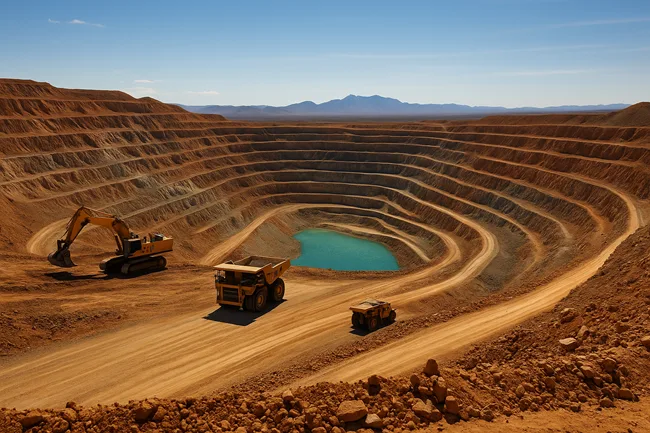
The Titan Critical Minerals Project covers more than 11,000 acres in Tennessee and contains what Iperionx describes as the largest JORC resource of titanium, rare earth elements, silica sand, and zircon in the United States. The project is currently progressing through Definitive Feasibility Study work. The strategic logic is that long-run vertical integration, where Iperionx feeds its own Virginia titanium manufacturing campus from its own US-based titanium and rare earth resource, removes dependence on imported primary feedstock entirely.
The current Virginia operations rely on titanium scrap feedstock, including the 290 metric tons received from the US Government and ongoing scrap procurement from US aerospace and industrial sources. Scrap-based titanium production is a sufficient feedstock model for the near-term ramp to 200 tpa and 1,400 tpa, but longer-term scaling would benefit from primary titanium source integration. The Titan project is positioned as the strategic backstop for that scaling, providing decades of feedstock optionality from a domestic resource base.
The risk for retail investors is that the Titan project remains pre-development. Permitting, construction, and commissioning of a critical minerals mining project in Tennessee would take multiple years and require significant capital. The current focus is correctly on the Virginia operations ramp, with Titan sitting as a longer-dated optionality. Any acceleration or delay in Titan project development would affect long-run earnings model assumptions but is unlikely to drive near-term share price movement. The rare earth and zircon content of the Titan project also provides exposure to other critical minerals categories, which adds optionality but also complexity to the resource development timeline.
How does the customer pipeline across defence, aerospace, automotive, and consumer electronics validate the commercial model?
Iperionx has been steadily expanding its customer programs across multiple advanced manufacturing sectors. The company serves defence and aerospace customers including programs related to military aircraft, missile systems, and specialty components. Automotive applications include components for electric vehicle drivetrains and high-performance vehicles. Consumer electronics customers include programs related to titanium device enclosures and structural components. Additive manufacturing customers are using Iperionx powders for 3D-printed titanium parts. Medical device, energy, and luxury goods customers add further diversification.
The strategic logic for retail investors is that customer diversification reduces single-segment dependence. Defence customers provide volume commitments and government-backed funding flows. Aerospace customers provide long-cycle contracts with specification-driven pricing. Consumer electronics customers provide higher-volume, faster-cycle demand. The combined customer pipeline creates a portfolio of demand that can absorb increasing Virginia production capacity as the ramp progresses through 50 tpa, 200 tpa, and toward 1,400 tpa.
The execution risk is qualification timing. Each customer program typically requires extensive qualification testing, particularly in defence and aerospace, before significant volume commitments can be secured. The timing of those qualifications is not always predictable, and qualification delays can push revenue recognition into later quarters. Iperionx has consistently disclosed customer program progression in its quarterly updates, but specific contract values and timing remain confidential for many programs. Investors are effectively buying into management execution on a customer pipeline whose individual milestones are not all publicly disclosed.
Why are ASX retail investors and titanium sector watchers positioned around Iperionx right now?
Iperionx’s shareholder base is split between Australian retail investors who hold through the ASX-listed CDI and US institutional and retail investors who hold the Nasdaq line. The company is headquartered in Charlotte, North Carolina, and operates entirely in the United States, but the ASX dual-listing dates back to its predecessor Hyperion Metals’ Australian incorporation. Australian retail interest has been a meaningful source of capital through equity raisings, with the ASX listing providing an entry point for Australian investors interested in US strategic metals exposure.
Forum and social discussion this week on HotCopper, Stocktwits, and X has focused on the Virginia 24/7 production transition, the 50 tpa annualised run rate, the 200 tpa year-end target, and the broader titanium reshoring narrative. The cashtag $IPX on X has been increasingly active, with retail commentary anchored on the comparison with other defence supply chain reshoring beneficiaries and the question of whether the current valuation appropriately reflects the production ramp trajectory. Quiver Quantitative analysis of social media discussion noted approximately 4 per cent share price gains following recent production updates.
The retail investor angle that needs flagging is that Iperionx remains a small-cap ASX defence supply chain story trading on long-dated production milestones. The ASX 12-month range of A$3.10 to A$5.65 indicates the stock has traded in a relatively wide band, with today’s A$5.38 close sitting near the top of the range. Investors entering at current levels are pricing in successful execution of the 200 tpa target by December 2026 and the longer-dated 1,400 tpa expansion. Any operational delay, particularly through the back half of 2026, would likely produce sharp drawdowns given the embedded execution expectations.
What is the milestone timeline for Iperionx between today’s session and the next major catalyst?
The next confirmed catalyst is the 200 tpa run-rate titanium powder production milestone, scheduled for December 31, 2026. Between now and December, the watch points include monthly and quarterly disclosure of HAMR powder output, throughput improvements, downstream press and HSPT furnace commissioning, and customer program progression. The April 27 March 2026 quarterly report disclosed that downstream presses and HSPT furnaces are being commissioned to remove production bottlenecks, which is the immediate operational priority.
Beyond the 200 tpa milestone, longer-dated catalysts include the completion of the 1,400 tpa expansion at the Virginia Titanium Manufacturing Campus, supported by the US$47.1 million IBAS funding. Management projects positive EBITDA inflection by year-end 2026 as the Virginia facility approaches the 1,400 tpa target, although the full expansion is expected to complete through 2027. Further SBIR Phase III task orders, additional customer program announcements, and Titan Critical Minerals Project Definitive Feasibility Study progress all sit as discrete milestones that could affect share price through 2026 and 2027.
The macro overlay matters substantially for Iperionx. US Department of War budget priorities, particularly around critical minerals, defence supply chain reshoring, and titanium specifically, are the single most important external variable. US-China geopolitical dynamics affect the strategic urgency of titanium reshoring. Tariff policy on Chinese titanium imports affects competitive economics. The broader US defence spending trajectory affects long-run customer demand for Iperionx products. Currency exposure between USD and AUD adds another return variable for ASX-listed CDI holders.
Key takeaways for retail investors watching Iperionx Limited on the ASX
- Iperionx Limited (ASX: IPX) closed up 2.09 per cent at A$5.38 in today’s ASX session, continuing the steady accumulation that has followed the April 27 March 2026 quarterly report and the transition to 24/7 operations at the Virginia Titanium Manufacturing Campus.
- HAMR titanium powder production reached approximately 4.2 metric tons in March 2026, equivalent to around 50 tpa annualised, with management targeting 200 tpa run-rate production by December 31, 2026 and 1,400 tpa following the IBAS-funded expansion.
- US Government support includes a US$47.1 million IBAS award for the 1,400 tpa expansion, an SBIR Phase III IDIQ contracting pathway worth up to US$99 million, and 290 metric tons of titanium scrap feedstock transferred at no cost.
- The proprietary HAMR and HSPT technologies produce titanium from 100 per cent recycled feedstock through a continuous process that is materially more energy-efficient than the legacy Kroll-based titanium supply chain.
- Quarter-end cash of US$48.2 million plus US$42.1 million in obligated reimbursable funding provides near-term capital runway, with management projecting positive EBITDA inflection by year-end 2026 as the Virginia facility approaches 1,400 tpa.
- The Titan Critical Minerals Project in Tennessee provides longer-term vertical integration optionality with what Iperionx describes as the largest JORC resource of titanium, rare earth elements, silica sand, and zircon in the United States.
- Customer programs span defence, aerospace, automotive, consumer electronics, additive manufacturing, medical, energy, and luxury goods, with the next confirmed catalyst being the 200 tpa production milestone scheduled for December 31, 2026.
Discover more from Business-News-Today.com
Subscribe to get the latest posts sent to your email.