




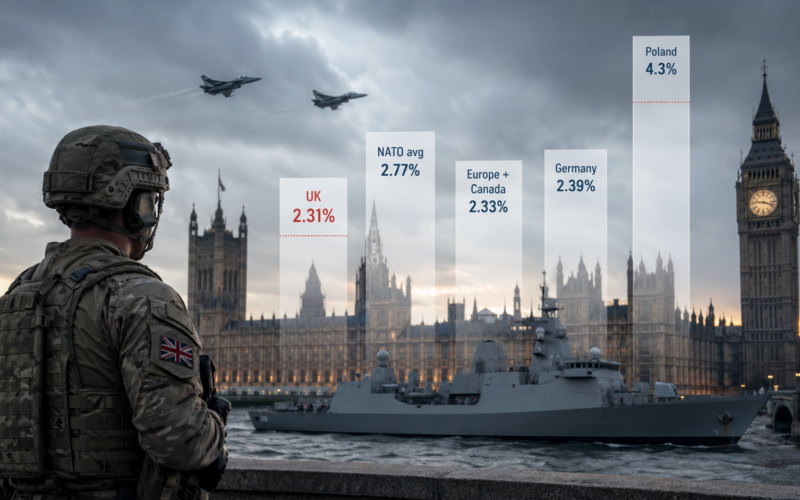
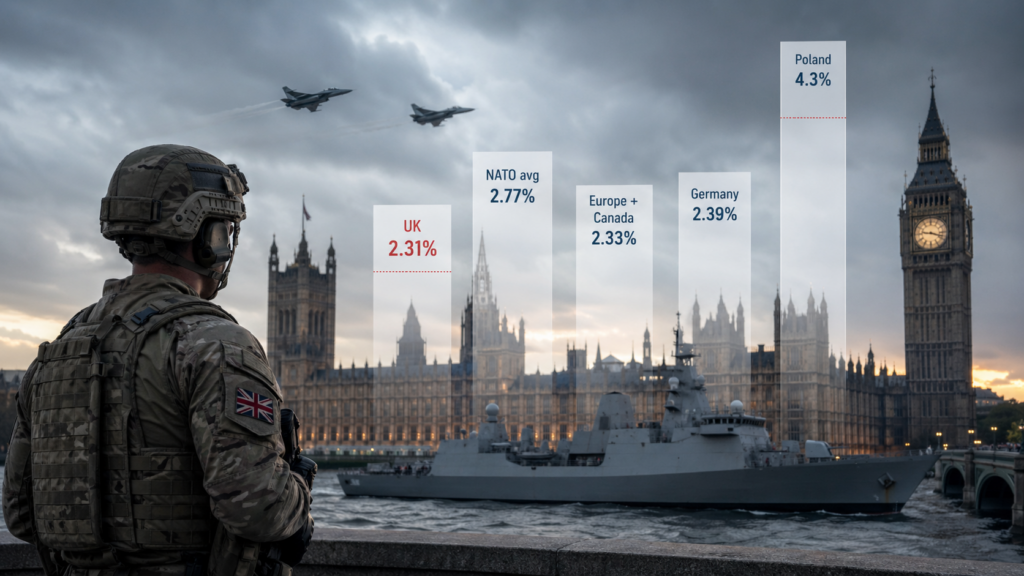
The United Kingdom is now spending a smaller share of its economy on defence than the average NATO member, according to the Alliance’s own 2025 Annual Report, with the latest figure of 2.31% of gross domestic product falling beneath the NATO-wide average of 2.77% and even below the 2.33% average for European members and Canada when the United States is excluded. The downward revision, from a previously projected 2.4%, lands at the worst possible moment for the UK Government, which has staked its credibility on a phased lift to 2.6% of GDP by 2027 and 3.5% by 2035 under the Hague Summit framework. The shortfall puts the UK behind 13 NATO allies, including Poland at 4.3%, Lithuania at 4%, Latvia at 3.74%, Estonia at 3.42%, and a Germany whose defence spend has more than doubled from 1.16% in 2014 to 2.39% in 2025, eclipsing both the UK and France. For listed defence contractors including BAE Systems, Rolls-Royce Holdings, Babcock International, QinetiQ, and Chemring, the slippage is less an investment thesis breaker than a reminder that the UK’s order book is now one of several second-tier sovereign demand signals in a market increasingly dominated by Berlin, Warsaw, and the Nordics.
How did the United Kingdom fall below the NATO defence spending average despite repeated political pledges to increase military funding?
The mechanical answer lies in the gap between political headline pledges and statistical accounting under the NATO definition of defence expenditure. The House of Commons Library has confirmed that the UK spent £60.2 billion on defence in 2024/25 and is projected to spend £62.2 billion in 2025/26, rising to £73.5 billion by 2028/29 under the 2025 Spending Review. That headline trajectory implies an annual real-terms growth rate of 3.8%, which on its own sounds substantial. The problem is that the NATO calculation is denominator-sensitive: when GDP grows faster than the defence vote, the percentage falls even as cash spending rises.
Compounding the optics is the accounting structure of the UK’s 2.6% pledge. The February 2025 commitment by the Starmer Government included the Single Intelligence Account, which funds MI5, MI6, and GCHQ. Critics have characterised this as an accounting reclassification rather than a genuine uplift in conventional warfighting capability. The House of Commons Library has confirmed that the headline 2.5% NATO-definition figure rises to 2.6% only when these additional security and intelligence elements are included. For an alliance increasingly focused on industrial mobilisation, ammunition stockpiles, and air and missile defence, intelligence-agency budgets do not deliver tanks, frigates, or interceptor missiles.
The NATO 5% target agreed at the 2025 Hague Summit is split into a 3.5% core defence component and a 1.5% allowance for critical infrastructure, civil resilience, and innovation. Even by that more generous definition, the UK is currently running closer to the lower end of the alliance. Estonia, Latvia, Lithuania, and Poland have already moved into the 3.4% to 4.3% band on core defence alone, leaving the UK relying on the broader 5% envelope’s flexibility to remain narratively competitive.
What does the NATO data reveal about the United Kingdom’s true conventional warfighting capability versus its declared defence budget?
Veda’s analysis of the underlying capability picture suggests the headline percentages flatter the reality. The Strategic Defence Review 2025, published by the Ministry of Defence on 2 June 2025, acknowledged that the British Armed Forces have been shaped by post-Cold War assumptions and are only now being reorientated for state-on-state conflict. The Review committed the UK to constructing up to 12 SSN-AUKUS class nuclear-powered submarines, establishing six new munitions and energetics factories, procuring 7,000 domestically produced long-range missiles, investing £15 billion in the Astraea sovereign warhead programme, and creating a new Cyber and Electromagnetic Command. Defence Secretary John Healey also confirmed a new £11 billion annual equipment budget under the National Armaments Director.
The capability dilemma is that a substantial proportion of UK defence spending is absorbed by the nuclear deterrent, which independent analysts including those cited in Airforce Technology coverage have estimated at up to a quarter of the total budget. This crowds out investment in deployable conventional land and naval forces. Chatham House analysts Olivia O’Sullivan and Marion Messmer have argued that while the SDR is rightly threaded through with lessons from the Ukraine war, the funding envelope is insufficient to redesign UK defence capabilities at the pace the threat environment demands.
The result is a structural mismatch. The UK still positions itself as a tier-one military power inside NATO, yet its conventional warfighting share of GDP, stripped of nuclear, intelligence, and pension elements, is materially lower than the headline 2.31% figure suggests. Estimates published in trade press analysis place the deployable conventional spend in the 1.5% to 1.8% range, which would put the United Kingdom behind the majority of front-line eastern European allies on a like-for-like basis.
Why are Poland, Germany, and the Baltic states now overtaking traditional European powers in defence spending and what does this mean for NATO burden sharing?
The eastward shift of NATO’s spending centre of gravity is the most consequential structural development inside the alliance in three decades. Poland, at 4.3% of GDP, is now the highest-spending NATO member by share of economy and is fielding one of the largest land armies in Europe. Germany has executed an unprecedented turnaround, with its defence spending more than doubling as a share of GDP since 2014 on the back of the €100 billion Sondervermögen and subsequent commitments. The Baltic states, sitting on the geographic front line with Russia, have lifted spending into the 3.4% to 4% band and are integrating their procurement with German, Polish, and Nordic industrial bases.
Türkiye, at 2.33%, now matches the UK on a percentage basis while operating a substantially larger land force and an expanding indigenous drone, missile, and naval shipbuilding sector. The implication for NATO burden sharing is that political weight inside the alliance is migrating toward members whose military expenditure trajectory is steeper, whose industrial production is scaling faster, and whose geographic exposure makes the threat assessment less abstract. The UK’s traditional claim to leadership inside NATO, built on its nuclear status, expeditionary doctrine, and special relationship with the United States, is increasingly being tested by allies who are simply spending more in absolute and relative terms on conventional capability.
For Brussels and Washington, the practical question is whether the UK can credibly co-lead European deterrence alongside Germany and Poland when its core defence spend trails both in percentage terms and in industrial output velocity. The September 2025 Defence Industrial Strategy explicitly framed the challenge as one of innovating at wartime pace and rebuilding the supply base, an admission that the UK’s industrial capacity has been hollowed out. The ADS Group has documented the contraction of UK defence employment from approximately 400,000 jobs in 1996 to 164,000 in 2023, a structural reduction that cannot be reversed in a single Parliament regardless of headline budget pledges.
How are listed UK defence contractors including BAE Systems, Rolls-Royce, Babcock, QinetiQ, and Chemring positioned for a slower than promised UK spending uplift?
The equity market has already digested a substantial rerating of UK defence contractors over the past 24 months. BAE Systems posted underlying sales growth of 10% to £30.7 billion in 2025 with underlying earnings before interest and tax rising 12% to £3.3 billion, and the stock currently trades on a price-to-earnings multiple in the high twenties. Babcock International reported underlying operating profit growth of 19% to £201 million on revenue of £2.5 billion in the six months to 30 September 2025, with an order backlog of £9.9 billion. QinetiQ and Chemring have also seen order books expand, with Chemring reporting a record £1.34 billion backlog providing 76% coverage of 2026 earnings.
JPMorgan analysts characterised the European rearmament cycle as turbo-charged in their March 2025 sector note, raising price targets across the UK names by an average of 25%. Citi has subsequently upgraded Babcock on a margin expansion thesis. The bullish case rests on three legs: continuous submarine production at BAE Systems Barrow and Rolls-Royce Derby underwritten by more than £6 billion of UK Government commitment over the current Parliament; Babcock’s deeply embedded role in AUKUS submarine maintenance providing decades of work visibility; and Rolls-Royce’s dual exposure to widebody civil aviation recovery and Small Modular Reactor commercialisation.
The bearish overlay is that valuations are now priced for sustained spending growth that a 2.31% UK GDP share does not entirely deliver. The Motley Fool has flagged talk of a £28 billion UK defence black hole, and Veda’s reading of the SDR implementation literature suggests that the gap between policy ambition and funded reality is wider than headline commitments imply. For a retail investor weighing UK defence exposure, the differentiating analytical question is exposure mix: BAE Systems derives a majority of its revenue from non-UK customers including the United States Department of Defense, which together with the UK Ministry of Defence accounted for 59% of revenue in 2025. QinetiQ and Babcock are more UK-weighted, with QinetiQ generating 66% of total sales from the UK and Babcock 63%, making both more sensitive to any further Treasury slippage on the spending pathway.
The structural risk for UK-weighted defence equities is not the headline 2.6% pledge being missed, since the cash budget is rising in any plausible scenario. The risk is that procurement timing, programme delays, and Treasury orthodoxy on capital allocation continue to push award flow to the right, as has already occurred with Chemring’s UK Sensors and Information business. Defence stocks priced for growth tend to punish modest disappointments severely, and the FTSE Aerospace and Defense index has already recorded a 9% pullback in the past week against a 12-month gain of 42%.
What are the key takeaways from the NATO 2025 Annual Report finding that UK defence spending has fallen below the alliance average?
- NATO’s 2025 Annual Report places UK defence spending at 2.31% of gross domestic product, below the alliance-wide average of 2.77% and below the 2.33% average for European members and Canada when the United States is excluded.
- The UK figure represents a downward revision from the 2.4% previously reported to the UK Parliament, deepening the credibility problem facing the Starmer Government’s pledge to reach 2.6% by 2027 and 3.5% by 2035.
- Thirteen NATO allies are now spending a higher share of GDP on defence than the United Kingdom, with Poland at 4.3%, Lithuania at 4%, Latvia at 3.74%, Estonia at 3.42%, and Germany at 2.39% having decisively overtaken traditional European powers.
- The 2.6% UK pledge relies on accounting reclassification that includes the Single Intelligence Account funding MI5, MI6, and GCHQ, a structure analysts have characterised as a denominator trick rather than a genuine warfighting uplift.
- Independent estimates suggest the UK’s deployable conventional warfighting spend, after stripping out nuclear deterrent costs, pensions, and intelligence agency funding, is closer to 1.5% to 1.8% of GDP.
- The Strategic Defence Review 2025 commits the UK to up to 12 SSN-AUKUS submarines, six new munitions factories, 7,000 long-range missiles, a £15 billion sovereign warhead investment, and an £11 billion annual equipment budget under the new National Armaments Director.
- The September 2025 Defence Industrial Strategy explicitly acknowledges that the UK industrial base must be rebuilt to operate at wartime pace, with defence employment having fallen from approximately 400,000 jobs in 1996 to 164,000 in 2023.
- BAE Systems, Rolls-Royce Holdings, Babcock International, QinetiQ, and Chemring have all benefited from European rearmament tailwinds, with JPMorgan raising sector price targets by an average of 25% and Citi upgrading Babcock on a margin expansion thesis.
- UK-weighted defence equities including QinetiQ at 66% UK sales exposure and Babcock at 63% are more vulnerable to Treasury slippage on the defence spending pathway than internationally diversified BAE Systems, where the United States accounts for the larger share of customer revenue.
- The structural challenge for the United Kingdom is not the absolute size of its defence budget but the migration of NATO’s military and political centre of gravity toward Berlin, Warsaw, and the Baltic capitals, where spending velocity, industrial scale-up, and threat exposure now outpace London on every measurable dimension.
Discover more from Business-News-Today.com
Subscribe to get the latest posts sent to your email.

