




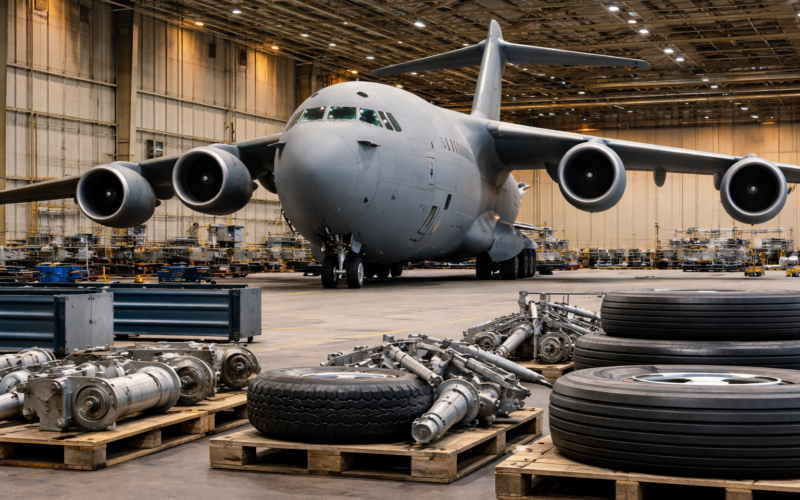
The Boeing Company (NYSE: BA) has secured a $166.8 million contract modification for C-17 Globemaster III sustainment, specifically for landing gear spares in Ordering Period Five. On the surface, it is a spare-parts award, not a flagship platform win. In practice, it reinforces Boeing’s grip on one of the U.S. military’s most durable airlift sustainment franchises and adds another predictable layer of defense revenue just days before the company reports first quarter 2026 results. With Boeing shares closing at $223.38 on April 17, the contract lands at a moment when investors are weighing whether Boeing’s recovery story is still mostly commercial aerospace or increasingly a two-engine narrative supported by defense and services as well.
Why does Boeing’s C-17 landing gear spares award matter more than its headline size suggests?
A $166.8 million award is not transformative for a company of Boeing’s scale. That is the obvious part. The less obvious part is that investors often underprice the quality of sustainment revenue because it lacks the drama of a fighter competition or a giant commercial jet order. Sustainment work tends to be slower, less glamorous, and far more valuable over time than its press-release profile suggests.
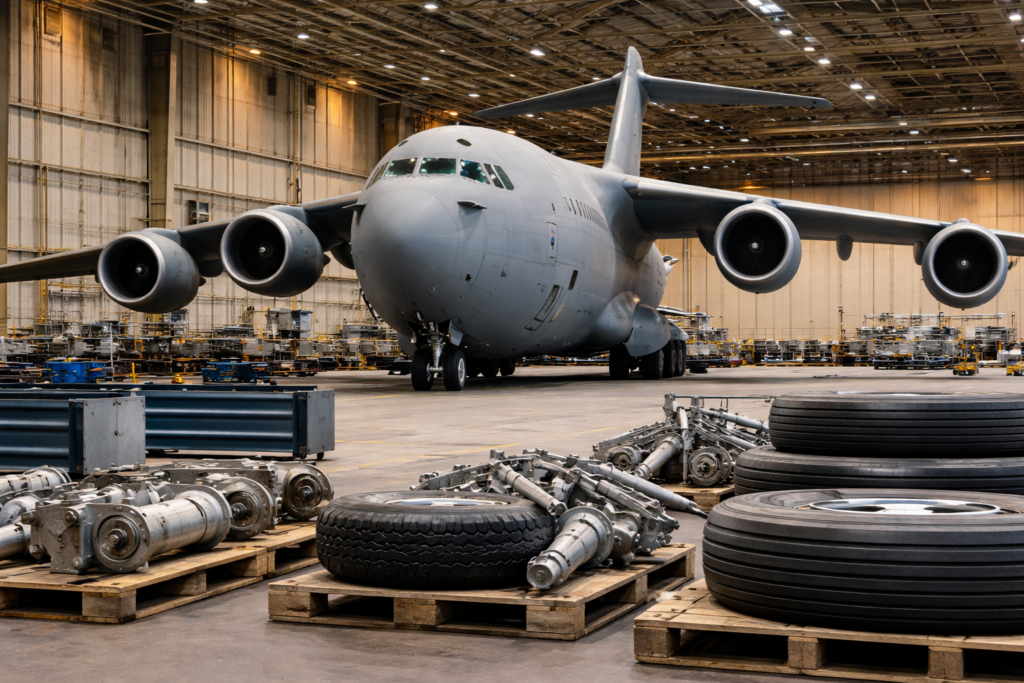
This contract modification raises the cumulative face value of the broader C-17 sustainment contract to more than $8.04 billion. That matters because it shows the C-17 is not being managed as a sunset platform waiting quietly for retirement. It is being funded, maintained, modernized, and internationally supported as a long-duration mobility asset. Landing gear spares are not exciting dinner conversation unless one works in military logistics, in which case they are exactly the point. Fleets stay operational because someone keeps funding the boring parts.
The strategic significance also lies in timing. Boeing is entering earnings with commercial airplane delivery progress improving, but still under scrutiny after March deliveries slowed because of 737 MAX wiring-related rework. Against that backdrop, recurring defense sustainment revenue helps smooth the narrative. It does not solve Boeing’s bigger execution questions, but it gives management another piece of evidence that parts of the portfolio are behaving with discipline and continuity.
How does the C-17 sustainment contract fit into Boeing’s wider defense and services strategy in 2026?
The C-17 is turning into a reminder that Boeing’s defense business is not only about new production programs. It is increasingly about installed-base monetization, platform life extension, and international support ecosystems. Boeing already said in February that the U.S. Air Force awarded it a contract to modernize the C-17A flight deck, aimed at keeping the aircraft mission-ready for decades. When that modernization push is viewed alongside this landing gear spares modification, the picture becomes clearer.
Boeing is effectively building a layered annuity around the C-17 fleet. One layer is sustainment, another is depot and engineering support, another is modernization, and another is international interoperability through Foreign Military Sales-linked support. That model is strategically attractive because it draws revenue from fleet longevity rather than new-aircraft procurement cycles alone. In a period when defense budgets can fluctuate by administration, and new starts can slow under congressional or industrial bottlenecks, sustainment-heavy programs offer a more durable earnings base.
There is also a competitive angle. Large primes increasingly fight over who owns the lifetime economics of a platform, not just who wins the initial program. Boeing’s entrenched role on the C-17 means rivals are largely competing at the margins, not for platform control. That strengthens Boeing Global Services and helps the company defend relevance in military aviation even where next-generation combat-air narratives often dominate headlines.
What does this contract say about the future of the C-17 fleet and allied airlift demand?
The contract notice explicitly includes Foreign Military Sales participation from allied and partner operators including Australia, Canada, India, Kuwait, Qatar, the United Arab Emirates, the United Kingdom, and the NATO Airlift Management Program. That matters because it shows the C-17 remains not just a U.S. Air Force workhorse but a multinational logistics backbone.
For policymakers and defense planners, that has two implications. First, shared sustainment across allied fleets tends to strengthen the business case for keeping a support ecosystem active for longer. Second, geopolitical instability keeps strategic airlift relevant in a way that few mobility platforms can match. The C-17’s mission set spans troop movement, heavy cargo, humanitarian lift, and aeromedical evacuation. Those are not niche roles, and recent years have only reinforced the premium on responsive logistics.
This also suggests that Boeing’s defense opportunity is partly geopolitical rather than purely budgetary. Even where governments hesitate on major new platform purchases, they are often more willing to fund readiness, spares, and mission availability. That creates a favorable market for companies that already sit at the center of sustainment architecture. Boeing does. The risk, of course, is that sustainment can be pressured by cost-containment drives if defense ministries start demanding greater affordability from prime contractors. The platform’s importance protects Boeing to a degree, but not from margin discipline.
Why are Boeing investors likely to see this as helpful but not thesis-changing for BA stock?
The stock market’s reaction to Boeing on April 17 was positive, but it would be a stretch to claim this contract alone drove the move. Boeing rose 2.06% to $223.38 in a generally stronger market, remains about 12.59% higher over one month, and still sits below its 52-week high near $254.35. Analysts tracked by market data aggregators continue to show target prices above the current share price, suggesting that the market still sees upside, though not without execution caveats.
For investors, the key point is not that this award changes the valuation framework. It does not. Boeing is still primarily judged on commercial deliveries, production stability, free cash flow recovery, Spirit AeroSystems integration execution, and whether management can turn operational progress into consistent financial results. Reuters reported in March that Boeing now expects its commercial airplane division to turn profitable in 2027 rather than 2026 because of higher-than-expected costs tied to Spirit AeroSystems. Reuters also reported this week that March deliveries slowed because of 737 MAX wiring-related repairs, even if annual targets were left intact.
What this contract does is improve the texture of the investment case. It adds support to the view that Boeing’s defense and services businesses can provide steadier ballast while the commercial turnaround remains the main event. In other words, investors are unlikely to pay a premium for a single spare-parts modification, but they may become incrementally more comfortable with a company that keeps stacking reliable defense cash flows while preparing to report earnings on April 22.
Could recurring C-17 awards become a bigger strategic signal for Boeing than investors currently assume?
Yes, particularly if they are viewed as proof of platform longevity and customer dependence rather than as isolated maintenance line items. The C-17 production line is closed, which means future revenue is inseparable from how well Boeing can keep the fleet relevant, supportable, and upgradeable. The February flight deck modernization award already pointed in that direction. This new spares modification adds another brick to the same wall.
That matters because aerospace investors sometimes separate Boeing into neat boxes: commercial recovery over here, defense noise over there, services somewhere in the background. Real corporate value does not work that cleanly. The best aerospace cash machines are usually ecosystems, not products. Boeing’s C-17 franchise increasingly looks like an ecosystem, complete with engineering work, sustainment, international support, and modernization layers that extend platform life and deepen customer reliance.
The catch is that Boeing still has to execute. A good sustainment franchise can cushion volatility, but it cannot fully offset commercial delays, defense fixed-price pain, or integration missteps elsewhere. So the right reading is disciplined, not euphoric. This award is strategically useful, financially constructive, and symbolically stronger than the headline number implies. It is not a grand slam. It is something closer to a clean single that keeps the inning alive, which, for Boeing in 2026, is not nothing.
What are the key takeaways on what Boeing’s C-17 spares contract means for BA, rivals, and airlift sustainment markets?
- The $166.8 million modification is small relative to Boeing’s revenue base, but meaningful as evidence of recurring, high-visibility defense sustainment income.
- The award lifts the cumulative C-17 sustainment contract above $8.04 billion, reinforcing the platform’s long-duration economic value for Boeing.
- Landing gear spares may look tactical, but they indicate continuing fleet-readiness spending, which is often more durable than new-platform procurement cycles.
- The inclusion of multiple allied operators shows that the C-17 remains a multinational logistics platform, not merely a domestic U.S. Air Force asset.
- Boeing is deepening an installed-base strategy around the C-17 through sustainment, engineering, modernization, and foreign support, all of which improve franchise resilience.
- The contract strengthens Boeing Global Services and the defense side of the company at a time when investors remain focused on commercial recovery risks.
- For BA stock, the award is supportive rather than thesis-changing, because commercial production, deliveries, and free cash flow still dominate valuation.
- Competitors are reminded that the lifetime economics of military platforms increasingly sit in sustainment control, not just in winning new production awards.
- The parallel flight deck modernization effort suggests the C-17 fleet will remain relevant long enough to keep generating upgrade and support revenue for years.
- The broader industry signal is that military airlift readiness and sustainment are becoming a steadier spending lane as governments prioritize availability over procurement headlines.
Discover more from Business-News-Today.com
Subscribe to get the latest posts sent to your email.

