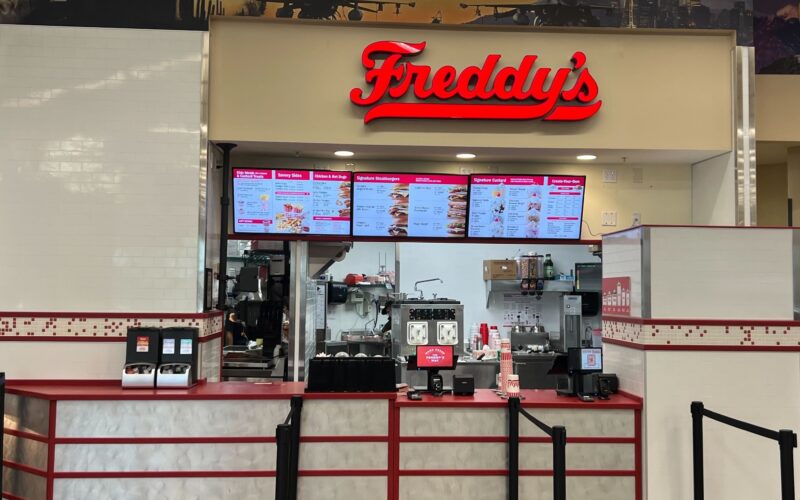
Freddy’s Frozen Custard & Steakburgers has opened its first restaurant on a United States military base, placing the new outlet inside the commissary at Fort Lee in Virginia. The move matters less for near-term unit economics than for what it says about the company’s willingness to adapt its format, operations, and approval process to enter tightly controlled environments that many restaurant chains still treat as too complex or too niche. For Freddy’s, which has expanded to more than 580 locations and has been pushing harder into alternative venues, the base opening is both a symbolic nod to founder Freddy Simon’s military background and a practical test of whether the brand can build a repeatable playbook for on-base growth. In restaurant strategy terms, this is not just a commemorative opening. It is a small-footprint pilot with national expansion implications.
What does Freddy’s first military base restaurant opening actually signal about its growth strategy in 2026?
The simplest reading is that Freddy’s is continuing to diversify where it grows, not just how fast it grows. In the traditional franchise model, expansion usually depends on suburban pads, strip centers, end caps, or freestanding sites with familiar traffic patterns and operating assumptions. Military bases are different beasts altogether. They come with controlled access, background-check requirements, operational restrictions, higher coordination demands, and a customer base that is stable but structurally distinct from open-market retail. That makes this opening strategically useful even if it is modest in immediate sales volume, because success here would show that Freddy’s can adapt the brand to environments that reward procedural discipline more than standard real estate aggression.
That matters because Freddy’s has already been leaning into nontraditional growth. The company said the Fort Lee site is its 25th nontraditional location, joining outlets in places such as airports, student centers, stadiums, and arenas. That number suggests this is no longer a side experiment tucked away in the development deck to impress conference audiences. It is becoming a meaningful parallel track in the brand’s expansion logic. The military-base move extends that logic into a channel that offers high institutional traffic, controlled competition, and potential multi-site scalability if the first unit proves operationally reliable. In other words, Freddy’s is not merely opening a restaurant where people wear uniforms. It is testing whether a franchised fast-casual concept can behave a bit more like an embedded service partner.
Why could military installations become a more attractive expansion channel for restaurant brands like Freddy’s?
Military bases offer something restaurant operators increasingly crave: concentrated demand with fewer of the randomness problems that define conventional retail. Foot traffic is not entirely predictable, but it is tied to a built-in community of service members, civilian employees, and families. That can reduce some location risk, particularly when a brand is placed inside a commissary or other existing institutional setting rather than being forced to create stand-alone destination traffic. The trade-off, of course, is that operators must accept tighter rules, more paperwork, and less design freedom. It is not exactly the place for a brand that wants to freestyle its way through permitting.
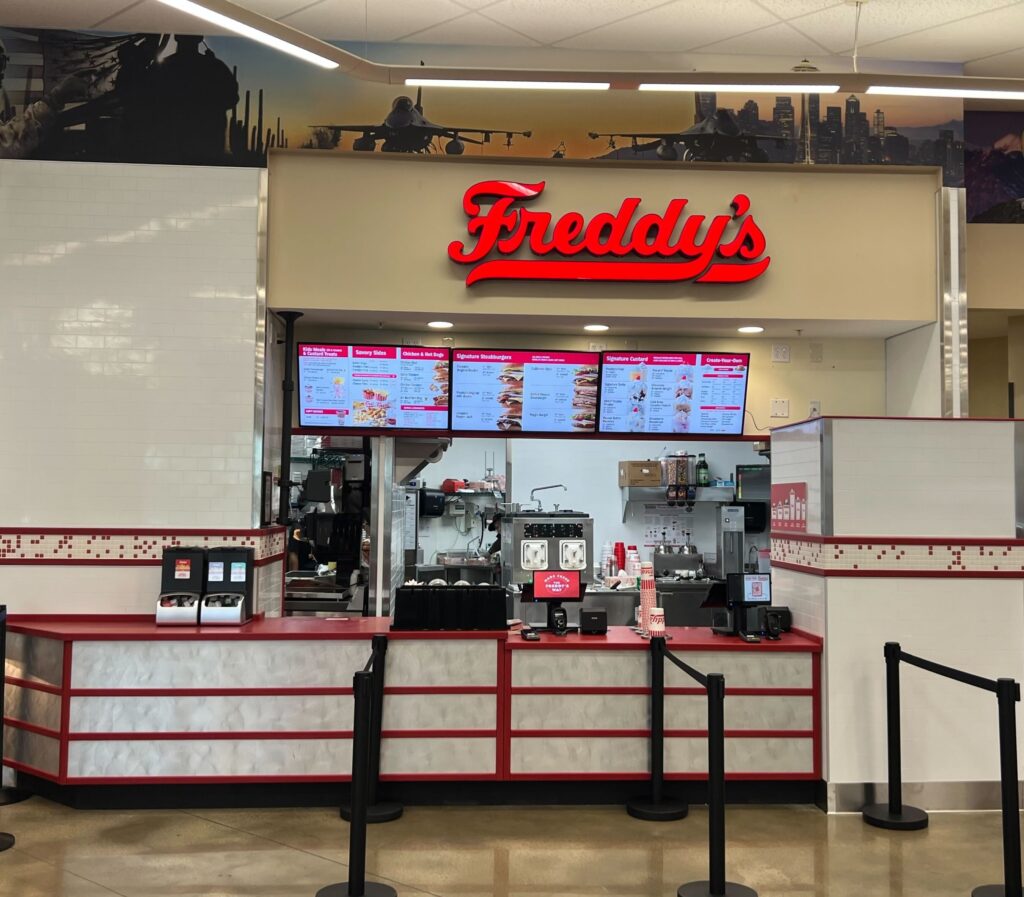
Freddy’s appears to have approached that trade-off pragmatically. The company said the Fort Lee location uses a smaller footprint, a streamlined kitchen, and a simplified menu tailored to the space. That is strategically important because it suggests the company was willing to protect the core brand experience while bending the operating model. Chains that insist on perfect standardization often struggle in nontraditional environments because the site dictates the format, not the other way around. Freddy’s seems to understand that controlled flexibility can be more valuable than rigid replication when entering settings like bases, airports, or institutional food venues.
There is also a timing argument here. Freddy’s enters 2026 after reporting record franchise development activity, with more than 580 restaurants in operation and more units in the pipeline. That creates pressure to keep finding new pockets of whitespace without oversaturating familiar suburban territories. A concept can only add so many conventional boxes before development starts cannibalizing itself or chasing weaker site economics. Nontraditional channels offer a way to extend brand reach without fighting the same site-selection battles in every metro. Military installations, if they can be systematized, become one more answer to the old restaurant question of where the next hundred units come from.
How does the Fort Lee location fit into Freddy’s broader ownership and scale story after its 2025 sale?
The opening also lands in a different ownership era for Freddy’s. In September 2025, investment firm Rhône acquired the chain from Thompson Street Capital Partners, a deal framed around continued market expansion. Private equity ownership does not automatically change day-to-day restaurant execution, but it often sharpens the focus on scalable growth channels, return on invested capital, and transferable operating models. A military-base prototype fits neatly into that mindset. It is the kind of small but strategically useful test that can reveal whether a new venue category deserves broader investment.
That does not mean every military location will be a home run. Base-by-base variation in layout, security rules, available space, and partner coordination could make rollout uneven. But private-equity-backed restaurant owners tend to value optionality, and this opening creates exactly that. If the Fort Lee model works, Freddy’s gains a fresh development lane. If it does not, the downside is manageable because the format has already been designed around constrained space and simplified operations. That is a fairly sensible test-and-learn setup, especially for a brand that appears to be balancing continued traditional growth with more specialized placements.
What operational risks could limit Freddy’s ability to expand to more military bases after this opening?
The biggest challenge is not consumer awareness. It is execution under institutional constraints. Freddy’s said it had to navigate an extended approval process, complete background checks for staff, and adapt to base-directed requirements. That means scaling this channel will depend not only on brand popularity or franchise interest but also on a company’s ability to handle compliance-heavy openings repeatedly and efficiently. Restaurant chains often talk a great game about flexibility until the paperwork starts breeding overnight.
There is also the menu and labor question. A simplified menu can help throughput and reduce complexity, but it may also cap average ticket potential if too many high-margin or brand-defining items are removed. Likewise, staffing on or around a military installation can introduce access and scheduling considerations that are different from open-market stores. If Freddy’s wants to grow this channel nationally, it will need a clear operating template that preserves service speed, food consistency, and labor efficiency despite those site-specific constraints. That is doable, but it is not automatic.
Another potential friction point is whether the military-base model remains franchisee-friendly at scale. Freddy’s credited JRI Hospitality in the Fort Lee effort, and that matters because sophisticated multi-unit operators are often better positioned than smaller franchisees to absorb the complexity of unusual venues. If future on-base growth depends on a narrow set of highly capable operators, expansion could be slower than the headline opportunity suggests. The concept is promising, but promising and plug-and-play are not the same thing.
Why does the Fort Lee naming context add an unusual political and institutional layer to this restaurant opening?
There is a small but notable context point here. Public reporting and official government sources show the Virginia installation previously operated as Fort Gregg-Adams after a 2023 redesignation, before transitioning back to Fort Lee in 2025. Freddy’s announcement uses the Fort Lee name, which aligns with the current installation naming reflected in local government and base communications. That does not alter the restaurant strategy, but it does underscore that institutional-site expansion often intersects with government systems that can be more politically and administratively fluid than standard commercial real estate. Even burger expansion, apparently, can stumble into federal naming history.
For Freddy’s, the more important point is that the brand is trying to align symbolic narrative with practical growth. The company explicitly tied the opening to founder Freddy Simon’s World War II service, but the larger business signal is not nostalgia. It is proof that the company wants to broaden the settings in which the brand can operate without losing recognizability. That is the more durable takeaway for executives and franchise observers. A commemorative story may get the headline, but a reproducible format is what gets the capital.
What do key takeaways on Freddy’s military base opening mean for restaurant competitors and nontraditional dining markets?
- Freddy’s is using the Fort Lee opening as a format test, not just a brand moment, which makes the site strategically more important than its size suggests.
- Military bases could become a meaningful whitespace channel for restaurant chains seeking captive demand without relying on standard suburban expansion.
- The company’s 25 nontraditional locations indicate that alternative venues are becoming part of its core development model rather than a side experiment.
- A smaller footprint and simplified menu show Freddy’s is willing to alter operations to fit institutional environments while protecting brand consistency.
- The opening reflects a broader industry reality that growth increasingly comes from format flexibility, not just opening more conventional stores.
- Freddy’s private-equity-backed ownership structure under Rhône may increase interest in scalable venue categories that can diversify long-term unit growth.
- Operational complexity, including approvals, staffing, security compliance, and site-specific restrictions, could slow military-base rollout if the template is not standardized.
- The Fort Lee unit may prove especially valuable if it gives Freddy’s and its franchise partners a playbook that can be repeated across other commissaries or installations.
- Competitors in fast casual and quick service may watch closely because controlled institutional environments offer attractive traffic patterns if execution hurdles can be managed.
- The real story is not one burger chain opening one unusual store. It is whether nontraditional dining is becoming the next serious battleground for franchised restaurant growth.
Share this:
Discover more from Business-News-Today.com
Subscribe to get the latest posts sent to your email.