



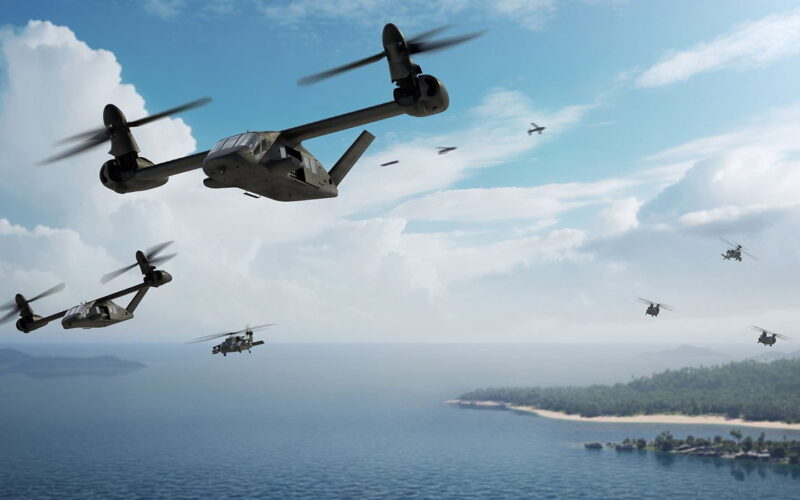
RTX Corporation (NYSE: RTX), the Arlington, Virginia-based aerospace and defense conglomerate, has secured multiple contracts through its Collins Aerospace business to supply five critical systems for the U.S. Army’s MV-75 Future Long Range Assault Aircraft program. The agreements were awarded by Bell Textron Inc., a Textron Inc. subsidiary and the MV-75 prime contractor, and cover systems spanning power generation, cockpit seating, air data, ice protection, and drivetrain interconnects. The announcement lands as the Army pursues one of its most aggressive acquisition accelerations in recent memory, with Army leadership pushing initial fielding from a previously targeted 2030 to as early as 2027 or 2028. For RTX, the contracts extend Collins Aerospace’s footprint on what could ultimately become a program valued at roughly $70 billion across its full production lifecycle.
The five systems Collins Aerospace will deliver include main power generation, an interconnect drive system, the SmartProbe air data system, cockpit seating, and an ice protection system. Work will be performed across seven U.S. states including Colorado, Illinois, Iowa, Minnesota, New York, Ohio, and West Virginia. Critically, several of the systems will be procured through commercial acquisition authorities rather than traditional defense contracting pathways. That distinction matters more than it might initially appear. Commercial acquisition routes typically compress procurement timelines, reduce bureaucratic overhead, and lower some of the testing burden compared to mil-spec development contracts, all of which aligns with the Army’s stated urgency to get the MV-75 to fielded units faster than conventional program timelines would allow.
How does Collins Aerospace’s MV-75 role fit into RTX’s broader defense revenue strategy across its three business segments?
Collins Aerospace sits alongside Pratt and Whitney and Raytheon as RTX’s three core business segments, and each has been working to carve out positions on next-generation military platforms ahead of what analysts expect to be a sustained uplift in defense budgets. The FLRAA program represents one of the most significant Army aviation procurement cycles in a generation. The MV-75 is designed to replace the Sikorsky UH-60 Black Hawk, a workhorse that has been in Army service for decades and that currently operates in at least 35 countries. The Army expects to take delivery of up to 334 MV-75 aircraft by the end of fiscal year 2040, and the full program value has been cited as high as $70 billion when production, sustainment, and services are included over the aircraft’s intended 50-year lifecycle.
For Collins Aerospace, the five systems secured on the MV-75 span some of the most operationally critical subsystems on any rotorcraft. The SmartProbe air data system collects essential flight parameters including airspeed, altitude, and angle of attack, and failures in such systems have had catastrophic consequences on other platforms. The interconnect drive system, which transfers power between the tiltrotor’s two proprotors, is equally unforgiving. Both systems require high reliability across extreme environmental conditions. Winning these roles early in the program development cycle matters because defense platforms tend to lock in suppliers for the production run once engineering is validated in the prototype phase, making competitive displacement later extremely difficult.
What is the Army’s actual MV-75 FLRAA fielding timeline and why has it compressed so dramatically since 2022?
When the Army originally awarded Bell a $1.3 billion development contract following the December 2022 FLRAA competition win over the Sikorsky-Boeing SB-1 Defiant, the expectation was first operational units by the mid-2030s. That window has been revised repeatedly and aggressively. By the start of 2025, the Army had moved the in-service target to 2030. By mid-2025, Army leaders were publicly studying a further pull-forward to 2028. In January 2026, Army Chief of Staff General Randy George stated at Fort Drum that the Army expected MV-75s flying in formations by the end of the year, a remark that Army spokespeople subsequently walked back to clarify that prototype acceptance and testing, rather than operational fielding, was the near-term objective. The first prototype acceptance event is currently expected no earlier than late 2026, with first flight to follow.
The program’s acceleration reflects genuine strategic urgency rather than bureaucratic optimism. Army Futures Command leadership has been explicit that the MV-75’s combination of twice the speed and twice the range of current rotorcraft is considered essential for operations in the Pacific theater, where vast distances and contested airspace make current Black Hawk limitations operationally significant. The 101st Airborne Division has been identified as the first frontline formation to receive the aircraft. Meanwhile, the Army is also restructuring its legacy aviation fleet in parallel, including divesting all older Boeing AH-64D Apache variants and cutting multiple air cavalry scout squadrons, partly to free resources and institutional bandwidth for the MV-75 transition.
What execution risks exist for Collins Aerospace and Bell on a compressed MV-75 development and production schedule?
The acceleration creates measurable risk alongside the strategic logic. The Government Accountability Office flagged in a 2025 report that the FLRAA program was at high risk of missing planned milestone dates, and noted that weight growth on the MV-75 design was putting certain payload mission capabilities at moderate risk. A preliminary design review identified a need for roughly 2,000 pounds of weight reduction, against which Bell had at that stage only accounted for around 270 pounds. Program officials indicated a system-level critical design review was planned for late fiscal year 2025, with its outcomes not yet publicly disclosed at the time of this announcement.
For Collins Aerospace, the commercial acquisition pathway does reduce some friction, but it does not eliminate the challenge of integrating five new subsystems into a platform that has never flown in its militarized configuration. The SmartProbe system, for instance, must be calibrated and certified against the MV-75’s specific aerodynamic profile, which differs meaningfully from prior tiltrotor platforms. The interconnect drive system must handle the tiltrotor’s distinctive mechanical demands during the transition from vertical to horizontal flight, a phase that places unusual stress loads on drivetrain components. Schedules built around program optimism rather than conservative engineering margins have a habit of correcting themselves expensively.
Bell has invested heavily to position itself for success. The company has committed $632 million to a new manufacturing facility at AllianceTexas near Fort Worth dedicated to MV-75 transmissions and rotor blades, and six prototype aircraft are already under assembly at its Wichita facility. Army Secretary Dan Driscoll personally visited the Wichita assembly center in January 2026, a signal of senior-level political backing that typically translates into budget protection in subsequent appropriations cycles. Congress provided $1.26 billion for FLRAA research, development, testing, and evaluation in fiscal year 2025 alone.
How does RTX stock reflect the commercial aerospace and defense market environment around the FLRAA contract announcement?
RTX shares closed at $201.56 on April 10, 2026, down marginally on the session, with the stock sitting approximately 6 percent below its 52-week high of $214.50 reached in early March 2026 and roughly 79 percent above its 52-week low of $112.63 from April 2025. The 12-month return for RTX is approximately 58 percent, a performance that significantly outpaces broad market indices over the same period and reflects sustained investor confidence in the defense spending outlook. The stock’s year-to-date return stands at around 10.8 percent.
The broader context around defense stocks is worth noting. Recent reports indicate that defense equities have experienced mixed performance following signals of an Iran ceasefire, which tempered some of the geopolitical risk premium that had been priced into the sector. RTX’s business mix, which splits roughly evenly between commercial aerospace and defense, provides some insulation from sentiment swings tied purely to military conflict cycles. The Collins Aerospace segment generates revenue from commercial aviation maintenance, repair, and overhaul alongside defense contracts, which provides a degree of revenue smoothing not available to pure-play defense contractors. Morningstar has assigned RTX a fair value estimate of $229 per share as of January 2026, suggesting the stock was trading at a meaningful discount to that assessment at current levels, though analysts note medium uncertainty in the estimate.
How does the Collins Aerospace MV-75 contract compare with RTX’s competitive position against other aerospace subsystem suppliers?
RTX’s ability to win across multiple MV-75 subsystems through Collins Aerospace reflects the structural advantage that large integrated aerospace suppliers maintain over smaller specialists. Consolidating power generation, air data, cockpit seating, ice protection, and drive interconnects under one primary supplier reduces Bell’s integration management burden and provides a single contractual point of accountability across interconnected systems. That kind of systems integration credibility is increasingly valuable to prime contractors managing compressed timelines. Smaller competitors such as Moog and Curtiss-Wright may hold positions on other MV-75 subsystems, but neither has the breadth of capabilities to cover five distinct system categories simultaneously.
The modular open systems approach mandated by Congress for FLRAA does create some theoretical risk of component competition at upgrade cycles, but in practice, the embedded integration knowledge accumulated during prototype development gives incumbent suppliers a durable advantage when production contracts are later awarded. Collins Aerospace’s global manufacturing and service network, with facilities in seven states supporting this program alone, also positions it to meet the Army’s demands for domestic supply chain resilience.
Key takeaways on what the Collins Aerospace MV-75 contract means for RTX, its competitors, and the U.S. defense aerospace industry
- RTX’s Collins Aerospace has secured five MV-75 subsystem positions, locking in early program revenue and establishing a strong baseline for follow-on production contracts across a potential 50-year, $70 billion program lifecycle.
- The use of commercial acquisition authorities signals the Army’s determination to compress procurement timelines, with RTX positioned to benefit from this structurally faster contracting pathway.
- Bell’s MV-75 prototype acceptance is expected no earlier than late 2026, with fielding now targeted for as early as 2027 to 2028 following sustained Army acceleration pressure from senior leadership.
- GAO-identified risks including weight growth and schedule pressure remain live concerns that could affect how quickly Collins Aerospace transitions from prototype supply to production volume orders.
- RTX stock has delivered approximately 58 percent returns over the past 12 months, supported by broad defense budget tailwinds, though it trades around 6 percent below its recent 52-week high.
- Collins Aerospace’s multi-system positioning on FLRAA mirrors the integration strategy it has applied to commercial aviation platforms, where portfolio breadth creates stickier customer relationships than single-component supply.
- The MV-75 program represents one of the first clean-sheet U.S. Army rotorcraft in a generation, and subsystem supplier selections made now will largely determine the competitive landscape for associated services and upgrades over the next several decades.
- Smaller aerospace subsystem suppliers lack the scale and breadth to match Collins Aerospace’s five-system package, reinforcing a trend toward larger integrated partners on major defense platform programs.
- The Army’s parallel divestment of older Apache and scout helicopter variants, combined with MV-75 acceleration, is compressing the transition window and increasing delivery schedule risk for all program participants.
- Bell’s $632 million manufacturing investment at AllianceTexas and the six test aircraft already under assembly at Wichita indicate genuine industrial commitment, which reduces but does not eliminate execution risk on an already aggressive timeline.
Discover more from Business-News-Today.com
Subscribe to get the latest posts sent to your email.