



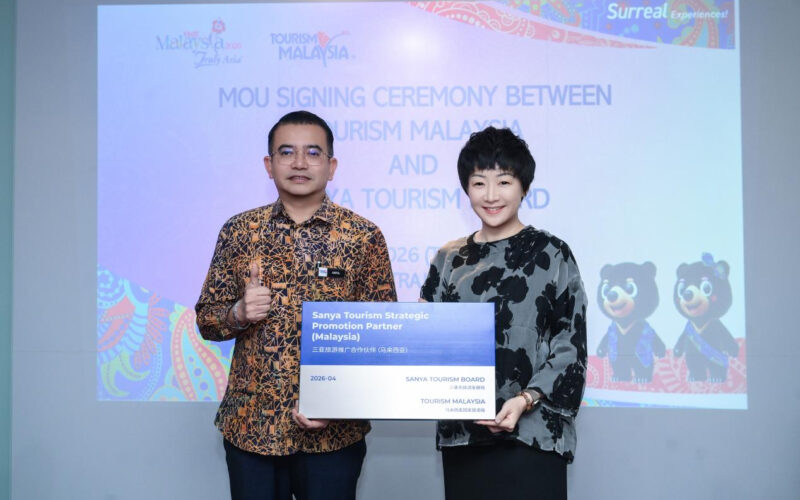
Sanya’s tourism authorities and Tourism Malaysia have formalized a strategic cooperation agreement that goes beyond symbolic destination marketing and points to a more coordinated Southeast Asia tourism push by Hainan Province. The partnership, announced after an April 2 agreement and publicized on April 11, ties Sanya’s international expansion efforts to Visit Malaysia Year 2026, while also widening cooperation with Malaysian tourism and hotel industry bodies. The immediate significance is commercial as much as diplomatic: Sanya is pairing easier travel access, direct air links, digital visitor infrastructure, and steep event-linked discounts in a bid to turn Malaysian demand into repeat inbound volume. For a tourism market increasingly driven by regional short-haul travelers, this is less a branding exercise than a competitive customer acquisition move dressed in tropical colors.
Why does the Sanya and Malaysia tourism cooperation matter more now for regional travel demand?
The timing is doing a lot of work here. Regional tourism boards across Asia are no longer selling only destinations. They are selling frictionless movement, digital convenience, and curated price-value bundles to travelers who compare options faster than tourism ministries update brochures. In that context, Sanya’s agreement with Tourism Malaysia matters because it links official promotion with practical enablers that can influence booking behavior. Visa-free access for Malaysian citizens to Hainan for up to 15 days sharply lowers decision friction, while a flight time of roughly three hours from Kuala Lumpur makes Sanya easier to position as a short-break or family leisure destination rather than a once-a-year international trip.
That matters because short-haul travel has become one of the most resilient segments in Asia’s tourism recovery and expansion cycle. Travelers are more willing to commit to nearby international destinations when entry rules are simple, payment systems are familiar, and itinerary planning does not feel like administrative homework. Sanya appears to understand that equation. Its message is not merely that it has beaches and attractions. Its message is that Malaysians can get there quickly, pay easily, navigate without language stress, and access discounted tourism products tied to a major sporting event.
The cooperation also gives Sanya a stronger institutional foothold in Malaysia through its liaison office and through exchanges with Malaysian Association of Tour and Travel Agents and the Malaysian Budget Hotel Association. That suggests a deeper channel strategy. Rather than relying only on direct consumer advertising, Sanya is trying to embed itself into the Malaysian tourism trade ecosystem, where tour operators, budget accommodation networks, and package designers can influence demand at scale. In tourism, distribution still matters. Instagram may inspire the trip, but travel intermediaries often close it.

How is Sanya using visa-free access, direct flights, and digital convenience to remove travel friction?
Sanya’s playbook looks unusually focused on travel conversion rather than generic destination image-building. Visa-free access for Malaysian passport holders visiting Hainan is the headline convenience lever, because it directly reduces the paperwork barrier that can kill impulse travel. But the infrastructure piece may be just as important over time. The press material highlights paperless airport and cruise-port processing, international credit card acceptance in arrival halls, multilingual signage, a foreign-language hotline, and a multilingual website. None of that sounds glamorous. All of it matters.
Tourism boards often market aspiration while underinvesting in the boring details that shape actual traveler satisfaction. Sanya appears to be packaging those operational details as part of the product itself. That is smart. For many international visitors, especially first-time visitors to China, the biggest concern is not whether the destination looks appealing online. It is whether they will be able to move, pay, ask for help, and solve problems without unnecessary friction. In effect, Sanya is attempting to reduce the “unknowns tax” that travelers apply when evaluating unfamiliar destinations.
The exploration of additional direct flights to Penang and Kota Kinabalu also points to a larger network strategy. Expanding beyond Kuala Lumpur would widen catchment areas and reduce Malaysia’s capital-city bias in outbound tourism flows. It would also allow Sanya to compete for leisure travelers from secondary urban markets, where price sensitivity is often high but international travel appetite can still be robust if connectivity improves. Airlines, tourism boards, and local authorities tend to talk about route expansion as if it were inevitable. It is not. Route economics depend on sustained demand, load factors, and marketing support. This partnership seems designed to improve those odds.
Can discounts tied to the 2026 Asian Beach Games turn Sanya into a stronger events-led tourism destination?
One of the clearest commercial signals in the announcement is Sanya’s use of the 2026 Asian Beach Games as a tourism accelerator rather than just a sports hosting exercise. Discounted attraction tickets of up to 73%, hotel rate cuts that can reach thousands of renminbi, and dining discounts around 48% suggest that Sanya is not trying to maximize margin on first touch. It is trying to maximize volume, visibility, and destination trial. That can make sense if the city believes event-linked tourism can generate repeat visits, social media exposure, and stronger international brand recall.
This approach reflects a broader shift in tourism strategy across Asia. Major events are increasingly being treated as demand aggregation engines rather than prestige showcases. Hosting alone is not enough. Cities now need to wrap events inside bookable, understandable, and price-attractive consumer packages. Themed travel products such as “Travel with the Asian Beach Games” are part of that logic. They create a hybrid proposition in which the event becomes both anchor content and urgency trigger. Travelers are not just booking a beach holiday. They are booking a temporary, time-bound experience that combines sports, leisure, and curated local consumption.
The risk, of course, is that steep discounting can train travelers to wait for promotions. Tourism demand built purely on price cuts can be fragile. But Sanya seems to be betting that the event window will function as a market-entry tool, especially for Malaysian travelers who may not yet see the city as a default China leisure choice. If that trial converts into familiarity and repeat visitation, the economics can improve later. Tourism boards rarely say it this plainly, but many are willing to buy the first visit in order to earn the second.
What does Sanya’s tourism product mix reveal about its strategy for families, youth travelers, and cultural tourism?
The destination positioning in the announcement is striking because it does not rely on a single travel identity. Sanya is being marketed simultaneously as a beach and diving destination, a family entertainment hub, a cultural and spiritual tourism site, and a premium shopping location through its duty-free complex. That broad product mix is not accidental. It allows Sanya to appeal to multiple traveler cohorts from the same origin market without forcing a narrow brand story.
For younger travelers and experience-seeking tourists, the diving, water sports, and major water park appeal are obvious demand hooks. For family travelers, the combination of attractions, discounted packages, and relatively short flight time strengthens the value proposition. For culturally motivated visitors, the Nanshan Cultural Tourism Zone and Li and Miao heritage references provide a different narrative, one that broadens Sanya beyond the beach-resort stereotype. For higher-spending visitors, the duty-free angle adds a retail incentive that can materially increase per-trip expenditure.
This kind of tourism portfolio diversification matters because it reduces overdependence on one traveler type or one seasonality pattern. Destinations that rely too heavily on a single product category become vulnerable when preferences shift, weather patterns disrupt travel, or competing destinations undercut pricing. Sanya is clearly trying to present itself as an integrated coastal destination with layered monetization opportunities, where accommodation, attractions, retail, food, and events all reinforce one another. In plain English, it wants more ways to make money from the same traveler. Tourism economics, as ever, is romantic only in the brochures.
Why could Malaysia become a strategic gateway market for Sanya’s broader Southeast Asia tourism ambitions?
The reported rise of more than 200% in Malaysian tourist arrivals to Hainan since early this year is the kind of figure tourism authorities love to showcase, though percentage growth rates always need context because low starting bases can produce dramatic-looking surges. Even so, the directional signal is clear. Malaysia is emerging as a meaningful source market for Hainan, and Sanya appears keen to convert that momentum into institutionalized demand rather than treat it as a temporary rebound.
Malaysia makes strategic sense as a gateway market for several reasons. It has strong outbound travel behavior, a large aviation ecosystem, high familiarity with regional beach destinations, and consumer segments that respond well to short-haul leisure packages. It also offers a multicultural traveler base that can help Sanya test messaging across different consumer preferences without immediately stretching into more complex long-haul markets. If Sanya can prove that its model works in Malaysia through partnerships, routes, pricing, and repeat visitor growth, it can potentially replicate parts of that playbook elsewhere in Southeast Asia.
There is also a geopolitical and economic subtext here. China’s regional tourism diplomacy increasingly intersects with local growth agendas across Southeast Asia. Destination partnerships can deepen people-to-people ties, support airline traffic, and stimulate related sectors such as hospitality, retail, and travel technology. For Malaysia, cooperation with Sanya complements Visit Malaysia Year 2026 ambitions by encouraging reciprocal visibility and tourism exchange. For Sanya, Malaysia is not just a customer base. It is a test market for how effectively Hainan can position itself as a more accessible international leisure gateway.
What are the execution risks if Sanya wants to convert Malaysian interest into sustained long-term visitor growth?
The obvious challenge is sustainability. Announcements are easy, route expansions are harder, and sustained repeat traffic is hardest of all. Sanya will need more than introductory offers and a ceremonial partnership if it wants Malaysian demand to remain durable after the novelty fades. Price promotions can spark interest, but long-term growth depends on service reliability, air connectivity, hotel value perception, digital ease, and destination reputation built through actual traveler experience.
Flight expansion to Penang and Kota Kinabalu remains exploratory, which means air capacity cannot yet be assumed. If new routes do not materialize or remain seasonal, growth could stay concentrated in Kuala Lumpur-origin traffic. There is also competitive pressure from established Southeast Asian beach destinations that are already deeply embedded in Malaysian travel behavior and often have mature low-cost airline ecosystems supporting them. Sanya is entering a competitive arena where consumers have alternatives and price transparency is brutal.
Another risk is that tourism infrastructure upgrades highlighted in the announcement need to work consistently, not occasionally. Multilingual services, payment acceptance, and foreign visitor support are meaningful differentiators only when delivered reliably at scale. International visitors tend to remember friction more vividly than promotion. A smooth arrival experience can create advocacy. A confusing one can destroy thousands of dollars of marketing effort in a single social media thread.
What do the key takeaways say about how Sanya and Malaysia are positioning for 2026 tourism growth?
Sanya’s partnership with Tourism Malaysia is best viewed as a demand-building strategy anchored in reduced friction, improved distribution, and event-linked consumer packaging rather than a routine tourism memorandum. The city is trying to convert regional proximity into repeat leisure traffic by aligning policy convenience, trade partnerships, digital infrastructure, and promotional intensity. Malaysia, meanwhile, appears positioned not just as an inbound source market for Hainan but as a strategic tourism partner during a year when both sides want stronger travel visibility. Whether this becomes a durable corridor will depend less on ceremonial announcements and more on air seats, traveler experience, and how well first-time visitors convert into repeat customers.
What are the key takeaways executives should watch in the Sanya and Malaysia tourism cooperation story?
- Sanya is shifting from broad destination branding to a more conversion-focused tourism strategy built around access, pricing, and operational convenience.
- Malaysia is emerging as a test market for Hainan’s wider Southeast Asia tourism expansion ambitions.
- Visa-free entry for Malaysian travelers is a major competitive advantage because it lowers booking friction at the earliest decision stage.
- The partnership with Malaysian tourism trade groups suggests Sanya wants deeper distribution support, not just awareness campaigns.
- Event-led packaging around the 2026 Asian Beach Games shows Sanya is using sports infrastructure as a commercial tourism demand engine.
- Heavy introductory discounting may help first-visit conversion, but long-term success will depend on repeat travel and yield quality.
- Possible new direct flights to Penang and Kota Kinabalu would materially strengthen Sanya’s access to secondary Malaysian outbound markets.
- Sanya’s diversified product mix across beach leisure, family attractions, culture, and duty-free retail improves resilience against narrow traveler segmentation.
- The tourism growth story will be credible only if digital services, multilingual support, and payments infrastructure work consistently on the ground.
- For regional tourism planners, this deal is a sign that Asian destination competition is increasingly being fought on friction reduction, not just destination image.
Discover more from Business-News-Today.com
Subscribe to get the latest posts sent to your email.