


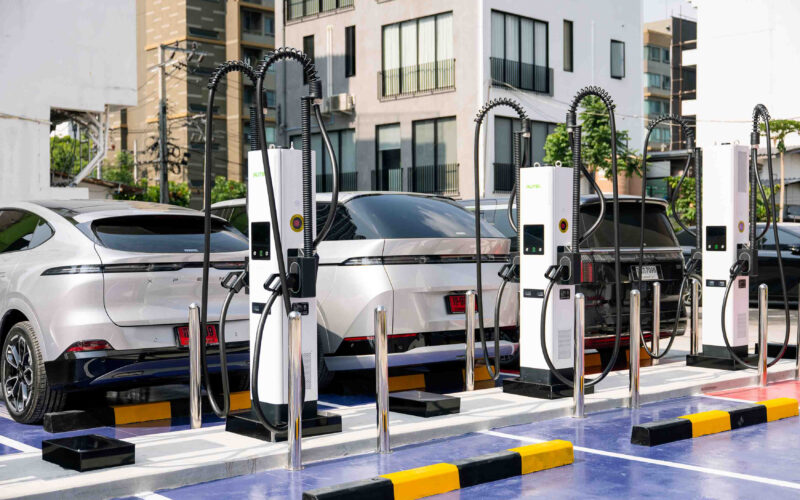
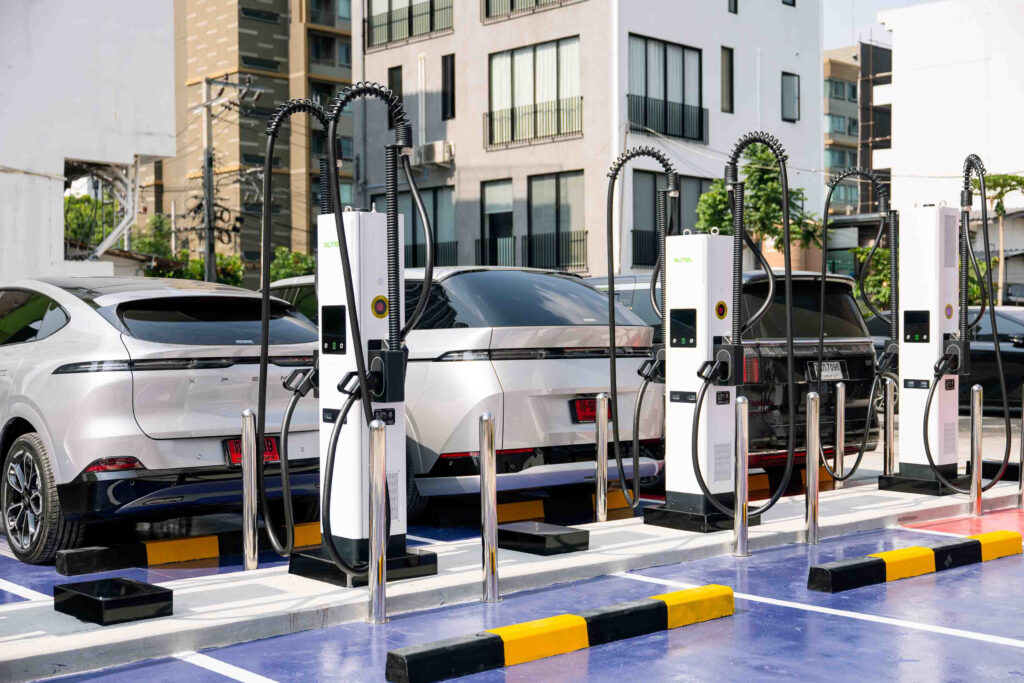
Autel Energy used a live deployment in Bangkok to showcase what it says is an ultra-fast electric vehicle charging experience that combines up to 780A current delivery with app-based usability, a pairing that matters more than the hardware headline alone suggests. The April 10 demonstration at Beans2Cup@Ratchada featured the Autel MaxiCharger DS480, DT500, and DT800, with the company claiming a Zeekr 009 was charged from 20% to 80% in 10 minutes. The immediate relevance is not just charging speed, but whether operators in Southeast Asia can turn ultra-fast charging into a commercially repeatable public-infrastructure model. In practical terms, Autel Energy is testing the proposition that the next phase of charging competition will be won not by installing more plugs, but by compressing dwell time, improving digital ease, and making premium charging sites economically viable.
The strategic point here is simple: once electric vehicle adoption passes the early-adopter stage, charging stops being a niche equipment business and starts becoming a convenience business. Drivers do not care much about charger architecture, cable cooling, or power electronics unless those things translate into a shorter stop and fewer failed sessions. That is why Autel Energy’s Thailand deployment is more interesting as a consumer-behavior signal than as a pure product launch. The company is effectively arguing that public charging needs to feel less like a technical chore and more like a quick retail transaction that fits naturally into everyday life.
Thailand is a logical place to make that argument. The country has become one of Southeast Asia’s most active electric vehicle markets, and its public charging footprint has expanded rapidly. Roland Berger, citing data from the Electric Vehicle Association of Thailand, said the country had 11,467 charging points as of December 2024, with 5,782 of them being DC chargers. That 50:50 AC-to-DC split is already ahead of the global norm in fast-charging intensity, but it also highlights the next challenge: as vehicle adoption rises, the market will need not just more DC chargers, but better-performing ones in high-throughput locations.
Why does Autel Energy’s Thailand deployment matter beyond a one-day product demonstration?
Because the showcase speaks directly to the bottleneck that still shadows mass electric vehicle adoption in many markets: charging time anxiety. Range anxiety used to dominate the conversation. Now, increasingly, the more commercially relevant concern is time lost at public chargers, especially for urban drivers, ride-hailing fleets, premium EV owners, and intercity travelers. A charger that can materially reduce that stop duration changes user expectations and can reshape site economics for operators. A station that turns over vehicles faster can, in theory, improve revenue productivity per bay, assuming utilization, tariffs, and grid constraints align.
That is where the “coffee break” framing, while obviously polished for publicity, still lands on a real industry truth. Public charging is becoming a contest over dwell-time optimization. Retail cafés, highway service areas, mixed-use sites, and convenience-led destinations stand to benefit most if charging sessions can be compressed without making the user experience more complicated. In that sense, Autel Energy is not merely selling chargers. It is pitching a higher-frequency site model where charging, software, retail footfall, and partner ecosystems all reinforce one another.
The inclusion of app experience in the announcement matters almost as much as the 780A specification. The electric vehicle charging industry has learned the hard way that speed on paper means little if activation is clumsy, payments fail, or users struggle to locate and start sessions. Software friction can quietly destroy the value proposition of premium charging hardware. By pushing a simpler app workflow alongside the charger performance narrative, Autel Energy is acknowledging that the next stage of public charging competition will be won by integrated experience rather than raw output alone.
What does this reveal about the next competitive phase of Thailand’s EV charging market?
It suggests the Thai market is entering a segmentation phase. Early charging rollouts tend to prioritize network coverage, basic availability, and visible infrastructure expansion. Later phases begin to stratify around use case. Fleets need uptime and depot efficiency. Retail sites need fast turnover. Highway corridors need confidence and redundancy. Premium EV owners increasingly expect high-power charging that feels seamless, not experimental. Autel Energy’s Bangkok showcase sits squarely in that second phase, where providers try to differentiate on speed, reliability, digital control, and interoperability across vehicle brands.
The live demonstration across multiple models, including Zeekr, Xpeng, Tesla, Mercedes-Benz, and Porsche, was clearly designed to support that broader compatibility message. Whether that performance can be replicated consistently outside a showcase environment is the more important question, but the intent is obvious. Autel Energy wants to be seen not as a charger vendor chasing one automaker ecosystem, but as a flexible infrastructure player that can support a mixed and increasingly international EV parc in Thailand. That matters because Thailand’s EV market is not evolving around a single dominant brand story. It is becoming a multi-brand arena shaped by Chinese entrants, legacy automakers, local infrastructure partners, and shifting consumer expectations.
There is also a timing advantage in making this move now. Thailand’s government-backed e-mobility transition is still being built out, and that means technical standards, site economics, and user habits are not fully locked in. Companies that establish performance credibility early may gain influence over where premium charging hubs are deployed and how public charging is monetized. The winner in charging is not always the company with the flashiest hardware. Sometimes it is the one that gets embedded into the right property, software, and service relationships before the market matures.
Can ultra-fast EV charging actually become a profitable and repeatable infrastructure model?
That is the billion-baht question, and it is where enthusiasm needs a little adult supervision. Ultra-fast charging sounds irresistible, but it is not automatically an easy business. High-power sites face significant capital costs, grid-connection considerations, maintenance demands, and utilization risk. A charger can be technically impressive and still fail commercially if traffic is inconsistent, power costs are unfavorable, or the station is placed in the wrong retail or mobility corridor. Academic work on Thailand’s charging-station economics has already pointed to the importance of operational model design, charger mix, and energy-cost variability in determining financial viability.
That means Autel Energy’s Thailand deployment should be read as a strategic signal, not a proven market verdict. The company is showing where the category wants to go. But the real test will be whether operators can sustain high utilization and whether site hosts can translate faster charging into better economics per square meter. In plain English, the charger may be able to fill the battery quickly, but the business still needs to fill the bay often enough.
Partner choice therefore matters. The announcement’s ecosystem framing around B2C Energy, ACharge, and Aplus Smart Mobility is not a side detail. It reflects a real truth about charging deployment: hardware alone rarely wins. Site access, payments, software integration, service response, and local operating knowledge often decide whether a rollout scales cleanly or becomes a patchwork of underperforming assets. In emerging high-growth markets, the partnership stack can matter almost as much as the charger stack.
What happens next if Autel Energy can turn this Thailand showcase into broader regional momentum?
If the model works, Autel Energy could strengthen its position in a regional charging market that is moving from infrastructure scarcity toward quality differentiation. The company would not just be selling charger boxes. It would be participating in a more valuable narrative around premium public charging, fleet readiness, and digitally managed energy infrastructure. That opens doors not only in Thailand, but potentially in other Southeast Asian markets where EV adoption is rising and public charging still has room to leapfrog older formats.
There is also a second-order implication for competitors. A visible, high-performance rollout raises consumer expectations for what a public charging stop should feel like. That can put pressure on slower, more cumbersome networks whose value proposition is still built mainly on presence rather than performance. Once a segment of drivers experiences something closer to 10-minute top-ups with a usable app flow, patience for awkward charging sessions tends to shrink fast. Infrastructure markets are funny that way. One strong demo does not prove dominance, but it can make legacy mediocrity look very old, very quickly.
Still, the industry should keep one eyebrow raised. Demonstration performance is not the same as network-wide performance. Real-world congestion, grid conditions, battery curves, heat, maintenance, and queue management can all dilute the headline promise. The Autel Energy deployment in Bangkok is important because it points toward the future shape of the market. It is not important because it has already settled the race.
What do Autel Energy’s 780A chargers and Thailand rollout mean for EV infrastructure competition in Southeast Asia?
The biggest takeaway is that the charging conversation is evolving from infrastructure availability to infrastructure quality. In Thailand, where the public charging base is already growing and DC penetration is comparatively strong, the next advantage is likely to come from better throughput, stronger digital experience, and smarter siting. Autel Energy is trying to position itself at exactly that intersection. Whether it succeeds will depend less on event-day spectacle and more on operating discipline, partner execution, and the economics of repeated use.
In that sense, this Bangkok deployment is not just about one coffee shop site or one charger family. It is an early marker for how EV infrastructure providers hope to justify the next wave of capital spending. The industry wants public charging to become faster, easier, and normal enough that drivers stop planning their day around it. If that happens, electric mobility becomes less of a behavioral adjustment and more of a default transport choice. That is the bigger strategic story behind the cables, kilowatts, and app screens.
What are the key takeaways on what Autel Energy’s Thailand EV charging showcase means for the company, competitors, and the industry?
- Autel Energy is using Thailand to position itself in the premium, high-throughput end of public EV charging rather than the commodity hardware segment.
- The Bangkok deployment signals that dwell time, not just charger count, is becoming the next major battleground in EV infrastructure.
- Thailand’s relatively strong DC charging base makes it a useful proving ground for next-generation public charging models.
- The 780A and high-power narrative matters only if Autel Energy and its partners can replicate performance consistently outside showcase conditions.
- App simplicity is emerging as a competitive differentiator because poor software can erase the benefit of ultra-fast hardware.
- Retail-linked charging locations could become more valuable if operators can turn shorter sessions into higher bay turnover and better site economics.
- Multi-brand compatibility is strategically important in Thailand because the EV market is becoming more diverse, not more standardized.
- Ecosystem partners such as B2C Energy, ACharge, and Aplus Smart Mobility are central to scalability because local execution often determines infrastructure success.
- Competitors may face pressure to upgrade both charging speed and digital usability as driver expectations rise.
- The broader industry implication is clear: public charging is shifting from coverage-first expansion to experience-first optimization.
Discover more from Business-News-Today.com
Subscribe to get the latest posts sent to your email.