






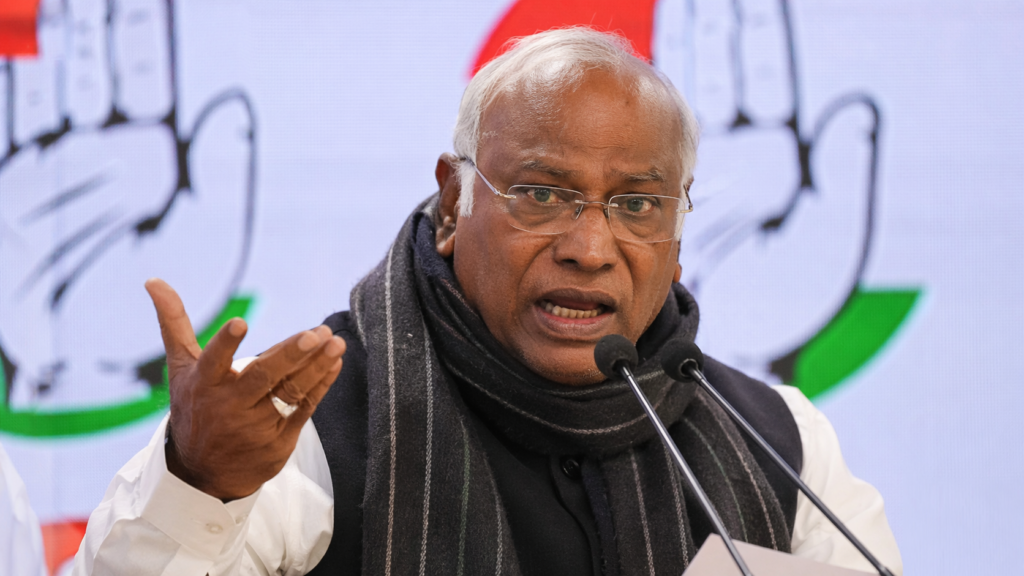
Congress president Mallikarjun Kharge said on Friday that the Modi government’s proposed delimitation exercise linked to the implementation of the women’s reservation law would have “grave consequences” and warranted thorough deliberation. Kharge made the remarks while addressing a meeting of the Congress Working Committee in New Delhi, convening the party’s top leadership to formulate a response ahead of a three-day special session of Parliament scheduled to begin on April 16, 2026.
Kharge said the central government was convening the parliamentary sitting with the sole intention of securing political advantage, which he characterised as a “violation” of the Model Code of Conduct, and was keen to pass the Constitutional Amendment Bill in “utmost haste.”
What did the Congress Working Committee meeting on April 10 discuss about the Women’s Reservation Amendment Bill?
The Congress Working Committee meeting was attended by Rahul Gandhi, Priyanka Vadra Gandhi, Jairam Ramesh, Shashi Tharoor, Sachin Pilot, and K C Venugopal, along with Telangana Chief Minister Revanth Reddy and Karnataka Chief Minister Siddaramaiah.
Kharge said the Congress had not received any formal proposal about the Women’s Reservation Amendment Bill, alleging that the Modi government wanted to pass the bill during the upcoming session to “take credit and benefit from it” in the ongoing assembly elections. Based on information received, Kharge said the government intended to implement women’s reservation from the 2029 Lok Sabha elections and also planned to increase the current seats in the Lok Sabha and state assemblies by 50 percent, raising the Lok Sabha from 543 to 816 seats, with a proportional increase in state assemblies.
Kharge warned that this delimitation proposal could carry serious consequences and accused the Bharatiya Janata Party-led government of wanting to push it through without proper deliberation for the purpose of gaining political advantage. He said the Congress party and floor leaders of opposition parties had written three times to the Minister of Parliamentary Affairs requesting that the government convene an all-party meeting after the last day of polling for the West Bengal elections on April 29, but the government had not heeded these requests. He further claimed this amounted to a violation of the Model Code of Conduct, which is enforced in all poll-bound regions.
Why does the opposition say calling Parliament during an election violates the Model Code of Conduct?
The Model Code of Conduct is a framework of guidelines issued by the Election Commission of India that governs the conduct of political parties, candidates, and governments during election periods. While the Code does not explicitly prohibit Parliament from meeting during an election season, the opposition’s objection rests on the argument that introducing major constitutional changes while Tamil Nadu and West Bengal are in the middle of active polling is designed to generate electoral benefit rather than reflect legislative necessity.
Kharge argued that most members of Parliament would be occupied with election campaigning in Tamil Nadu and West Bengal during the session from April 16 to 18, and accused the government of a habit of “weakening democracy and taking arbitrary decisions.”
What is the Nari Shakti Vandan Adhiniyam and why does it need to be amended for 2029 implementation?
The Nari Shakti Vandan Adhiniyam, enacted in September 2023 as the Constitution (106th Amendment) Act, provides for 33 percent reservation for women in the Lok Sabha and state legislative assemblies. The law as originally enacted linked its implementation to a delimitation exercise based on a new national census. With the proposed 2027 census not yet completed, the reservation was not expected to come into force before 2034 under the existing framework. The government’s proposed amendment seeks to overcome this timeline by basing delimitation on the 2011 census data rather than the proposed 2027 census, enabling the reservation to take effect from the 2029 general elections.
Kharge noted that he had himself demanded the immediate implementation of the Nari Shakti Vandan Adhiniyam during the debate in the Rajya Sabha on September 21, 2023, but the government had not agreed at that time, and he questioned why there was now such urgency approximately 30 months after the law’s passage.
How does the proposed Lok Sabha expansion from 543 to 816 seats affect southern states and federal representation?
The proposed expansion of the Lok Sabha has added a further dimension to the political dispute. The delimitation question is particularly sensitive for India’s southern states, including Kerala, Tamil Nadu, Karnataka, and Telangana, which have controlled population growth more effectively than many northern states, and where there is concern that any redistribution of seats based on current population data will increase the representation of more populous northern states at their expense. Congress leader Jairam Ramesh pointed out that the current gap in Lok Sabha seats between Uttar Pradesh and Kerala stands at 60 seats and could widen to 90 seats after expansion, diluting the relative political weight of smaller states. Prime Minister Narendra Modi addressed these concerns at public rallies, stating that no seats would be reduced in Kerala or Tamil Nadu, though the Congress disputed this assurance.
What did the Kharge-Rijiju correspondence reveal about the breakdown in all-party consultation?
A series of letters exchanged between Kharge, as Leader of Opposition in the Rajya Sabha, and Parliamentary Affairs Minister Kiren Rijiju were made public by Jairam Ramesh, who said the correspondence laid bare the background to what he described as a unilateral decision by the central government to call a special session at a time when election campaigning in Tamil Nadu and West Bengal was at its peak.
The letters showed that Kharge had first written to Rijiju on March 16, 2026, seeking an all-party meeting chaired by the Prime Minister to discuss the modalities and roadmap for implementing the Nari Shakti Vandan Adhiniyam, and had reiterated the demand on March 24, suggesting that the meeting be held after April 29 once the current round of assembly elections concluded. Rijiju responded on March 26, stating that the government was committed to the effective and timely implementation of the law, but cautioned that convening an all-party meeting at that stage could delay the process. Kharge responded the same day, questioning why the government was in such a hurry to amend the law more than two and a half years after it was originally passed.
Opposition parties, excluding the Trinamool Congress, jointly wrote to the government on March 24, 2026, requesting that consultations on the constitutional amendments be deferred until after the election cycle, with the Congress asserting that any delay would not affect the law’s implementation timeline from the 2029 elections.
What concerns has the Congress raised about the bill’s implications for federalism and the size of Parliament?
Congress leader Shashi Tharoor, who said he had not yet seen the draft bill, stated the party needed to examine the implications for federalism and the functioning of the legislature, and raised questions about the practical operation of a parliament with more than 800 members. The proposed amendments are expected to require passage as constitutional amendments, and a separate Delimitation Bill is also expected to be introduced during the April 16 to 18 session, with no provision for Other Backward Classes reservation included in the current framework, while Scheduled Castes and Scheduled Tribes reservations are to continue.
Following the Congress Working Committee meeting, Kharge said the party would hold consultations with opposition parties on a collective strategy and would “move forward unitedly” ahead of the Parliament session.
Key takeaways on what the Congress Working Committee meeting and the Centre’s women’s reservation move mean for India’s Parliament, electoral system, and federal structure
- Congress president Mallikarjun Kharge characterised the central government’s decision to convene Parliament from April 16 as a “violation” of the Model Code of Conduct, alleging the session is motivated by political advantage during ongoing Tamil Nadu and West Bengal assembly elections rather than legislative necessity.
- The government’s proposed amendments to the Nari Shakti Vandan Adhiniyam seek to delink women’s reservation from the 2027 census by using 2011 census data, enabling 33 percent reservation in the Lok Sabha and state assemblies to come into effect from the 2029 general elections rather than 2034.
- The associated delimitation proposal would increase the number of Lok Sabha seats from 543 to 816, a 50 percent expansion, with 273 seats reserved for women, and a proportional increase in state assembly seats.
- Southern states including Tamil Nadu, Kerala, Karnataka, and Telangana have raised concerns that a population-based seat expansion will widen the gap in Lok Sabha representation between more and less populous states, reducing their relative political weight in Parliament.
- The Congress party has said it does not oppose women’s reservation but has demanded an all-party meeting after April 29, 2026, asserting that cross-party deliberation is necessary for constitutional changes of this scale and that the opposition is not against implementation from the 2029 Lok Sabha elections.
Discover more from Business-News-Today.com
Subscribe to get the latest posts sent to your email.

