


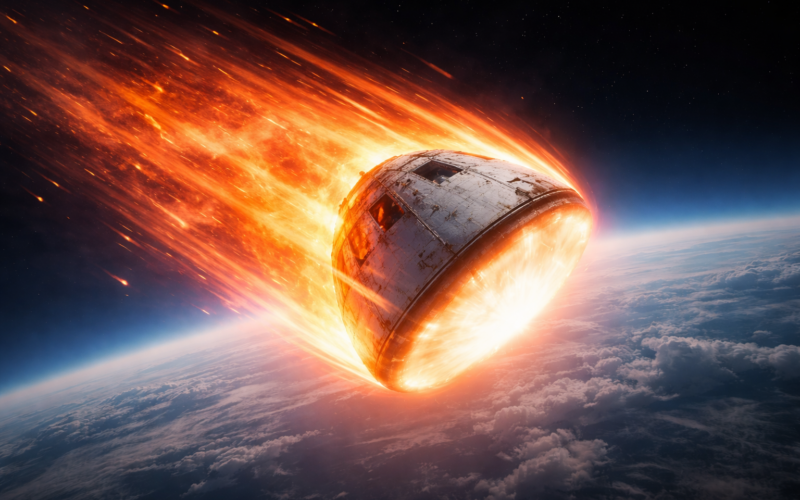
Artemis II is due to end its 10-day lunar mission on Friday, April 10, 2026, with a Pacific Ocean splashdown off the coast of San Diego, but one of the most closely watched parts of the return will happen when nobody on the ground can hear the crew at all. NASA has said Orion will enter a planned six-minute communications blackout during reentry at about 7:53 p.m. Eastern Time, when plasma forms around the capsule during peak heating as it descends from roughly 400,000 feet at a speed of about 23,864 miles per hour.
That temporary loss of signal is not a mission failure, and it is not the same event as the longer communications gap Orion experienced when it passed behind the Moon earlier in the mission. NASA has explained that the far-side lunar blackout happens because the Moon physically blocks radio signals to and from Earth, while the reentry blackout happens because Orion’s interaction with Earth’s atmosphere creates superheated plasma around the spacecraft that interferes with communications.
For Artemis II, that distinction matters because the mission is not just about going around the Moon. It is also a full end-to-end test of whether Orion can safely bring astronauts home from deep space under real lunar-return conditions. NASA’s currently assigned Artemis II crew is commander Reid Wiseman, pilot Victor Glover, mission specialist Christina Koch, and mission specialist Jeremy Hansen. The agency has described Artemis II as the first crewed flight test of the Space Launch System rocket and Orion spacecraft around the Moon, with the return through Earth’s atmosphere serving as one of the mission’s most critical validations.
Why will Artemis II crew lose communication with mission control during reentry into Earth’s atmosphere?
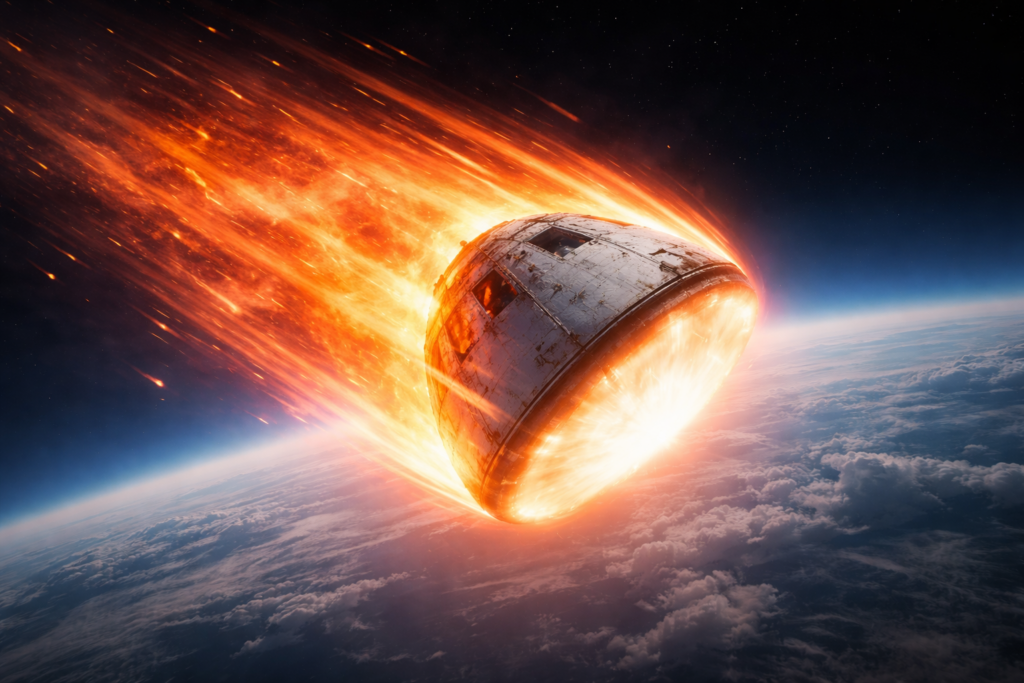
NASA’s explanation is straightforward but dramatic. As Orion begins to encounter the upper atmosphere, friction and compression rapidly heat the air around the spacecraft. That process creates a layer of ionized gas, or plasma, around the capsule. NASA’s Artemis II press kit says superheated plasma will begin to build up around the spacecraft within seconds as atmospheric friction increases, and communications with the crew will be temporarily blocked by that plasma.
In practical terms, that means radio signals sent from Earth struggle to pass through the plasma sheath, and signals transmitted from Orion struggle to get out. ABC News, citing NASA’s description of the reentry sequence, reported that the plasma bubble would engulf the spacecraft and prevent radio signals from passing in either direction during the planned blackout. NASA’s own current mission update gives the same operational bottom line: a six-minute communications loss is expected during peak heating, and it is built into the reentry timeline rather than treated as an anomaly.
This is one of those spaceflight moments that sounds cinematic because it really is. But in engineering terms, it is a known physical consequence of high-speed atmospheric entry. Orion is not dropping back from low Earth orbit. It is returning from a lunar mission, which means its entry energy is far higher than that of spacecraft coming home from the International Space Station. NASA says Orion will be moving at about 23,864 miles per hour just before entry interface. That speed is a major reason the heating environment becomes so severe.
How is the Artemis II reentry blackout different from the earlier Moon-side communications loss?
Artemis II has already shown the public two very different kinds of silence. During the lunar flyby, NASA said Orion would lose contact with Earth for roughly 30 to 50 minutes as it passed behind the Moon. In a separate NASA communications explainer published during the mission, the agency described that lunar blackout as lasting approximately 41 minutes, caused by the Moon blocking radio-frequency signals to and from Earth-based networks.
That earlier blackout was therefore geometric. Orion was temporarily out of line of sight. The reentry blackout is aerodynamic and thermal. Orion will remain physically close enough to Earth for real-time communication, but the surrounding plasma generated during atmospheric entry becomes the barrier. One silence is caused by celestial alignment. The other is caused by the violent physics of coming home at lunar-return speed.
This distinction is important for public understanding because “loss of communication” can sound like a systems breakdown. In Artemis II’s case, both communications gaps were expected mission phases described in NASA materials before they happened. The mission architecture, recovery plans, and crew procedures all assume those interruptions will occur.
What happens inside NASA’s Orion spacecraft while communications are cut off from Earth?
Even when radio contact drops out, Orion is not flying blind. During reentry, the spacecraft continues operating through onboard systems, crew procedures, and preplanned guidance logic. NASA’s press kit says the reaction control system engines steer the heat shield into the direction of travel to prepare for peak heating, while the capsule continues through the upper atmosphere toward the parachute deployment sequence.
NASA’s April 9 mission update lays out the sequence in unusually specific terms. The service module separates around 7:33 p.m. Eastern Time, roughly 20 minutes before Orion reaches the upper atmosphere southeast of Hawaii. A final trajectory-adjustment burn follows at 7:37 p.m. Eastern Time. Orion then reaches maximum velocity just before entry interface. At about 7:53 p.m. Eastern Time, the planned six-minute communications blackout begins as plasma forms around the capsule during peak heating. After contact is restored, Orion jettisons its forward bay cover, deploys drogue parachutes near 22,000 feet at about 8:03 p.m. Eastern Time, then deploys three main parachutes around 6,000 feet at about 8:04 p.m. Eastern Time ahead of splashdown.
NASA also says the crew could experience up to 3.9 Gs in a nominal landing profile. That figure matters because reentry is not only a communications problem or a heat problem. It is also a human-performance problem. The crew must remain strapped in, monitor their systems, and continue the return sequence while enduring elevated loads and waiting for the blackout window to pass.
Why does Orion’s heat shield matter so much during the Artemis II reentry blackout phase?
The six-minute blackout is also the period when Orion’s heat shield has to do its most essential work. NASA says the crew module will experience temperatures around 3,000 degrees Fahrenheit during entry. That is why the communications gap cannot be looked at in isolation. It is inseparable from the thermal environment that makes shielding, trajectory, and vehicle orientation so important.
The heat shield carries extra public attention on Artemis II because NASA spent more than a year investigating unexpected char loss seen after the uncrewed Artemis I mission. In December 2024, NASA said engineers had identified the cause as pressure buildup inside the Avcoat ablative material after gases generated during ablation could not vent as expected. The agency said flight data from Artemis I showed that if crew had been aboard, they would still have been safe, but the issue required deeper testing and operational changes before flying astronauts.
NASA’s investigation found that Artemis I’s skip-guidance entry profile contributed to the thermal environment that produced the cracking and uneven shedding. The agency said operational changes to entry would keep Artemis II crew safe using the current heat shield, while future heat shields are being produced with improved material uniformity and permeability.
That background helps explain why Artemis II reentry is being watched as a systems test rather than merely a homecoming. The mission’s return phase will effectively demonstrate whether NASA’s post-Artemis I heat-shield analysis, trajectory refinements, and operational mitigation strategy perform as intended under crewed conditions. The blackout itself is normal. The context around it is what gives this reentry broader program significance.
Why does the Artemis II reentry blackout matter for NASA’s future Moon missions and deep-space planning?
Artemis II is not a stand-alone spectacle. NASA describes the mission as a test flight meant to verify that its deep-space transportation system works with humans aboard. That means every expected mission phase, including communications interruptions, is part of a larger certification and learning process for future lunar missions.
NASA is already framing communications as a long-term infrastructure issue, not just a mission-by-mission operational detail. In its January 2026 explainer on Artemis II communications, the agency said the mission uses the Deep Space Network and Near Space Network, and also carries the Orion Artemis II Optical Communications System as a laser communications demonstration. At the same time, NASA said its Lunar Communications Relay and Navigation Systems project is working with industry to build future relay-satellite networks designed to eliminate blackouts on and around the Moon’s far side.
That means the reentry blackout and the lunar blackout point to two different future policy and engineering directions. The lunar far-side blackout may eventually be reduced or eliminated through relay architecture. The reentry blackout is tougher, because it is rooted in the basic physics of a spacecraft plunging through an atmosphere at extreme speed. In that sense, Artemis II is a reminder that some communications gaps can be engineered around, while others must still be managed as inherent features of high-energy spaceflight.
For NASA, the institutional value of Artemis II lies in showing that mission control, vehicle systems, recovery teams, and astronauts can all handle those moments as planned. If the public sees a few minutes of silence on Friday night, that silence will not mean uncertainty inside the mission. It will mean Orion is doing exactly what a lunar-return spacecraft is supposed to do on the way back through Earth’s atmosphere.
Key takeaways on what Artemis II reentry blackout means for NASA, Orion, and future lunar missions
- NASA says Artemis II will enter a planned six-minute communications blackout during reentry at about 7:53 p.m. Eastern Time as plasma forms around Orion during peak heating.
- The reentry blackout is different from Artemis II’s earlier far-side lunar blackout, which NASA says was caused by the Moon blocking radio signals rather than plasma around the spacecraft.
- Orion will return from the Moon at about 23,864 miles per hour and face temperatures around 3,000 degrees Fahrenheit, making reentry one of the mission’s most demanding technical phases.
- Artemis II’s return is also a major test of NASA’s post-Artemis I heat-shield mitigation strategy after the agency identified the cause of earlier char loss and adjusted entry operations for crew safety.
- The mission supports NASA’s longer-term effort to improve deep-space communications, including relay systems for lunar operations, even though atmospheric reentry blackouts remain a built-in feature of high-speed return from deep space.
Discover more from Business-News-Today.com
Subscribe to get the latest posts sent to your email.