



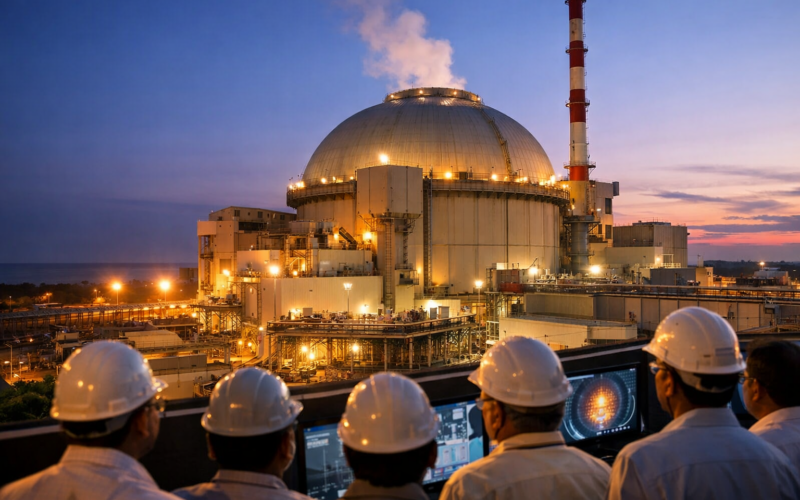
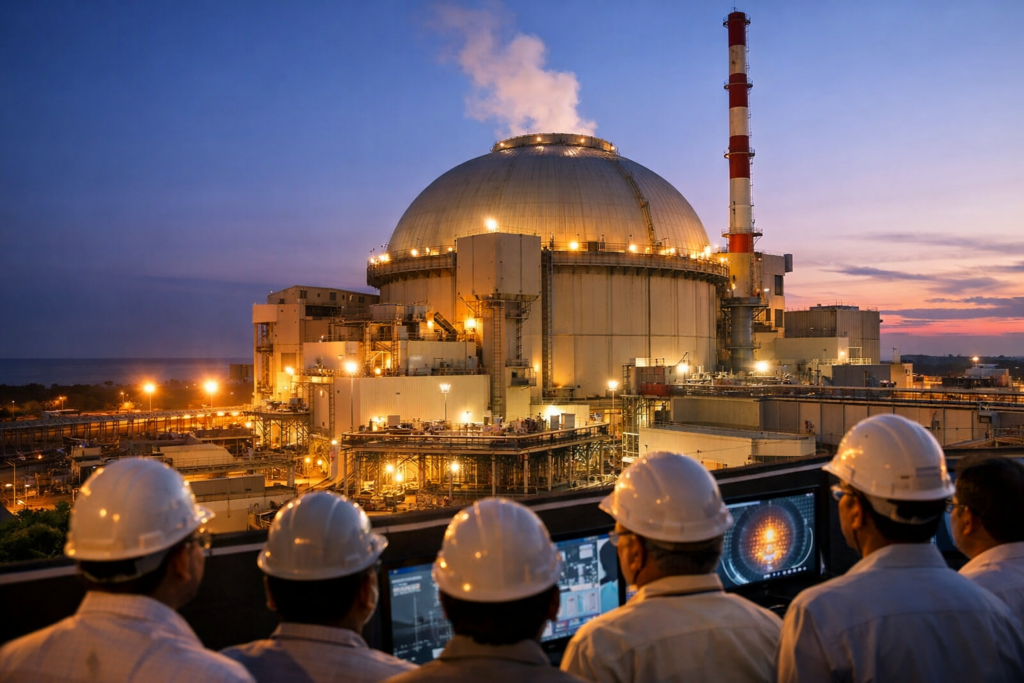
India’s Prototype Fast Breeder Reactor (PFBR) at Kalpakkam, Tamil Nadu achieved first criticality on 6 April 2026 at 8:25 PM, marking the start of a controlled fission chain reaction at the 500 MWe facility. The milestone, cleared by the Atomic Energy Regulatory Board after a rigorous safety review, was overseen by senior officials from the Department of Atomic Energy, Indira Gandhi Centre for Atomic Research (IGCAR), and Bharatiya Nabhikiya Vidyut Nigam Limited (BHAVINI). The achievement is the most significant step forward in India’s indigenous nuclear programme in decades and directly advances the country’s long-term strategy of energy self-sufficiency built around its vast thorium reserves.
How does India’s three-stage nuclear programme work and where does the PFBR fit?
India’s nuclear energy doctrine, conceived in the 1950s by Homi Bhabha, is structured across three sequential stages, each feeding the next. The first stage, already mature, relies on pressurized heavy water reactors fuelled by natural uranium. The second stage, now entering its operational phase with the PFBR, deploys fast breeder reactors that use Uranium-Plutonium Mixed Oxide fuel and generate more fissile material than they consume. The third stage, still in development, will use Uranium-233 derived from thorium as its primary fuel, unlocking energy from a resource India holds in extraordinary abundance.
The PFBR is the physical bridge between stages two and three. Its core is surrounded by a blanket of Uranium-238, which absorbs fast neutrons and converts into fissile Plutonium-239. That plutonium then feeds the reactor’s own fuel cycle. In a later configuration, Thorium-232 will replace Uranium-238 in the blanket, producing Uranium-233 through transmutation. The geometry of this design means India can progressively reduce its dependence on imported uranium while building toward a fuel cycle almost entirely anchored in domestically available thorium.
What makes fast breeder reactor technology strategically different from conventional nuclear generation?
Conventional thermal reactors use slow neutrons and consume fuel without regenerating it. Fast breeder reactors operate with high-energy neutrons and, under the right fuel cycle conditions, produce more fissile material than they consume. This breeding gain is the central economic and strategic justification for the technology: it dramatically extends the energy yield from a fixed uranium input and effectively multiplies the resource base available to the country.
For India, which holds approximately 25 percent of the world’s known thorium reserves but limited uranium, this is not an abstract advantage. It is a structural solution to a long-term resource constraint. The closed fuel cycle approach embedded in the PFBR design also allows nuclear materials to be recycled continuously, reducing both waste volumes and the accumulation of spent fuel liabilities that conventional reactors generate.
The liquid sodium coolant system used in the PFBR is another technical distinguishing factor. Sodium offers superior heat transfer properties compared to water, enabling higher operating temperatures and greater thermal efficiency. It is, however, chemically reactive with both air and water, demanding precision engineering and operational discipline at every system interface. The fact that IGCAR designed this system indigenously and BHAVINI built and commissioned it without significant foreign construction support is a material indicator of the depth of India’s nuclear engineering capability.
What is the significance of indigenous design and domestic execution at this scale?
The PFBR was designed entirely by IGCAR, a research and development institution under the Department of Atomic Energy, and built by BHAVINI, a public sector undertaking established specifically to execute the fast breeder programme. The reactor incorporates advanced safety systems, sodium coolant handling infrastructure, and a closed fuel cycle architecture, all developed and fabricated predominantly within India.
This matters beyond national sentiment. Indigenous capability in fast breeder technology means India retains full design authority over future reactor variants, controls intellectual property in the fuel cycle, and is not exposed to technology denial risks that have historically complicated its access to civilian nuclear infrastructure. The knowledge base built through the PFBR programme, covering reactor physics, advanced materials, large-scale sodium handling, and precision fabrication, will directly inform the design of follow-on commercial fast reactors.
The Department of Atomic Energy has indicated that multiple additional fast breeder reactors are planned. The PFBR’s successful criticality provides the empirical operational baseline those designs will need, and the industrial supply chain developed for Kalpakkam now has a proven reference project to build from.
What are the execution and operational risks as the PFBR moves toward power generation?
First criticality is a necessary but early milestone. The reactor has demonstrated a controlled fission chain reaction, but the path to full commercial power output involves progressive power ascension testing, sodium system performance validation at load, fuel cycle integration, and extended operational data collection before the plant can be declared commercially operational.
Fast breeder reactors have a complicated global track record. France’s Superphénix and Russia’s BN-600 demonstrated the technology’s feasibility but also exposed the operational sensitivities of sodium-cooled systems at scale. Japan’s Monju program was effectively terminated after a sodium leak incident in 1995 and subsequent regulatory and political complications. Russia’s BN-800, commissioned in 2016, remains the most directly comparable operational reference point globally, and even that program experienced extended commissioning timelines.
India’s PFBR has been in development for significantly longer than originally projected, with first criticality delayed by multiple years across different phases of design revision, regulatory review, and construction. That history is worth acknowledging not as failure but as evidence that the technical demands of the program were genuinely difficult and that regulatory rigor was maintained rather than bypassed.
The AERB clearance, issued after what the Department of Atomic Energy describes as a rigorous review of plant system safety, is the formal signal that the regulator is satisfied with the reactor’s readiness for controlled operation. The quality and independence of that clearance process will be important context as the plant moves toward higher power levels.
How does the PFBR milestone affect India’s clean energy and baseload strategy?
India’s electricity demand is growing at a rate that makes diversification of baseload supply a pressing operational necessity, not a strategic preference. Renewable generation, dominated by solar and wind, is expanding rapidly but cannot reliably cover baseload requirements without storage infrastructure that remains expensive and immature at scale. Nuclear power, operating at high capacity factors with low carbon output, fills the baseload gap that renewables currently cannot.
The PFBR at full commercial output would contribute 500 megawatts of electrical capacity to the grid, a modest number in the context of India’s total generation mix but a significant proof point for the technology. The more consequential contribution is the signal it sends to future capacity planning. If the PFBR performs reliably across its initial operational years, the case for accelerated deployment of subsequent fast reactors becomes substantially easier to make in policy, regulatory, and financing terms.
India’s nuclear capacity currently stands at approximately 7,500 megawatts, a small fraction of total installed generation. The government has stated ambitions to expand nuclear capacity significantly by 2047, the centenary target year for the Viksit Bharat development agenda. Fast breeder reactors, particularly if they can demonstrate commercial-scale reliability, are central to any credible pathway toward that expansion.
Key takeaways on what PFBR first criticality means for India’s energy future, nuclear sector, and strategic position
- India’s PFBR becoming critical on 6 April 2026 is the most consequential milestone in the country’s nuclear programme since the commissioning of its first pressurized heavy water reactors, directly activating stage two of the three-stage nuclear doctrine.
- The breeding capability of fast reactors allows India to multiply its effective nuclear fuel resource base, reducing structural dependence on imported uranium and preparing the fuel cycle for eventual thorium-based generation.
- Full indigenous design and construction by IGCAR and BHAVINI strengthens India’s nuclear technology sovereignty and eliminates technology denial exposure for future reactor programs.
- The closed fuel cycle architecture reduces long-term waste accumulation and enables continuous recycling of fissile material, improving the economic and environmental sustainability of the nuclear program.
- First criticality is a regulatory and technical threshold, not commercial operation. Power ascension testing and long-term sodium system performance will determine how quickly the PFBR transitions to grid contribution.
- Global fast breeder experience, including France, Japan, and Russia, indicates that the technology is viable but operationally demanding. India’s program must now demonstrate reliability at sustained load, not just controlled criticality.
- The industrial and knowledge infrastructure built for the PFBR directly supports the design and procurement pipeline for follow-on commercial fast reactors, which are essential to India’s 2047 nuclear expansion targets.
- For India’s baseload power strategy, a commercially operational PFBR strengthens the argument for accelerated nuclear investment as the most credible complement to intermittent renewable generation.
- The program’s success reinforces the depth and self-sufficiency of India’s nuclear engineering ecosystem, with implications for export diplomacy, strategic partnerships, and civilian nuclear cooperation agreements.
- BHAVINI’s role as executing agency positions it as a primary vehicle for future fast reactor construction, and the Kalpakkam project now serves as the reference plant for all subsequent capacity additions in the fast breeder segment.
Discover more from Business-News-Today.com
Subscribe to get the latest posts sent to your email.