




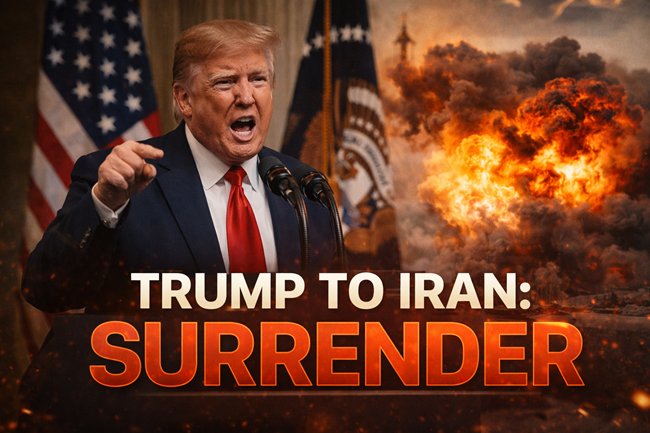
United States President Donald Trump issued an ultimatum to Iran on Monday, April 7, 2026, warning of a four-hour military campaign to destroy every bridge and power plant inside the country unless Tehran agreed to terms acceptable to the United States by 8 p.m. Eastern Time on Tuesday. Speaking at a White House press briefing alongside senior defence and intelligence officials, Trump said the entire country could be “taken out in one night, and that night might be tomorrow night.”
Trump told reporters the United States possessed a military plan under which every bridge and power plant in Iran would be targeted within four hours if the deadline passed without a deal. He said “very little is off limits” for the United States to target if Iran did not relent, and declined to specify what would not be struck. The president framed the ultimatum around the reopening of the Strait of Hormuz, the waterway connecting the Persian Gulf to the Arabian Sea, through which more than 20 percent of the world’s traded oil and liquefied natural gas ordinarily passes. Trump said any deal with Iran would need to guarantee “free traffic of oil” through the strait.
The press conference had initially been convened to present details of the rescue of two United States Air Force crew members whose F-15 fighter jet had been shot down over Iran. Defense Secretary Pete Hegseth, Central Intelligence Agency Director John Ratcliffe, and General Dan Caine, the chairman of the Joint Chiefs of Staff, appeared alongside Trump and provided an account of the rescue operation. Trump said the recovery of the weapons systems officer had involved well over 100 aircraft, including four bombers, 64 fighters, 48 refueling tankers, and 13 rescue aircraft. He acknowledged that some military officers had advised against attempting a rescue inside Iran, and said he understood those reservations but chose to proceed. General Dan Caine noted that an A-10 Warthog aircraft was also downed during the operation, with the pilot eventually ejecting over friendly territory after determining the aircraft was not landable.
What is the 45-day ceasefire proposal submitted by Pakistan, Egypt, and Turkey, and why did Iran reject it?
A draft ceasefire framework drawn up by Egyptian, Pakistani, and Turkish mediators emerged from intensive overnight diplomatic contacts and was submitted to both Iran and the United States late on Sunday night. The proposal called for an immediate halt to hostilities and the reopening of the Strait of Hormuz, followed by negotiations on a broader permanent settlement to be concluded within 15 to 20 days. The 45-day window was intended to provide time for direct talks aimed at a permanent end to the conflict.
Pakistan’s army chief, Field Marshal Asim Munir, was in contact throughout Sunday night with United States Vice President JD Vance, United States special envoy Steve Witkoff, and Iranian Foreign Minister Abbas Araghchi. The proposal was transmitted by Pakistan to both parties, with mediators describing it as a last-ditch effort to prevent a major escalation ahead of Trump’s deadline.
Iran rejected the proposal on Monday, stating through Pakistani intermediaries that any temporary ceasefire was unacceptable and citing prior experiences with the United States. In a 10-point response conveyed through Pakistan, Iran demanded the lifting of Western sanctions, reparations for reconstruction, and protocols to ensure safe passage through the Strait of Hormuz. Iran’s Foreign Ministry spokesperson Esmaeil Baghaei said Tehran regarded negotiations as incompatible with ultimatums and threats. Iran said it would not reopen the Strait of Hormuz as part of a temporary arrangement and would not be pressured into accepting deadlines.
A White House official described the 45-day ceasefire framework as “one of many ideas” being considered, and confirmed that Trump had not signed off on the proposal. At the White House Easter Egg Roll earlier on Monday, Trump said Iran’s latest offer was “a significant step” but “not good enough,” adding that “the only one that’s going to set a ceasefire is me.”
Why is the Strait of Hormuz the central demand in the United States-Iran war negotiations?
The Strait of Hormuz, the narrow waterway between the Islamic Republic of Iran and the Sultanate of Oman, has been under a de facto Iranian blockade since the early weeks of the conflict that began on February 28, 2026. The strait is the world’s most critical maritime oil transit chokepoint, through which more than 20 percent of the world’s traded oil and liquefied natural gas flows. Iran’s parliament passed legislation to formally collect tolls on vessels transiting the waterway, though the route remains largely closed to shipping from countries Iran designates as hostile. The Islamic Revolutionary Guard Corps Navy has struck commercial vessels attempting to pass through the strait during the conflict.
The blockade has driven crude oil prices sharply higher. United States crude oil prices moved from approximately 112 dollars per barrel to approximately 114 dollars per barrel when Trump began speaking at Monday’s press conference, though prices eased slightly after the event. The disruption to global energy supplies has prompted mediation efforts not only from Pakistan, Egypt, and Turkey, but also from Qatar, Oman, and the United Arab Emirates, all of which are directly affected by instability in the strait.
Anwar Gargash, a senior policy adviser to the United Arab Emirates leadership, said any settlement must guarantee access through the Strait of Hormuz and warned that a deal failing to constrain Iran’s nuclear program and its missiles and drones would create conditions for a more dangerous and volatile regional environment. Separately, Aliakbar Velayati, an adviser to newly appointed Iranian Supreme Leader Mojtaba Khamenei, warned that Iran may also consider targeting the Bab al-Mandeb Strait, the waterway connecting the Red Sea, the Gulf of Aden, and the Arabian Sea to the Suez Canal, stating that Iran’s leadership viewed that corridor with the same strategic intensity as the Strait of Hormuz. Approximately 10 percent of global trade moves through the Red Sea route connected to the Bab al-Mandeb Strait.
How did Iran and international institutions respond to Trump’s threat to strike civilian infrastructure?
The Islamic Revolutionary Guard Corps rejected Trump’s threats as “baseless” and vowed to continue military operations. Iran warned of a “more severe and expansive” response if Trump followed through on his stated plan to strike power plants and bridges. Iran’s deputy foreign minister Kazem Gharibabadi said on social media that the threatened strikes would be contrary to the Geneva Conventions and would constitute an act of aggression under the United Nations Charter, adding that Trump’s statements created individual criminal responsibility before the International Criminal Court.
European Council President Antonio Costa said in a social media post that the Iranian civilian population was already the primary victim of the Iranian regime and would also be the primary victim of a widening of the military campaign. Costa called on Iran to immediately end its attacks against countries in the region and allow for the reestablishment of full freedom of navigation through the Strait of Hormuz, and stated that escalation would not achieve a ceasefire and that only negotiations would.
Iranian Foreign Minister Abbas Araghchi condemned Costa’s remarks as “disgraceful” for not referencing Israel’s role in the joint war against Iran.
What is the battlefield situation as Trump’s Tuesday deadline approaches?
The United States and Israel’s military campaign against Iran, which commenced on February 28, 2026 with joint strikes targeting Iranian nuclear facilities, Islamic Revolutionary Guard Corps military infrastructure, and leadership structures, has been underway for more than five weeks at the time of Trump’s Monday press conference. The intelligence chief of Iran’s Islamic Revolutionary Guard Corps, identified in reporting as Major General Majid Khademi, was among more than 25 people killed in a wave of United States and Israeli strikes on Iran on Monday. Iran’s newly appointed Supreme Leader Mojtaba Khamenei expressed condolences over the killing.
Strikes on Monday also targeted the South Pars natural gas field and a major Tehran university. Iran continued to retaliate with missile and drone attacks. Four people were killed by an Iranian missile attack in Israel, the Israeli military confirmed.
Iran’s total death toll from United States and Israeli strikes, according to Iran’s Health Ministry, exceeded 2,000 killed and 26,500 injured as of early April 2026, with victims ranging in age from eight months to 88 years old. The conflict has drawn in Lebanon, where the Israeli Defense Forces have conducted ground operations against Hezbollah, with more than 1,300 killed in Lebanon across fighters and civilians. The overall verified death toll across all fronts in the region has exceeded 4,500 killed.
Trump said Monday that he did not know whether the trajectory of the war was escalation or wind-down. “It depends what they do,” he told reporters, referring to the Iranian government.
The Department of War has indicated it may request a supplemental appropriations package of approximately 200 billion dollars from the United States Congress for the Iran operations. In a separate development, Trump unveiled a 2027 budget proposal calling for a 44 percent increase in military spending to 1.5 trillion dollars. Trump also expressed frustration that NATO allies had not joined the United States in military operations against Iran, describing their absence as “a mark on NATO that will never disappear.”
What did the proposed Islamabad Accord framework include and who was involved in its negotiation?
The ceasefire framework being referred to informally as the Islamabad Accord envisioned a two-phase process in which an immediate ceasefire would be followed by negotiations toward a permanent settlement to be concluded within 15 to 20 days, with final in-person talks held in Islamabad, Pakistan. The final agreement, under the framework, was expected to include Iranian commitments not to pursue nuclear weapons in exchange for sanctions relief and the release of Iranian frozen assets.
Pakistan, Egypt, and Turkey served as the primary architects of the draft proposal. Oman separately engaged with Iranian diplomats to discuss options for ensuring the smooth flow of passage through the Strait of Hormuz. Qatar’s prime minister Mohammed bin Abdulrahman bin Jassim Al-Thani held a series of phone calls with officials from India, Spain, and Norway, emphasizing the need for negotiations to ensure global energy security and regional stability.
Iran’s 10-point counteroffer, conveyed through Pakistan, included a protocol for safe passage through the Strait of Hormuz, reconstruction assistance, and the lifting of sanctions, according to translated reports from Iranian state media outlet IRNA. Iran’s foreign ministry separately said the United States had “destroyed the path to diplomacy” through the combination of military strikes and ultimatums.
Key takeaways on what this development means for Iran, the United States, regional mediators, and global energy markets
- United States President Donald Trump set a final deadline of 8 p.m. Eastern Time on Tuesday, April 7, 2026, for Iran to agree to a deal including the reopening of the Strait of Hormuz, threatening a four-hour military campaign to destroy every bridge and power plant in Iran if no agreement was reached.
- Iran rejected a 45-day ceasefire proposal submitted by Pakistani, Egyptian, and Turkish mediators, stating it would not reopen the Strait of Hormuz under a temporary arrangement and would only engage in negotiations aimed at a permanent end to the war, including sanctions relief and reconstruction reparations.
- Field Marshal Asim Munir of Pakistan maintained overnight contacts with United States Vice President JD Vance, special envoy Steve Witkoff, and Iranian Foreign Minister Abbas Araghchi as part of a last-ditch diplomatic effort, reflecting the urgency and multilateral character of the mediation effort.
- The Strait of Hormuz, through which more than 20 percent of global oil and liquefied natural gas flows, remains under a de facto Iranian blockade, with crude oil prices rising to approximately 114 dollars per barrel during Trump’s press conference; an Iranian adviser additionally threatened to target the Bab al-Mandeb Strait if strikes on Iranian infrastructure proceed.
- European Council President Antonio Costa warned that further escalation would primarily harm Iranian civilians and called on Iran to restore freedom of navigation; Iran’s death toll from United States and Israeli strikes has exceeded 2,000 killed and 26,500 injured, according to Iran’s Health Ministry, with the overall regional death toll exceeding 4,500.
Share this:
Discover more from Business-News-Today.com
Subscribe to get the latest posts sent to your email.