




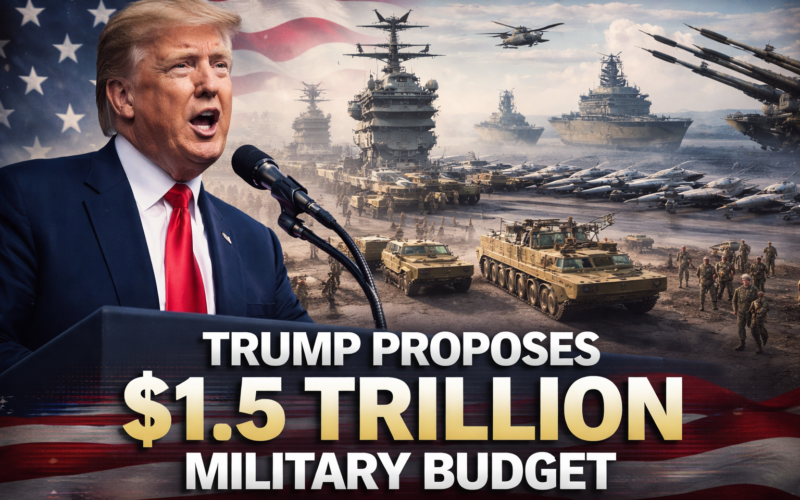
The White House released its fiscal year 2027 budget request on Friday, April 3, 2026, proposing approximately $1.5 trillion in defense spending — the largest military budget in United States history. The request represents a $445 billion increase over the fiscal year 2026 total defense allocation, equivalent to a 42 to 44 percent rise, and arrives as the United States remains in active military conflict with Iran, which began on February 28, 2026.
The proposal is structured around two distinct funding mechanisms. The first is a $1.15 trillion base budget submitted through the standard annual appropriations process, which would mark the first occasion in American history that base defense discretionary spending has crossed the $1 trillion threshold. The second is $350 billion designated to pass through the congressional budget reconciliation process, a legislative procedure that allows spending legislation to advance with a simple majority vote in the Senate, removing the requirement for bipartisan support.
Russell Vought, the director of the Office of Management and Budget, introduced the proposal stating that the budget builds on the president’s vision by continuing to constrain non-defense spending and reform the federal government. Vought characterised the spending as advancing what he described as President Donald Trump’s delivery of peace through strength by reinvesting in the foundations of American military power.
Why is the Trump administration requesting $1.5 trillion for defense in the fiscal year 2027 budget?
The budget request comes during a period of simultaneous domestic and international pressure on United States federal finances. The United States debt has passed $39 trillion, with annual deficits running at approximately $2 trillion. The scale of the proposed defense expansion has prompted analysts to note that the proposed non-defense cuts of $73 billion fall significantly short of offsetting the military buildup. The nonpartisan Committee for a Responsible Federal Budget projected the defense expansion could add more than $3.2 trillion to the national debt over the next decade.
The Trump administration separately requested $200 billion from Congress in emergency supplemental funding to support the ongoing conflict with Iran, a request distinct from the fiscal year 2027 budget. The active war has reinforced the administration’s framing of the defense increase as a national security imperative. Speaking at a private White House event on Wednesday before the budget’s release, President Trump stated the United States cannot address domestic programme spending while fighting active wars, and suggested programmes including Medicaid and Medicare transition to state-level administration.
What weapons systems and military programs does the fiscal year 2027 Pentagon budget prioritise for funding?
The combined base budget and reconciliation request allocates approximately $760 billion for weapons acquisition and development. The base budget alone includes approximately $260 billion for procurement and approximately $220 billion for research, development, testing, and evaluation. The reconciliation component would add around $280 billion to weapons accounts.
Shipbuilding receives $65.8 billion across both funding streams to construct 18 battle force ships and 16 non-battle force ships, directly supporting the administration’s stated objective of expanding the United States naval fleet. The F-35 Joint Strike Fighter program is funded for 85 aircraft: 38 F-35A conventional takeoff and landing variants, 10 F-35B short takeoff and vertical landing jets, and 37 F-35C carrier variant aircraft. Of the 85 aircraft, 32 are covered under the base budget and the remaining 53 are contingent on reconciliation approval.
The Golden Dome missile defense system, a signature Trump administration priority, would receive $17.5 billion in fiscal year 2027, though only $400 million of that sum is within the base budget. The remaining $17.1 billion is reliant on passage of the reconciliation bill. This follows $25 billion approved for Golden Dome in a previous reconciliation measure intended to be deployed in fiscal year 2026. The Department of Energy’s National Nuclear Security Administration would see a $3.5 billion funding increase for warhead development, warhead modernisation, and naval systems technology. Military personnel across all branches would receive pay increases of between 5 and 7 percent, which the administration stated is designed to support recruitment and retention.
What domestic and social programmes would face cuts to support the record United States defense expansion?
The fiscal year 2027 budget proposes a 10 percent reduction in non-defense discretionary spending, amounting to $73 billion in cuts. The Low Income Home Energy Assistance Program, a $4 billion safety net programme that Congress retained despite a similar elimination proposal in 2025, is again targeted for removal. The $775 million Community Services Block Grant is also proposed for elimination. The Department of Health and Human Services would face a $5 billion reduction to the National Institutes of Health, with several institutes at the department proposed for closure.
Clean energy programmes face the largest cuts among specific categories, with more than $15 billion in Department of Energy grants cancelled. Agriculture spending would be reduced by 19 percent. The Internal Revenue Service would lose an additional $1.4 billion, and $4.2 billion in subsidies for electric vehicle charging infrastructure would be eliminated. The Department of Education would continue on its stated path to elimination. The Federal Emergency Management Agency and the Cybersecurity and Infrastructure Security Agency, both components of the Department of Homeland Security, would also face budget reductions.
Federal law enforcement would receive a 15 percent increase, amounting to more than $19 billion in funding. Immigration and Customs Enforcement funding would be maintained at the fiscal year 2026 level, including $2.2 billion to sustain 41,500 immigration detention beds. The budget also proposes a $10 billion mandatory fund within the National Park Service for construction and beautification projects in and around Washington, DC.
How have Congress and independent fiscal analysts assessed the scale and structure of the $1.5 trillion defense request?
Congressional reaction has divided broadly along partisan lines. Republican defence hawks praised the record topline as a significant improvement over the fiscal year 2026 release, when several senior Republicans on defence committees criticised the White House for submitting a flat base budget. Senator Mitch McConnell, who chairs the Senate Appropriations defence subcommittee, welcomed what he described as significant growth in the defence topline while also cautioning that reconciliation funding cannot serve as a replacement for the regular annual appropriations process.
Democratic opposition was direct and immediate. Senator Patty Murray, the ranking Democrat on the Senate Appropriations Committee, stated that the defence budget should not be dictated by a president sending service members into what she characterised as reckless foreign wars, and questioned whether the Department of Defense could responsibly absorb an increase of this magnitude. Representative Betty McCollum, the ranking Democrat on the House Appropriations defence subcommittee, called the increase outrageous and unacceptable, and said she would not provide a blank check to the Pentagon, arguing the department’s challenge is one of efficient spending and financial accountability rather than inadequate funding.
Independent economists and fiscal analysts pointed to the structural implications of the proposal. The nonpartisan Committee for a Responsible Federal Budget projected the total defense expansion could add more than $3.2 trillion over the next decade. Federal Reserve Chair Jerome Powell, speaking earlier in the week at Harvard University, stated that the country must ensure its economy grows fast enough to keep pace with spending and warned that the current trajectory will not end well without corrective action.
The passage of the $350 billion reconciliation component depends on near-complete Republican unity in both chambers. Republicans hold slim majorities in both the Senate and the House of Representatives, and the White House does not have final authority over how Congress shapes the reconciliation legislation. The House and Senate are also navigating a separate, ongoing partial government shutdown — now in its 49th day — related to Department of Homeland Security funding, which has added further complexity to the path toward a final fiscal year 2027 budget.
The annual White House budget request does not carry the force of law. It functions as an expression of the administration’s legislative priorities and the starting point for negotiations with Congress, which retains constitutional authority over government spending. Congress has historically modified or declined to act on major portions of executive budget proposals.
Key takeaways on what the White House fiscal year 2027 defense budget request means for the United States government, military, and global security posture
- The White House has formally requested $1.5 trillion in defense spending for fiscal year 2027, the largest military budget proposal in United States history, structured as a $1.15 trillion base appropriation and $350 billion through the congressional budget reconciliation process.
- The $445 billion increase in total defense spending, representing a 42 to 44 percent rise over fiscal year 2026 levels, arrives as the United States is engaged in active military conflict with Iran, which began on February 28, 2026, and has now entered its fifth week.
- Key spending priorities within the request include $65.8 billion for shipbuilding, $17.5 billion for the Golden Dome missile defense system, 85 F-35 Joint Strike Fighter aircraft, and pay increases of 5 to 7 percent for all military personnel.
- The proposal simultaneously seeks a 10 percent cut to non-defense discretionary spending, targeting housing, health care, clean energy, agriculture, and social services programmes, with the nonpartisan Committee for a Responsible Federal Budget projecting the net defense expansion could add over $3.2 trillion to the national debt over the next decade.
- The reconciliation funding component requires near-complete Republican congressional unity to pass, and the White House does not hold final authority over how Congress shapes the reconciliation bill; the budget itself does not carry the force of law.
Discover more from Business-News-Today.com
Subscribe to get the latest posts sent to your email.