


Iran’s Islamic Revolutionary Guard Corps has made a series of public claims asserting that it struck the United States Navy’s Nimitz-class nuclear-powered supercarrier USS Abraham Lincoln during the ongoing West Asia conflict, declaring the vessel sustained significant damage and was forced to withdraw from its operational position in the Sea of Oman. The United States Central Command has rejected each Iranian assertion in categorical terms, confirming through official statements, imagery, and video documentation that the carrier has continued its combat flight operations without interruption in support of Operation Epic Fury.
The conflict that produced these claims began on 28 February 2026, when the United States and Israel launched coordinated surprise airstrikes on military sites, government facilities, and cities across Iran. The joint campaign, designated Operation Epic Fury by the United States Central Command, killed Iran’s Supreme Leader, Ayatollah Ali Khamenei, along with multiple senior Iranian military and intelligence officials, and caused civilian casualties. Iran responded with ballistic missile and drone attacks directed at Israel, United States military bases in Bahrain, Jordan, Kuwait, and other Gulf states, and United States-allied maritime traffic. Iran also moved to close the Strait of Hormuz to commercial vessels. The closure of that waterway, a critical maritime chokepoint through which an estimated 20 percent of global oil supply passes, has represented one of the most economically consequential elements of Iran’s retaliation strategy.
How did Iran claim to have struck the USS Abraham Lincoln and what evidence was offered for these assertions?
The first Iranian claim regarding the USS Abraham Lincoln emerged on 1 March 2026, the second day of Operation Epic Fury. The Islamic Revolutionary Guard Corps, in a statement disseminated by the Iranian state-linked media outlet Tasnim and attributed to an official IRGC public relations notice, asserted that its forces had targeted the carrier with four ballistic missiles as part of what the IRGC designated the ‘True Promise 4’ operation. No evidence of damage to the vessel or casualties was offered by Iranian authorities. The name ‘True Promise’ carries deliberate symbolic significance in Iranian military communications; Iran had used the same designation for retaliatory strike operations against Israel in 2024.
The United States Central Command rejected the claim immediately. In a statement posted to the social media platform X on 1 March 2026, the United States Central Command stated that the USS Abraham Lincoln was not hit and that no Iranian missiles came close to striking the vessel. The United States Central Command confirmed that the carrier was continuing to launch aircraft in direct support of the campaign against Iranian military infrastructure. Fact-checkers subsequently determined that a video circulated widely on social media, attributed to Iranian accounts and purportedly showing the USS Abraham Lincoln on fire after being struck by Iranian missiles, was fabricated. The video had originally appeared on 23 June 2025 during the separate Iran-Israel Twelve-Day War and appeared to have been generated using the Arma 3 commercial military simulation game. The Defence Visual Information Distribution Service and the United States Central Command published verified imagery and video of the carrier strike group continuing its operations on the same day the claim was made.
What were the subsequent Iranian claims about drone attacks on the USS Abraham Lincoln near the Strait of Hormuz?
A second and more elaborate set of Iranian claims followed on or around 5 and 6 March 2026. A spokesperson for the Islamic Revolutionary Guard Corps’ Khatam al-Anbiya Central Headquarters stated, in an account carried by the Tehran Times, that Islamic Revolutionary Guard Corps naval drone units had struck the USS Abraham Lincoln in the Sea of Oman after the carrier had approached to within approximately 340 kilometres of Iran’s territorial waters near the Strait of Hormuz. The spokesperson stated that the carrier and its escort destroyers had retreated from the engagement zone at high speed, withdrawing more than 1,000 kilometres from the area. The Islamic Revolutionary Guard Corps framed the incident as evidence that the United States had failed to establish control over the strategically critical Strait of Hormuz.
No independent verification of this claim was possible. The United States Central Command again rejected the assertion. Two officials who spoke to CBS News on condition of anonymity provided a different account of events during this period, describing a confrontation in which a United States Navy vessel engaged an Iranian ship that had closed within unsafe proximity to the USS Abraham Lincoln. According to those officials, an attempt to engage the Iranian vessel using a 5-inch, 54-calibre Mark-45 naval gun mounted aboard a destroyer proved unsuccessful. A United States Navy helicopter armed with Hellfire missiles was subsequently launched and struck the Iranian vessel with two missiles. The United States Central Command simultaneously published imagery confirming the Abraham Lincoln carrier strike group was continuing its operational activities.
Further Iranian claims of damage to the USS Abraham Lincoln followed in subsequent weeks. Iran’s army spokesperson Abolfazl Shekarchi stated in a televised interview that a combined missile and drone attack had rendered the nuclear-powered vessel out of operational service and forced a withdrawal from the Sea of Oman. Shekarchi did not present evidence for this claim. The United States military rejected the assertion on each occasion it was made.
Why has the USS Abraham Lincoln been a focal point of the Iran-United States naval confrontation in the Sea of Oman and Arabian Sea?
The USS Abraham Lincoln, hull number CVN-72, is a Nimitz-class nuclear-powered aircraft carrier and the lead vessel of Carrier Strike Group 3. The carrier is accompanied by Carrier Air Wing 9 and guided-missile destroyers of Destroyer Squadron 21, including the USS Spruance and the USS Michael Murphy. Each carrier strike group includes warships equipped with the Aegis integrated air and missile defence combat system, along with vertical launch systems capable of firing Tomahawk land-attack cruise missiles with a range exceeding 1,500 kilometres.
The USS Abraham Lincoln was deployed to the broader Gulf of Oman and Arabian Sea region as part of the United States military buildup in West Asia that intensified from January 2026. The carrier conducted a documented incident on 3 February 2026 in which an F-35C Lightning II launched from its flight deck intercepted and destroyed an Iranian drone that had aggressively approached the vessel while it was transiting the Arabian Sea approximately 800 kilometres from Iran’s southern coast. In a separate incident hours later, two Islamic Revolutionary Guard Corps fast boats accompanied by an Iranian Mohajer unmanned aerial vehicle approached a United States-flagged commercial tanker, the Stena Imperative, in the Strait of Hormuz, threatening to board and seize the vessel. The guided-missile destroyer USS McFaul responded and escorted the tanker, with the situation de-escalating after United States Air Force defensive air support was also deployed.
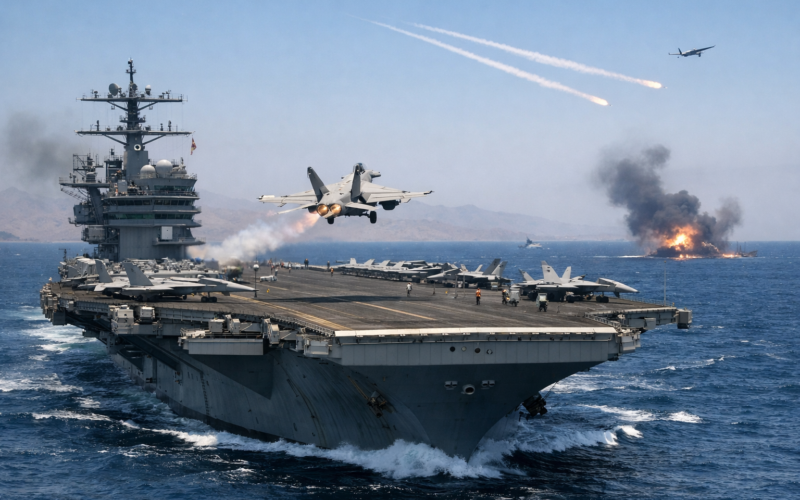
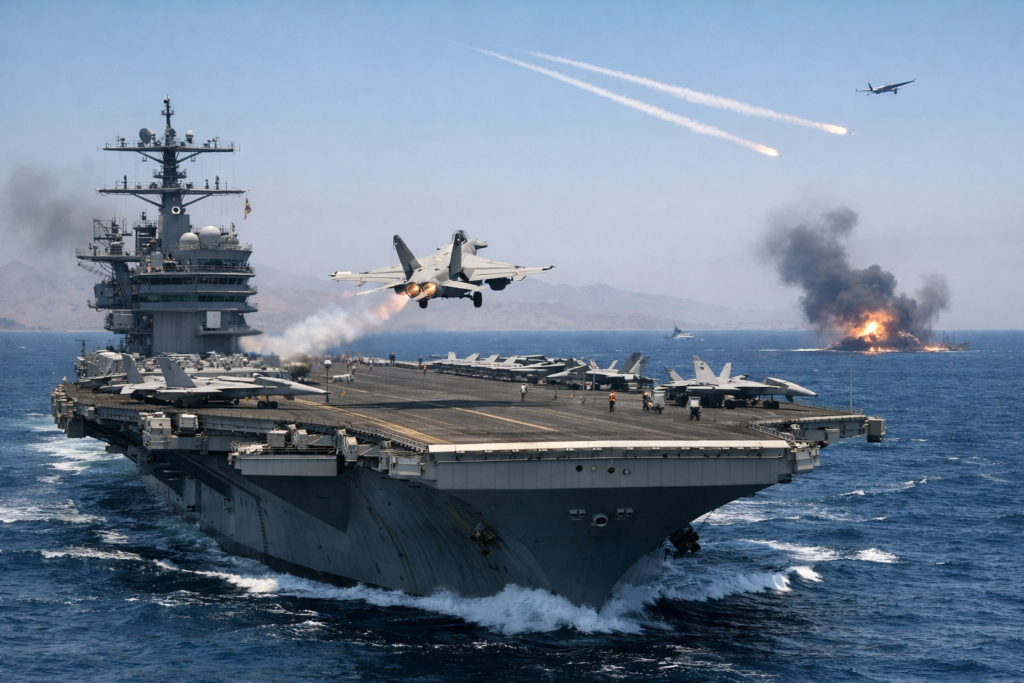
The USS Abraham Lincoln’s continued operational status across multiple weeks of Iranian claims has been documented through official United States military releases. Video footage published by the Defence Visual Information Distribution Service on 31 March 2026 showed the carrier launching F/A-18E Super Hornets in support of active combat operations under Operation Epic Fury. As of 1 April 2026, the USS Abraham Lincoln was confirmed as the only United States carrier actively launching daily combat sorties against Iranian targets.
How has the United States carrier deployment in West Asia evolved as Iranian claims about the USS Abraham Lincoln continued to mount?
The USS Gerald R. Ford, the United States Navy’s lead ship of the Gerald R. Ford class and the flagship carrier of Carrier Strike Group 12, had been conducting operations in the region alongside the USS Abraham Lincoln since the commencement of Operation Epic Fury. The USS Gerald R. Ford was subsequently directed to undergo repair work in Croatia after a fire broke out in a laundry compartment aboard the vessel during combat operations. The United States Navy’s Chief of Naval Operations indicated the Ford would return to mission readiness following completion of its repairs.
To address the temporary reduction in carrier capacity, the United States Department of Defense announced on 31 March 2026 the departure of the USS George H.W. Bush, hull number CVN-77 and the tenth and final Nimitz-class carrier, from Naval Station Norfolk in Virginia toward the Middle East. Secretary of Defense Pete Hegseth confirmed the deployment publicly. The USS George H.W. Bush had completed the United States Navy’s Composite Training Unit Exercise certification, the final qualification required before a major operational deployment, prior to its departure. The arrival of the George H.W. Bush would give the United States the capacity to sustain two to three aircraft carrier strike groups within operational reach of the combat zone simultaneously, enabling continuous strike coverage while the Ford completes its repair cycle.
What are the strategic implications of Iran’s pattern of unverified claims about striking United States naval assets in the Sea of Oman?
The repeated pattern of Iranian claims regarding the USS Abraham Lincoln reflects an established element of Iranian public information operations during the West Asia conflict. Iran’s declared ambition to strike a United States supercarrier had been telegraphed publicly before the conflict began. The late Supreme Leader Ayatollah Ali Khamenei made a statement on X in February 2026 asserting that Iran possessed weapons capable of sending a United States warship to the bottom of the sea. That statement came as the United States and Iran were simultaneously engaged in indirect nuclear negotiations in Oman and Geneva, negotiations that collapsed when Operation Epic Fury commenced on 28 February 2026.
Defence analysis and United States military doctrine consistently assess that sinking a Nimitz-class or Gerald R. Ford-class supercarrier would represent an exceptionally difficult military task. Iranian naval doctrine emphasises asymmetric tactics including drone swarm operations, coastal missile batteries, naval mines, and fast-attack craft designed to challenge United States naval forces in the confined waters of the Persian Gulf and adjacent seas. The United States Navy’s experience conducting sustained anti-drone operations during its earlier campaign against Houthi forces in Yemen has informed its defensive posture in the current conflict. United States analysts assess that the greater strategic risk lies not with the carriers themselves but with less-defended escort vessels.
United States President Donald Trump stated on 1 April 2026 that the intense phase of combat operations under Operation Epic Fury was nearing its conclusion and indicated United States forces could withdraw from the region within two to three weeks, though he specified no formal peace agreement with Iran was required before any withdrawal. United States Secretary of State Marco Rubio characterised Iran’s closure of the Strait of Hormuz and attacks on commercial shipping as illegal acts and called on allied nations to take a direct stake in pressing for resolution. Discussions on a potential ceasefire arrangement were reported by Axios, with sources describing a possible deal in which Iran would reopen the Strait of Hormuz in exchange for a halt to United States military operations.
Iran’s newly installed interim leadership council, which began functioning on 1 March 2026 following the death of Ayatollah Khamenei under the provisions of Article 111 of the Iranian constitution, continued to oversee retaliatory military operations and diplomatic signalling simultaneously. Iran’s President Masoud Pezeshkian published an open letter addressed to the people of the United States on 1 April 2026, leaving the door open to diplomatic engagement. The letter represented the first formal direct public outreach from Iranian leadership to American civil society since the commencement of Operation Epic Fury.
Key takeaways on what this development means for the United States, Iran, and global maritime security
- Iran’s Islamic Revolutionary Guard Corps made multiple unverified claims across March 2026 asserting it had struck the USS Abraham Lincoln with ballistic missiles and naval drones, each of which was categorically rejected by the United States Central Command, which confirmed the carrier continued daily combat operations under Operation Epic Fury throughout the period.
- The United States Central Command documented a counter-incident in which a United States Navy helicopter struck an Iranian vessel that had approached the USS Abraham Lincoln at unsafe proximity during one of the periods when Iranian claims of a carrier strike were being publicly made, a detail not captured in Iranian accounts.
- The USS Gerald R. Ford was temporarily taken out of active operations for repair work in Croatia after a fire during combat, reducing the United States to a single combat-active carrier strike group during part of the conflict, a gap being addressed by the deployment of the USS George H.W. Bush from Naval Station Norfolk on 31 March 2026.
- The pattern of Iranian claims about striking United States supercarriers without evidence, combined with United States Central Command denials supported by official imagery and operational video, has reinforced a sustained information operations dimension to the West Asia conflict that runs parallel to the active military campaign.
- Ceasefire discussions between United States and Iranian representatives, as reported by Axios, centred on a possible exchange involving Iran’s reopening of the Strait of Hormuz, underscoring the waterway’s centrality to both the conflict’s strategic logic and any eventual resolution.
Discover more from Business-News-Today.com
Subscribe to get the latest posts sent to your email.