



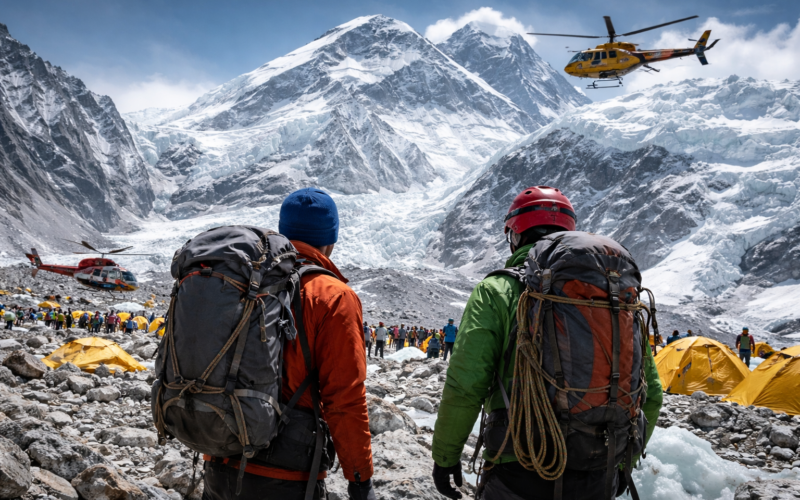
Nepalese authorities have filed a case against 32 individuals in connection with an alleged insurance fraud scheme tied to Mount Everest and other Himalayan trekking routes, with investigators accusing parts of the rescue, trekking, and medical ecosystem of staging or fabricating emergencies to extract millions of dollars from international insurers. Court records and police findings say the case involves fake helicopter rescues, forged flight and treatment documents, and in some instances allegations that trekkers were deliberately made ill to justify costly evacuations.
The case sits at the intersection of tourism governance, insurance oversight, aviation regulation, and Nepal’s international reputation as the world’s premier high-altitude trekking destination. According to The Kathmandu Post and the Organized Crime and Corruption Reporting Project, the Kathmandu District Court is now handling charges that arose from a lengthy Central Investigation Bureau investigation, while The Associated Press separately reported that Nepal police had earlier arrested six travel and mountain rescue executives as the wider probe gathered pace.
Why has Nepal booked 32 people in the Mount Everest rescue fraud investigation?
The immediate legal trigger is a charge sheet filed in Kathmandu that accuses a network of helicopter companies, hospitals, trekking companies, insurance-linked actors, and field guides of collaborating to create false or exaggerated rescue scenarios involving foreign trekkers and climbers. The Kathmandu Post reported that Nepal’s Central Investigation Bureau had originally recommended prosecution of 33 individuals in a 1,243-page report, but the final case filed before the Kathmandu District Court named 32.
According to that reporting, the charge sheet describes a structure in which rescue flights were mislabeled, passenger and cargo manifests were falsified, treatment records were allegedly fabricated, and foreign tourists with relatively minor health complaints were presented as needing urgent air evacuation. The Organized Crime and Corruption Reporting Project said authorities filed organized crime and fraud charges and that nine suspects were produced in court while 23 others remained at large when the case moved forward.
The Associated Press reported earlier in the investigation that Nepal police accused the network of sending fake passenger manifests, hospital reports, and medical invoices to insurers, and said the alleged false claims covered the period from 2022 to 2025. That timeline matters because it suggests the activity was not a one-off abuse of the rescue system but, according to investigators, an organized pattern that persisted over multiple trekking and climbing seasons.
How did investigators say fake Everest rescues and hospital claims were carried out?
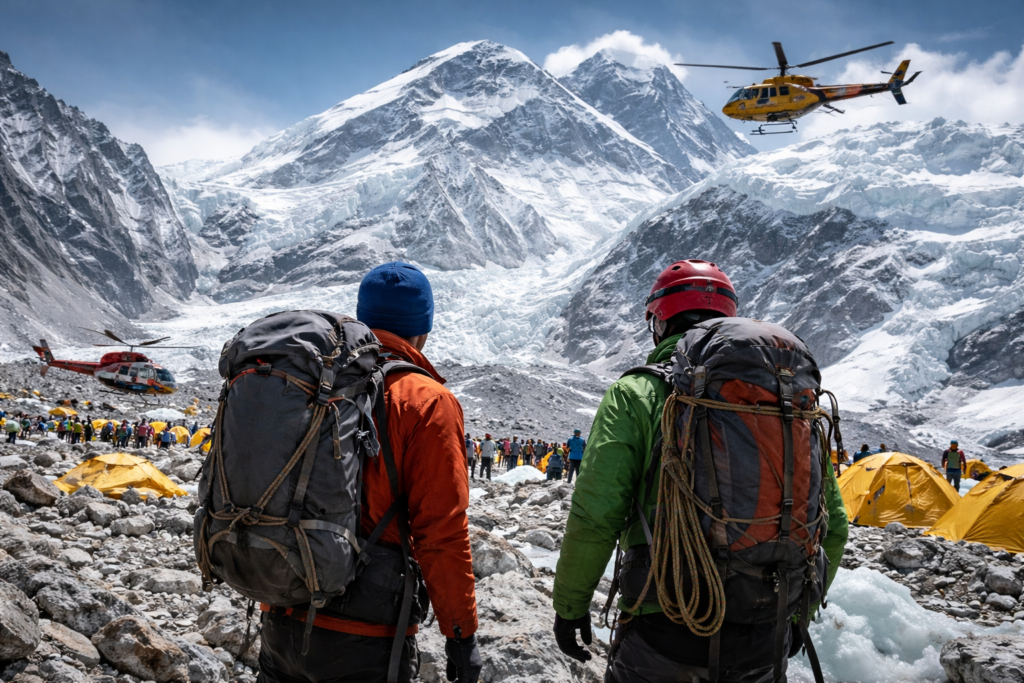
Investigators say the suspected fraud worked because high-altitude rescue in Nepal occupies a grey zone where real emergencies are common, helicopter access is expensive, and quick judgment calls are often made far from formal oversight. The Associated Press noted that many climbers and trekkers in Nepal operate in areas with limited roads and restricted medical infrastructure, which makes helicopter evacuation both plausible and difficult to audit in real time.
Within that environment, police alleged that some companies created or inflated medical crises, then paired the evacuation with forged or manipulated documentation so international insurers would reimburse large sums. The Kathmandu Post said the charge sheet accused Sandip Bhandari of Mountain Helicopters of forging passenger and cargo manifests to falsely show that chartered passengers were rescue cases. It also reported that doctors and hospital operators were charged for allegedly fabricating treatment records.
The Organized Crime and Corruption Reporting Project reported an even darker allegation: that some trekkers were secretly fed baking soda to induce gastrointestinal distress that could resemble altitude sickness or food poisoning, thereby making helicopter evacuation appear medically necessary. That allegation has made the story travel globally because it shifts the case from administrative fraud into an alleged betrayal of the core duty of care expected in expedition tourism.
Which companies and institutions were named in Nepal’s Everest insurance fraud case?
The Kathmandu Post reported that the police investigation pointed to collusion among three helicopter companies, three hospitals, more than a dozen trekking companies, insurance agents, and trekking guides. The helicopter companies identified in that reporting were Mountain Helicopters, Manang Air, now known as Basecamp Helicopter, and Altitude Air.
The same report named several medical actors and hospital-linked individuals, including doctors and operators associated with Swacon International Hospital, Shreedhi International Hospital, and Era International Hospital. The significance here is institutional rather than merely personal. This is not being framed by investigators as an isolated guide-level scam on a remote trail. It is being presented as a coordinated, multi-node operation spanning aviation, hospitality, trekking logistics, and medical billing.
The Organized Crime and Corruption Reporting Project also identified Mountain Rescue Service, Nepal Charter Service, and Everest Experience and Assistance as key entities in the alleged insurance extraction system. The Associated Press independently supported the broad pattern by reporting that three separate rescue operators were accused of filing false claims worth nearly $20 million in total.
How large was the alleged Mount Everest insurance fraud and why does the amount matter?
According to police records cited by the Organized Crime and Corruption Reporting Project, the total suspected fraud reached about $19.69 million. That number is large enough to turn what might have looked like a niche tourism crime into a policy and reputational issue for Nepal’s wider travel economy. Prosecutors, according to the same report, are seeking total fines of about 1.51 billion Nepalese rupees, roughly $11.3 million, with penalties varying by offense.
The Associated Press reported that one operator was accused of 171 fake rescues out of 1,248 claimed rescues, leading to more than $10 million in unjustified payouts. Another was accused of fabricating 75 of 471 claimed rescues for roughly $8 million, while a third operator allegedly made 71 fake claims worth more than $1 million. Those numbers matter because they suggest the alleged fraud did not simply piggyback on genuine emergencies. Investigators say the rescue business itself became a revenue engine.
In governance terms, this turns the issue into more than criminal misconduct. It raises a question about whether insurance-backed mountain rescue in Nepal has been operating with structural weaknesses in verification, classification, billing, and inter-agency data matching. The Kathmandu Post reported, for example, that investigators cited conversations about avoiding the term “rescue” in data sought by the Civil Aviation Authority of Nepal and classifying such flights instead as charter operations.
Why does the Everest rescue fraud case matter for Nepal’s tourism credibility and institutions?
The case lands at a sensitive moment because Everest is not just a mountain. It is a symbol of Nepal’s tourism brand, foreign exchange potential, and international prestige. When a rescue system associated with Everest becomes linked to allegations of fake evacuations, falsified medical treatment, and deliberate harm to clients, the damage spreads well beyond one court file. It touches the trust architecture that supports permits, expedition logistics, insurance underwriting, and foreign visitor confidence.
The Organized Crime and Corruption Reporting Project reported that fraudulent rescue practices have been an open secret in Kathmandu for years and that some international insurers had already stopped offering coverage for trekking in Nepal because of repeated abuse. It also said that after media reporting in 2018, the Nepalese government formed a probe panel, but the findings were never made public and no disciplinary action followed against implicated companies.
That background makes the current case politically and institutionally significant. It suggests the present crackdown is not simply a reaction to a fresh scandal, but part of a delayed response to a long-running enforcement problem. In current affairs terms, this is why the story matters. It is about the credibility of state supervision over a globally visible tourism economy in which private operators, hospitals, aviation companies, and regulators all rely on mutual trust and cross-verifiable records.
What does the Kathmandu court case reveal about Nepal’s legal and regulatory response now?
The current legal process shows that Nepalese authorities are attempting to convert a complex tourism scandal into a formal organized-crime and fraud prosecution rather than treating it as isolated misconduct. The Organized Crime and Corruption Reporting Project cited a Kathmandu District Court spokesperson as saying the court was recording statements from the accused and giving high priority to what it described as a high-profile corruption case.
The Kathmandu Post’s reporting adds another important layer: investigators were dissatisfied that one prominent figure originally recommended for prosecution was left out of the final case because the government attorney’s office said the available evidence did not yet establish involvement or financial benefit. That detail matters because it shows the case is already testing the line between broad police suspicion and the narrower evidentiary standards required for prosecution.
In practical terms, the next institutional test will be whether Nepal can pair criminal prosecution with durable regulatory fixes. The Associated Press has already highlighted the system’s underlying vulnerability: climbers need helicopter rescue insurance before permits are issued, while rescues occur in places where independent verification is hard. That means any lasting response will likely depend not only on convictions but on better audit trails, flight classification rules, hospital documentation controls, and insurer access to reliable rescue data. That final point is an inference drawn from the pattern described by investigators and reporters, rather than a stated government reform package.
What does the Mount Everest insurance fraud case mean for Nepal, global insurers, and Himalayan tourism?
- Nepal’s Everest-linked rescue fraud case has moved from rumor and media investigation into a formal court process, with 32 people booked and multiple sectors named by investigators.
- The alleged scheme involved not only trekking guides but also helicopter operators, rescue firms, hospitals, and medical documentation, making it a broader institutional integrity issue.
- Police records cited by multiple reports place the suspected fraud at about $19.69 million between 2022 and 2025, showing the scale was large enough to affect international insurer confidence.
- The case matters globally because Mount Everest is central to Nepal’s international tourism image, and allegations of fake rescues and induced illness can undermine trust in high-altitude expedition safety systems.
- The legal proceedings now underway will test whether Nepal can convert a high-profile fraud probe into a wider regulatory clean-up across aviation, rescue, and hospital billing systems.
Discover more from Business-News-Today.com
Subscribe to get the latest posts sent to your email.