



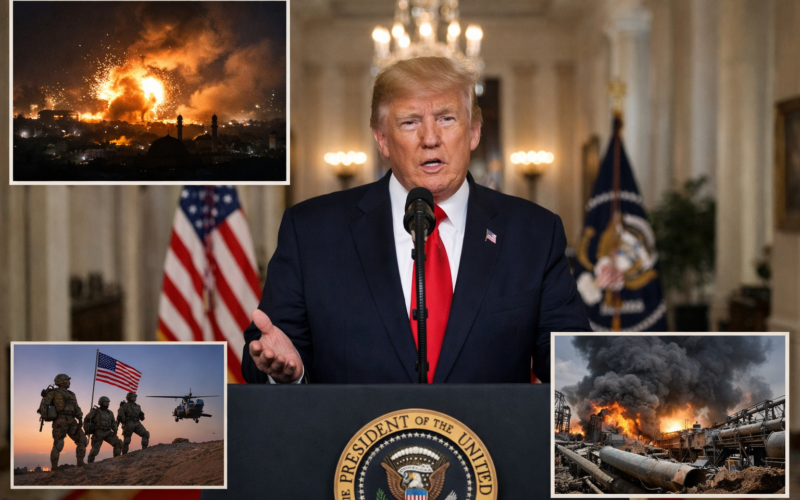
President Donald Trump delivered his first prime-time address to the United States nation since the launch of Operation Epic Fury, speaking for approximately 19 minutes from the Cross Hall of the White House on the evening of April 1, 2026. The address came as the joint United States-Israeli military campaign against Iran entered its fifth week, generating mounting domestic pressure over surging energy costs, a de facto blockade of the Strait of Hormuz, and a rapidly shifting diplomatic landscape across Europe, the Middle East, and Asia.
Trump told the nation that United States armed forces had delivered swift, decisive, and overwhelming victories on the battlefield in the four weeks since the operation began, calling such victories like few people had ever seen before. He declared that Iran had been essentially decimated across military, economic, and institutional dimensions, citing the destruction of the country’s navy, air force, and command and control infrastructure within the Islamic Revolutionary Guard Corps. Trump stated that Iran’s navy was gone, its air force was in ruins, and that the command and control of the Islamic Revolutionary Guard Corps was being decimated as he spoke, with Iran’s ability to launch missiles and drones dramatically curtailed and its weapons factories and rocket launchers being destroyed.
Despite those sweeping declarations, Trump confirmed that hostilities were not over and would intensify before any potential conclusion. He said the United States would hit Iran extremely hard over the next two to three weeks and warned that if no deal was reached in that timeframe, the administration had its eyes on key targets. He threatened to obliterate all of Iran’s electric generating plants and to strike its oil infrastructure if Iranian leaders did not enter into an agreement, warning that such strikes could happen simultaneously. The combination of declared success and threatened escalation reflected a pattern that had defined the administration’s public posture throughout the duration of the conflict.
Since the war began, the Trump administration had given shifting explanations of its goals. Trump’s descriptions of diplomatic negotiations had frequently been contradicted by Iranian officials. The president had alternated between threatening to ramp up attacks on civilian infrastructure and asserting that the war was essentially won and the United States would leave the region shortly.
How Operation Epic Fury began and what it has achieved across five weeks of fighting
President Trump announced major combat operations against Iran on February 28, 2026, with massive joint United States-Israeli strikes targeting military and government sites. Ayatollah Ali Khamenei, Iran’s supreme leader, was among those killed in Tehran on the first day of strikes, with his son Mojtaba Khamenei subsequently chosen to succeed him. The stated objectives of the operation, as consistently articulated by senior administration officials across multiple briefings and public statements, were to obliterate Iran’s ballistic missile arsenal and production capability, annihilate its navy, sever its support for militant proxy groups across the Middle East, and ensure Iran could never acquire a nuclear weapon.
Iran responded with missile and drone attacks targeting Israel, regional United States military bases, and multiple Gulf nations, and began attempting to block commercial shipping traffic through the Strait of Hormuz. Israel simultaneously intensified its ongoing strike campaign against Hezbollah in Lebanon and expanded ground operations in the south of that country. The conflict rapidly became the most significant disruption to oil supply flows through the Strait of Hormuz in modern history, with the waterway ordinarily carrying approximately one-fifth of the world’s oil and liquified natural gas supply each day.
Thirteen United States service members had been killed since Operation Epic Fury began, and 348 had been wounded, according to United States Central Command. The majority of the wounded had returned to duty. The total death toll across the Middle East from the conflict exceeded 3,000 people. In Iran, United States and Israeli strikes had killed more than 1,900 people, according to the country’s deputy health minister. At least 1,200 people had been killed in Lebanon, and 19 had died in Israel.
Why Trump’s claims about the Strait of Hormuz reopening naturally face challenges from energy analysts and allied governments
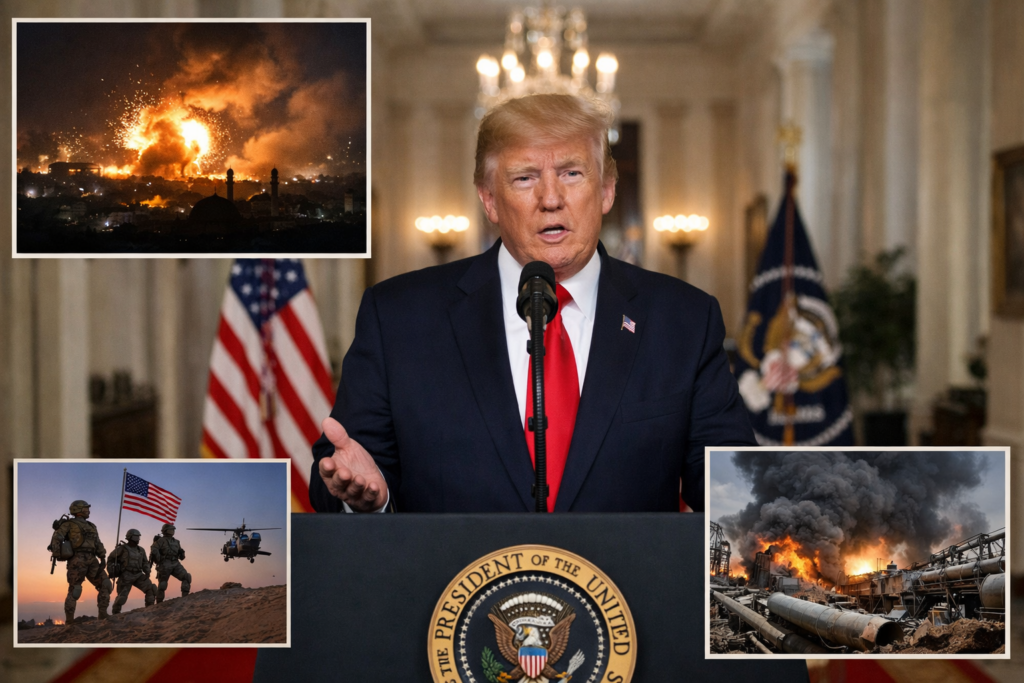
Trump said in his address that when the conflict was over, the Strait of Hormuz would open up naturally, and that Iran would want to be able to sell oil to rebuild. He urged allied nations to take responsibility for securing the waterway themselves, saying they should go to the strait and take it. Energy market analysts and experts consulted by major news organisations said that ending the war without physically reopening the Strait of Hormuz was unlikely to fix the energy crisis, given Iran’s stated intent to maintain control of the waterway.
Before the war, approximately 110 ships passed through the strait daily, carrying oil from Iran, Iraq, Saudi Arabia, and Qatar to markets across Asia and Europe. By the time of Trump’s address, between five and ten ships per day were transiting the waterway, and those vessels were subject to inspection and in some cases a transit fee arrangement imposed by Iranian forces, which observers had described as the Tehran toll booth. Former Islamic Revolutionary Guard Corps commander Mohsen Rezaei stated that even if the whole world came together, it could not reopen the Strait of Hormuz, citing the waterway’s geographical characteristics.
The average price of gasoline in the United States passed four dollars per gallon on April 1, the first time that threshold had been crossed since 2022. Prices at the pump had risen from an average of approximately two dollars and 46 cents per gallon on February 28 to more than four dollars within five weeks. Trump told the nation that gas prices would rapidly come down once the conflict was over, but provided no mechanism for how that would occur without resolution of the strait’s status.
Senior Trump administration officials had privately acknowledged that they could not both achieve stated military objectives quickly and commit to reopening the Strait of Hormuz within the same timeline, as the administration faced the end of its self-imposed four-to-six-week window for concluding the operation.
How United States allies are responding to Trump’s address and the Strait of Hormuz impasse
United Kingdom Prime Minister Keir Starmer announced on April 1 that the United Kingdom would host a virtual diplomatic conference the following day focused on restoring access to the Strait of Hormuz, led by British Foreign Secretary Yvette Cooper. Starmer said 35 nations had signed a joint statement committing to work together on restoring maritime security in the waterway, and confirmed that military planners were also developing contingency plans.
France maintained its position of not authorising the use of French territory or military bases for attacks on Iran, and declined to permit military supply flights to Israel to cross French airspace. Trump had previously described France as very unhelpful in a post on Truth Social. United Kingdom Defence Secretary John Healey, during a visit to Qatar, insisted that the United Kingdom remained a key ally of the United States even as Trump publicly challenged allied nations to do more in securing the strait.
China and Pakistan, with Pakistan serving as a key diplomatic intermediary between the United States and Iran, jointly released a five-point plan for restoring peace and stability in the Middle East, including provisions calling on parties to protect ships and crew members stranded in the Strait of Hormuz and to allow the early and safe passage of civilian and commercial shipping.
Asian financial markets reacted negatively to Trump’s address. Japan’s Nikkei 225 index fell 1.4 percent, South Korea’s Kospi dropped 2.82 percent, and Australia’s Standard and Poor’s/ASX 200 declined 0.48 percent. Hong Kong’s Hang Seng index opened 0.5 percent lower. In United States off-hours trading, Standard and Poor’s 500 futures slid 0.75 percent, Nasdaq futures dropped by one percent, and Dow Jones futures fell more than 310 points. United States crude oil prices rose from around 98 dollars to nearly 104 dollars per barrel following the address.
What the nuclear question means for the stated objectives of Operation Epic Fury
Trump asserted in his address that the goal of preventing Iran from acquiring a nuclear weapon had been attained and that Iran would not be able to develop a nuclear weapon for years. However, he also told Reuters on April 1 that he did not care about Iran’s highly enriched uranium stockpiles, which are stored in underground tunnels, stating that he would always be watching them by satellite. That statement contradicted remarks he had made the previous week, when he told journalists from a major United States television network that the United States wanted no enrichment and also wanted the enriched uranium itself.
United States intelligence officials had assessed as recently as last year that Iran was not actively trying to build a nuclear bomb. Even as Trump insisted in his address that a main goal of the war was ensuring Iran never attained a nuclear weapon, his own statements to news organisations indicated uncertainty about whether underground stockpiles of enriched uranium had been neutralised. Hundreds of United States Special Operations Forces and thousands of Marines and Army paratroopers were deployed in the Middle East, giving Trump additional military options if he chose to expand the operation, including potential operations to seize Iran’s enriched uranium stockpile, a move that military and intelligence officials said would likely require a risky ground operation.
What domestic political pressures are shaping the administration’s approach to the war in Iran
Trump’s address came against the backdrop of record low approval ratings and broad public concern about rising energy prices. An Economist/YouGov poll conducted March 27 to 30 found Trump’s net job approval rating at 35 percent, with 58 percent of Americans disapproving, the lowest recorded across either of his presidential terms. The same survey found 61 percent of Americans saying gas prices had gone up substantially where they lived. The conflict’s first month has coincided with the onset of the midterm election cycle, with Republican strategists warning that sustained high energy prices and an inconclusive war represent significant political liabilities heading into November 2026.
Senate Minority Leader Chuck Schumer, Democrat of New York, condemned Trump’s address and called it a rambling, disjointed presidential war speech, accusing the administration of failing to articulate clear objectives, alienating allies, and ignoring the economic pressures facing American families. Schumer warned that Trump was completely unfit to serve as commander-in-chief. Secretary of State Marco Rubio, who attended the address at the White House alongside Secretary of Defense Pete Hegseth and Chairman of the Joint Chiefs of Staff General Dan Caine, applauded the speech and reiterated the administration’s stated war objectives.
Trump closed his address by predicting that when the conflict was over, the United States would be safer, stronger, more prosperous, and greater than it had ever been before.
What Trump’s April 1 address on Operation Epic Fury means for Iran, the United States, and global energy markets
- President Trump declared that the core strategic objectives of Operation Epic Fury were nearing completion and described Iran as having been essentially decimated militarily and economically, while simultaneously warning the United States would strike Iran extremely hard for another two to three weeks before any potential conclusion.
- Trump stated that the Strait of Hormuz would open naturally once the conflict ended and placed responsibility for securing the waterway on allied nations, a position that energy analysts and regional governments said does not reflect the reality of Iran’s established chokehold on the route, through which one-fifth of global oil and gas supply normally passes.
- The average price of gasoline in the United States exceeded four dollars per gallon on April 1, the highest level since 2022, while oil futures rose sharply following Trump’s address, underscoring the absence of a clear mechanism for easing the energy crisis without resolution of the Strait of Hormuz impasse.
- The United Kingdom announced a 35-nation diplomatic coalition to work toward restoring maritime security in the Strait of Hormuz, with Prime Minister Keir Starmer convening a virtual international conference the day after Trump’s address, as European and Asian governments faced accelerating fuel supply disruptions.
- Thirteen United States service members have been killed and 348 wounded since Operation Epic Fury began on February 28, 2026, with the total death toll across the Middle East from the conflict exceeding 3,000 people, including more than 1,900 in Iran and at least 1,200 in Lebanon.
Discover more from Business-News-Today.com
Subscribe to get the latest posts sent to your email.