


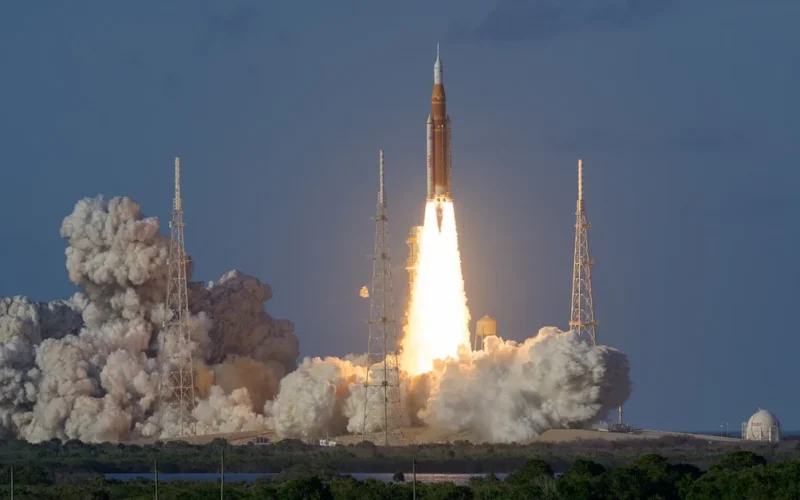
NASA’s Space Launch System rocket lifted off from Launch Complex 39B at Kennedy Space Center in Florida on 1 April 2026 at 6:35 p.m. Eastern Daylight Time, sending four astronauts aboard the Orion spacecraft on the first crewed lunar mission in more than 50 years. The launch marks the beginning of an approximately 10-day test flight that will carry the crew around the Moon and back to Earth, constituting the inaugural crewed mission of NASA’s Artemis program.
The four-member crew comprises NASA astronauts Commander Reid Wiseman, Pilot Victor Glover, and Mission Specialist Christina Koch, along with Canadian Space Agency Mission Specialist Jeremy Hansen. The Orion spacecraft, named Integrity by the crew, separated from the Space Launch System’s upper stage after a series of engine burns and began operating independently in space.
The Space Launch System generated approximately 8.8 million pounds of thrust at liftoff, with twin solid rocket boosters delivering more than 75 percent of the force required to lift the 5.75-million-pound vehicle off the launch pad. Following main engine cutoff, the core stage separated from the interim cryogenic propulsion stage and the Orion spacecraft, completing the first major propulsion phase of the mission.
Approximately 49 minutes into the flight, the Space Launch System rocket’s upper stage fired to place Orion into an elliptical orbit around Earth. A second planned burn by the upper stage will propel the Orion spacecraft into a high Earth orbit extending approximately 46,000 miles beyond Earth, after which Orion will separate from the stage and fly independently.
Shortly after reaching space, the Orion spacecraft deployed its solar array wings, enabling the spacecraft to receive power from the Sun. Flight controllers at NASA’s Mission Control Center at Johnson Space Center in Houston confirmed that all four solar array wings unfolded as planned and began drawing power. A temporary partial communications issue lasting several minutes occurred approximately 51 minutes into the flight during a planned handover between satellites, but did not affect mission operations.
What are the primary mission objectives of NASA’s Artemis II crewed lunar test flight?
The Artemis II mission is designated as a test flight, with its primary purpose being to validate the Orion spacecraft’s systems and hardware in a crewed deep-space environment for the first time. Among its key objectives is the demonstration of Orion’s life support systems while astronauts are aboard, a capability not tested during the uncrewed Artemis I flight in 2022.
During the mission, the crew will conduct a manual pilot demonstration to test Orion’s handling capabilities while in high Earth orbit. The astronauts, working alongside Mission Control Center teams at Johnson Space Center, will continue systematic checks of spacecraft systems throughout the orbital phase before the translunar injection burn is executed.
Mission controllers are scheduled to command Orion’s European-built service module to conduct the translunar injection burn on Thursday, 2 April 2026, pending confirmation that all spacecraft systems remain healthy. The approximately six-minute burn will send the spacecraft on a trajectory that will carry the crew around the Moon while using lunar gravity to slingshot the vehicle back toward Earth.
Human health scientific investigations, including the AVATAR study, will be conducted throughout the mission to inform planning for future crewed Moon missions. Crew observations during the lunar flyby phase will contribute data on surface conditions in areas not previously seen at close range by human observers.
How does Artemis II’s crew represent historic milestones in crewed spaceflight and lunar exploration?
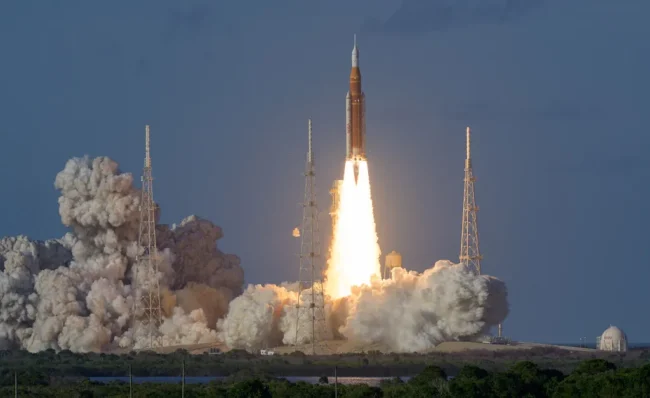
The Artemis II crew represents several firsts in the history of human spaceflight. Victor Glover will become the first person of color to travel beyond low Earth orbit and to the Moon’s vicinity. Christina Koch will become the first woman to travel to the Moon’s vicinity. Jeremy Hansen of the Canadian Space Agency will become the first non-United States citizen to travel beyond low Earth orbit and toward the Moon.
The mission also marks the first time any human has traveled beyond low Earth orbit since the final Apollo mission, Apollo 17, in December 1972. At a planned distance of approximately 4,700 miles beyond the Moon, Artemis II is expected to set a new record for the farthest distance traveled by any human from Earth, surpassing the distance reached during the Apollo 13 mission in 1970.
The mission trajectory will also subject the Orion spacecraft to an atmospheric reentry speed of approximately 25,000 miles per hour upon return to Earth, which would set a new record for crewed spacecraft reentry speed. These performance benchmarks are central to NASA’s objective of validating the Orion spacecraft and Space Launch System for increasingly demanding missions.
What will happen during the Artemis II lunar flyby and how will the crew observe the Moon’s far side?
A planned multi-hour lunar flyby is scheduled for Monday, 6 April 2026. During this phase, the four astronauts will become the first people to view portions of the Moon’s far side at close range, offering direct human observation of surface regions not previously accessible to crewed spacecraft.
Although the lunar far side will be only partially illuminated during the flyby, lighting conditions are expected to produce extended shadows across the surface. Those shadows are anticipated to enhance the visibility of surface relief features, including ridges, slopes, crater rims, and depth variations that are typically difficult to detect under full illumination. The crew will photograph these features and provide direct observations to mission scientists.
Following a successful lunar flyby, the astronauts are scheduled to return to Earth and splash down in the Pacific Ocean, completing the approximately 10-day mission. Recovery operations will be conducted by NASA in coordination with supporting agencies.
What technical issues occurred before and during the Artemis II launch at Kennedy Space Center?
The path to the 1 April 2026 launch involved a series of technical delays dating back to early 2026. A liquid hydrogen leak identified during a wet dress rehearsal of the countdown on 2 February 2026 prompted NASA to postpone the original launch target from February to March. Additional issues, including a valve associated with Orion crew module hatch pressurization that required retorquing and extended closeout operations, contributed to schedule adjustments.
A second wet dress rehearsal conducted on 19 February 2026 was completed successfully. However, a helium flow issue detected on 21 February 2026 triggered a rollback of the integrated Space Launch System rocket and Orion spacecraft to the Vehicle Assembly Building, pushing the launch target to April at the earliest. The rollback began on 25 February 2026 and the vehicle arrived at the Vehicle Assembly Building that evening.
On the day of launch, a last-minute Flight Termination System issue briefly placed the mission in a no-go status approximately one hour before the scheduled 6:24 p.m. liftoff. Engineers resolved the issue using legacy Space Shuttle-era equipment retrieved by an experienced operator, clearing the way for an on-time launch at 6:35 p.m. Eastern Daylight Time.
What role do international partners and CubeSat payloads play in the Artemis II mission?
The Artemis II mission includes participation from international space agencies through both crew representation and secondary payload deployments. The Canadian Space Agency’s Jeremy Hansen serves as one of four crew members, reflecting a longstanding partnership between NASA and Canada under the Artemis program framework.
In addition to the primary crew mission, four CubeSats are being deployed from the Space Launch System rocket’s upper stage at a safe distance from the Orion spacecraft. The CubeSats are provided by Argentina’s Comision Nacional de Actividades Espaciales, the German Aerospace Center, the Korea AeroSpace Administration, and the Saudi Space Agency. Each of these small satellites will conduct independent scientific investigations and technology demonstrations during the mission.
NASA has characterized the Artemis program as a multilateral initiative extending beyond the current test flight, with the agency stating that future missions will send astronauts on increasingly difficult missions to explore more of the Moon for scientific discovery and economic benefits, and to build toward the first crewed missions to Mars.
How does Artemis II build on Artemis I and what does it mean for the future of lunar exploration?
The Artemis I mission, which launched in November 2022, was an uncrewed test flight of the Space Launch System rocket and Orion spacecraft combination. Artemis II represents the second flight of the Space Launch System and the first time the Orion spacecraft has carried a crew, allowing NASA to test systems that could not be validated without human operators aboard.
NASA has described Artemis II as one mission within a longer campaign of lunar exploration. NASA Associate Administrator Amit Kshatriya stated that the crew would put Orion through its paces so that subsequent crews could proceed to the Moon’s surface with confidence, characterizing the work ahead as greater in scale than what has already been accomplished.
The broader Artemis program envisions the establishment of a sustained human presence on the Moon, referred to by NASA Administrator Jared Isaacman as a Moon Base, as well as the eventual development of capabilities needed for crewed Mars missions. Isaacman described the 1 April 2026 launch as the start of something larger than any single mission and as a return to the Moon not merely as a visit but as the foundation for a long-term presence.
The Lunar Gateway, a planned space station in lunar orbit that had been part of prior Artemis architecture, was cancelled in March 2026 before the Artemis II launch, reflecting an evolution in NASA’s planned approach to sustained lunar operations.
Key takeaways on what the Artemis II launch means for NASA, international partners, and global spaceflight
- NASA’s Artemis II mission lifted off on 1 April 2026, marking the first crewed mission beyond low Earth orbit since Apollo 17 in December 1972 and the first crewed lunar test flight of the Orion spacecraft and Space Launch System.
- The four-member crew, comprising Reid Wiseman, Victor Glover, Christina Koch, and Canadian Space Agency astronaut Jeremy Hansen, will collectively set new records including first person of color, first woman, and first non-United States citizen to travel to the Moon’s vicinity.
- The approximately 10-day mission is designed to validate Orion’s life support systems with crew aboard and test spacecraft handling capabilities, providing the performance data required for subsequent missions targeting a crewed lunar surface landing.
- Four CubeSats from Argentina, Germany, South Korea, and Saudi Arabia are being deployed from the Space Launch System’s upper stage as secondary payloads, reflecting multilateral participation in the Artemis program.
- A series of technical setbacks, including a liquid hydrogen leak, a helium flow issue, and a last-minute Flight Termination System fault resolved on launch day, preceded the eventual successful liftoff, underscoring the complexity of crewed deep-space operations.
Share this:
Discover more from Business-News-Today.com
Subscribe to get the latest posts sent to your email.