



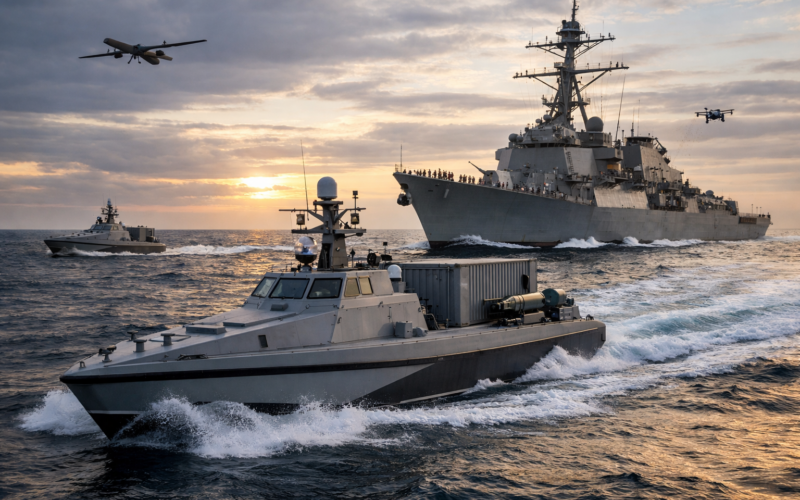
The United States Navy cancelled its Modular Attack Surface Craft programme on 26 March 2026 and immediately replaced it with a new Medium Unmanned Surface Vessel Family of Systems marketplace, marking the most significant pivot in the service’s autonomous surface vessel acquisition strategy in several years. The cancellation, announced by Rebecca Gassler, the Navy’s Portfolio Acquisition Executive for Robotic and Autonomous Systems, signals that the service has concluded the prototyping phase for medium USVs is effectively over and that production-ready platforms already exist in sufficient number to go straight to procurement. Backed by $2.1 billion from the One Big Beautiful Bill Act signed by President Donald Trump in July 2025, the new marketplace replaces a single-mission, narrowly specified programme with a multi-role, recurring competitive model designed to qualify as many vendors as possible and measure their surge production capacity. The MUSV marketplace solicitation opened on 26 March and closes on 17 April 2026, with on-water testing required by the end of fiscal year 2026 and first production vessel deliveries expected in fiscal year 2027.
Why did the US Navy cancel the MASC programme after less than a year, and what strategic logic underlies the shift to an MUSV marketplace?
The Modular Attack Surface Craft programme was announced only in July 2025, making its cancellation barely eight months later an unusually fast reversal even by the standards of a Pentagon acquisition environment that has grown accustomed to programme churn. Gassler’s explanation for the change is straightforward: MASC was designed around a specific mission profile and a specific quantity of vessels, whereas the Navy’s evolving Golden Fleet strategy requires a much wider range of mission types and a flexible procurement mechanism capable of expanding and contracting as demand signals from the fleet change. The MASC specification called for a vessel capable of carrying up to two 40-foot containers at 25 knots for up to 2,500 nautical miles in sea state four, which proved too constraining as the Navy identified a broader set of roles it wanted the medium USV tier to fill.
The second and arguably more consequential reason for the pivot is that the Navy discovered it had been leaving significant private capital on the table. Gassler noted that her team surveyed industry before making the cancellation public and found substantial vendor investment in platforms that already exceeded MASC requirements but did not fit the programme’s narrow template. By moving to an open marketplace model, the Navy can now access that investment without forcing companies to re-engineer production-ready vessels to comply with a specification that no longer reflects operational priorities. This is an important strategic signal for the defence industrial base: the Navy is telling vendors that platforms built to their own engineering judgement, rather than a government specification, are now the preferred starting point for procurement conversations.
The timing also reflects the broader impatience within the current administration and Navy leadership with traditional acquisition timelines. Navy Secretary John Phelan’s public statement welcoming the marketplace launch explicitly framed it as rewarding companies that deliver at the speed of relevance, a phrase that has become something of a mantra in the Pentagon’s current unmanned systems push. Chief of Naval Operations Admiral Daryl Caudle’s Fighting Instructions, released in February 2026, established a hedge strategy built around modular, containerised capabilities that can be rapidly redeployed without carrier strike group-scale commitments. The MUSV marketplace is the procurement mechanism for delivering that doctrine at scale.
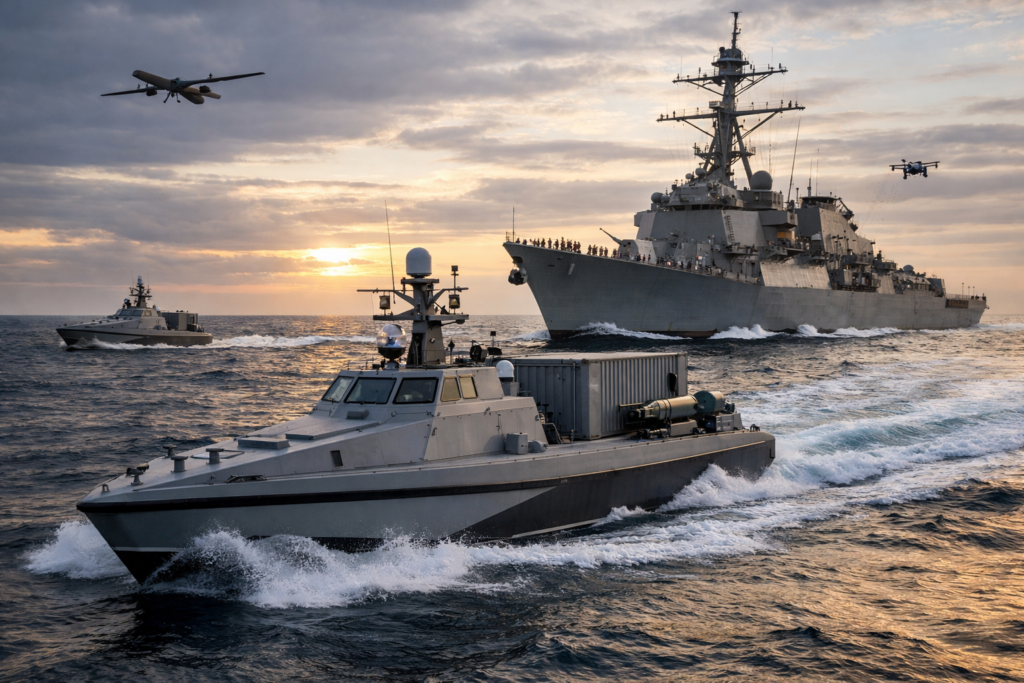
How does the MUSV Family of Systems marketplace work, and what does the evaluation process require from vendors competing for Navy production awards?
The new marketplace operates through a prototype Other Transaction Agreement, a flexible acquisition vehicle that allows the Navy to move faster than traditional Federal Acquisition Regulation contracting while still requiring meaningful technical and commercial validation. Companies responding to the solicitation must submit a technical design for their MUSV, a business and manufacturing plan, a supply chain and sustainment strategy, and a test plan. Proposals are due by 17 April 2026, giving the industry fewer than three weeks to respond from the date the solicitation opened, which itself reflects the Navy’s preference for platforms that are already mature enough to be described without extended design work.
Selected vendors will then proceed to an on-water test that must be completed by 30 September 2026, the end of the current fiscal year. The test will take place in a designated offshore area and will involve a combination of live contact vessels and simulated data inputs across three primary phases over a total of six days. At a minimum, the MUSV must demonstrate the capacity to operate autonomously and carry containerised payloads, consistent with Admiral Caudle’s containerized capability campaign plan, which he described at the McAleese Defense Programs conference the previous week as a framework for deploying modular weapons, sensors, and drones from any vessel without costly platform overhauls. The Navy has confirmed that the minimum payload specification requires at least two 40-foot ISO container-style payloads carried side by side, though the solicitation documents indicate larger payload configurations from individual vendors may also be accommodated.
Following successful on-water testing, the Navy will offer a fixed-price payment to vendors and move directly into production or a leasing arrangement. Gassler was explicit that there would be no additional year of prototyping and development between the test and the production decision. This is a meaningful compression of the typical defence acquisition cycle, and the leasing option in particular is notable because it creates a pathway for the Navy to field vessels rapidly without requiring full capital transfer, potentially lowering the barrier for smaller vendors whose balance sheets cannot absorb the working capital burden of a major production run ahead of payment.
What does the Golden Fleet initiative mean for the MUSV procurement, and how does the containerised capability doctrine reshape what the Navy actually needs these vessels to do?
The Golden Fleet, announced by President Trump in December 2025 at Mar-a-Lago, is a comprehensive naval modernisation plan that spans Trump-class guided missile battleships at the high end, continued Arleigh Burke-class destroyer production as the fleet workhorse, a new highly producible frigate designation, and a rapidly expanding unmanned tier at the lower end. The MUSV is described by the Navy as the unmanned centrepiece of the Golden Fleet, which positions it as more than a supplementary capability and implies a meaningful operational role in the distributed fleet architecture the service is pursuing. The programme of record quantity has not been publicly disclosed, though the Navy has indicated it has a number in mind, and earlier force structure assessments referenced procurement of several dozen medium unmanned vessels.
Admiral Caudle’s containerized capability campaign plan is the doctrinal framework that defines what the MUSV tier is actually expected to deliver. The concept involves packing ISO shipping containers with tailored weapons, sensors, drones, repair equipment, or other payloads that can be deployed on any vessel, manned or unmanned, without extensive platform modification. Caudle’s stated goal is to give combatant commanders options that do not require a full carrier strike group deployment, using instead smaller, more flexible force packages that can be rapidly assembled and positioned. The MUSV, as a floating autonomous platform capable of carrying multiple 40-foot containers, is the vehicle through which this doctrine achieves persistent maritime presence without personnel risk.
The implications for the vendor community are significant. A platform that passes the MUSV marketplace evaluation is not simply being procured for a single mission; it is being qualified as a persistent node in a networked fleet architecture that will evolve over time through software and payload updates rather than hull replacement. This creates a different kind of long-term value from a traditional government contract, one where the recurring relationship between vendor and fleet could extend for years across multiple container payload configurations. Companies that secure an early qualification in the marketplace gain incumbency advantages that could prove durable as the Navy’s containerised capability catalogue expands.
Which USV vendors are best positioned to win MUSV marketplace qualification, and how does the cancellation of MASC change the competitive rankings?
The MASC cancellation reshuffles competitive positioning in ways that are not uniformly positive for all vendors. Companies that invested heavily in engineering specifically to meet MASC’s 2,500-nautical-mile range and 25-knot speed requirements may find their platforms over-engineered for a broader marketplace that values flexibility and payload capacity over any single performance metric. Conversely, vendors that built to their own judgement and whose platforms were previously disqualified on MASC technical grounds now have a clear route back into competition.
Magnet Defense LLC, which announced production of its M48 Unmanned Surface Vessel on the same day the MASC cancellation was confirmed, appears well positioned under the new framework. The M48’s 17,000-nautical-mile range substantially exceeds the MASC threshold, its 40,000-nautical-mile prototype heritage directly addresses the Navy’s reliability concerns, and its 157-foot, 48-metre hull is scaled appropriately for multi-container payloads. The company’s timing of its production announcement on 26 March now reads as deliberate positioning ahead of an anticipated programme restructure rather than coincidence. Blue Water Autonomy’s Liberty class, entering production with a 10,000-nautical-mile range and up to 150 tonnes of payload capacity, is similarly well suited to a multi-mission specification that values endurance and payload volume.
Anduril Industries, which was developing its dual-use autonomous vessel for MASC with an explicit focus on mass production and austere-environment maintenance, should remain competitive given the Navy’s continued emphasis on producibility and supply chain resilience. Saronic, the Austin-based startup led by Navy veterans and pursuing American Bureau of Shipping certification, is aligned with the marketplace’s preference for production-ready platforms. Sea Machines Robotics, which unveiled its STEAMRACER-class in February 2026 and claimed strong positioning in the MASC competitive evaluation, must now re-present its case to a different set of requirements, though the underlying autonomy stack and domestic industrial partnerships the company has assembled remain relevant. Saildrone, backed by a $50 million Lockheed Martin investment and operating its ABS-classified Surveyor-class platform, operates at a different weight and mission class but could find entry points in the marketplace as the Navy’s sensor and persistent maritime intelligence requirements expand.
What are the execution risks in the Navy’s compressed MUSV timeline, and can vendors realistically complete on-water testing before the 30 September 2026 deadline?
The timeline the Navy has set for the MUSV marketplace is ambitious by any measure. Vendors have roughly three weeks from 26 March to submit proposals by 17 April. Awards under the Other Transaction Agreement framework will follow, and then vendors must complete a six-day on-water test by 30 September 2026, leaving approximately five months for logistical preparation, maritime regulatory approvals, and the test itself. Gassler acknowledged that the test vessels do not need to be full production boats but must be representative of a vendor’s final submission. This is a meaningful accommodation that allows companies whose first production unit is still under construction to present a validated prototype in its place.
The compressed timeline is a deliberate policy choice rather than an oversight. The Navy is explicitly trading evaluation rigour for speed, on the basis that the cost of delayed fielding in the current strategic environment outweighs the risk of procuring platforms that require post-delivery refinement. This is consistent with the broader Trump administration preference for fielding imperfect capability quickly rather than waiting for perfect capability on a longer timeline. The practical consequence for the defence industrial base is that companies with vessels already in the water, with documented sea trial hours and operational reliability data, have a structural advantage over those that are still in late-stage development or transitioning from prototype to production.
Longer-term execution risk resides in the Navy’s own organisational capacity to absorb an accelerating fleet of unmanned systems. Admiral Caudle has spoken publicly about the importance of getting the command, control, maintenance, and deployment structures right before buying at scale, noting that vessels that arrive faster than the fleet’s operational concepts can absorb them will stack up unused. The MUSV marketplace’s leasing option could partly address this by allowing the Navy to hold capability on contract without committing to full ownership until doctrine and infrastructure are ready, but that model introduces its own sustainment and interoperability complexities that have not yet been publicly resolved.
Key takeaways on what the US Navy’s MASC cancellation and MUSV Golden Fleet marketplace mean for the autonomous maritime sector, the defence industrial base, and US naval strategy
- The Navy cancelled MASC less than eight months after launching it, replacing the narrow single-mission programme with a broader MUSV Family of Systems marketplace that is explicitly designed to qualify multiple vendors and measure industry surge capacity across a wider range of missions.
- The $2.1 billion in MUSV funding from the One Big Beautiful Bill Act is the financial backstop for the marketplace, and the Navy has confirmed that up to $5 billion in total unmanned programme funding from that legislation is available across all vessel classes.
- The solicitation closed for new entrants on 17 April 2026, with on-water testing required by 30 September 2026 and first production vessel deliveries in fiscal year 2027, creating a five-month window that strongly favours vendors with production-ready platforms and documented at-sea performance.
- Admiral Caudle’s containerised capability campaign plan is the doctrinal framework that defines what MUSVs must deliver: floating autonomous platforms capable of carrying modular ISO container payloads housing weapons, sensors, drones, or repair equipment deployable without carrier strike group-scale commitments.
- Magnet Defense, Blue Water Autonomy, Anduril Industries, Saronic, and Sea Machines Robotics are among the best-positioned vendors under the new framework, though the cancellation of MASC reshuffles competitive rankings and opens the door to platforms previously excluded by the narrower specification.
- The fixed-price payment model and leasing option represent a meaningful departure from traditional defence acquisition, lowering the working capital barrier for smaller vendors while giving the Navy flexibility to scale holdings up or down as fleet doctrine evolves.
- The Navy’s explicit acknowledgement that it was not capitalising on significant private industry investment under MASC is a strategic validation of the commercially funded development approach that multiple USV startups have pursued over the past three years.
- Execution risk is concentrated in the compressed test timeline, the Navy’s organisational capacity to absorb and operate an expanded unmanned fleet, and the unresolved question of how many MUSVs the service ultimately intends to procure across the programme’s life.
- The Golden Fleet’s MUSV tier sits alongside Trump-class battleships at the high end of the fleet architecture, positioning autonomous surface vessels not as supplementary capabilities but as a persistent, networked operational layer in the Navy’s distributed maritime operations concept.
- The creation of a recurring marketplace model, rather than a single-round procurement, is the most structurally significant element of the announcement: it signals that USV procurement will become a continuous commercial relationship between the Navy and qualified vendors rather than a one-time contract competition.
Discover more from Business-News-Today.com
Subscribe to get the latest posts sent to your email.


