

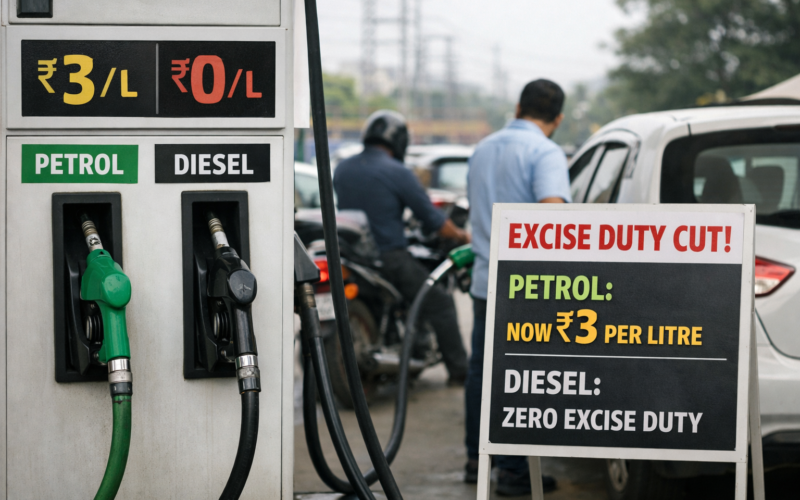
The central government cut excise duty on petrol and diesel by Rs 10 per litre each on 26 March 2026, bringing the levy on petrol down to Rs 3 per litre from Rs 13 and eliminating the duty on diesel entirely from a previous level of Rs 10. The Finance Ministry issued formal notifications under the Central Excise Act, 1944, stating that the cuts were in the public interest and took effect immediately. Finance Minister Nirmala Sitharaman confirmed the move on 27 March, saying that Prime Minister Narendra Modi had always ensured that citizens are protected from price volatility.
The reduction represents one of the sharpest single-step excise cuts on auto fuel India has seen in recent years. The trigger was the dramatic escalation in global energy markets following the United States and Israel launching military strikes on Iran on 28 February 2026, a development that prompted sweeping retaliatory action from Tehran and sent international crude prices surging by nearly 50 per cent within weeks. Benchmark crude touched USD 119 per barrel earlier in March before pulling back to around USD 100, remaining volatile as the conflict continued.
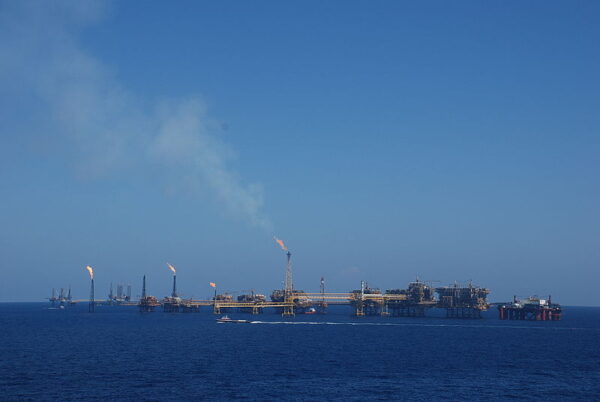
India imports approximately 88 per cent of its crude oil requirements and roughly half of its natural gas. A significant share of those supplies passes through the Strait of Hormuz, the narrow maritime corridor through which an estimated 20 to 25 million barrels of crude and around 10 billion cubic feet of gas flow each day. Before the conflict, India sourced between 12 and 15 per cent of its crude imports through that corridor. Tehran’s blockade of the strait in retaliation for the military strikes disrupted those flows, sharpening the urgency for New Delhi to act on the domestic pricing front.
Why did the government choose to cut excise duty rather than raise pump prices for consumers?
The government faced a binary choice: pass surging international crude costs on to consumers in the form of higher retail prices, or absorb the shock through the tax line. It chose the latter. Sitharaman said that in keeping with the commitment maintained since the Russia-Ukraine conflict began four years ago, the administration decided to take a hit on its own finances to safeguard Indian citizens rather than allow prices at the pump to spike as they have in most other countries. Petrol and diesel prices in South East Asian nations have risen by 30 to 50 per cent since the Iran conflict began, those in North American countries by around 30 per cent, in Europe by approximately 20 per cent, and in several African nations by as much as 50 per cent.
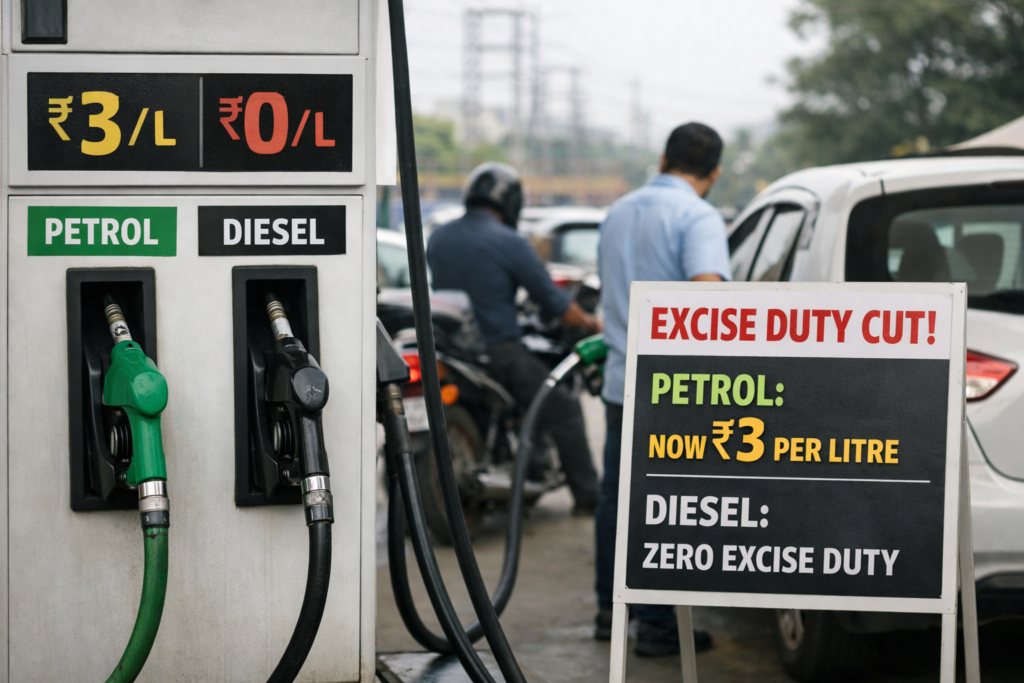
In Delhi, retail petrol remained at Rs 94.77 per litre and diesel at Rs 87.67 per litre as of 27 March, unchanged from pre-conflict levels. The government’s decision to freeze consumer prices while international crude surged has placed the financial strain squarely on oil marketing companies. Fuel retailers have been absorbing mounting under-recoveries since retail prices were last revised, and the excise cut was framed in part as a mechanism to ease their losses without altering what motorists pay at the forecourt.
How much relief do the excise duty cuts actually provide to Indian oil marketing companies?
Rating agency ICRA, in a note issued on 26 March, estimated that if the average crude oil price settles between USD 100 and USD 105 per barrel, fuel retailers would incur a loss of Rs 11 per litre on petrol and Rs 14 per litre on diesel. ICRA had also noted that the government was likely to reduce excise duty rates to help oil companies collect additional revenue to compensate for refining losses, and to keep retail sale prices stable at existing levels. The duty cuts announced the following day were broadly in line with those projections and were expected to absorb approximately 30 to 40 per cent of annual losses on auto fuels at current prices.
Shares of Indian Oil Corporation, Bharat Petroleum Corporation and Hindustan Petroleum Corporation opened higher on the Bombay Stock Exchange on 27 March following the announcement. The excise reduction gives OMCs additional headroom by shrinking the gap between what they collect at the pump and what it costs to procure and refine crude. The government has simultaneously levied an export tax on petrol, diesel, and aviation turbine fuel, ensuring that refiners cannot route domestically refined product overseas to capture higher international prices at the cost of local supply.
What changes has the government made to aviation turbine fuel duties alongside the petrol and diesel cuts?
Alongside the petrol and diesel duty cuts, the Finance Ministry introduced a new special additional excise duty of Rs 50 per litre on aviation turbine fuel. However, exemptions built into the same notification cap the effective duty burden at Rs 29.5 per litre. The government also fixed a windfall tax on exports of aviation turbine fuel at Rs 29.5 per litre and on diesel at Rs 21.5 per litre. Amendments to the Central Excise Rules, 2017, specify that rebate and export procedures will not apply to petrol, diesel, and ATF, with a narrow exception for exports to neighbouring countries by public sector firms.
The aviation sector has been under its own form of pressure as the conflict disrupted air traffic over West Asian airspace and pushed jet fuel costs higher. India’s aviation industry, which relies heavily on imported fuel, faced a double burden of higher procurement costs and rerouted flight paths that burn more fuel per sector. The ATF exemptions are aimed at partially cushioning carriers without forgoing all tax revenue on a commodity whose international price has also risen sharply since the conflict began.
How has India secured crude oil supply amid the Strait of Hormuz blockade and broader West Asia crisis?
Despite the disruption caused by Tehran’s blockade of the Strait of Hormuz, Hindustan Petroleum Corporation stated that there was no shortage of petrol, diesel, or LPG anywhere in the country, with supplies remaining stable and stocks adequate. The Ministry of Petroleum and Natural Gas confirmed that all retail outlets were operating normally, urging the public not to be misled by rumours or engage in panic buying. India has diversified its crude sourcing in response to the disruption, increasing procurement from West Africa, Latin America, and the United States to replace volumes that previously transited the Hormuz corridor.
India is the world’s third-largest oil importer and consumer, meeting over 90 per cent of its oil needs through overseas purchases. The country consumed 33.15 million metric tons of cooking gas last year, with imports accounting for roughly 60 per cent of demand. Around 90 per cent of those LPG imports originated in the Middle East. Disruptions to Qatar’s liquefied natural gas facilities, which represent India’s largest LNG supplier, have led the government to prioritise gas for domestic users and CNG vehicles while implementing some curtailment for industrial consumers including fertiliser plants. Prime Minister Modi has stressed that the government has contingency measures in place to ensure fertiliser supply for the summer sowing season and to sustain coal supplies for rising electricity demand.
What does the Iran conflict and Hormuz blockade mean for India’s long-term energy security strategy?
The current crisis has placed India’s structural dependence on Middle Eastern energy in sharp relief. Before the US-Israel strikes on Iran, a fifth of all seaborne crude and gas globally transited the Strait of Hormuz. India’s exposure to that single chokepoint has been a known vulnerability in its energy security planning, but the pace and severity of the current disruption has accelerated pressure on policymakers to deepen diversification. Unlike China, India has not moved to restrict exports of refined fuels as a buffer measure, a choice that reflects both diplomatic positioning and a commitment to maintaining open trade relationships with regional partners.
The government’s decision to absorb fiscal pain rather than pass costs to consumers follows a pattern established during the Russia-Ukraine conflict, when India similarly used excise reductions to insulate domestic pump prices from international volatility. That 2022 playbook, now applied again under more acute pressure, has become a defining feature of India’s approach to global energy shocks under the Modi administration. The fiscal cost is real: cutting excise duty by Rs 10 per litre on both petrol and diesel on the volumes India consumes represents a significant reduction in central tax revenues, with the shortfall expected to weigh on the fiscal deficit calculation for the current financial year.
Will petrol and diesel retail prices in India actually fall following the excise duty reduction?
The immediate answer is no. The government has not directed state-owned oil marketing companies to reduce pump prices in tandem with the excise cut. The duty reduction is instead being used to improve the margins of OMCs, who control around 90 per cent of domestic fuel retail, without changing what consumers pay. Private players in the market, who account for a smaller share, have begun adjusting their rates independently. The design of the measure reflects the government’s assessment that the priority at this stage is financial stability for the oil sector rather than retail price reductions that could encourage consumption at a time when global supply remains constrained.
Whether pump prices move later will depend on the trajectory of the Iran conflict and global crude markets. If international prices ease materially, the government may have room to allow OMCs to pass some benefit to consumers while also recovering part of the excise revenue. If prices remain elevated or rise further, the fiscal position of OMCs and the broader government budget will come under continued pressure, and further policy interventions cannot be ruled out.
What are the key takeaways from India’s Rs 10 per litre excise cut on petrol and diesel?
- The Finance Ministry cut excise duty on petrol from Rs 13 to Rs 3 per litre and removed the duty on diesel entirely, effective 26 March 2026.
- The cuts follow a near-50 per cent surge in international crude prices since the US and Israel launched strikes on Iran on 28 February 2026.
- Retail pump prices in India remain unchanged; the excise reduction is designed to ease losses at oil marketing companies rather than lower consumer prices.
- ICRA estimated OMC losses of Rs 11 per litre on petrol and Rs 14 per litre on diesel if crude averages USD 100 to 105 per barrel; the duty cuts are expected to absorb 30 to 40 per cent of those losses.
- India has diversified crude sourcing to West Africa, Latin America, and the United States to compensate for disruptions to Hormuz corridor flows.
- A new excise duty of Rs 50 per litre on aviation turbine fuel was introduced alongside exemptions capping the effective rate at Rs 29.5 per litre.
- Windfall taxes of Rs 21.5 per litre on exported diesel and Rs 29.5 per litre on exported ATF were imposed simultaneously to prevent domestic refiners from diverting supply abroad.
- The government has ruled out fuel shortages, with state-run oil firms confirming adequate national stocks.
Discover more from Business-News-Today.com
Subscribe to get the latest posts sent to your email.