


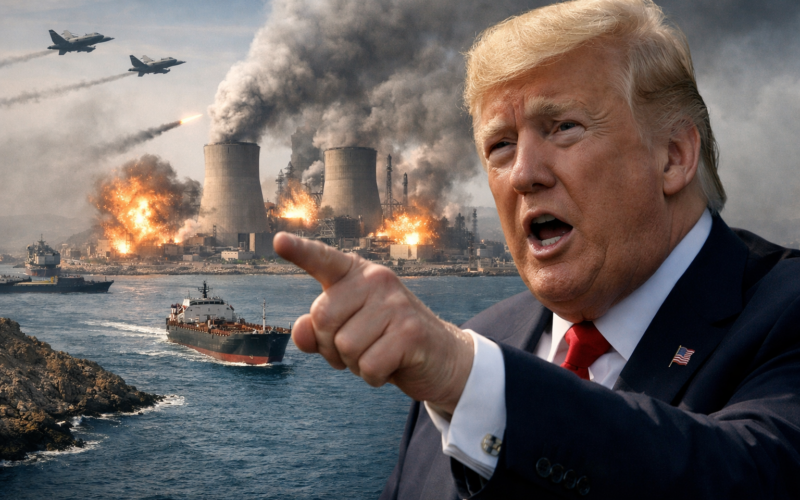
United States President Donald Trump issued a sharp public warning to Iran on Thursday, March 26, 2026, telling Iranian negotiators they needed to get serious about a peace agreement to end nearly four weeks of armed conflict, or face severe consequences. Trump posted on his Truth Social platform that Iranian negotiators had better get serious soon, before it is too late, because once that happens, there is no turning back, and it will not be pretty. The statement came one day after Iran’s Foreign Minister, Abbas Araghchi, told state television that Tehran had no plans to enter negotiations with Washington, even as messages continued to be relayed between the two governments through multiple regional intermediaries.
The warning marked a notable escalation in tone from Trump’s posture earlier in the week, when the president had spoken of productive diplomatic contacts and temporarily suspended planned strikes on Iranian energy infrastructure. Trump described Iranian negotiators as very different and strange, and claimed Tehran was privately seeking a deal. At a White House cabinet meeting later Thursday, the president said he was uncertain whether the United States would ultimately be willing to accept one, asking aloud whether he knew if the United States was willing to do that.
The diplomatic standoff intensified on Wednesday, March 25, 2026, when Iran’s state television broadcaster Press TV, citing an unnamed senior political-security official, reported that Tehran had responded negatively to the United States 15-point framework to end the war, with the official stating Iran would not allow Trump to dictate the terms or timing of the conflict’s resolution.
The United States proposal had been delivered to Iran through Pakistan, which has maintained relatively warm ties with both the Trump administration and Tehran. Pakistan’s Deputy Prime Minister and Foreign Minister, Ishaq Dar, publicly confirmed on Thursday that indirect communication between Washington and Tehran was continuing, writing on the social media platform X that US-Iran indirect talks are taking place through messages being relayed by Pakistan. Dar noted that Egypt and Turkey were also participating in the effort. The statement was the first time Pakistan had formally and publicly confirmed its role as the primary channel between the two governments since the conflict began on February 28, 2026.
What Iran’s foreign minister said about direct negotiations with the United States
Iranian Foreign Minister Abbas Araghchi said in a state television interview that his government had not engaged in talks to end the war and did not plan on any negotiations. Araghchi drew a distinction between the exchange of messages through intermediaries and formal diplomatic talks, insisting the two were not equivalent. He stated that Tehran did not want a ceasefire, arguing it would lead to a repeated cycle of conflict. He said Iran wanted the war to end in a way that it would not recur, on its own terms, and with compensation for the destruction inflicted on the people of Iran.
Iran’s armed forces spokesperson, Lieutenant Colonel Ebrahim Zolfaghari, separately dismissed Washington’s ceasefire effort in a recorded statement aired on Iranian state television, questioning whether the United States had descended into negotiating with itself. A senior Iranian official dismissed the United States proposal as a wish list. A senior United States official, in remarks reported by the Wall Street Journal, described Iran’s counter-demands as ridiculous and unrealistic.
Iran’s five conditions for ending the war with the United States and Israel
Iran’s conditions for ending the war, as reported by Press TV citing a senior political-security official, included a complete halt to attacks and assassinations by the United States and Israel; the establishment of concrete mechanisms to ensure the war does not resume; compensation for damages caused during the war; a halt to all United States and Israeli attacks against Hezbollah in Lebanon and pro-Iranian militias in Iraq; and international recognition of Iran’s authority over the Strait of Hormuz. Iran also told intermediaries that Lebanon must be included in any ceasefire arrangement, according to multiple regional sources.
The Strait of Hormuz demand is significant under international law. The waterway at the mouth of the Persian Gulf is classified as an international strait to which transit passage rights apply under the United Nations Convention on the Law of the Sea. Iran’s effective blockade of most commercial traffic since the start of the conflict had by Thursday pushed Brent crude oil prices to approximately 104 United States dollars per barrel, a roughly 60 percent increase above pre-war levels. Two government-affiliated Iranian news agencies, Tasnim and Fars, also reported that Iran’s parliament was pursuing a plan to formally codify Iran’s sovereignty and control over the Strait of Hormuz and create a revenue mechanism through levying transit fees on shipping.
What the United States 15-point proposal contained and how it was transmitted to Tehran
The full contents of the United States proposal have not been publicly confirmed by Washington. According to two Pakistani officials who described the proposal broadly, it included provisions for sanctions relief, a rollback of Iran’s nuclear program, limits on Iranian missile capabilities, and the reopening of the Strait of Hormuz. Reports from the New York Times and Israel’s Channel 12 indicated the proposal also addressed Iran’s commitment to never pursuing nuclear weapons and the removal of enriched uranium from Iranian territory, though a person briefed on the plan told NPR that the Channel 12 version reflected an earlier draft and that changes had been made. White House Press Secretary Karoline Leavitt acknowledged there were elements of truth in media reports but declined to confirm the specific points, cautioning against reliance on anonymous sourcing.
Leavitt told reporters the United States was close to achieving its core objectives in the conflict and that Iran was seeking an exit ramp due to sustained military pressure. She also warned that if Iran failed to accept the reality of the current military situation, President Trump would ensure Iran was struck harder than it had ever been struck before.
Why Pakistan holds a unique diplomatic position as primary mediator between Washington and Tehran
Pakistan’s emergence as the primary channel between Washington and Tehran reflects a combination of geographic, sectarian, and diplomatic factors. Pakistan has a Shia Muslim minority and maintains cross-border trade and diplomatic relations with Iran. It also holds a defence agreement with Saudi Arabia, has a Sunni majority closely aligned with Gulf states, and maintains no United States military bases on its territory, which reduces the likelihood of Tehran dismissing it as a Washington proxy. Pakistani Prime Minister Shehbaz Sharif publicly offered to facilitate talks, tagging the social media accounts of President Trump, United States envoy Steve Witkoff, and Iranian Foreign Minister Araghchi.
Mediators were pushing for possible in-person talks between Iranian and American representatives as early as Friday in Pakistan, according to Egyptian and Pakistani officials. Egypt’s Foreign Minister, Badr Abdelatty, told reporters that Cairo had noted a mutual desire for calm and exploration of negotiations on both sides, though no specific conclusions had been reached. Turkey’s ruling AK Party also indicated Ankara was actively passing messages between the two governments.
Israel reportedly removed Iranian Foreign Minister Abbas Araghchi and parliament speaker Mohammad Bagher Ghalibaf from its targeting list at Pakistan’s request, following Islamabad’s warning to Washington that eliminating these figures would remove key potential interlocutors for any future negotiations.
How military operations continued alongside diplomatic exchanges on March 26, 2026
Israel’s defense minister, Israel Katz, announced that Israeli forces had killed Alireza Tangsiri, the commander of Iran’s Islamic Revolutionary Guard Corps Navy, a key figure behind the near-total blockade of the Strait of Hormuz, in an overnight airstrike in Bandar Abbas. Israel’s military also reported that Iran’s intelligence navy chief, Behnam Rezaei, had been killed. The Israeli military completed a wave of extensive strikes targeting infrastructure in the central Iranian city of Isfahan. Iran fired multiple rounds of ballistic missiles at central Israel on Thursday, with air sirens sounding across Tel Aviv, Modi’in, and Jerusalem. An Israeli soldier serving in Lebanon was killed in the fighting.
Iran had been repositioning troops and air defense systems to Kharg Island in preparation for a possible United States operation to seize control of it, according to people familiar with United States intelligence reporting. Kharg Island handles approximately 90 percent of Iran’s crude oil exports. Between 2,000 and 3,000 United States Army paratroopers from the 82nd Airborne Division had received written deployment orders to the Middle East. Trump’s five-day suspension of strikes on Iranian energy infrastructure was set to expire on Saturday, March 28, 2026, heightening the risk of significant military escalation if no diplomatic progress was recorded.
How Gulf Arab states and the international community responded to the escalating conflict
Saudi Arabia, the United Arab Emirates, and several other Gulf Arab states issued a joint statement on Thursday condemning Iran’s attacks on their territory as criminal and signaling a readiness to act in self-defense. Kuwait International Airport had been struck on Wednesday, igniting a fire at a fuel tank. Bahrain and Saudi Arabia intercepted separate drone attacks. Oman Air announced cancellations of flights to numerous regional countries and parts of Europe until April 15, 2026. Sultan Ahmed Al Jaber, who heads the Abu Dhabi National Oil Company, accused Iran of economic terrorism for its control over the Strait of Hormuz.
The United Nations human rights chief, Volker Turk, said United States and Israeli strikes were hitting homes, hospitals, schools, and cultural sites in Iran, while Iranian attacks were striking energy and water infrastructure in Gulf Arab countries. The United Nations assessed the war had caused approximately 63 billion United States dollars in economic losses across the Arab region. The total death toll had surpassed 1,900 in Iran and nearly 1,100 in Lebanon, with dozens more killed in Israel and other parts of the region. Thirteen United States military personnel had died. Millions of people in Lebanon and Iran had been displaced.
China’s Foreign Ministry expressed support for all efforts to ease tensions and restore dialogue. Germany’s defense minister, Boris Pistorius, called the conflict a catastrophe for the world’s economies, and indicated Berlin would not participate militarily but could help secure the Strait of Hormuz once a ceasefire was agreed.
Public opposition to the conflict within the United States remained high, with a Pew Research survey conducted March 16 to 22, 2026, finding that 59 percent of United States adults said the country had made the wrong decision in using military force against Iran, and that only 25 percent considered the military action to be going extremely or very well.
Key takeaways on what Trump’s warning and Iran’s rejection of the United States proposal mean for the countries, institutions, and global context involved
- President Trump warned Iran publicly on March 26, 2026, that Iranian negotiators must get serious about a peace deal before it is too late, as his five-day suspension of strikes against Iranian energy infrastructure was set to expire on Saturday, March 28, 2026, raising the prospect of significant military escalation.
- Iran responded negatively to the United States 15-point ceasefire framework, presenting five conditions of its own including war reparations, an end to all attacks on Iran and its allied forces across the region, and international recognition of Iranian sovereignty over the Strait of Hormuz.
- Pakistan’s Deputy Prime Minister and Foreign Minister, Ishaq Dar, publicly confirmed for the first time that indirect United States-Iran talks are taking place through Pakistani mediation, with Egypt and Turkey also involved as supporting intermediaries.
- Israel killed Alireza Tangsiri, the commander of Iran’s Islamic Revolutionary Guard Corps Navy, on March 26, 2026, and Iran moved troops and air defenses to Kharg Island, which handles approximately 90 percent of Iran’s crude oil exports, raising fears of further escalation over a critical economic asset.
- The United Nations assessed the war had already caused approximately 63 billion United States dollars in economic losses across the Arab region, with the Strait of Hormuz blockade keeping global oil prices at roughly 60 percent above pre-war levels, affecting energy costs worldwide.
Discover more from Business-News-Today.com
Subscribe to get the latest posts sent to your email.