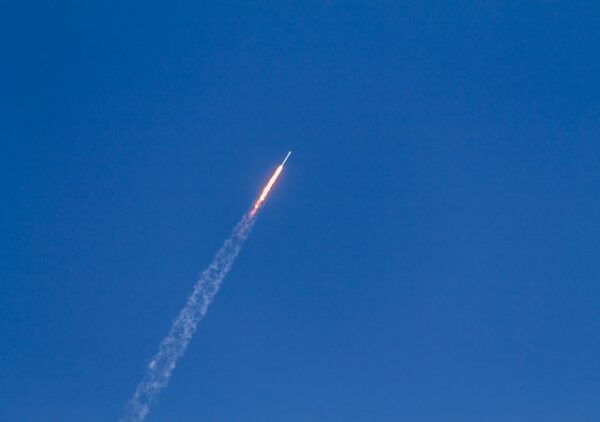


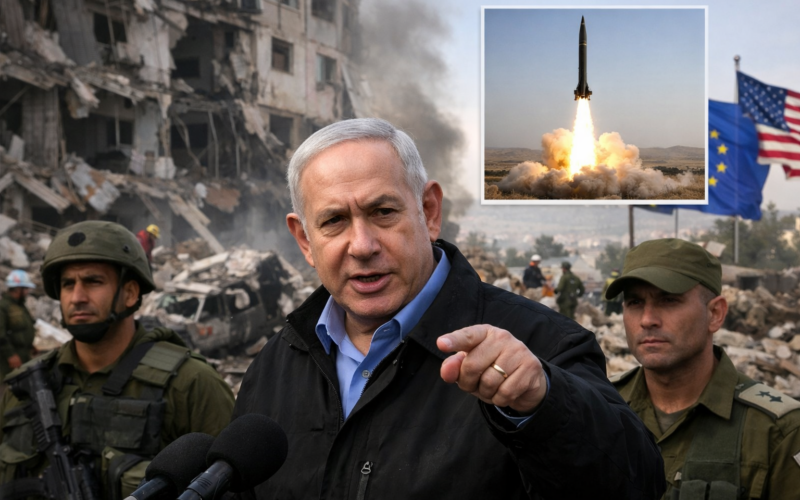
Israeli Prime Minister Benjamin Netanyahu visited the site of an Iranian ballistic missile strike in the southern Israeli city of Arad on Sunday, 22 March 2026, and issued a direct appeal to European and world leaders to join the United States and Israel in their ongoing military campaign against Iran. Netanyahu cited the Islamic Republic’s recent launch of a two-stage ballistic missile targeting the joint United Kingdom-United States military base at Diego Garcia in the Indian Ocean as evidence that Tehran’s threat has expanded far beyond the Middle East.
Speaking from the rubble of an apartment block in Arad that was struck by an Iranian missile on 21 March 2026, Netanyahu said Iran had demonstrated through its actions in the preceding 48 hours that it poses a danger to the entire world. He pointed to four specific escalations: a ballistic missile strike on a civilian area in Arad that wounded dozens, a missile launched near the holy sites of Jerusalem, the attempted targeting of the Diego Garcia base at a range of approximately 4,000 kilometres, and what he described as Tehran’s efforts to blackmail the world through threats to close the Strait of Hormuz.
Netanyahu stated that Iran has the capacity to reach deep into Europe and has already fired on European countries, referencing Cyprus specifically. He added that it was time for the leaders of other countries to act, saying he could see some nations beginning to move in that direction, but that more was needed. United States President Donald Trump has repeatedly complained about the lack of international support for the offensive and has described America as a model ally in its partnership with Israel.
What happened in the Iranian ballistic missile attack on Diego Garcia in March 2026?
Iran launched two ballistic missiles at Diego Garcia on 20 March 2026, targeting the joint United Kingdom-United States military installation in the Chagos Archipelago in the Indian Ocean. Neither missile struck the base. According to multiple United States and United Kingdom government accounts, one missile malfunctioned and failed mid-flight, while the second was intercepted by a United States Navy warship using a Standard Missile-3 interceptor. The Israeli Defence Forces described the weapon as a two-stage intercontinental ballistic missile, with Israeli Chief of Staff Lieutenant General Eyal Zamir stating that such missiles carry a range of up to 4,000 kilometres, sufficient to place European capitals within direct threat range.
The attempted strike on Diego Garcia marks the first known operational use by Iran of ballistic missiles at a range exceeding its previously declared self-imposed ceiling. Before the conflict began, Iranian Foreign Minister Abbas Araghchi had stated in an interview with NBC News on 8 March 2026 that Iran had intentionally limited its missiles to below 2,000 kilometres in range. Diego Garcia lies approximately 4,000 kilometres from Iran’s coastline, double that declared ceiling. Iran’s semi-official Mehr News Agency confirmed the attempted strike, describing it as a significant step demonstrating that Iran’s missile range exceeded what adversaries had previously imagined. A senior Iranian official, however, told Al Jazeera that Tehran was not responsible for the launch.
Defence analysts cited by multiple outlets suggested the attack may have involved an improvised use of Iran’s Simorgh space launch vehicle, which could offer greater range at the cost of accuracy, or a modified existing ballistic missile carrying a reduced payload to extend reach. Questions were also raised about the origin of targeting intelligence, given Iran’s limited satellite coverage of the Indian Ocean region.
Why did Netanyahu say Iran now threatens European capitals including Berlin, Paris, and Rome?
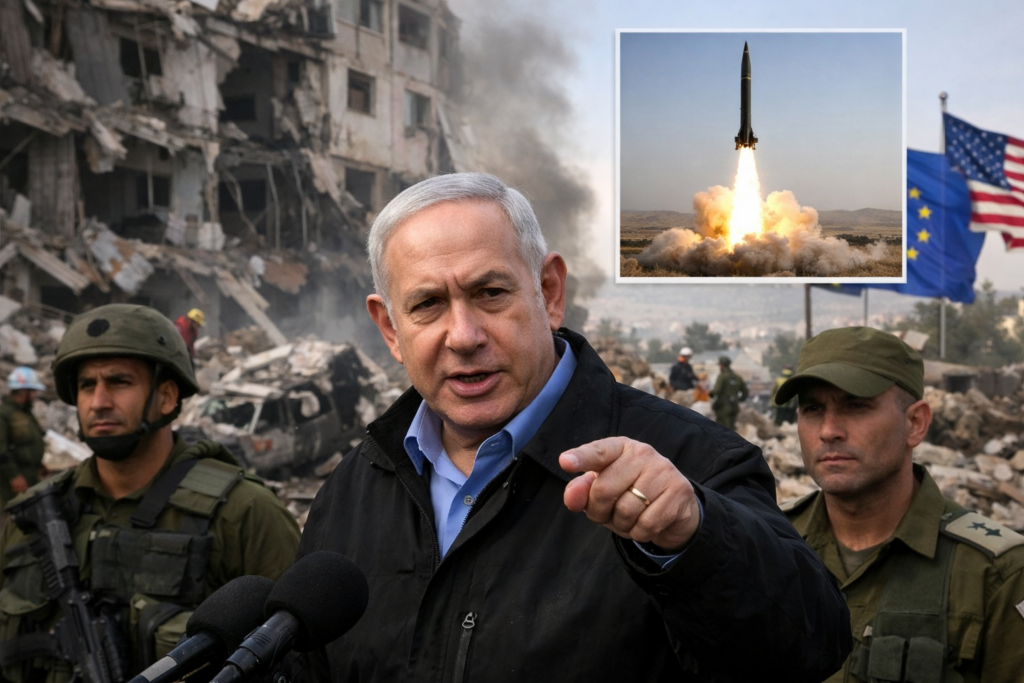
Israeli Chief of Staff Lieutenant General Eyal Zamir stated explicitly on 21 March 2026 that the missiles used against Diego Garcia were not intended to strike Israel, and that their range places the capitals of Europe, naming Berlin, Paris, and Rome, within direct threat range. Netanyahu built on this assessment in his Arad remarks on 22 March 2026, declaring that Iran has the capacity to reach deep into Europe and has already fired on European countries, citing Cyprus. Netanyahu said Tehran is putting everyone in its sights and attempting to blackmail the entire world through threats to disrupt shipping in the Strait of Hormuz.
British Housing Secretary Steve Reed, who appeared on behalf of the United Kingdom government on Sunday morning news programmes, rejected those assessments as unsupported by British intelligence. Reed told the BBC there was no assessment to substantiate claims that Iran is planning to strike Europe with ballistic missiles, and that he was not aware of any intelligence indicating Iran was even trying to target Europe, let alone that it could do so if it tried. He declined to provide operational details on how close the Diego Garcia missiles came to the base. Reed separately confirmed that the United Kingdom’s assessment is that Iran did target Diego Garcia, and that one missile fell short while the other was intercepted.
How has the United Kingdom responded to the Iran war and the Diego Garcia missile attack?
The United Kingdom has maintained a position of calibrated engagement throughout the conflict, which began on 28 February 2026 when the United States and Israel launched coordinated airstrikes on Iran under Operation Epic Fury, targeting nuclear facilities, missile production infrastructure, and senior leadership. Prime Minister Keir Starmer initially declined to endorse the opening strikes, describing the decision as deliberate and standing by it in a statement to Parliament on 1 March 2026. However, on the same evening, Starmer authorized the United States to conduct airstrikes on Iranian capabilities using British bases for specific and limited defensive purposes, citing Iran’s increasingly reckless conduct including missile strikes near British personnel in Bahrain.
The British position was expanded further on 20 March 2026, when British ministers approved the use of United Kingdom bases at RAF Fairford in England and Diego Garcia in the Chagos Islands for United States defensive operations to degrade Iranian missile sites targeting commercial vessels in the Strait of Hormuz. The United Kingdom Ministry of Defence condemned Iran’s attack on Diego Garcia as reckless and described it as a threat to British interests and British allies. Starmer separately told Cyprus President Nikos Christodoulides that Britain would not use its sovereign base at RAF Akrotiri in Cyprus for Iran-related offensive operations.
Reed on Sunday reiterated that the United Kingdom would not be dragged into the war but would protect its interests and work with allies to de-escalate the situation. When asked about Trump’s 48-hour ultimatum to Iran over the Strait of Hormuz, Reed said the United States president was perfectly capable of speaking for himself. He acknowledged the historical precedent of the United Kingdom taking a different position from the United States president, citing Vietnam. He also stated that the United Kingdom retains sufficient defensive strength to protect itself even in a scenario where Iranian missiles could reach British territory.
What is Operation Roaring Lion and what are Netanyahu’s stated military objectives in the Iran war?
The Israeli-American military campaign is known as Operation Roaring Lion on the Israeli side and Operation Epic Fury on the United States side, having begun on 28 February 2026. The operation opened with coordinated airstrikes targeting Iranian nuclear facilities, ballistic missile production sites, and leadership targets, including the assassination of Supreme Leader Ali Khamenei. Netanyahu stated at a press conference on 19 March 2026 that after 20 days of the campaign, Iran had no ability to enrich uranium and no ability to produce ballistic missiles, a claim he did not repeat in subsequent English-language remarks.
Netanyahu has publicly defined two clear goals for the campaign. The first is to completely destroy Iran’s nuclear programme, ballistic missile programme, and the industrial capacity required to rebuild those programmes. The second is to create conditions under which the Iranian people can remove the government he described as a tyranny that has made life miserable for Iranians and for the world. He repeatedly denied that Israel dragged the United States into the conflict, stating that Trump required no convincing and that America is acting alongside Israel for a common goal, not on Israel’s behalf.
Israeli Defence Forces Chief of Staff Zamir told commanders on 21 March 2026 that the campaign was at a halfway stage. The Israeli Air Force has conducted multiple waves of strikes on Iranian ballistic missile array sites across Iran throughout the campaign. Israel said it carried out five strikes within seconds on multiple infrastructure sites within a large-scale missile facility in western Iran as part of ongoing degradation efforts. The death toll in Iran from the war reached over 1,500 according to Iranian state broadcaster figures cited on 21 March 2026.
What missile strikes hit southern Israel and Jerusalem in the 48 hours before Netanyahu’s Arad remarks?
Iranian ballistic missile attacks struck the southern Israeli cities of Arad and Dimona on 21 March 2026. In Arad, a missile impact caused serious damage to residential buildings, with Magen David Adom reporting 64 casualties including seven in serious condition, 15 in moderate condition, and 42 lightly hurt. In Dimona, a missile struck near the city, injuring dozens; 47 people were taken to Soroka Hospital in Beersheba. The Israeli Air Force investigated the failure to intercept the Arad missile. It marked the first time in the war that Israel’s nuclear research facility in the Dimona area was targeted. The Israeli Home Front Command tightened public gathering and workplace restrictions across southern Israel and closed schools nationally on Sunday and Monday.
A missile component, likely a warhead section, struck the Old City of Jerusalem on 20 March 2026 after being intercepted by Israeli air defense systems during an Iranian attack. Netanyahu said Iran had fired on Jerusalem right next to the holy sites of the three monotheistic faiths, naming the Western Wall, the Church of the Holy Sepulchre, and the Al-Aqsa Mosque, calling it a miracle that none of the sites were damaged. A cluster munition from an Iranian ballistic missile also struck a daycare facility in Rishon Lezion in central Israel on 21 March 2026, causing damage. Iran’s missile campaigns have also struck civilian areas in Israel’s north, with Ofer Moskovitz becoming the first Israeli civilian killed by a Hezbollah rocket during the current conflict.
How has Iran responded to Trump’s 48-hour Strait of Hormuz ultimatum issued on 21 March 2026?
United States President Donald Trump issued an ultimatum on 21 March 2026 via his Truth Social platform, threatening to strike and obliterate Iranian power plants, starting with the largest one first, if Iran did not fully and unconditionally reopen the Strait of Hormuz within 48 hours. Iran responded by warning that any attack on its infrastructure would trigger retaliation against energy and desalination facilities across the Gulf region, with Iranian Parliament Speaker Mohammad Baqer Qalibaf stating that critical infrastructure could be irreversibly destroyed if Iranian power plants were targeted.
Iran has continued to block commercial shipping through the Strait of Hormuz, a chokepoint through which a significant portion of global oil trade passes, prompting an increase in global oil prices. Iranian Foreign Minister Abbas Araghchi signalled a partial exception, stating that Tehran was ready to facilitate the passage of Japanese vessels and that negotiations with Japan on the issue were ongoing. Twenty-two countries signed a joint statement signalling readiness to contribute to ensuring safe passage through the Strait of Hormuz. Egypt, Saudi Arabia, and other Arab states expressed concern, with Saudi Crown Prince Mohammed bin Salman and Egyptian President Abdel-Fattah el-Sissi stressing that Iranian escalation against Gulf states endangers regional stability.
What was the G7 and European Union position on the Iran missile attacks as of 22 March 2026?
The foreign ministers of the Group of Seven advanced economies, comprising Canada, France, Germany, Italy, Japan, the United Kingdom, and the United States, along with the European Union foreign policy chief, issued a joint statement on 21 March 2026 calling for an immediate and unconditional cessation of all attacks by the Iranian regime. The statement called on Iran to stop firing at allies in the Middle East. The G7 and European Union did not endorse joining the United States-Israel military campaign. The United Kingdom’s position, as reiterated by Reed on 22 March 2026, remained focused on de-escalation and protecting British interests rather than active participation in offensive operations.
Netanyahu’s appeal on Sunday, 22 March 2026, represents the most explicit public call for European governments to move from condemnation to active participation. He acknowledged that some countries are beginning to move in that direction without naming them or specifying in what capacity, but stated that more is needed. Trump, according to Netanyahu, has repeatedly complained about the absence of international support for the offensive. The Israeli prime minister positioned the campaign as one of global significance, stating that America is not fighting for Israel but with Israel for a common goal of protecting civilization.
Key takeaways on what Netanyahu’s Europe appeal and the Diego Garcia attack mean for the Iran war and global security
- Israeli Prime Minister Benjamin Netanyahu called on European and world leaders on 22 March 2026 to actively join the United States-Israel military campaign against Iran, citing Iran’s demonstrated ability to strike at a range of approximately 4,000 kilometres as evidence that Tehran poses a threat to global security beyond the Middle East.
- Iran launched two ballistic missiles at the joint United Kingdom-United States military base at Diego Garcia on 20 March 2026; both failed to reach their target, with one intercepted by a United States Navy warship and one failing mid-flight, but the attempt revealed capabilities exceeding Iran’s declared self-imposed 2,000-kilometre missile range limit.
- The United Kingdom government rejected Israeli assessments that Iran’s missiles can reach or are intended to target European capitals, with British Housing Secretary Steve Reed stating on 22 March 2026 that no intelligence assessment supports those claims; the United Kingdom maintains it will not be drawn into the conflict while allowing United States use of British bases for specific defensive operations.
- Iranian ballistic missiles struck the southern Israeli cities of Arad and Dimona on 21 March 2026, injuring more than 100 people; a missile component also fell near holy sites in Jerusalem’s Old City, prompting Netanyahu to invoke the shared significance of the sites to the world’s three major monotheistic faiths.
- United States President Donald Trump issued a 48-hour ultimatum on 21 March 2026 threatening to strike Iranian power plants if the Strait of Hormuz is not fully reopened; Iran responded with counterthreats to destroy Gulf energy infrastructure, raising the stakes for global energy markets and prompting concern from Arab states and the European Union.
Discover more from Business-News-Today.com
Subscribe to get the latest posts sent to your email.