




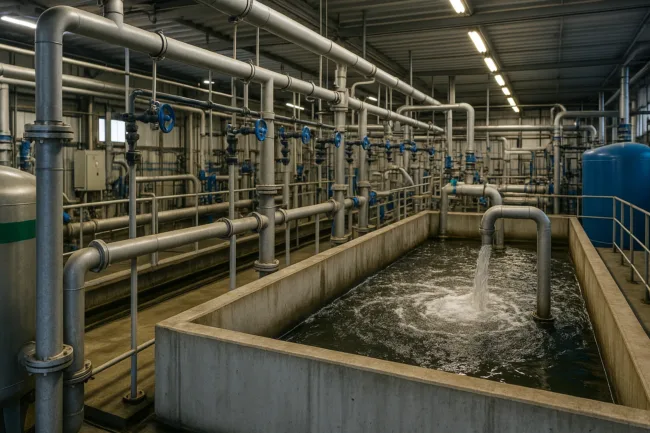
VA Tech Wabag Limited (NSE: WABAG | BSE: 533269), the Chennai-headquartered water technology multinational, has won a consortium contract from United Water Supply Company of Georgia LLC to design, build, and commission a 19 million litres per day wastewater treatment plant in Kutaisi, Georgia’s third-largest city. The order, classified as ‘Large’ under the company’s international sizing framework and valued between USD 30 million and USD 75 million, is funded by the European Investment Bank, adding an institutional financial guarantor that materially reduces counterparty and payment risk. VA Tech Wabag will lead the consortium in the full engineering, procurement and construction scope before supervising 12 months of operations and maintenance, with the EPC phase targeted for completion within 36 months. The award marks the company’s first entry into the Commonwealth of Independent States region and the Georgian market, extending a geographic footprint already present in more than 25 countries.
Why did VA Tech Wabag win the Kutaisi WWTP contract and what is the full scope of the EIB-funded Georgia project?
The Kutaisi project involves the full demolition of an existing, presumably outdated wastewater treatment facility and its replacement with a new 19 MLD plant incorporating advanced mechanical and biological treatment with nutrient removal, based on the activated sludge process. The technical specification also covers final sedimentation and ultraviolet disinfection, sludge treatment facilities, solar sludge drying systems, odour control infrastructure, and associated pumping networks. Critically, the plant has been engineered for future expansion up to 56 MLD, a design decision that signals Georgia’s intent to use the Kutaisi facility as long-term wastewater infrastructure for a growing urban region rather than a fixed-capacity point solution.
VA Tech Wabag’s role as Consortium Leader places the company at the centre of the risk, reward, and delivery accountability structure. The scope covers design, engineering, supply, installation, and commissioning of the treatment systems, along with training of client personnel. The subsequent 12-month operations and maintenance supervision period creates a knowledge-transfer obligation that is increasingly standard in European Investment Bank-funded projects across developing markets, and positions VA Tech Wabag as the project’s technical authority through the full commissioning cycle.
How does EIB funding change the risk profile of VA Tech Wabag’s Georgia WWTP contract compared to direct sovereign deals?
European Investment Bank financing transforms what might otherwise be a sovereign credit risk exposure into a multilateral-backed receivable structure. For contractors executing infrastructure in smaller economies, the involvement of a development finance institution of the European Investment Bank’s standing typically provides payment certainty mechanisms, procurement standards that favour technically qualified operators over price-only bidders, and project governance frameworks that reduce the risk of scope creep or unilateral client-side changes. Georgia has a track record of engaging multilateral lenders for infrastructure upgrades, and the Kutaisi WWTP is consistent with the country’s environmental alignment with European Union standards, which it has been pursuing through its EU Association Agreement pathway.
For VA Tech Wabag specifically, the EIB backing is a commercial validation as much as a financial protection. Winning an EIB-funded procurement process signals that the company’s technical and commercial proposal was assessed against international benchmarking criteria, not simply regional relationships. The Georgian wastewater sector has historically relied on aging Soviet-era infrastructure, and the shift to modern biological treatment with nutrient removal and UV disinfection represents a generational upgrade in environmental standards for the River Rioni’s receiving water quality.
What does entry into Georgia and the CIS region mean for VA Tech Wabag’s international order book strategy in 2026?
VA Tech Wabag arrives in Georgia at a strategically significant moment. The company’s recent announcements paint a picture of a sustained order intake cycle: a mega order from Chennai Metropolitan Water Supply and Sewerage Board for a 45 MLD tertiary treatment reverse osmosis plant, a mega Chennai city-wide looped water grid contract awarded in March 2026, and now a Large-classified international award in a new geography. The combined effect is an order book that the company itself has referenced at approximately Rs 16,300 crore, which equates to roughly 4 to 5 times recent annual revenue, providing multi-year revenue visibility for a capital-light EPC model.
The CIS region presents a substantial long-term opportunity for water treatment contractors. Much of the former Soviet bloc’s municipal water and wastewater infrastructure was built in the 1960s through 1980s and is now approaching or past end-of-life, while urbanisation pressures and environmental compliance requirements tied to EU accession or partnership processes are forcing modernisation. VA Tech Wabag’s European operational heritage through its Austrian subsidiary gives it genuine familiarity with both the technical standards relevant to EIB-funded projects and the engineering cultures of Central and Eastern European markets. The Georgia contract may prove to be a reference project that opens further doors in Armenia, Azerbaijan, and other regional markets where similar infrastructure gaps exist.
How does the WABAG stock price context reflect investor expectations around the company’s order intake cycle in early 2026?
WABAG shares were trading at approximately Rs 1,209 on March 20, 2026, which represents a decline of roughly 28% from the 52-week high of Rs 1,680 reached earlier in the cycle. The 52-week low stands at Rs 1,033, placing the current price at the lower half of the annual range despite a fundamental backdrop that has continued to strengthen. Q3 FY26 results showed net profit growth of 30.63% year-on-year to Rs 91.70 crore on revenue of Rs 961.30 crore, itself up 18.53%, and the company’s trailing 12-month operating revenue has crossed Rs 3,695 crore. The market capitalisation at current prices is approximately Rs 7,648 crore.
The disconnect between the stock’s proximity to its 52-week low and the accelerating order intake narrative is an analytical question worth flagging. Motilal Oswal has maintained a Buy rating with a target price of Rs 1,900, citing the Rs 163 billion order book at approximately 5 times FY25 revenue, 15 to 20 percent revenue growth expectations, and a robust net cash position of approximately Rs 8.9 billion. The stock trading below both its 50-day and 200-day moving averages suggests that broader market conditions or sector rotation rather than company-specific deterioration may be the dominant driver of current price weakness. The Georgia contract, while a positive incremental development, falls within the Large classification bracket of USD 30 to 75 million and is unlikely on its own to materially shift market sentiment, but it contributes to an order book quality story that longer-duration investors are tracking. [SINGLE SOURCE – VERIFY: Motilal Oswal target price and order book figures cited from Groww/market aggregators only]
What are the execution risks for VA Tech Wabag in delivering a complex EPC wastewater project in an emerging market like Georgia?
Georgia presents a mix of manageable and genuine execution risks for an international EPC contractor. On the manageable side, the EIB’s oversight role provides contractual and governance frameworks that reduce arbitrary regulatory interference, the 36-month construction timeline is not unusually compressed for a 19 MLD plant, and VA Tech Wabag’s European Cluster has direct regional familiarity. The plant design includes solar sludge drying, which introduces renewable energy integration into a wastewater project and reflects the company’s broader capability in resource-efficient treatment, but also adds technical complexity compared to conventional thermal drying alternatives.
Genuine risks include supply chain logistics to a Caucasus market with limited local manufacturing for advanced wastewater components, currency exposure between the Georgian lari and the likely USD or euro contract denomination, and the inherent challenges of demolishing and replacing operational infrastructure in a live urban environment. The effluent pipeline to the River Rioni adds civil works complexity beyond the plant boundary, requiring coordination with local authorities and environmental regulators. VA Tech Wabag’s consortium structure implies a local or regional partner sharing delivery responsibility, and the quality of that relationship will be a material factor in whether the project runs to budget and timeline.
How does VA Tech Wabag’s international expansion compare with the competitive landscape in global water EPC contracting?
The global water EPC market sits at an intersection of infrastructure spending, environmental regulation, and institutional lending that is structurally growing. VA Tech Wabag competes against a set of European and Asian specialists including Veolia, Suez, IDE Technologies, and ACWA Power in various geographies, while its Indian peers such as Ion Exchange India, Thermax, and Voltas Water operate primarily in the domestic market. The company’s pure-play water focus across 25 countries and its 125-plus intellectual property rights in treatment technologies give it differentiated positioning versus generalist infrastructure contractors that have water divisions alongside much larger civil or energy businesses.
The EIB-funded Georgia project illustrates a broader pattern in VA Tech Wabag’s international strategy: targeting multilateral-backed procurements in markets where local technical capacity is insufficient to deliver complex biological treatment infrastructure independently. This approach trades the volume potential of large single-country markets for geographic diversification and the risk-reduction characteristics of development finance institution oversight. The strategy has historically resulted in lower project failure rates but also means the company must maintain technical and business development presence across a geographically dispersed set of markets, which carries its own overhead cost structure.
Key takeaways: what the VA Tech Wabag Georgia WWTP contract means for the company, its order book, and the water EPC sector
- VA Tech Wabag has secured a Large international order (USD 30 to 75 million) from United Water Supply Company of Georgia LLC for a 19 MLD EIB-funded wastewater treatment plant in Kutaisi, Georgia, marking the company’s first entry into the CIS region and the Georgian market.
- European Investment Bank funding substantially de-risks the contract from a payment and governance standpoint, providing multilateral oversight that typically improves delivery outcomes on infrastructure projects in smaller emerging economies.
- The Kutaisi plant is designed for expansion from 19 MLD to 56 MLD, signalling long-term infrastructure intent from the Georgian government and potentially positioning VA Tech Wabag for follow-on scope as the city’s wastewater treatment needs grow.
- The contract extends a strong recent order intake sequence that already includes two mega-classified domestic orders from Chennai in March 2026, taking the total order book to approximately Rs 16,300 crore, roughly 4 to 5 times recent annual revenue.
- Q3 FY26 financials confirm strong underlying momentum with net profit up 30.63% year-on-year and revenue growing 18.53%, providing fundamental support for longer-term holders despite current share price weakness of approximately 28% from the 52-week high.
- WABAG trades at around Rs 1,209, below both its 50-day and 200-day moving averages, suggesting that the stock’s weakness reflects broader market conditions rather than company-specific deterioration, with at least one major broking house maintaining a Buy rating and a target of Rs 1,900.
- Entry into Georgia opens a potential reference project pathway into adjacent CIS markets including Armenia and Azerbaijan, where similar Soviet-era wastewater infrastructure requires generational replacement investment.
- The consortium structure with VA Tech Wabag as leader, combined with a 12-month post-commissioning O&M supervision obligation, creates a sticky client relationship model that is standard in EIB-funded procurements and increases the probability of follow-on engagement.
- Execution risks include supply chain logistics to the Caucasus, currency management, and urban demolition-plus-replacement complexity at the Kutaisi site, but are partially mitigated by the EIB’s contractual framework and the company’s European Cluster operating experience.
- Peers in the domestic water EPC space, including Ion Exchange India and Thermax, do not currently operate at comparable international scale with multilateral funding experience, reinforcing VA Tech Wabag’s differentiated competitive positioning in cross-border water infrastructure.
Discover more from Business-News-Today.com
Subscribe to get the latest posts sent to your email.


