



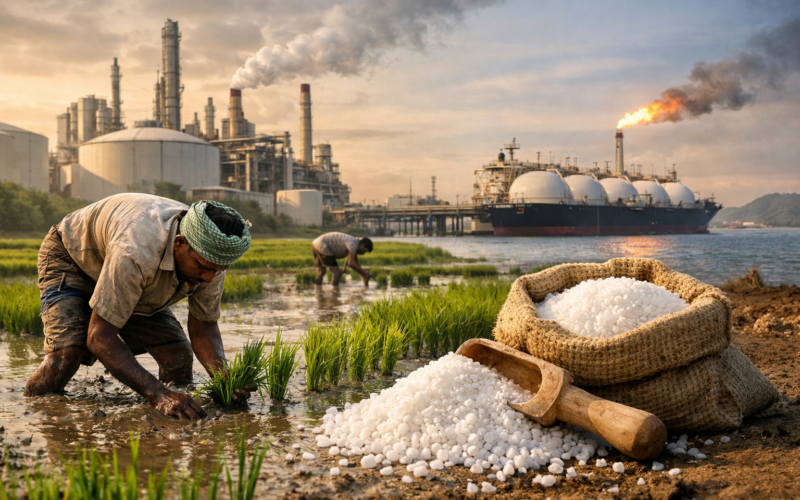
The Government of India has implemented a multi-pronged strategy to stabilize and increase fertilizer availability ahead of the Kharif 2026 sowing season, responding to disruptions in natural gas supply and geopolitical developments in West Asia. Through a combination of emergency domestic production increases and an accelerated global procurement programme, the Department of Fertilizers has moved to insulate Indian farmers from international market volatility ahead of the summer agricultural season.
How did India’s emergency gas procurement through EPMC raise urea output by 23% in March 2026?
A central element of the government’s response involves securing additional natural gas for domestic urea manufacturing plants. Through the Empowered Pool Management Committee (EPMC) bidding mechanism, the government finalized the procurement of an additional 7.31 million metric standard cubic metres per day (MMSCMD) of natural gas on a spot basis. This raised total gas supply to urea plants by 23 per cent, from 32 MMSCMD to approximately 39.31 to 40 MMSCMD, and increased fulfilment of plants’ average gas requirements from 62 per cent to 76 per cent. Domestic urea production is projected to rise by approximately 23 per cent as a result, from 54,500 metric tonnes per day to 67,000 metric tonnes per day.
Fertilizer plants in India require approximately 52 MMSCMD of natural gas to operate at full installed capacity. Prior to the emergency EPMC procurement, plants were receiving only around 32 MMSCMD, representing a shortfall of approximately 38 per cent that directly curtailed urea output. Following the additional gas purchases, plants are expected to operate at between 78 and 80 per cent of installed capacity, up from 62 per cent. The incremental production from this intervention is estimated at between 12,500 and 13,000 metric tonnes of urea per day through the end of March 2026.
The Empowered Pool Management Committee is a government body that facilitates pooled and coordinated procurement of natural gas for priority sectors, including the fertilizer industry. The mechanism allows the government to secure gas at competitive terms while distributing additional supply across multiple urea plants. The completion of the EPMC spot bidding process in March 2026 represents one of the primary near-term supply interventions in response to the West Asia disruption.

Why is the West Asia conflict creating gas supply pressure for Indian urea plants in the Kharif season?
India is among the world’s largest producers and consumers of urea, producing approximately 306.67 lakh tonnes in 2024-25 and importing a further 56.47 lakh tonnes to meet domestic requirements. Domestic urea production is almost entirely dependent on natural gas as both a feedstock and fuel source, and a significant portion of India’s gas imports originate from or transit through the West Asia region. The escalation of conflict in West Asia from late 2025 disrupted gas shipping routes, elevated spot gas prices, and introduced uncertainty around the continuity of supply from key regional producers. These developments directly reduced gas availability at Indian urea plants, causing production rates to fall to approximately 62 per cent of installed capacity before the emergency procurement was concluded.
India has imported approximately 98 lakh tonnes of urea in the first eleven months of the 2025-26 fiscal year, reflecting the structural gap between domestic production and demand. The Kharif season, which covers summer-sown crops including rice, maize, cotton, and pulses, is the primary agricultural season in India and accounts for the majority of annual fertilizer consumption. Any disruption to fertilizer availability or affordability ahead of the Kharif sowing window, which builds from May onward with the monsoon, carries material implications for agricultural output, rural incomes, and food security.
What is the current stock position of major fertilizers in India ahead of the Kharif 2026 sowing season?
As of 19 March 2026, India’s fertilizer stock position across all major categories is significantly stronger than the same period in 2025. Total urea stocks stand at 61.14 lakh metric tonnes (LMT), up from 55.22 LMT in March 2025, an increase of approximately 10.7 per cent. Diammonium Phosphate (DAP) stocks have more than doubled to 24.24 LMT from 11.85 LMT a year earlier, representing the largest year-on-year improvement among all categories tracked. NPK compound fertilizer stocks have risen to 57.21 LMT from 34.44 LMT, reaching a record high. Single Superphosphate (SSP) stocks stand at 24.80 LMT compared to 23.15 LMT in March 2025. Muriate of Potash (MOP) stocks are at 12.65 LMT, compared to 14.13 LMT in the year-ago period.
| Product (LMT) | Stock as on 19.03.2026 | Stock as on 19.03.2025 | Year-on-Year Change |
| Urea | 61.14 | 55.22 | +10.7% |
| DAP | 24.24 | 11.85 | +104.6% |
| NPKs | 57.21 | 34.44 | +66.1% |
| SSP | 24.80 | 23.15 | +7.1% |
| MOP | 12.65 | 14.13 | -10.5% |
The government has indicated that comfortable fertilizer stocks are targeted ahead of 15 May 2026, the date by which peak Kharif demand is expected to build as the monsoon arrives. With the Rabi winter season concluding and April typically representing a lean period in fertilizer offtake, the current stock buffer provides a meaningful window for additional procurement and distribution before the demand surge.
How has India diversified its fertilizer import sources to insulate Kharif 2026 from geopolitical supply risks?
The Department of Fertilizers preponed its global urea import tender to mid-February 2026, earlier than the typical annual schedule, in anticipation of potential geopolitical disruptions. Orders for 13.5 lakh tonnes of fertilizer were placed before the current supply challenges fully materialized, and approximately 90 per cent of these quantities are on track to reach Indian warehouses by the end of March 2026. The early tendering decision has given India a material lead time advantage compared with procurement scheduled on a standard annual cycle.
India’s active international supply lines have been deliberately diversified across multiple corridors and counterparties. A five-year supply contract for three million tonnes of DAP per year with Saudi Arabia remains in full effect with no force majeure declaration. Uninterrupted deliveries of urea, DAP, and NPK from Russia are continuing via the Cape of Good Hope shipping route. Additional supplies from Morocco are also arriving via the Cape of Good Hope corridor. Indian companies have additionally secured long-term agreements with major international producers of phosphatic and potassic fertilizers, reducing exposure to spot market volatility across these segments.
During an inter-ministerial press briefing on 19 March 2026, Ministry of External Affairs spokesperson Randhir Jaiswal confirmed that India’s stock position is comfortable for Kharif 2026 and that the Department of Fertilizers had issued global tenders well in advance of the current situation. Jaiswal stated that the tenders received a strong response from international suppliers and that the majority of ordered quantities are expected to arrive in India by month-end. Jaiswal also underlined that India maintains a diversified approach to fertilizer imports and remains in active diplomatic engagement with multiple supplier nations.
What district-level monitoring is the government using to ensure fertilizer reaches Indian farmers in Kharif 2026?
The government has stated that it is actively monitoring fertilizer distribution and sales patterns across 652 districts nationwide to detect and address abnormal patterns that could indicate hoarding, diversion, or localized shortfalls. This district-level surveillance is intended to ensure that the improved national stock position translates into actual availability for farmers at subsidized prices at the point of purchase. The government has flagged that market discipline will be maintained throughout the Kharif distribution period.
Domestic urea output averages approximately 25 lakh tonnes per month under normal operating conditions. March 2026 production is forecast at approximately 17 lakh tonnes, as manufacturers have advanced their scheduled annual plant maintenance cycles to coincide with the current period of reduced gas availability and lower seasonal demand. This sequencing of maintenance activity is intended to optimize gas utilization and position plants for higher output rates when Kharif demand peaks from May onward. The incremental urea production generated by the EPMC spot gas procurement is expected to partially offset the lower March output from scheduled maintenance.
Key takeaways on what India’s fertilizer strategy means for Kharif 2026 farmers, supply chains, and energy policy
- The Government of India secured an additional 7.31 MMSCMD of natural gas through the Empowered Pool Management Committee spot bidding mechanism, raising total gas supply to urea plants by 23 per cent and lifting projected daily urea production from 54,500 to 67,000 metric tonnes, with plant utilization rates expected to reach 78 to 80 per cent of installed capacity.
- India’s fertilizer stock position as of 19 March 2026 is materially stronger than the same period in 2025 across nearly all major categories, with urea at 61.14 LMT, DAP at 24.24 LMT (more than double the year-ago level), and NPK at 57.21 LMT (a record high), providing a significant buffer ahead of peak Kharif demand expected around 15 May 2026.
- The Department of Fertilizers preponed its global urea import tender to mid-February 2026 and placed orders for 13.5 lakh tonnes, with approximately 90 per cent of these quantities expected to arrive in India by the end of March, reflecting advance planning in anticipation of West Asia supply disruptions.
- India’s international fertilizer supply lines have been deliberately diversified across multiple corridors and counterparties, including Saudi Arabia (under an active five-year DAP contract with no force majeure), Russia (via the Cape of Good Hope), Morocco (via the Cape of Good Hope), and multiple other sources for phosphatic and potassic fertilizers, reducing dependence on any single route or supplier.
- The government is monitoring fertilizer distribution and sales patterns across 652 districts to ensure national stock improvements translate into farmgate availability at subsidized prices, with comfortable stock levels targeted before peak Kharif demand builds from mid-May 2026.
Discover more from Business-News-Today.com
Subscribe to get the latest posts sent to your email.