




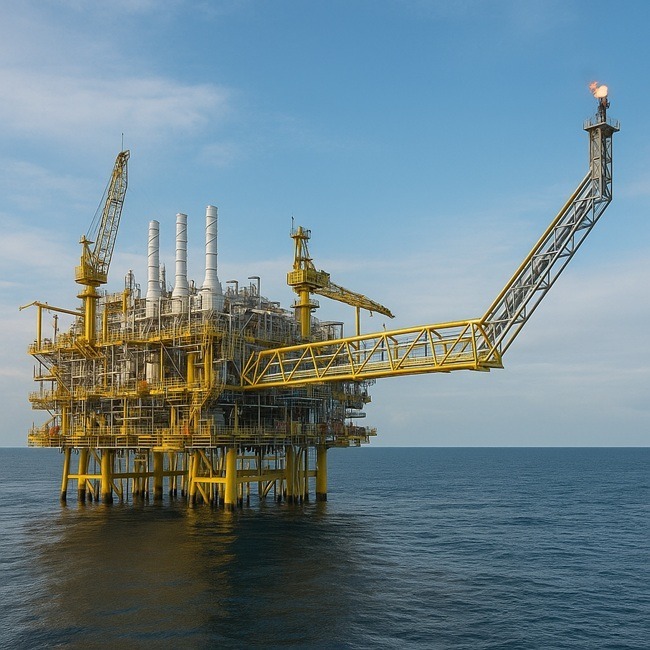
Eni S.p.A. (NYSE: E) has taken simultaneous Final Investment Decisions (FIDs) for two major deepwater gas projects offshore East Kalimantan, Indonesia, sanctioning both the Gendalo-Gandang South Hub and the Geng North-Gehem North Hub within 18 months of receiving regulatory approval for their development plans. The combined projects hold nearly 10 trillion cubic feet of gas initially in place alongside 550 million barrels of associated condensate, representing one of the largest deepwater gas development commitments in Southeast Asia in recent years. At plateau production, expected in 2029, the two hubs are designed to deliver up to 2 billion standard cubic feet per day of gas and 90,000 barrels per day of condensate, materially reinforcing both Indonesian domestic supply and regional LNG export capacity through the Bontang liquefaction plant. Eni shares on the NYSE closed at $53.22 on 18 March 2026, within striking distance of their 52-week high of $53.98, reflecting a market that has broadly repriced the company’s production growth story over the past year.
What does Eni’s dual FID in Indonesia mean for deepwater gas development timelines in Southeast Asia?
The speed of progression from approved development plan to FID is the first thing worth noting. Eni received Indonesian government approval for these Projects of Development in 2024 and reached sanctioning in March 2026, a timeline that compares favourably with industry norms for projects of this scale and technical complexity. Deepwater gas developments in the 1,000 to 2,000 metre water depth range typically involve multi-year engineering definition phases before capital is committed, and the ability to compress that cycle speaks to the pre-work Eni had already completed on these blocks following its 2023 acquisition of Chevron Corporation’s operating stakes in the Rapak, Ganal, and Makassar Straits production sharing contracts.
The South Hub, comprising the Gendalo and Gandang fields, sits in water depths ranging from 1,000 to 1,800 metres and will be developed using seven producing wells tied back to the existing Jangkrik Floating Production Unit. This infrastructure reuse is deliberate and consequential. Rather than constructing a new processing facility for the South Hub, Eni is routing production through Jangkrik, which reduces both capital expenditure and execution risk. The North Hub, covering Geng North and Gehem, operates in deeper water between 1,700 and 2,000 metres and requires a newly built Floating Production Storage and Offloading vessel capable of handling over 1 billion standard cubic feet per day of gas and 90,000 barrels per day of condensate, with 1.4 million barrels of storage capacity. Sixteen producing wells are planned for the North Hub, reflecting the larger resource base and the absence of nearby processing infrastructure in that part of the Kutei Basin.
How does the Bontang LNG plant reactivation fit into Eni’s Indonesia gas commercialisation strategy?
Gas from both hubs will move onshore via an export pipeline to a receiving terminal feeding the existing domestic gas network and the Bontang LNG plant in East Kalimantan. The Bontang plant is one of the world’s largest LNG facilities by nameplate capacity, but has been running below that capacity for years as legacy feed gas fields in the Mahakam block declined. Eni’s development plan includes the reactivation of Train F at Bontang, one of the currently idle liquefaction trains, adding LNG processing capacity that had been effectively stranded waiting for a new gas source. This is a capital-efficient way to restore LNG export volume without constructing greenfield liquefaction, and it speaks to the infrastructure leverage that makes the Kutei Basin economics relatively attractive compared with frontier deepwater developments elsewhere.
The commercialisation structure also addresses both ends of the Indonesian market. A portion of gas will enter the domestic pipeline network, supporting Indonesian energy security targets at a time when the government is actively seeking to substitute coal in the power sector with gas. The remainder flows to Bontang for LNG export, serving international buyers. Condensate from the North Hub will be processed and stored on the FPSO for export via shuttle tanker, providing a liquid revenue stream that partially offsets the longer payback profile typical of deepwater gas projects.
How do these FIDs strengthen Eni’s position ahead of the planned Petronas joint venture closing in 2026?
Both the North Hub and South Hub assets are among the portfolio that Eni intends to contribute to the NewCo joint venture it is forming with Malaysia’s Petroliam Nasional Berhad (Petronas). The two companies signed a binding investment agreement in November 2025, establishing NewCo as an equally owned entity that will manage 19 upstream assets across Indonesia and Malaysia, with a production target exceeding 500,000 barrels of oil equivalent per day by 2029. The joint venture is expected to invest more than USD 15 billion over its first five years and is designed to operate as a financially self-sufficient company capable of raising external financing independently.
Reaching FID on the Gendalo-Gandang and Geng North-Gehem projects before closing the NewCo transaction is strategically significant. It demonstrates to Petronas and to future NewCo investors that the Indonesian gas resource base is not merely a paper reserve but an actively sanctioned development programme with defined engineering, contracted timelines, and government alignment. The 2028 first production target creates an early cash flow anchor for the new entity, reducing the reliance on exploration upside to justify the combined valuation. It also positions NewCo to absorb development capital from inception rather than spending the first several years in a pre-FID holding pattern.
The satellite model that Eni is applying here has precedent across its portfolio. The company followed a structurally similar path with Var Energi in Norway, Azule Energy in Angola, and Ithaca Energy in the United Kingdom, each time creating an independent upstream vehicle with a third-party or co-venturer structure to crystallise value and drive focused capital allocation. The Indonesia-Malaysia NewCo fits that pattern, and the dual FIDs are the kind of pre-closing value accretion that makes the asset combination more compelling to all parties.
What are the execution and capital risks in developing dual deepwater hubs simultaneously in East Kalimantan?
Running two major deepwater development campaigns in parallel is operationally demanding even for a company with Eni’s project track record. The South Hub requires seven producing wells and deep-water subsea tie-back engineering, while the North Hub calls for 16 wells plus the construction and commissioning of a new FPSO. Drilling rig availability in Southeast Asia has tightened considerably as regional deepwater activity has rebounded from the post-2020 contraction, and managing rig scheduling across both campaigns simultaneously will require careful contractor management. Any slippage in FPSO fabrication, a common source of delay in deepwater project execution, could push North Hub first production beyond the 2028 target.
Capital allocation discipline is also worth watching. Eni guided 2026 capital expenditure at approximately EUR 7 billion, down from 2025, and the company has made reducing net debt and sustaining shareholder returns central to its near-term financial messaging. The Indonesia FIDs add committed capital to a programme that is already diversified across Libya, Congo, Ivory Coast, and other upstream geographies, alongside Eni’s Enilive biofuels and Plenitude renewables businesses. How Eni manages the capital phasing across all these commitments, particularly if Brent crude weakens from current levels, will be a live question for investors through the remainder of 2026 and into 2027.
What do Eni’s Indonesia FIDs signal about LNG supply competition in the Asia Pacific market over the next decade?
The decision to sanction these projects now, with first LNG volumes from Bontang targeted in the late 2020s, reflects a broader industry conviction that Asian LNG demand will remain structurally elevated through the 2030s, underpinned by gas-to-power switching in Southeast Asia, continued industrial demand in South Korea and Japan, and India’s growing import appetite. The competitive field for new LNG supply into Asian markets is becoming more crowded, with Australian brownfield expansions, Papua New Guinea developments, Mozambique LNG eventually returning to production, and a wave of US LNG projects reaching final investment decisions in recent years all targeting the same buyer base.
What distinguishes Eni’s position is the combination of a low-cost brownfield infrastructure play at Bontang and a greenfield FPSO development that creates a new hub in the northern Kutei Basin with additional tie-back potential for future discoveries. The northern Kutei Basin has seen limited development relative to its resource potential, and the Geng North field, discovered by Eni roughly three years ago under the North Ganal production sharing contract, is the anchor for what the company frames as a future exploration cluster. If exploration success in the northern basin continues, NewCo will have a pipeline of potential tie-back projects to sustain production beyond the initial plateau.
For incumbent LNG players with long-term supply agreements into Northeast Asia, a new Indonesian source with access to Bontang’s existing offtake infrastructure represents a credible competitive entrant rather than a speculative project. Buyers watching the next round of long-term contracting discussions will take note of Eni’s sanctioned timeline.
How is the market pricing Eni’s upstream growth strategy as NYSE: E approaches its 52-week high?
Eni shares on the NYSE closed at $53.22 on 18 March 2026, the day the Indonesia FIDs were announced, pulling back marginally from the prior close of $53.70 and sitting just below the 52-week high of $53.98. The stock’s 52-week low of $24.65 reflects how dramatically the market has revalued Eni over the past year, a re-rating driven by a combination of upstream production growth outperforming guidance, stronger-than-expected Q4 2025 adjusted profitability, and the strategic clarity provided by the Petronas NewCo announcement. J.P. Morgan upgraded Eni to Overweight in early March 2026, citing top-quartile oil and gas volume growth through multi-year upstream development and a relative discount to European peers.
The FID announcement did not produce a visible positive price reaction on the day, which is consistent with a market that had anticipated sanctioning of these projects following the regulatory approvals in 2024 and the public framing of the Petronas deal. At $53.22, the stock trades well above the consensus 12-month price target of around $34.60, suggesting the market is either pricing in a more optimistic production and oil price scenario than sell-side models reflect, or has assigned strategic optionality value to the Petronas NewCo and satellite model monetisation that analyst discounted cash flow frameworks do not fully capture. Morningstar’s fair value estimate of $26.80 represents an even wider divergence, reflecting that firm’s more conservative Brent price assumptions and concern about capital allocation across Eni’s diversified transition portfolio. With Q1 2026 earnings expected on 24 April, investors will be watching for any updated guidance on Indonesia capital phasing and NewCo closing timelines.
Key takeaways on what Eni’s dual Indonesia FIDs mean for the company, its competitors, and the LNG sector
- Eni has simultaneously sanctioned two major deepwater gas projects in East Kalimantan, targeting first production in 2028 and a combined plateau of 2 Bcfd of gas plus 90,000 bpd of condensate by 2029, among the largest upstream commitments in Southeast Asia this cycle.
- The South Hub (Gendalo-Gandang) uses existing Jangkrik FPU infrastructure for cost efficiency, while the North Hub (Geng North-Gehem) requires a new FPSO capable of processing over 1 Bcfd, introducing construction and delivery risk.
- Bontang LNG’s idle Train F will be reactivated to absorb gas from both projects, a brownfield solution that avoids greenfield liquefaction capital and accelerates time-to-export-market.
- Both assets will be contributed to the Eni-Petronas NewCo joint venture, expected to close in 2026. Reaching FID before closing strengthens the asset’s valuation case and demonstrates execution credibility to the new entity’s stakeholders.
- The NewCo is targeting production above 500,000 boe/d by 2029 and plans to invest more than USD 15 billion over five years across 19 assets in Indonesia and Malaysia, with Eni and Petronas holding equal stakes.
- The northern Kutei Basin, previously underdeveloped, gains a permanent production hub through Geng North-Gehem, creating future tie-back opportunities for additional discoveries under the North Ganal production sharing contract.
- Eni’s NYSE-listed ADR (E) closed at $53.22 on the day of announcement, near its 52-week high of $53.98, reflecting a broader market re-rating of Eni’s upstream growth profile over the past 12 months.
- Consensus analyst price targets sit materially below current trading levels, suggesting the market is pricing in strategic optionality around NewCo and the satellite model that conventional valuation frameworks do not fully reflect.
- The sanctioning decision adds to competitive pressure on Asian LNG buyers negotiating long-term supply contracts, as a credible new Indonesian source with access to Bontang’s offtake infrastructure now has defined timelines.
- Execution risk remains concentrated in FPSO fabrication scheduling, simultaneous dual-hub drilling campaign management, and capital allocation discipline across Eni’s broader portfolio as 2026 capex guidance is set below 2025 levels.
Discover more from Business-News-Today.com
Subscribe to get the latest posts sent to your email.


