




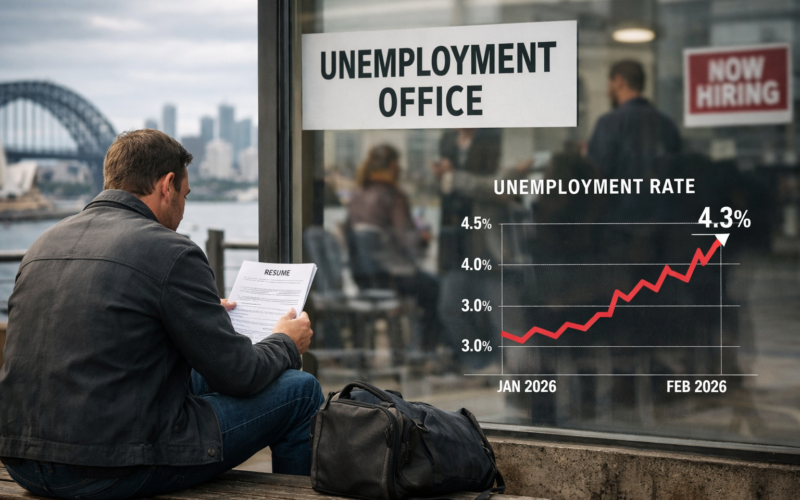
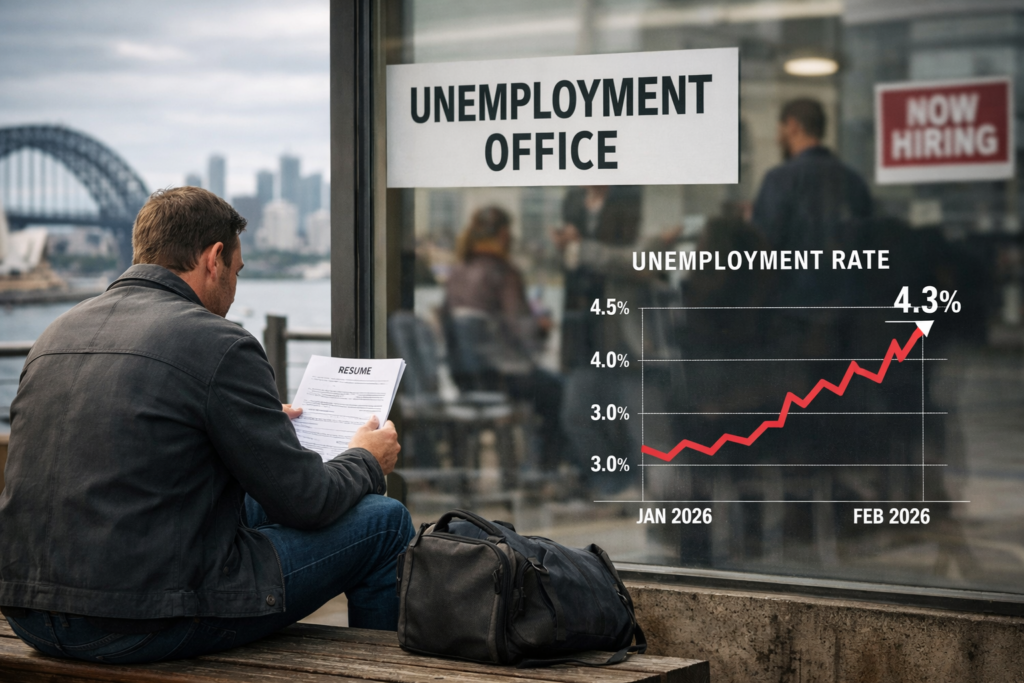
Australia’s seasonally adjusted unemployment rate rose to 4.3 per cent in February 2026, up 0.2 percentage points from 4.1 per cent in January, according to data released on 19 March 2026 by the Australian Bureau of Statistics. The increase was driven by a rise of 35,000 in the number of unemployed people, bringing the total to 659,100 from 624,200 in the previous month. The February 2026 reading returns the unemployment rate to the level it held across much of the second half of 2025, reversing the improvement recorded at the end of last year.
Sean Crick, the Australian Bureau of Statistics head of labour statistics, said that fewer people who were unemployed and waiting to start a job in January moved into employment in February compared with recent Februarys, and that more people remained unemployed in the month compared with the same period in prior years. Crick did not attribute the rise to a structural shift in the labour market but rather to the timing of labour market transitions in what is historically a seasonally variable month.
Why did full-time employment fall while part-time employment surged in Australia’s February 2026 labour force data?
Despite the rise in unemployment, employed people grew by 49,000 in February 2026. However, the composition of that employment growth was uneven. Part-time employment rose by 79,400 people to 4,631,800, while full-time employment fell by 30,500 people to 10,117,000. Crick said the increase in part-time employment was driven largely by workers aged 65 and over moving into part-time roles, and noted that fewer people were leaving employment to retire compared with the same period a year ago. The shift from full-time to part-time work in February 2026 continues a pattern observed in several recent months, reflecting the elevated cost-of-living environment encouraging older Australians to remain in the workforce in reduced-hours capacity.
The participation rate rose by 0.2 percentage points to 66.9 per cent in seasonally adjusted terms, as both employment and unemployment expanded simultaneously. This indicates that the February 2026 rise in unemployment was partly a function of more Australians entering or re-entering the labour force rather than solely a reflection of job losses. On an annual basis, the participation rate was 0.2 percentage points higher than in February 2025, remaining close to its historical high of 67.1 per cent recorded in early 2025.
How does Australia’s February 2026 unemployment rate compare with the Reserve Bank of Australia’s monetary policy forecasts and rate-setting context?
The February 2026 Labour Force data is the first official reading published after the Reserve Bank of Australia’s board meeting of 17 to 18 March 2026. In its February 2026 Statement on Monetary Policy, the Reserve Bank of Australia projected that the unemployment rate would be broadly stable in the near term before rising gradually to 4.6 per cent by mid-2028. The central bank noted at the time that leading indicators including job advertisements, vacancies, and employment intentions suggested labour market conditions could ease a little in the near term, balanced by a stronger near-term economic activity outlook.
The Reserve Bank of Australia raised the official cash rate by 25 basis points in February 2026, citing inflation remaining above the midpoint of the 2 to 3 per cent target range and a labour market the central bank assessed as tighter than the level consistent with bringing inflation sustainably back to target. The February 2026 unemployment reading of 4.3 per cent aligns with the upper end of the Reserve Bank of Australia’s near-term stability assessment, before the central bank’s forecast of a more pronounced gradual rise from late 2026.
The annual change in the number of unemployed people provides additional context. In seasonally adjusted terms, unemployed people increased by 47,600, or 7.8 per cent, over the 12 months to February 2026. Employment growth over the same period was 264,700, or 1.8 per cent. The divergence between the annual rate of growth in employment and the rate of growth in unemployment reflects the ongoing, moderate loosening of the Australian labour market that has been underway since the cycle of extreme tightness in late 2022 and early 2023.
What does the trend unemployment rate of 4.2 per cent in February 2026 indicate about the underlying direction of Australia’s labour market?
The trend unemployment rate, which smooths month-to-month volatility to show the underlying direction, fell marginally from a revised 4.3 per cent in January 2026 to 4.2 per cent in February. Trend employment grew by 24,000 people to 14,721,400. Monthly hours worked in trend terms rose to 2,009 million hours, with annual growth in hours worked outpacing annual growth in employment. Crick said that annually, hours worked grew faster than employment in trend terms in February 2026, suggesting that existing workers are carrying a greater share of total output than in earlier periods. The trend underemployment rate remained unchanged at 5.9 per cent.
The divergence between the seasonally adjusted unemployment rate of 4.3 per cent and the trend rate of 4.2 per cent reflects the inherent volatility of the monthly Labour Force Survey. The Australian Bureau of Statistics and the Reserve Bank of Australia both monitor trend estimates alongside seasonally adjusted figures. The marginal improvement in the trend rate in February 2026 is consistent with the Reserve Bank of Australia’s February 2026 assessment that labour market conditions remain broadly stable, with no sharp deterioration in the underlying pace of employment or job-seeking activity.
What is the significance of the monthly hours worked data and the underemployment rate for Australia’s labour market in February 2026?
Monthly hours worked in all jobs fell slightly in seasonally adjusted terms to 2,007 million hours in February 2026, down from 2,011 million hours in January. In trend terms, hours worked increased to 2,009 million, with annual growth of 1.7 per cent over the 12 months to February 2026. The underemployment rate, which measures people who are employed but seeking additional hours, remained at 5.9 per cent in both January and February 2026. Combined with the unemployment rate, the underutilisation rate for February 2026 stood at 10.2 per cent in seasonally adjusted terms.
The stability of the underemployment rate at 5.9 per cent across consecutive months, combined with the slight shift toward part-time employment in February, points to a labour market where demand for additional hours among existing part-time workers is neither improving nor deteriorating sharply. This reading remains above the low points recorded in 2022 and early 2023 when underemployment was falling alongside historically tight overall conditions, but it is still substantially below the levels seen during the early phases of the COVID-19 pandemic.
The Australian Bureau of Statistics also confirmed in its February 2026 release that it will begin transitioning to a modernised Labour Force Survey data collection system from April 2026. Crick said the new system will give survey participants a more accessible and secure method for completing the survey, and that the bureau is managing the process carefully to ensure the accuracy, trustworthiness, and security of published labour market statistics are maintained throughout the transition.
Key takeaways on what the February 2026 rise in Australia’s unemployment rate means for the economy, the labour market, and monetary policy
- Australia’s seasonally adjusted unemployment rate rose to 4.3 per cent in February 2026, up 0.2 percentage points from 4.1 per cent in January, driven by a 35,000 increase in unemployed people to 659,100, according to the Australian Bureau of Statistics.
- Employment grew by 49,000 in February 2026, but the composition was skewed heavily toward part-time work, which rose by 79,400, while full-time employment fell by 30,500, with the Australian Bureau of Statistics attributing the part-time increase largely to workers aged 65 and over.
- The trend unemployment rate fell marginally from a revised 4.3 per cent in January to 4.2 per cent in February 2026, suggesting the underlying labour market trajectory remains one of gradual easing rather than abrupt deterioration.
- The February 2026 reading is consistent with the Reserve Bank of Australia’s February 2026 Statement on Monetary Policy forecast of broadly stable unemployment in the near term, before the rate rises gradually to 4.6 per cent by mid-2028 as gross domestic product growth slows.
- The participation rate rose to 66.9 per cent in seasonally adjusted terms in February 2026, as more Australians entered the labour force, while the underemployment rate was unchanged at 5.9 per cent, indicating stable pressure on workers seeking additional hours.
Discover more from Business-News-Today.com
Subscribe to get the latest posts sent to your email.