
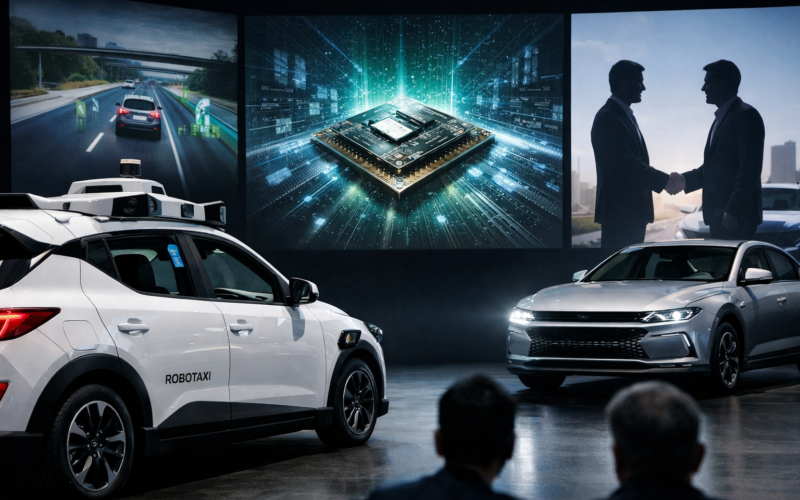
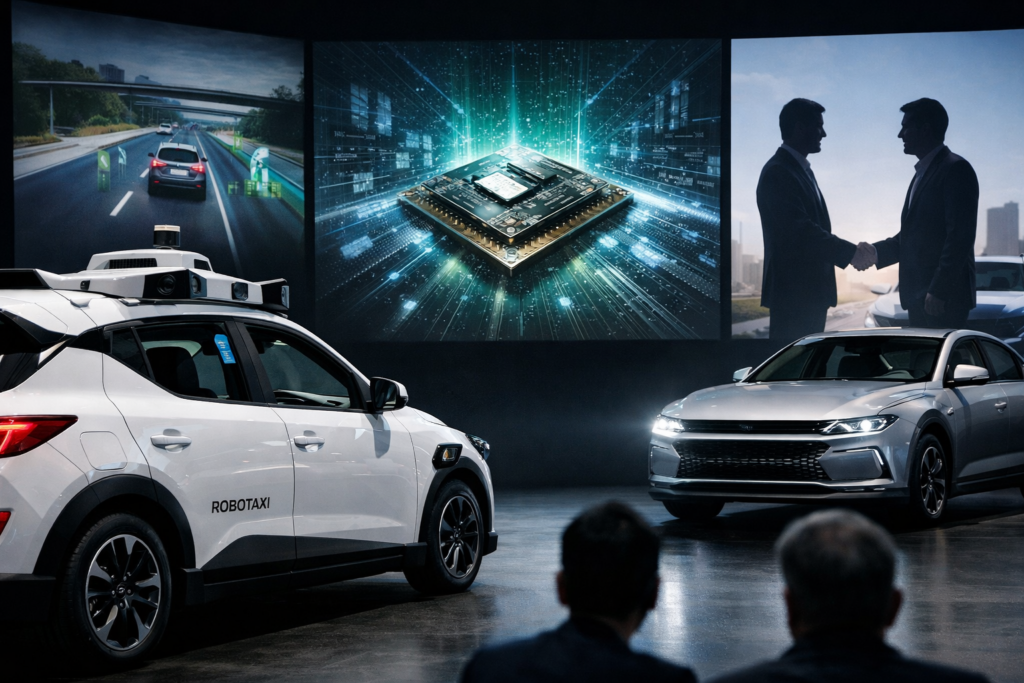
Hyundai Motor Company (KRX: 005380) and Kia Corporation (KRX: 000270) have expanded their strategic technology partnership with NVIDIA Corporation (NASDAQ: NVDA), deepening a collaboration that spans the full autonomy spectrum from level 2 driver assistance to level 4 robotaxi deployment. The deal, announced at NVIDIA’s GTC 2026 conference in San Jose on 16 March, positions Hyundai Motor Group as a cornerstone partner in NVIDIA’s accelerating push to embed its DRIVE Hyperion platform across the global automotive industry. At its core, the agreement formalises a group-wide framework to integrate NVIDIA’s autonomous driving stack into select production vehicles and to advance robotaxi capabilities through Motional, the autonomous vehicle joint venture between Hyundai Motor Group and Aptiv. For two South Korean automakers navigating an intensely competitive transition to software-defined vehicles, aligning with NVIDIA at this depth signals both the scale of their technological ambition and the urgency of the challenge ahead.
Why is Hyundai Motor Group betting on NVIDIA DRIVE Hyperion for its software-defined vehicle strategy?
The strategic logic behind the expanded NVIDIA partnership is rooted in Hyundai Motor Group’s recognition that autonomous driving competitiveness will increasingly be determined by the quality of AI training pipelines rather than traditional vehicle engineering alone. Hyundai Motor Group operates one of the world’s largest passenger vehicle fleets, and that scale generates an enormous volume of real-world driving data that, if captured and processed effectively, becomes a durable competitive asset. The group’s challenge has been building the computational and software infrastructure to turn that raw data into refined AI models at the pace the market now demands.
The NVIDIA DRIVE Hyperion platform addresses precisely that bottleneck. By adopting NVIDIA’s accelerated computing infrastructure for data collection, AI model training, simulation, and deployment validation, Hyundai Motor Group gains access to a unified, scalable development cycle that compresses the iteration time between real-world event capture and updated software deployment. The group has made clear its ambition to internalise a proprietary autonomous driving AI, meaning it does not intend to remain perpetually dependent on third-party system providers. The NVIDIA relationship serves that goal by providing the compute foundation on which Hyundai Motor Group can build and own its own models, trained on its own fleet data, rather than simply licensing a finished autonomous driving product.
This distinction matters strategically. Automakers that adopt a platform approach without investing in proprietary model development risk becoming hardware assemblers for software companies. Hyundai Motor Group appears to be pursuing a more deliberate path: using NVIDIA’s infrastructure as the engine while developing the intellectual property that will differentiate Hyundai and Kia vehicles in autonomous capability over time.
How does the Motional robotaxi joint venture fit into the NVIDIA partnership and what does level 4 deployment actually require?
Motional, the autonomous mobility joint venture between Hyundai Motor Group and Aptiv, represents the group’s most advanced bet on fully driverless commercial deployment. NVIDIA’s announcement indicates it will explore expanded collaboration with Motional to advance level 4 robotaxi capabilities and accelerate next-generation autonomous mobility services. The phrasing here is deliberately careful: ‘explore’ leaves room for the operational and regulatory complexities that have slowed even the most well-resourced level 4 programmes globally.
Level 4 autonomy requires systems that can handle the complete driving task within defined operational design domains without any human fallback. The computational and sensing requirements are substantially more demanding than level 2 or level 3 systems, and the safety validation burden is correspondingly higher. Motional has been operating commercially with Hyundai Ioniq 5-based robotaxis, but scaling that programme requires both a validated technology stack and a regulatory environment conducive to driverless deployment. Aligning Motional’s development roadmap with NVIDIA’s DRIVE Hyperion architecture creates a degree of platform consistency across Hyundai Motor Group’s autonomy efforts, from the mass-market level 2 vehicles Hyundai and Kia sell in volume to the level 4 Motional robotaxis operating in limited commercial geographies.
The practical question is execution timeline. Level 4 commercial robotaxi operations have proven significantly harder to scale than the industry projected several years ago. Motional’s partnership with Lyft in the United States and its robotaxi deployments in Las Vegas have demonstrated technical viability in constrained environments, but geographic and operational expansion remains the unresolved challenge. NVIDIA’s involvement strengthens the technology foundation but does not by itself resolve the regulatory, operational, or unit economics challenges that govern when level 4 robotaxi services become genuinely scalable businesses.
What competitive pressure is forcing Hyundai Motor Group to accelerate its autonomous driving investment now?
The competitive context around this announcement is instructive. NVIDIA’s GTC 2026 conference produced a wave of autonomous driving partnership disclosures, with the chip and software company deepening ties with BYD, Geely, Nissan, and Isuzu alongside the Hyundai Motor Group expansion. For Hyundai and Kia, the simultaneous announcement that NVIDIA is building out its automotive platform across multiple major manufacturers, including Chinese players with significant software development resources, underscores that standing still carries real competitive risk.
Tesla remains the reference point for vertically integrated autonomous driving development, using its own chip designs, proprietary training infrastructure, and a fleet of millions of vehicles generating continuous real-world data. Chinese automakers, led by BYD and supported by a mature domestic software ecosystem, are advancing rapidly in both software-defined vehicle architecture and AI-driven driver assistance. For a Korean automaker with genuine global ambitions, the choice is not simply whether to invest in autonomous driving technology but at what pace and through which partnerships.
The NVIDIA alignment provides Hyundai Motor Group with best-in-class accelerated computing and a partnership ecosystem that includes other major automotive and technology players. There is also a signalling dimension: a formal, expanded partnership announced at NVIDIA’s flagship developer conference communicates to institutional investors, suppliers, and talent markets that Hyundai Motor Group is a serious participant in the next generation of vehicle technology rather than a followeron waiting for the market to mature.
How does NVIDIA’s automotive strategy extend beyond Hyundai and what does GTC 2026 signal about the broader competitive landscape?
NVIDIA’s automotive ambitions at GTC 2026 extended well beyond the Hyundai Motor Group announcement. The company also disclosed a major expansion with Uber, under which a large fleet of robotaxis running on the NVIDIA DRIVE AV software stack will be deployed on the Uber network in phases, beginning in Los Angeles and the San Francisco Bay Area in early 2027 and expanding to 28 cities across four continents by 2028. The scale of that programme positions NVIDIA as potentially the dominant infrastructure provider for commercial robotaxi services at a global level.
NVIDIA chief executive Jensen Huang used the GTC keynote to project that AI computing demand could approach one trillion dollars in addressable infrastructure spend by 2027, a forecast underpinning the company’s strategy of embedding its platforms across every industry with high AI training requirements. The automotive vertical, with its combination of safety-critical AI, massive data generation requirements, and long product development cycles, is precisely the kind of durable, high-value engagement NVIDIA’s business model favours.
For NVIDIA, the Hyundai Motor Group deal reinforces a consistent strategic pattern: it is not trying to build cars or operate autonomous vehicle services itself. Instead, it is building the infrastructure layer on which others must run, from the DRIVE Hyperion reference architecture to the data pipelines, simulation tools, and AI training platforms that autonomous vehicle programmes require. Partners that standardise on NVIDIA’s stack face meaningful switching costs, which creates long-term revenue visibility that purely transactional hardware sales do not.
What does NVDA stock performance signal about market confidence in NVIDIA’s automotive platform push?
NVIDIA shares closed at $183.22 on 16 March 2026, up 1.65% on the day of the GTC keynote, with pre-market trading on 17 March indicating a further fractional gain to around $183.67. The stock’s 52-week range spans $86.62 to $212.19, meaning the current price sits roughly 14% below the 52-week high reached in late 2025. Over the trailing twelve months, NVIDIA has gained approximately 59%, a performance driven primarily by data centre AI demand rather than automotive revenues, which remain a comparatively small contributor to overall results.
The market’s reaction to the GTC automotive announcements was broadly constructive but measured. NVIDIA’s stock has been consolidating in a wide horizontal channel since its peak in late 2025, with the current range implying that investors are awaiting further evidence of revenue acceleration before pushing the valuation materially higher. The automotive platform announcements, including the Hyundai Motor Group and Uber expansions, contribute to a longer-term revenue visibility narrative but are unlikely to move near-term earnings estimates in a material way. Automotive revenues typically have development lead times measured in years before they translate into meaningful production volumes.
For Hyundai Motor Company and Kia Corporation, the market implications are also context-dependent. Both are valued primarily as traditional automotive manufacturers, and the market tends to reward autonomous driving investments only when they translate into tangible product differentiation or clear cost leadership. The NVIDIA partnership is a necessary investment but will need to demonstrate visible product outcomes, whether in the form of differentiated driver assistance features or credible Motional commercialisation progress, before it materially re-rates either company’s autonomous driving premium with institutional investors.
What execution risks could limit the strategic impact of the Hyundai Motor Group and NVIDIA collaboration?
The partnership carries several layers of execution risk that deserve scrutiny. The first is integration complexity. Building a scalable autonomous driving stack on NVIDIA DRIVE Hyperion requires sustained engineering investment across hardware integration, data pipeline architecture, software validation, and regulatory certification. Hyundai Motor Group is doing this across a diverse vehicle portfolio spanning economy to premium segments, with Hyundai and Kia requiring somewhat different feature configurations for their respective brand positions. Managing that complexity at scale, while also developing proprietary AI models and maintaining Motional’s separate level 4 programme, is a significant organisational undertaking.
The second risk is competitive speed. The autonomous driving technology landscape is evolving rapidly, and a platform partnership that represents best-in-class capability today may be under competitive pressure from alternative architectures, including those developed by Chinese technology companies with state-backed resources, within a relatively short window. Hyundai Motor Group’s strategy of internalising proprietary AI models while using NVIDIA’s infrastructure provides some hedge against platform dependency, but the execution of that internalisation strategy is not yet demonstrated at scale.
Third, Motional’s commercialisation trajectory remains uncertain. The joint venture has made genuine technical progress but has not yet achieved the operational scale that would justify significant capital allocation at the group level. The robotaxi economics question, specifically whether level 4 commercial services can achieve unit profitability at realistic fleet densities, remains unresolved across the industry. NVIDIA’s involvement strengthens the technology stack but does not simplify those underlying economics.
Key takeaways: what the Hyundai Motor, Kia and NVIDIA partnership means for the industry
- Hyundai Motor Group has formalised a group-wide, multi-level autonomous driving framework with NVIDIA, spanning level 2 production vehicles to level 4 robotaxi development through Motional, creating a consistent technology spine across its autonomy portfolio.
- The partnership’s strategic core is the internalisation of proprietary driving AI: Hyundai Motor Group intends to own the models, not just license the platform, using NVIDIA’s infrastructure to accelerate that process.
- Fleet scale is a genuine competitive asset here. Hyundai Motor Group’s global vehicle volumes generate real-world driving data at a scale that, if captured effectively through the NVIDIA pipeline, can compound into a durable AI training advantage over time.
- NVIDIA is simultaneously deepening automotive partnerships with BYD, Geely, Nissan, Uber, and others at GTC 2026, positioning DRIVE Hyperion as the de facto industry infrastructure layer rather than a bespoke OEM arrangement.
- NVDA closed at $183.22 on announcement day, up 1.65%, within a 52-week range of $86.62 to $212.19. Market reaction was positive but not dramatic, reflecting that automotive revenues are a longer-dated contributor to NVIDIA’s financials.
- The Motional level 4 collaboration is framed as exploratory rather than committed, a realistic acknowledgement that commercial robotaxi scaling involves regulatory, operational, and unit economics challenges that no technology partnership alone resolves.
- Competitors including Tesla, BYD, and Waymo continue to develop vertically integrated or deeply differentiated autonomous stacks, raising the competitive bar that Hyundai Motor Group’s NVIDIA-backed programme must ultimately clear.
- For Hyundai Motor Company and Kia Corporation as listed equities, the partnership represents a necessary infrastructure commitment rather than an imminent valuation catalyst; tangible product differentiation or Motional commercialisation progress would be the more meaningful signals for autonomous driving premium re-rating.
- The NVIDIA automotive ecosystem strategy, embedding switching-cost-laden infrastructure across multiple major manufacturers simultaneously, mirrors the company’s broader data centre playbook and suggests persistent long-cycle revenue visibility from the automotive vertical.
- Execution risk is real: integration complexity across a diverse vehicle portfolio, competitive speed from Chinese technology-automotive convergence, and Motional’s unresolved commercialisation economics are the three most material constraints on the partnership delivering its stated strategic ambitions.
Discover more from Business-News-Today.com
Subscribe to get the latest posts sent to your email.