




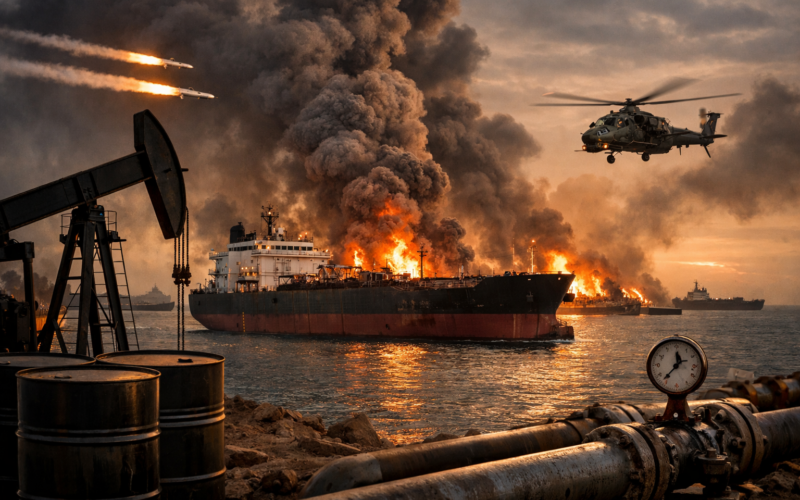
Oil prices extended gains on Monday, March 16, 2026, as the United States-Israeli military campaign against Iran entered its third week with no diplomatic resolution in sight, driving crude benchmarks higher amid deepening concerns about the physical security of Gulf energy export terminals and the continued effective closure of the Strait of Hormuz, the world’s most critical oil transit chokepoint.
Brent crude futures rose $2.01, or 1.95%, to $105.15 a barrel in early Asian trading after settling $2.68 higher on Friday. United States West Texas Intermediate crude climbed $1.61, or 1.63%, to $100.32 a barrel, following a gain of nearly $3 in the previous session. Both benchmarks have now surged more than 40% in March alone, reaching their highest levels since 2022, driven by Tehran’s decision to halt tanker traffic through the Strait of Hormuz in retaliation for United States and Israeli strikes launched on February 28. The 52-week price range for Brent crude futures has spanned from $58.40 to $119.50, with Monday’s trading range between $104.89 and $106.44.
The conflict disrupted approximately 20% of global oil supplies transiting the Strait of Hormuz, causing Brent crude prices to rise from around $70 to over $110 per barrel within days of the conflict’s outbreak. Oil prices have now risen more than 40% since the United States and Israel launched attacks on Iran on February 28.
Why are Saudi Arabia’s Ras Tanura and Abqaiq facilities now considered the most vulnerable oil infrastructure in the Gulf?
Saudi Arabia’s Ras Tanura export terminal and the Abqaiq oil processing complex have been listed as critical and highly vulnerable energy facilities in the Gulf by JPMorgan analysts, alongside the United Arab Emirates’ Fujairah terminal. Ras Tanura is the world’s largest crude export terminal by throughput and a central node in Saudi Aramco’s export logistics. Abqaiq, operated by Saudi Aramco, processes and stabilizes the majority of Saudi crude before it enters the export pipeline. A successful strike on either facility would reduce global oil output by several million barrels per day on top of existing war-related supply losses, representing a materially different threat to international energy markets than tanker disruptions alone.
Oil loading operations at Fujairah resumed on Sunday, according to a Fujairah-based industry source who spoke to Reuters. Fujairah, which lies outside the Strait of Hormuz, serves as the outlet for about 1 million barrels per day of the United Arab Emirates’ flagship Murban crude oil, a volume equivalent to approximately 1% of global daily demand. The resumption of loading at Fujairah provides a functioning but limited bypass route for United Arab Emirates crude exports, though the volume falls far short of what the country previously moved through the Strait.
How the Strait of Hormuz closure became the largest oil supply disruption in the history of global energy markets
The International Energy Agency has described the conflict as creating the largest supply disruption in the history of the global oil market. Crude and oil product flows through the Strait of Hormuz have plunged from around 20 million barrels per day before the war started to a trickle. Gulf countries have cut total oil production by at least 10 million barrels per day.
At least 16 commercial vessels have been attacked in the region since the start of the conflict, according to the United Kingdom Maritime Trade Operations centre. No more than five ships have passed through the Strait of Hormuz each day since the United States and Israel launched joint strikes on Iran on February 28, compared with an average of 138 daily transits before the war.
Iran’s Islamic Revolutionary Guard Corps has declared it will not allow any vessel through the Strait of Hormuz, with a spokesperson for the Khatam al-Anbiya Headquarters warning that any vessel linked to the United States, Israel, or their allies would be considered a legitimate target. Iran’s new supreme leader Mojtaba Khamenei, who succeeded his slain father, further reinforced the closure in his first public address via state television, vowing to continue attacks on Persian Gulf neighbors and maintain the effective blockade of the waterway.
The Strait of Hormuz sits at the entrance to the Persian Gulf from the Gulf of Oman, with Iran lying to its north and Oman to its south. No comparable maritime route exists for the volume of crude and petroleum products that previously transited the passage. Pipeline alternatives have been activated but cannot absorb the shortfall. Saudi Arabia has increasingly diverted oil to the Red Sea port of Yanbu via the East-West Crude Oil Pipeline, while the United Arab Emirates has diverted oil via the Abu Dhabi Crude Oil Pipeline to the port of Fujairah on the Arabian Sea. The combined capacity of these pipelines, however, is unable to match the volume previously moved through the Strait, leaving a structural deficit of about 12 million barrels per day.
Why the International Energy Agency’s record 400 million barrel reserve release cannot resolve a 20 million barrel daily deficit
The International Energy Agency confirmed on Sunday that more than 400 million barrels of oil reserves will begin flowing to the market in a record coordinated draw aimed at combating price spikes caused by the Middle East war. Stocks from Asia and Oceania will be released immediately, with stocks from Europe and the Americas becoming available at the end of March.
The intervention has so far produced limited market stabilization relative to the underlying supply gap. At the United States Energy Information Administration’s projected global consumption rate of 105.17 million barrels per day for 2026, the 400 million barrels of released reserves would theoretically cover just four days of total global consumption. When measured against normal daily traffic through the Strait of Hormuz of around 20 million barrels per day, the released volume equals only about 20 days of typical flows.
The United States Strategic Petroleum Reserve held 415.4 million barrels as of February 18, 2026, with a maximum drawdown capacity of 4.4 million barrels per day and a transit time of approximately 13 days to United States markets after a presidential release order. Energy analysts have noted the release may soften the shock and calm nerves temporarily, but would remain limited as long as the fundamental problem of tanker movement through the Strait of Hormuz goes unresolved.
How Gulf producers from Kuwait to Qatar have declared force majeure as regional energy output collapses
On March 6, Qatari Energy Minister Saad Sherida al-Kaabi warned that if the war continues, other Gulf energy producers may be forced to halt exports and declare force majeure. Qatar halted gas production on March 2 and declared force majeure on gas contracts on March 4. Kuwait declared force majeure and announced cuts to oil production on March 7.
Disruptions extend beyond upstream production and exports. Several refineries and gas processing facilities have shut down due to attacks or safety concerns, while the Strait closure is forcing export-oriented refineries to reduce output or shut completely as product storage fills up. More than 4 million barrels per day of refining capacity is at risk. Gulf producers exported roughly 3.3 million barrels per day of refined products and 1.5 million barrels per day of liquefied petroleum gas in 2025.
Energy products beyond crude oil facing severe supply pressures include jet fuel and liquefied natural gas. Some 30% of Europe’s supply of jet fuel originates from or transits via the Strait, while one-fifth of the global supply of liquefied natural gas passes through the waterway. The blockade has also triggered a near halt of sulfur exports from the Gulf, which accounts for approximately 45% of global sulfur supply, with downstream knock-on effects expected in fertilizer markets, copper processing, and sulfuric acid availability.
What the disruption means for Asia’s oil-dependent economies and the global demand outlook through mid-2026
The majority of the crude oil shipped through the Strait of Hormuz goes to Asia. China, India, Japan, and South Korea account for nearly 70% of Strait shipments, according to the United States Energy Information Administration.
Japanese refiners have asked the government to release some of their stockpiled oil. The refiners obtain about 95% of their crude oil from Saudi Arabia, Kuwait, the United Arab Emirates, and Qatar, with approximately 70% of this Middle Eastern oil delivered to Japan via ships transiting the Strait of Hormuz. Japanese Prime Minister Sanae Takaichi confirmed the country would begin releasing emergency oil reserves on Monday. In the second week of March 2026, California’s gasoline prices exceeded $5 per gallon due to the conflict with Iran. China, which receives a third of its oil via the Strait, has continued limited vessel movements through the waterway under Iranian tolerance, though the scale is insufficient to materially offset the broader shutdown.
The International Energy Agency’s March 2026 Oil Market Report noted that widespread flight cancellations across the Middle East, combined with large-scale disruptions to liquefied petroleum gas supplies, are expected to curb global oil demand by around 1 million barrels per day during March and April compared with previous estimates. Global oil consumption growth for 2026 has been revised down to 640,000 barrels per day year-on-year, a reduction of 210,000 barrels per day from the prior month’s forecast.
How diplomatic deadlock between Washington, Tehran, and regional allies is sustaining the oil market crisis
The Trump administration has rebuffed efforts by Middle Eastern allies to start diplomatic negotiations, according to three sources familiar with the efforts, while Iran has rejected the possibility of any ceasefire until United States and Israeli strikes end. The dual diplomatic impasse has narrowed the path to a rapid resolution and extended the horizon of market uncertainty.
United States Energy Secretary Chris Wright said on Sunday that he expects the war with Iran to end within the next few weeks, with oil supplies rebounding and energy costs declining afterwards. Tyler Goodspeed, chief economist at ExxonMobil, expressed skepticism about the assumption that abundant oil on the water and strategic reserves would be sufficient to cover short-term gaps, describing many more scenarios in which the Strait remains effectively closed for longer than scenarios in which normal traffic resumes.
Neil Atkinson, former head of oil at the International Energy Agency, described the effective closure of the Strait of Hormuz as something energy markets had never before encountered, and said that unless something changes very soon, the world could be facing a game-changing and unprecedented energy crisis. Brent crude futures could climb to $135 per barrel if the current situation persists for four months, according to Janiv Shah, vice president of oil markets at Rystad Energy.
Iran’s Islamic Revolutionary Guard Corps has separately warned in public statements that oil could reach $200 per barrel, directly linking price trajectory to the security environment it asserts the United States and Israel have created in the region. SEB analyst Meyersson noted that as the conflict enters its third week, the lack of a clear resolution has left global markets increasingly worried about an uncontrollable escalatory spiral.
What the Strait of Hormuz oil crisis and Gulf infrastructure threat means for global energy markets and supply security
- Brent crude futures rose to $105.15 a barrel on Monday, March 16, 2026, as both Brent and West Texas Intermediate benchmarks extended gains exceeding 40% since the United States-Israeli strikes on Iran began on February 28, representing their highest levels since 2022.
- The International Energy Agency has classified the conflict as the largest oil supply disruption in the history of global energy markets, with Gulf producers having cut total output by at least 10 million barrels per day and global oil supply projected to fall by 8 million barrels per day in March.
- Saudi Arabia’s Ras Tanura export terminal and Abqaiq oil processing facilities, along with the United Arab Emirates’ Fujairah terminal, have been identified by JPMorgan analysts as critical and highly vulnerable energy infrastructure in the Gulf, raising concern that the crisis could escalate beyond a shipping disruption to direct damage to production capacity.
- The International Energy Agency has authorized the release of more than 400 million barrels from member nations’ strategic stockpiles in a record intervention, though analysts note this volume covers approximately four days of global consumption and cannot substitute for restored shipping flows through the Strait of Hormuz.
- Diplomatic efforts to end the conflict remain deadlocked, with the Trump administration rebuffing regional mediation efforts and Iran rejecting any ceasefire while strikes continue, sustaining upward pressure on oil prices as the conflict enters its third week without a clear resolution.
Discover more from Business-News-Today.com
Subscribe to get the latest posts sent to your email.