




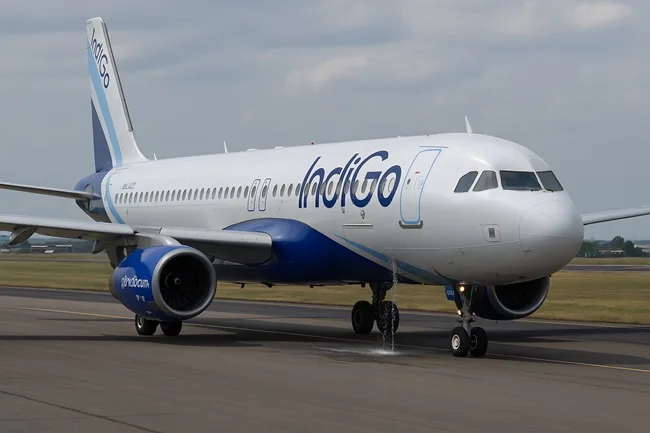
InterGlobe Aviation Limited (NSE: INDIGO), the parent company of IndiGo, India’s dominant low-cost carrier with roughly 62 percent of the domestic aviation market, confronted a compounding operational crisis in the fortnight beginning March 10, 2026 when three interlocking developments struck simultaneously: the immediate resignation of chief executive officer Pieter Elbers, the partial suspension of Middle East flight operations due to geopolitical conflict, and the introduction of a structured fuel surcharge across all routes in response to an 85-plus percent spike in Aviation Turbine Fuel costs. Managing Director Rahul Bhatia, who co-founded the airline 22 years ago, has stepped in as interim chief executive while a permanent successor is sought. The confluence of leadership disruption, route network contraction, and sharply higher operating costs arrives at a moment when InterGlobe Aviation’s stock has already shed significant ground from its 52-week high of Rs 6,232.50, with the shares trading around Rs 4,370 on the NSE as of March 15, 2026.
Why did Pieter Elbers resign from IndiGo and what does the leadership change signal for InterGlobe Aviation’s strategy?
Elbers, a Dutch aviation veteran who led KLM for eight years before joining IndiGo in September 2022, cited personal reasons in his resignation letter and requested that his notice period be waived. The Board accepted both requests at a meeting that lasted all of 15 minutes on the evening of March 10. The official framing, however, has not fully suppressed the context. His departure comes three months after IndiGo cancelled more than 4,000 flights between December 1 and 9, 2025 — a breakdown triggered by the airline’s failure to plan adequately for the Directorate General of Civil Aviation’s tightened Flight Duty Time Limitations, which extended mandatory weekly rest for pilots from 36 to 48 hours and restricted night landings. The crisis left an estimated 300,000 passengers stranded across India’s airports, prompted direct government intervention, and drew a record DGCA fine of Rs 22.20 crore, with show-cause notices directed personally at senior management, including Elbers.
The timing of the resignation — arriving at a moment when the airline was already under pressure from geopolitical disruption to its international network — suggests the board concluded that a reset of the executive leadership was a necessary precondition for rebuilding credibility with regulators, investors, and the travelling public. Whether characterized as a decision driven by personal circumstances or institutional pressure, the outcome is the same: IndiGo enters a period of strategic transition without a permanent CEO at the precise moment it faces the most complex multi-front challenge in its 20-year history.
The Elbers era delivered genuine structural progress. Under his leadership, InterGlobe Aviation crossed the USD 10 billion revenue threshold, expanded the fleet to more than 440 aircraft, and secured a landmark order for 500 Airbus A320-family planes — one of the largest single procurement commitments in aviation history. Elbers also pushed hard on internationalisation, initiating long-haul planning and launching business-class services on select routes, moves that departed meaningfully from IndiGo’s traditionally spartan low-cost identity. That strategic pivot now faces its first test without the executive who originated it.
How has the US-Iran conflict disrupted IndiGo’s Middle East operations and what is the revised network as of March 2026?
IndiGo’s Middle East network, historically one of the airline’s most lucrative international corridors given the large Indian diaspora workforce in Gulf countries, came under severe stress as geopolitical hostilities in the region escalated in early March 2026. The airline initially suspended several destinations entirely and has since undertaken a phased restoration, settling on 252 weekly flights covering the period from March 16 to March 28, 2026.
Within that revised schedule, operations to Saudi Arabia have been largely restored at 126 weekly flights, covering Riyadh from Mumbai and Delhi, Jeddah from Bengaluru, Mumbai, Calicut, Hyderabad, and Delhi, and Medina from Mumbai. Oman returns at 28 weekly flights, with daily Muscat services from Mumbai and Kochi. The UAE corridor operates at 98 weekly flights, with daily Dubai services from Delhi and Mumbai across multiple timings and daily Abu Dhabi rotations from both hubs. However, planned operations to Doha, Kuwait, Bahrain, Dammam, Fujairah, Ras Al Khaimah, and Sharjah remain fully suspended until at least March 28. The airline has noted that airspace restrictions, airport constraints, rising fuel and insurance costs, and broader security uncertainty all factor into capacity decisions, and that the schedule remains subject to change.
For IndiGo, the Middle East represents more than a geographic network segment. The corridors to Saudi Arabia, the UAE, and Oman connect millions of Indian migrant workers, students, and business travellers who form a structurally loyal and volume-consistent passenger base. Any prolonged suspension not only removes contribution margin from a high-load-factor set of routes but risks ceding slot-level advantages and market relationships to competitors including Air India and SpiceJet that may move faster to restore connectivity once conditions stabilise. The decision to maintain a 252-flight weekly floor even under these conditions reflects a calculation that abandoning the market entirely would be strategically costly beyond the immediate period.
What is the impact of IndiGo’s new fuel surcharge on domestic and international ticket prices from March 14, 2026?
IndiGo introduced a route-differentiated fuel surcharge effective 00:01 hours on March 14, 2026, covering all new bookings across its domestic and international network. The charge is structured in six bands: Rs 425 per sector for travel within India and across the Indian subcontinent, Rs 900 for Middle East routes, Rs 1,800 for South East Asia, China, Africa, and West Asia, and Rs 2,300 for European routes.
The airline’s basis for the surcharge is an 85-plus percent increase in jet fuel prices for the Middle East region as tracked by the International Air Transport Association’s Jet Fuel Monitor. Aviation Turbine Fuel represents one of the single largest line items in any airline’s cost structure, typically accounting for 35 to 45 percent of total operating expenses at Indian carriers. A surge of this magnitude in regional fuel pricing creates an immediate and material earnings headwind that cannot be absorbed through yield management or capacity adjustments alone within a short time horizon.
The framing chosen by IndiGo — a transparent, separately itemised fuel charge rather than a silent fare increase — is both pragmatic and defensible from a regulatory standpoint. It makes the cost driver visible to consumers while giving the airline the flexibility to adjust or withdraw the surcharge if fuel prices correct. Air India Group announced comparable surcharges from March 12, confirming that this is a sector-wide response rather than a carrier-specific vulnerability. The practical implication for passengers is a net ticket price increase ranging from roughly Rs 425 on short domestic hops to Rs 2,300 on European routes, applied per sector. A round-trip passenger on a London service, for example, faces an additional Rs 4,600 in surcharges at current rates, a non-trivial addition to fares that were already elevated.
How is IndiGo’s stock performing and what do analysts project for InterGlobe Aviation’s earnings outlook through FY27?
InterGlobe Aviation’s shares have had a difficult few months in market terms. The stock touched a 52-week high of Rs 6,232.50 before progressively declining. By mid-March 2026, the NSE-listed shares were trading around Rs 4,370, having shed more than 30 percent from their peak. The one-week decline of approximately 11 percent indicates that the market is treating the convergence of leadership uncertainty, Middle East network disruption, and fuel cost escalation as a compounding negative rather than as discrete and manageable events.
The consensus analyst view remains broadly constructive on IndiGo’s structural position. Citi maintains a Buy rating but has reduced its target price to Rs 5,100, citing geopolitical risk, fuel cost headwinds, and Indian rupee depreciation. Investing.com data from March 13 shows 21 of 22 tracked analysts in a Buy or Strong Buy posture, with an average 12-month target of Rs 5,708.80 and a high estimate of Rs 6,600. The implied upside from current levels is substantial — suggesting the market selloff has moved the stock into territory where the risk-reward calculus becomes interesting for investors with a 12-to-18-month horizon and tolerance for near-term earnings volatility.
The earnings trajectory has, however, deteriorated noticeably. InterGlobe Aviation reported a 77.6 percent year-on-year decline in consolidated net profit to Rs 549.8 crore in the third quarter of FY26, reflecting the combined impact of the December operational crisis, associated labour and compensation costs, and early fuel price pressure. JPMorgan has cut its FY26 and FY27 earnings per share estimates by 13 and 14 percent respectively, citing ongoing fuel cost exposure, a weaker rupee, and slower-than-expected traffic recovery on disrupted international routes. The next earnings release is scheduled for May 27, 2026, and will be the first formal financial accounting of the March disruption period.
What are the competitive implications of IndiGo’s crisis for Air India, Akasa Air, and India’s aviation market in FY26?
IndiGo’s market position remains formidable by any comparative standard. A domestic share of around 62 percent, a fleet of 400-plus aircraft, 95-plus domestic and 40-plus international destinations, and 124 million customers carried in CY25 represent scale that none of its Indian competitors can match in the near term. Air India Group and Akasa Air are the two carriers with credible growth trajectories, but both operate at a fraction of IndiGo’s network depth and operational footprint.
However, the period of leadership transition and network volatility does create selective openings. Air India, backed by Tata Group capital and executing its own transformation, has moved quickly to introduce fuel surcharges on a comparable timetable, signalling competitive parity on yield management rather than opportunistic discounting. That discipline on both sides is rational given the shared cost shock, but it also means any market share movement will likely occur on schedule reliability and customer experience rather than pricing during the current period.
The Middle East suspension, if prolonged beyond March 28, presents the most concrete competitive risk. Indian carriers with meaningful Gulf exposure — including Air Arabia India and Akasa on emerging international routes — could accelerate capacity deployment to capture the diaspora traffic segment that IndiGo is currently unable to serve on suspended routes. Regaining those passengers once normal operations resume is not guaranteed, particularly if competing carriers lock in loyalty or corporate accounts during the gap period.
For IndiGo, the strategic question under Rahul Bhatia’s interim leadership is whether the immediate period of consolidation — tightening operational processes, stabilising the Middle East network, managing the fuel cost environment, and identifying a credible permanent CEO — can be executed quickly enough that the structural advantages built under Elbers, particularly the international expansion agenda and the wide-body long-haul optionality, are not simply suspended but actively maintained as live strategic commitments.
Key takeaways: what IndiGo’s triple crisis means for management, investors, and the broader Indian aviation sector
- CEO Pieter Elbers resigned effective March 10, 2026, citing personal reasons, following months of regulatory pressure stemming from the December 2025 flight cancellation crisis that left 300,000-plus passengers stranded and attracted a record DGCA fine of Rs 22.20 crore.
- Rahul Bhatia, IndiGo’s co-founder and Managing Director, has assumed interim leadership; the board has indicated a permanent appointment is expected in short order, but the timeline and candidate pool remain undisclosed.
- IndiGo is operating a reduced Middle East schedule of 252 weekly flights from March 16 to March 28, 2026, with Saudi Arabia, UAE, and Oman partially restored while Doha, Kuwait, Bahrain, Dammam, and four UAE secondary cities remain fully suspended.
- A structured fuel surcharge ranging from Rs 425 per sector domestically to Rs 2,300 per sector for European routes took effect on March 14, 2026, driven by an 85-plus percent increase in Aviation Turbine Fuel costs in the Middle East region per IATA data.
- InterGlobe Aviation’s NSE-listed shares are trading around Rs 4,370 as of mid-March 2026, down more than 30 percent from the 52-week high of Rs 6,232.50, with the market pricing in compounding operational and earnings risks.
- The analyst consensus remains weighted toward Buy with an average 12-month target of approximately Rs 5,709, but JPMorgan has cut FY26 and FY27 EPS estimates by 13-14 percent citing fuel, currency, and traffic recovery risks.
- Q3FY26 net profit fell 77.6 percent year-on-year to Rs 549.8 crore; the next earnings release on May 27, 2026 will be the first comprehensive financial assessment of the March multi-crisis period.
- Air India Group moved to introduce parallel fuel surcharges from March 12, confirming that India’s aviation sector faces a broad-based cost shock rather than an IndiGo-specific financial event.
- The Elbers-era strategic priorities — international network expansion, wide-body long-haul optionality, and a nascent premium product — remain in place structurally but face execution risk during the leadership transition period.
- IndiGo’s 62 percent domestic market share and 400-plus aircraft fleet provide a structural buffer, but the convergence of leadership uncertainty, route network disruption, and rising operating costs in a single fortnight represents the most complex operating environment the carrier has faced in its 20-year history.
Discover more from Business-News-Today.com
Subscribe to get the latest posts sent to your email.