




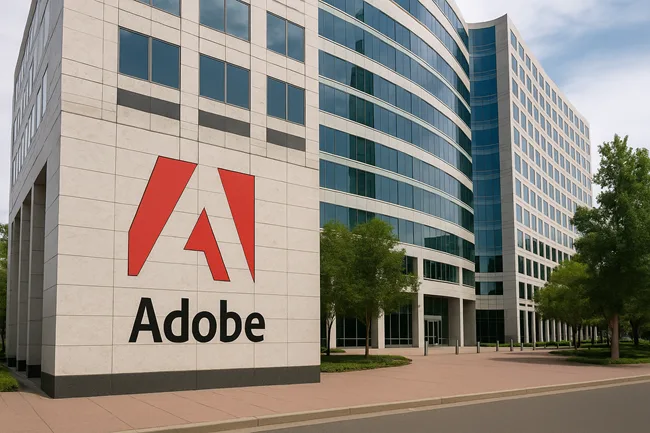
Adobe Inc. (Nasdaq: ADBE) reported record first-quarter FY2026 results on 12 March 2026, posting total revenue of $6.40 billion and non-GAAP diluted earnings per share of $6.06, both ahead of analyst consensus, while simultaneously disclosing that long-serving chief executive Shantanu Narayen will depart once a successor is named. The dual announcement captured the tension that has defined Adobe’s investment thesis for the past two years: genuinely improving financial fundamentals shadowed by persistent questions about AI-era competitive relevance. Adobe’s AI-first annualised recurring revenue more than tripled year over year, offering the clearest evidence yet that the company is converting its creative installed base into a monetisable AI franchise. Markets, however, focused heavily on the leadership change, with ADBE declining sharply in extended trading before opening Friday near 52-week lows.
How did Adobe’s Q1 FY2026 revenue and earnings compare to analyst expectations?
Adobe’s first-quarter FY2026 revenue of $6.40 billion represented 12 percent year-over-year growth, or 11 percent on a constant-currency basis. Total subscription revenue reached $6.17 billion, up 13 percent year over year, with Creative and Marketing Professionals generating $4.39 billion, a 12 percent increase, and Business Professionals and Consumers contributing $1.78 billion, up 16 percent. Non-GAAP earnings per share of $6.06 beat analyst expectations of $5.87, while Creative and Marketing Professionals subscription revenue of $4.39 billion cleared the $4.31 billion StreetAccount consensus. GAAP diluted EPS came in at $4.60, against the prior-year period’s $4.14. GAAP operating income grew to $2.42 billion from $2.16 billion a year earlier, while non-GAAP operating income reached $3.04 billion, implying a non-GAAP operating margin of approximately 47.4 percent.
Record operating cash flow of $2.96 billion in the quarter was a notable operational milestone, exceeding the prior-year period’s $2.48 billion by roughly 19 percent. Remaining Performance Obligations exited the quarter at $22.22 billion, with 67 percent classified as current, reflecting durable near-term revenue visibility. Total Annualised Recurring Revenue stood at $26.06 billion at quarter end. Adobe also repurchased approximately 8.1 million shares during the period at a cost of $2.48 billion, reducing diluted share count to 411 million from 438 million a year earlier, which contributed meaningfully to per-share earnings growth.
What does Adobe’s AI-first ARR tripling year over year signal about its monetisation strategy?
The most strategically significant data point in Adobe’s Q1 release was not the headline revenue figure but the AI-first ARR trajectory. The metric more than tripling year over year, even from a base that has grown substantially over the past several quarters, indicates that Adobe is successfully embedding AI-powered features into its subscription tiers and that customers are paying incremental amounts to access them. Adobe has taken a deliberate approach: rather than releasing AI tools as standalone products competing with OpenAI, Midjourney, or Stability AI, it has woven generative capabilities into Photoshop, Illustrator, Premiere Pro, and Acrobat, anchoring them to workflows that creative and enterprise users already pay to access. During the quarter, Adobe announced availability of Acrobat, Express, and Photoshop applications within OpenAI’s ChatGPT assistant, extending the reach of its tools into one of the highest-traffic AI interfaces in the world.
The Business Professionals and Consumers segment’s 16 percent subscription growth is particularly instructive. This is the cohort most susceptible to displacement by free or low-cost AI tools, yet Adobe is growing it faster than its core professional segment. That dynamic suggests the company is successfully pulling prosumer and enterprise workflows upmarket through AI-enhanced capabilities rather than defending a static feature set. Whether the AI-first ARR metric reaches the scale Narayen described on the earnings call as Adobe’s potential next billion-dollar business will depend on sustaining pricing discipline and continuing to ship genuinely differentiated AI features faster than the competitive field converges.
Why is Shantanu Narayen stepping down as Adobe CEO after 18 years and what does the succession search mean for strategy?
Narayen, 62, notified Adobe’s board on 9 March 2026 of his decision to transition from the chief executive role and will remain in position until a successor is appointed, at which point he will assume the role of Chair of the Board. The board has appointed Frank Calderoni, Lead Independent Director, to chair a special committee overseeing a search that will consider both internal and external candidates. Narayen has served as CEO since 2007, having joined Adobe in 1998 as a vice president. Under his leadership, Adobe navigated the shift from perpetual software licences to a subscription model, completed transformative acquisitions including Marketo and Magento, and grew its market capitalisation from under $10 billion to a peak exceeding $300 billion in late 2021.
The timing is charged. Adobe’s stock has fallen more than 23 percent in the year to date through Thursday’s close, and is approximately 60 percent below its all-time high. The prevailing investor concern is that generative AI will erode demand for Adobe’s traditional creative tools, a thesis that the company’s financial results do not currently support but that continues to weigh on the multiple the market is willing to assign. Narayen’s departure introduces an additional layer of uncertainty precisely when a consistent strategic narrative and visible commitment to AI integration would be most valuable. The share price reaction in extended trading, with ADBE declining roughly 6 to 9 percent before recovering partially, reflected investor discomfort with leadership discontinuity at this juncture.
Narayen’s stated intention is to follow the model established by Adobe’s co-founders John Warnock and Charles Geschke, who remained on the board after stepping back from executive roles. Industry peers reacted warmly. Microsoft chief executive Satya Nadella publicly praised Narayen’s record, noting the empathy he brought to the creative process and the significance of what Adobe has built. Figma co-founder and CEO Dylan Field, whose company abandoned a $20 billion acquisition by Adobe in 2023 after regulatory opposition, also offered commendation. The broadly positive reception from the technology community underscores that the transition is being presented as planned and orderly rather than forced, but markets will not stabilise until a credible shortlist of candidates emerges.
How does Adobe’s Q2 FY2026 guidance and Semrush acquisition fit into its competitive positioning against Canva and Figma?
For the second quarter of FY2026, Adobe guided total revenue of $6.43 billion to $6.48 billion and non-GAAP diluted EPS of $5.80 to $5.85, both modestly ahead of the analyst consensus of $6.42 billion and $5.68 per share respectively. The company reaffirmed its full-year FY2026 targets and noted that second-quarter guidance excludes any contribution from its pending acquisition of Semrush Holdings, which remains subject to regulatory approval. Semrush, a search engine optimisation and content intelligence platform, would extend Adobe’s reach into the digital marketing workflow and reinforce its experience cloud positioning against Salesforce Marketing Cloud and broader marketing technology stacks.
Adobe’s competitive environment has become materially more complex over the past three years. Canva has expanded aggressively into the professional market with collaboration features, an enterprise tier, and an AI toolkit that directly addresses mid-market creative teams. Figma, following the failed Adobe acquisition, has continued to scale its design platform and is now publicly listed. In the AI-native design space, a wave of newer entrants from Midjourney to Runway has demonstrated that high-quality generative output is achievable at consumer price points. Adobe’s structural advantage remains its depth of professional workflow integration: Photoshop, Illustrator, and Premiere Pro are embedded in the production pipelines of advertising agencies, broadcasters, publishing houses, and enterprise marketing teams in a way that requires years of re-platforming to displace.
The succession question intersects directly with this competitive context. An internal candidate drawn from Adobe’s product or engineering leadership would likely provide continuity of the current AI integration roadmap. An external candidate with a stronger enterprise software or platform background could accelerate the Experience Cloud repositioning and the Semrush integration thesis. The board’s decision to consider both pools is strategically appropriate given the breadth of Adobe’s product estate, but the extended uncertainty of an open-ended search creates a window in which competitors can accelerate recruitment of key talent and deepen relationships with shared enterprise customers.
What does Adobe ADBE stock’s 52-week decline and the CEO departure mean for valuation and investor thesis?
As of the morning of 13 March 2026, ADBE was trading in the range of approximately $247 to $275, against a 52-week high of $422.95 and a 52-week low of approximately $244. That places the stock roughly 40 percent below its year-ago peak and in the bottom quartile of its one-year range. The shares had already declined approximately 23 percent in the year to date before Thursday’s earnings release, pricing in significant concern about AI disruption well before the CEO transition announcement added further pressure. Stifel lowered its price target on ADBE to $400 from $450 while maintaining a Buy rating following the results, characterising the Q1 print as relatively positive while acknowledging that the leadership transition introduces a new variable.
Morningstar’s published fair value estimate for ADBE stands at $717, with the stock trading at what the firm characterises as deeply undervalued territory relative to intrinsic value. The gap between current trading prices and both analyst price targets and intrinsic value models reflects the degree to which the market has discounted the AI disruption scenario into the share price. At approximately $247, ADBE is trading at roughly 11 to 12 times trailing twelve-month non-GAAP earnings, a multiple more consistent with a mature, low-growth technology company than with a business generating 12 percent revenue growth, 47 percent non-GAAP operating margins, and record operating cash flows. The question for institutional investors is whether the depressed multiple represents a mispricing of durable fundamentals or a rational forward discount for an accelerating competitive threat that has not yet shown up materially in quarterly results.
The earnings beat and guidance raise are, in isolation, constructive for the bull case. Non-GAAP EPS of $6.06 beat by approximately 3 percent, revenue cleared consensus, and forward guidance exceeded expectations. The AI-first ARR more than tripling year over year is the kind of specific, measurable metric that gives long-only investors a genuine growth narrative to hold against the broader disruption fear. The problem is that the CEO departure, disclosed simultaneously, prevented the earnings results from closing any valuation gap on their own. Adobe’s management challenge for the next two to three quarters is to demonstrate that strategic continuity is intact and that the AI ARR trajectory is extending into the total addressable market rather than simply capturing existing subscription base upgrades.
What are the balance sheet and capital return implications of Adobe’s Q1 FY2026 cash flow and share buyback programme?
Adobe’s balance sheet at quarter end showed $6.33 billion in cash and cash equivalents, up from $5.43 billion at the end of the prior quarter, against total debt of approximately $6.23 billion, resulting in a roughly net-neutral debt position. The $2.96 billion operating cash flow in a single quarter gives Adobe substantial financial flexibility. The company deployed $2.48 billion of that in share repurchases during Q1, reducing share count by approximately 8.1 million. This pace of buyback activity signals that management views the current share price as an attractive return of capital opportunity, which is consistent with the stock trading well below internal valuation assessments.
Deferred revenue stood at $7.37 billion, comprising $7.28 billion in current and $95 million in long-term obligations, providing a clear line of sight into near-term recognised revenue. Current Remaining Performance Obligations at 67 percent of total RPO of $22.22 billion imply roughly $14.89 billion of revenue expected to be recognised within the next twelve months, a figure that cross-checks against Adobe’s full-year guidance framework. The pending Semrush acquisition will add to the balance sheet’s complexity, requiring integration capital and likely incurring acquisition-related costs in subsequent quarters that will inflate GAAP expense lines even as non-GAAP results remain relatively insulated.
Key takeaways: what Adobe’s Q1 FY2026 results and CEO transition mean for investors, competitors, and the creative software industry
- Adobe’s Q1 FY2026 revenue of $6.40 billion and non-GAAP EPS of $6.06 both beat consensus, with record operating cash flow of $2.96 billion demonstrating sustained capital generation capacity.
- AI-first ARR more than tripling year over year is the single most important leading indicator that Adobe’s generative AI monetisation is gaining real traction rather than remaining a roadmap narrative.
- Shantanu Narayen’s planned departure after 18 years introduces material leadership risk at a pivotal strategic moment; the market’s negative after-hours reaction confirms that his tenure has been a core element of investor confidence.
- The CEO search spanning internal and external candidates provides optionality but risks an extended period of strategic ambiguity that competitors including Canva and Figma can exploit to accelerate enterprise sales efforts.
- Adobe’s ADBE stock trading near 52-week lows at an approximately 11 to 12 times non-GAAP earnings multiple represents a significant discount to intrinsic value models and analyst price targets if the AI disruption thesis fails to materialise in revenue loss.
- Q2 FY2026 guidance of $6.43 billion to $6.48 billion in revenue and $5.80 to $5.85 non-GAAP EPS modestly exceeded consensus and reaffirmed full-year targets, supporting near-term revenue visibility.
- The pending Semrush acquisition, excluded from current guidance pending regulatory approval, could strengthen Adobe’s digital marketing data and SEO capabilities but adds integration execution risk in a period of leadership transition.
- Adobe’s $22.22 billion in Remaining Performance Obligations, with 67 percent classified as current, provides meaningful forward revenue visibility and reduces near-term downside risk to guidance.
- The Business Professionals and Consumers segment’s 16 percent subscription growth outpacing the core Creative and Marketing Professionals cohort suggests Adobe is successfully expanding its addressable base through AI-enhanced entry-tier offerings.
- Stifel’s maintained Buy rating with a reduced price target reflects the near-term consensus: the financial fundamentals are intact, but the leadership transition has compressed the timeline within which Adobe needs to resolve its AI narrative with investors.
Discover more from Business-News-Today.com
Subscribe to get the latest posts sent to your email.


