




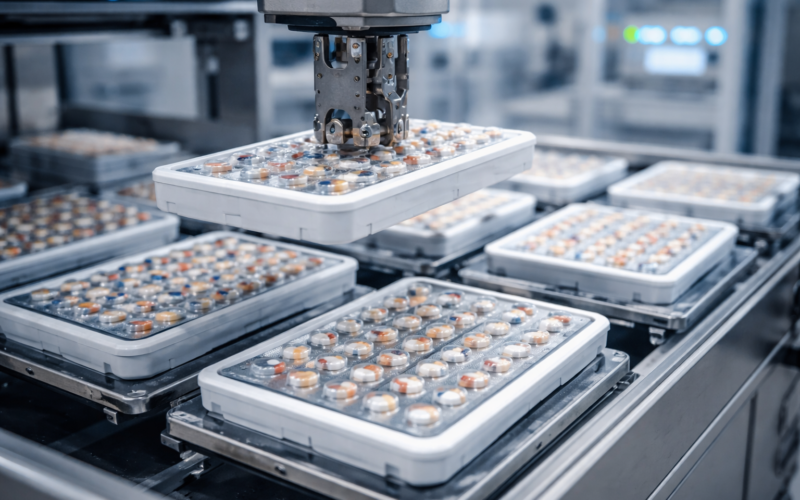
JFCRx has introduced TruCard Stack, a modular automation add-on designed to increase throughput in pharmacy blister card packaging operations. The new system integrates with the existing TruCard blister card platform and automates the loading and unloading of up to twenty patient trays at a time, allowing pharmacies to run higher-volume packaging workflows with reduced manual intervention. The launch directly addresses a growing operational constraint across pharmacies that manage adherence packaging programs, where rising prescription complexity and labor shortages have made blister card production difficult to scale. By embedding the technology inside its cloud-connected EnLite ecosystem, JFCRx is positioning the system as part of a broader analytics-driven automation platform aimed at improving pharmacy productivity and operational visibility.
The move reflects a quiet but accelerating shift in pharmacy operations toward automation and workflow digitization. While pharmacy automation historically focused on dispensing robotics or medication storage systems, adherence packaging has emerged as a different operational challenge. Blister card production is repetitive and technician-intensive, yet accuracy standards remain extremely high because pharmacists must verify every patient medication pack. As pharmacies expand adherence packaging programs for aging populations and complex chronic disease patients, the operational pressure on packaging lines has steadily increased.
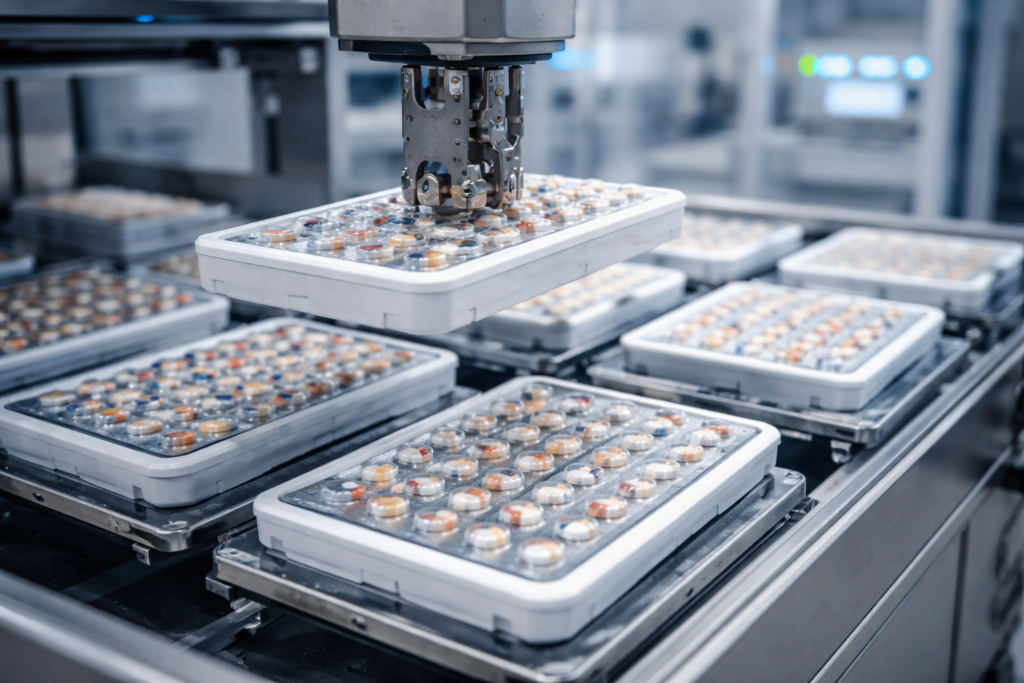
JFCRx’s new system is designed to address this bottleneck by automating one of the most time-consuming steps in blister packaging workflows: tray handling. In many pharmacies, technicians manually load and unload patient trays throughout the packaging process, which limits the number of cards that can be produced during a shift. Automating this step may appear incremental at first glance, but it removes a repetitive manual task that often slows the entire packaging line.
The company’s leadership has indicated that the goal behind TruCard Stack is to protect technician time and preserve pharmacist oversight capacity while increasing throughput. In practice, that means allowing pharmacies to produce higher packaging volumes without proportionally increasing staffing levels.
Why blister card adherence packaging is becoming a strategic operational priority for pharmacies
Medication adherence packaging has gradually moved from a niche service into a central pharmacy workflow, particularly in long-term care, specialty pharmacy, and chronic disease management programs. Blister cards organize medications into daily or time-based dosing compartments, helping patients follow complex medication regimens more accurately.
The clinical benefits of adherence packaging are widely recognized. Patients managing multiple prescriptions often struggle with dosing schedules, especially when medications must be taken at different times of the day. Packaging systems that visually organize medications can reduce missed doses and improve compliance, which in turn lowers hospitalizations and healthcare costs.
For pharmacies, however, adherence packaging creates operational challenges. Producing blister cards requires careful filling, verification, labeling, and quality control. Each patient pack must be checked by a pharmacist to ensure accuracy before it can be dispensed.
As demand grows, pharmacies face a difficult balancing act. Expanding packaging capacity can generate new revenue streams and strengthen patient retention, but scaling production without automation increases labor intensity. Technician shortages across the healthcare sector have only made the situation more complicated.
Automation solutions that increase packaging throughput without adding staff therefore occupy an increasingly important role in pharmacy infrastructure. Systems like TruCard Stack attempt to address that gap by enabling continuous production while preserving verification workflows.
How the TruCard Stack system fits into the broader JFCRx EnLite pharmacy automation ecosystem
JFCRx has structured TruCard Stack as a modular expansion to its existing TruCard blister card system rather than as a standalone product. This design approach allows pharmacies already using TruCard hardware to expand their production capacity without reconfiguring their facilities.
The system’s compact physical footprint is intended to simplify deployment. By integrating directly with existing equipment, the company aims to reduce installation complexity and allow pharmacies to scale incrementally as packaging demand grows.
TruCard Stack is also designed to operate within the EnLite platform, the cloud-based analytics and workflow ecosystem that connects multiple JFCRx automation tools. Through EnLite, pharmacies can monitor production activity, analyze workflow performance, and manage operational data from a centralized interface.
This integration highlights a broader strategic direction in pharmacy technology: the shift from isolated hardware systems toward connected operational platforms. Instead of treating automation devices as standalone tools, companies increasingly embed them inside software ecosystems that capture workflow data.
Such platforms allow pharmacy managers to track packaging performance metrics, identify bottlenecks, and optimize technician workloads. Over time, analytics capabilities may become as important as the automation hardware itself.
Could automation like TruCard Stack reshape the economics of adherence packaging programs
The business case for adherence packaging is relatively straightforward. Pharmacies that offer blister card services often generate stronger patient loyalty, improved refill consistency, and higher prescription retention rates. For healthcare systems and insurers, adherence improvements translate into reduced hospitalizations and better long-term outcomes.
However, the economics depend heavily on production efficiency. If packaging workflows require large amounts of technician time, margins can shrink quickly.
Automation that increases throughput therefore has the potential to shift the financial equation. By enabling higher packaging volumes without proportional staffing increases, systems like TruCard Stack could improve profitability for pharmacies that operate adherence programs at scale.
Continuous production capability may also unlock after-hours packaging workflows. If systems can operate with minimal technician oversight, pharmacies may be able to produce blister cards outside of traditional operating hours.
Such operational flexibility could allow pharmacies to smooth production schedules and manage demand spikes more effectively.
What competitive dynamics are shaping the pharmacy automation technology market today
The pharmacy automation sector has evolved significantly over the past two decades. Early automation systems focused primarily on dispensing robots and medication storage systems. More recent innovation has shifted toward workflow integration and data analytics.
Companies competing in this space increasingly emphasize end-to-end operational ecosystems rather than individual devices. Automation vendors now offer connected platforms that include packaging systems, verification tools, analytics dashboards, and workflow consulting services.
This approach reflects a growing recognition that pharmacy operations resemble complex production environments rather than simple retail workflows. Efficiency improvements often come not from a single machine but from coordinated process optimization across multiple steps.
JFCRx appears to be positioning itself within this broader trend by integrating hardware automation with analytics and workflow software through its EnLite platform. The strategy aligns with how many healthcare technology companies are approaching operational technology today.
Instead of selling isolated equipment, vendors are attempting to create data-driven infrastructure that becomes embedded in pharmacy operations.
What operational risks and adoption challenges could limit the impact of new pharmacy automation systems
Despite the operational advantages automation can provide, adoption is rarely frictionless. Pharmacy technology systems must integrate smoothly into existing workflows while maintaining strict regulatory and safety standards.
Pharmacists remain legally responsible for verifying medication accuracy, which means automation cannot replace the professional oversight that ensures patient safety. Any new system must therefore support verification processes rather than bypass them.
There are also financial considerations. Smaller pharmacies may hesitate to invest in automation equipment if packaging volumes remain modest. Capital expenditure decisions often depend on whether adherence packaging programs have already reached sufficient scale.
Training and workflow adaptation can also influence adoption speed. Even systems designed for seamless integration require staff training and operational adjustments.
However, as technician shortages continue to affect healthcare staffing, automation investments may become less discretionary and more essential. Pharmacies that struggle to recruit qualified staff may view automation as the only practical way to maintain service levels.
How pharmacy workflow automation is likely to evolve as healthcare systems prioritize medication adherence
Medication adherence remains one of the most persistent challenges in healthcare. Patients frequently miss doses, discontinue treatment early, or struggle to follow complex medication schedules. These issues can reduce treatment effectiveness and increase healthcare costs.
Healthcare systems, insurers, and policymakers increasingly recognize adherence improvement as a key lever for reducing avoidable medical spending. Pharmacies therefore play a critical role in delivering adherence support tools such as blister packaging.
Automation technologies that enable pharmacies to expand adherence services could indirectly influence broader healthcare outcomes. If pharmacies can scale packaging programs efficiently, more patients may gain access to adherence-friendly medication formats.
At the same time, pharmacy automation will likely become more data-driven. Future systems may combine packaging automation with predictive analytics that identify patients at risk of medication non-adherence.
By linking operational data with patient engagement tools, pharmacy technology platforms could eventually evolve into clinical decision support systems rather than purely operational tools.
Key takeaways: what the TruCard Stack launch signals for pharmacy automation and adherence packaging
- The launch of TruCard Stack highlights the growing operational pressure on pharmacies managing high-volume adherence packaging programs.
- Automation of tray handling addresses one of the most repetitive and labor-intensive steps in blister card production workflows.
- JFCRx is positioning TruCard Stack as a modular expansion within its broader EnLite analytics and automation ecosystem.
- Integration of hardware automation with cloud analytics reflects a wider shift toward data-driven pharmacy infrastructure.
- Technician shortages across healthcare are increasing the strategic importance of pharmacy workflow automation technologies.
- Adherence packaging programs can strengthen patient retention and refill consistency, but profitability depends heavily on operational efficiency.
- Continuous production capability may enable pharmacies to operate packaging workflows outside traditional working hours.
- Adoption of automation solutions may accelerate as pharmacies seek to scale services without increasing staffing levels.
- The competitive pharmacy automation market is increasingly defined by integrated platforms rather than standalone devices.
- If automation continues to improve packaging economics, adherence services could become a larger part of pharmacy care delivery models.
Discover more from Business-News-Today.com
Subscribe to get the latest posts sent to your email.