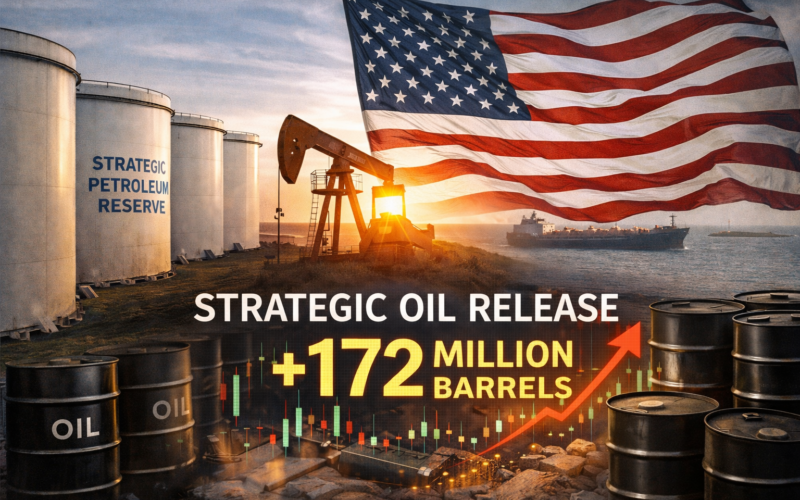
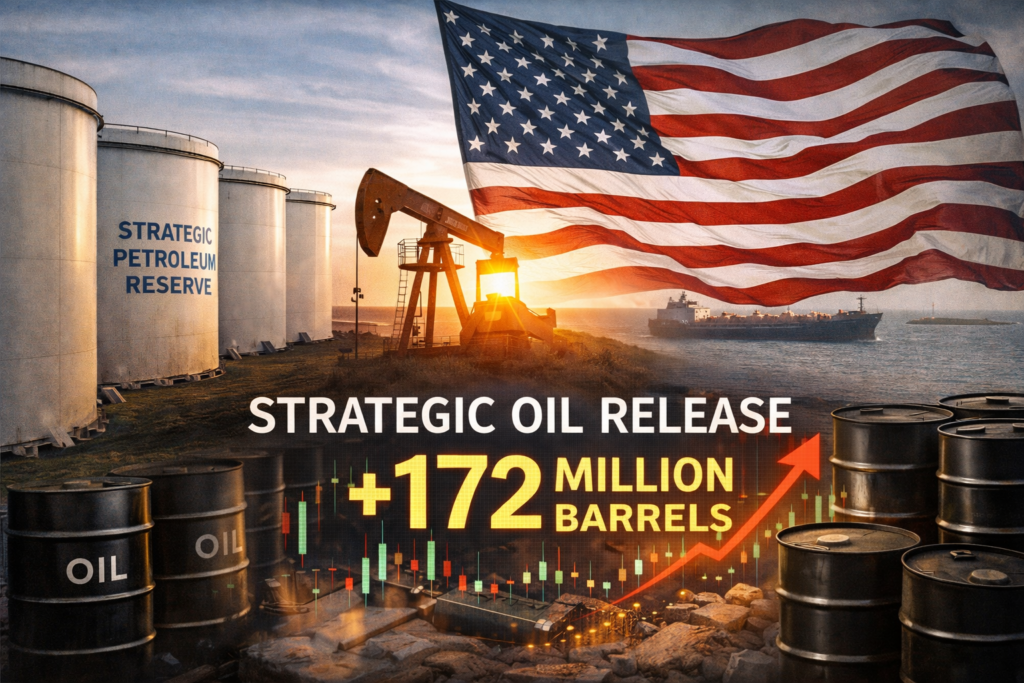
The United States government has authorised the release of 172 million barrels of crude oil from the Strategic Petroleum Reserve, the nation’s emergency energy stockpile, as part of the largest coordinated drawdown of global oil reserves in the history of the International Energy Agency. United States Secretary of Energy Chris Wright announced the decision in a formal statement issued on Wednesday, 11 March 2026, confirming that deliveries would begin the following week and would take approximately 120 days to complete based on planned discharge rates.
Secretary Wright stated that 32 member nations of the International Energy Agency unanimously agreed to President Donald Trump’s request to lower energy prices through a coordinated release of 400 million barrels of oil and refined products from their respective national reserves. The United States government’s contribution of 172 million barrels constitutes the largest single-country share of that coordinated 400 million barrel total.
The Strategic Petroleum Reserve currently holds more than 415 million barrels of crude oil, representing approximately 58 percent of its authorised maximum capacity of approximately 714 to 715 million barrels. Secretary Wright indicated that the United States government intends to replace approximately 200 million barrels within the following year, framing the release as a temporary and managed drawdown rather than a permanent reduction of the reserve.
President Trump confirmed the decision during a television interview with WKRC Local 12 in Cincinnati, Ohio on Wednesday, stating that his administration would reduce the reserve slightly and then refill it. Trump had previously been critical of decisions by the administration of former President Joe Biden to draw down the Strategic Petroleum Reserve to address fuel price pressures in 2022, but indicated that the current circumstances in the Middle East warranted the action.
The International Energy Agency’s decision was announced by IEA Executive Director Fatih Birol from the agency’s headquarters in Paris, France. Birol described the coordinated stock release as the largest emergency collective action in the organisation’s history, noting that IEA member countries unanimously agreed to the measure. The IEA said the reserves would be released over a timeframe appropriate to the national circumstances of each of its 32 member governments.
The coordinated release is the sixth time the International Energy Agency has deployed emergency oil stocks since the organisation was founded in 1974. Previous collective actions occurred in 1991, 2005, 2011, and twice in 2022. The most recent precedent, a release of 182.7 million barrels in two tranches in 2022 in response to Russia’s full-scale invasion of Ukraine, was at the time the largest in IEA history. The current 400 million barrel release more than doubles that 2022 figure.
IEA member countries collectively hold more than 1.2 billion barrels of public emergency oil stocks, with a further 600 million barrels of industry stocks held under government obligation. The 32 IEA member nations are primarily advanced economies across Europe, North America, and northeast Asia.
Japan’s Prime Minister Sanae Takaichi announced ahead of the formal IEA decision that Japan would release oil from its national and private reserves as early as Monday, 16 March 2026, without waiting for formal IEA approval. Japan committed approximately 80 million barrels from its reserves. Germany’s Economy and Energy Minister Katherina Reiche announced that Germany planned to release approximately 2.4 million tonnes of oil from its strategic holdings. The United Kingdom confirmed a contribution of 13.5 million barrels. South Korea announced a contribution of 22.46 million barrels from its strategic reserves. Austria and additional European nations also confirmed participation in the coordinated IEA drawdown.
The Group of Seven advanced economies discussed the release at a video conference chaired by French President Emmanuel Macron on Wednesday. Group of Seven energy ministers had met the previous day at IEA headquarters in Paris to assess available policy options, including making IEA emergency oil stocks available to global markets. United States Interior Secretary Doug Burgum said on Wednesday that the decision on whether Washington would participate in the IEA action rested ultimately with President Trump, and that he did not believe the world was facing an outright energy shortage, characterising the Strait of Hormuz blockade as a temporary transit problem.
Why has the Strait of Hormuz closure triggered the largest emergency oil reserve release in International Energy Agency history?
The coordinated reserve release is a direct response to the near-total disruption of oil and gas transit through the Strait of Hormuz, a critical maritime chokepoint off the southwestern coast of Iran through which approximately 20 million barrels of crude oil and oil products ordinarily pass each day. That volume represents approximately 20 to 25 percent of the world’s seaborne oil trade. Since the commencement of United States and Israeli military operations against Iran on 28 February 2026, the strait has been effectively impassable for commercial tanker traffic, owing to Iranian military threats against shipping, reported mining of the waterway, and attacks on vessels across the Persian Gulf.
The United States Navy confirmed on Tuesday, 10 March 2026, that United States forces had destroyed 16 Iranian minelaying vessels near the Strait of Hormuz, though President Trump said in social media posts that there were no confirmed reports of Iran having mined the passage. Iran, for its part, has threatened to block all oil shipments through the strait to countries associated with the United States and Israel, with Iranian officials warning publicly that oil prices could be driven above 200 United States dollars per barrel if the conflict escalates further.
Export volumes of crude oil and refined petroleum products through the Strait of Hormuz are currently estimated by the International Energy Agency at less than 10 percent of pre-war levels. The consequent supply shock has sent global energy markets into extreme volatility. International benchmark Brent crude oil surged above 119 United States dollars per barrel earlier in the week of 9 March 2026, the first time the Brent crude benchmark had exceeded 100 United States dollars since 2022 in the immediate aftermath of Russia’s full-scale invasion of Ukraine. United States crude oil prices are up more than 30 percent since the commencement of operations on 28 February 2026. The national average retail gasoline price in the United States has risen more than 50 cents per gallon since that date, reaching approximately 3.57 to 3.58 United States dollars per gallon, according to data from the American Automobile Association.
How does the United States Strategic Petroleum Reserve release compare with prior emergency drawdowns and what are the implications for domestic fuel prices?
The United States Strategic Petroleum Reserve is a federally managed emergency oil stockpile stored in underground salt caverns along the coastlines of Louisiana and Texas. It is the world’s largest government-owned emergency petroleum reserve by volume. The reserve was last drawn down in 2022, first as part of the International Energy Agency’s coordinated response to the Russia-Ukraine war and subsequently through a separate United States government sale of approximately 180 million barrels over a six-month period authorised by the Biden administration. Both the Biden administration and the Trump administration have subsequently signalled intentions to refill the reserve, though officials have noted that damage to some underground salt caverns has slowed replenishment efforts. As of late February 2026, the reserve contained approximately 415 million barrels, representing roughly 58 percent of its total capacity.
Analysts at JPMorgan Chase noted in a research note that once a presidential order is issued to deploy oil from the Strategic Petroleum Reserve, the United States Department of Energy typically does not begin deliveries for approximately 13 days, with additional shipping time required before volumes reach end consumers. JPMorgan Chase commodity analysts wrote that policy measures may have limited impact on oil prices unless safe passage through the Strait of Hormuz is assured. A United States Treasury Department estimate from the 2022 drawdown found that the combined release of United States and international reserves that year shaved approximately 17 to 42 cents from the price of a gallon of gasoline in the United States.
The International Energy Agency itself has noted that 400 million barrels, while historically unprecedented in scale, would be absorbed by market demand in approximately 26 days if it were used to replace the full volume of oil ordinarily passing through the Strait of Hormuz. IEA Executive Director Birol emphasised that the coordinated reserve release is designed to address immediate supply disruptions, but stated explicitly that the most important factor for restoring stable energy flows is the resumption of transit through the Strait of Hormuz.
How have other International Energy Agency member countries responded to the coordinated oil reserve release request and what is the scale of global participation?
The International Energy Agency’s 32 member countries, predominantly advanced economies in Europe, North America, and northeast Asia, unanimously agreed to participate in the coordinated release. Japan, which holds among the largest strategic petroleum reserves globally as a proportion of its import dependence, committed approximately 80 million barrels from its combined national and private reserves. Prime Minister Takaichi stated that Japan would act ahead of formal IEA approval, citing Japan’s exceptionally high dependence on Middle Eastern oil supplies and the acute risk to Japan’s energy security posed by the Strait of Hormuz disruption.
The United Kingdom confirmed participation with a commitment of 13.5 million barrels. South Korea confirmed a release of 22.46 million barrels from its strategic reserves. Germany committed the equivalent of approximately 2.4 million tonnes of petroleum products. Austria announced participation. Additional European Union member states are expected to confirm contributions consistent with the IEA collective action framework. Diplomatic pressure for the coordinated release came primarily from the United States government. The Group of Seven advanced economies collectively hold approximately 1.1 billion barrels of strategic oil reserves, with the United States alone holding the largest single-country share.
Market reaction to the announcement was mixed. Global oil prices briefly fell following the initial reports of a planned coordinated release but recovered within hours. Brent crude was trading at approximately 91 United States dollars per barrel following IEA Executive Director Birol’s formal announcement, representing an increase of approximately four percent on the day. West Texas Intermediate crude was similarly elevated. Commodity market analysts have cautioned that the pace of daily stock releases matters as much as the total volume announced, and that 100 million barrels released over one month would translate to approximately 3.3 million barrels per day of additional supply, a fraction of the approximately 20 million barrels per day ordinarily transiting the now-blocked strait.
What are the geopolitical and economic consequences of sustained disruption to global oil flows through the Strait of Hormuz and the broader Middle East energy corridor?
The Strait of Hormuz, a narrow waterway located between the Sultanate of Oman and Iran, is the world’s most critical single chokepoint for global oil and liquefied natural gas trade. Approximately one fifth of all globally traded oil and gas ordinarily transits the strait. Options to bypass it are limited and operationally complex. The near-closure of the strait since 28 February 2026 has reverberated across global energy systems. The International Energy Agency has reported that global liquefied natural gas supply has been reduced by approximately 20 percent as a result of the conflict, forcing higher-income Asian economies to compete directly with European importers for available liquefied natural gas cargoes.
Gulf Arab states, including Saudi Arabia, have faced Iranian attacks on oil fields, refineries, and related energy infrastructure across the region. Saudi Aramco, the world’s largest publicly traded oil company by production volume, announced on Tuesday, 10 March 2026, that it would ramp up crude oil flows via its overland pipeline to the Red Sea port of Yanbu, enabling a resumption of approximately 70 percent of its usual oil shipments through a route that bypasses the Strait of Hormuz. Bahrain’s Bapco oil refinery on Sitra Island was struck in operations confirmed by media reporting on 9 March 2026. Reporting from the United Kingdom’s maritime trade monitoring agency on Wednesday confirmed at least three commercial vessels had been struck with projectiles in the region, further deterring insurers, oil companies, and cargo operators from transiting the area.
Countries outside the immediate conflict zone have also been affected. Bangladesh deployed army units to guard oil storage depots. India imposed tighter controls over the distribution of natural gas and cooking gas. French government officials conducted inspections at petrol stations and imposed fines on stations found to be inflating retail fuel prices. Ireland’s Tanaiste Simon Harris stated that the IEA release would help restore market confidence and reduce volatility, while indicating that close monitoring of retail fuel pricing would continue.
Key takeaways: US Strategic Petroleum Reserve release and IEA coordinated oil drawdown amid Iran war
- The United States Department of Energy, authorised by President Donald Trump, will release 172 million barrels of crude oil from the Strategic Petroleum Reserve beginning the week of 16 March 2026, with delivery expected over approximately 120 days.
- The United States release is the single largest national contribution to a coordinated International Energy Agency action totalling 400 million barrels across 32 member countries, the largest emergency oil reserve deployment in the IEA’s history since its founding in 1974.
- The coordinated release is a direct response to the near-total closure of the Strait of Hormuz to tanker traffic since 28 February 2026, which has reduced Iranian export volumes to less than 10 percent of pre-war levels and driven Brent crude prices above 119 United States dollars per barrel earlier in the week.
- Energy analysts and commodity market participants have cautioned that the 400 million barrel release, while historically unprecedented, would offset only approximately 26 days of the disrupted supply volume if the Strait of Hormuz blockade continues, and that sustained price stabilisation depends on the resumption of safe transit through the waterway.
- Japan, the United Kingdom, South Korea, Germany, and Austria are among the confirmed international participants in the coordinated release; the United States Strategic Petroleum Reserve currently holds approximately 415 million barrels, equivalent to roughly 58 percent of its maximum authorised capacity.
Share this:
Discover more from Business-News-Today.com
Subscribe to get the latest posts sent to your email.