
Iran’s military command warned on Wednesday that global oil markets should prepare for crude prices to reach $200 a barrel, as forces of the Islamic Revolutionary Guard Corps (IRGC) attacked merchant vessels in the blockaded Strait of Hormuz. The statement came on the same day that the International Energy Agency recommended the largest coordinated release of strategic petroleum reserves in the organisation’s history, calling on 32 member states to collectively release 400 million barrels to dampen what analysts have described as the worst disruption to global energy supply since the oil shocks of the 1970s.
The conflict, which began with joint United States and Israeli air strikes on 28 February 2026, has entered its second week and has now killed approximately 2,000 people, the majority of them Iranian and Lebanese civilians, according to figures reported by Reuters. The war has spread into Lebanon, disrupted international commercial shipping, and delivered a severe shock to global energy markets. Despite what the Pentagon characterised as the most intense air strikes since the war began, Iran demonstrated it retained the capacity to strike back on Wednesday, launching attacks on Israel and on targets across the Middle East.
What did Iran’s military say about oil prices and shipping in the Strait of Hormuz on Wednesday?
Ebrahim Zolfaqari, spokesperson for Iran’s military command, addressed his warning directly to Washington on Wednesday. Zolfaqari stated that oil prices are determined by regional security conditions and accused the United States of destabilising the region. The spokesperson also warned that Iran would respond to overnight air strikes on bank offices in Tehran with retaliatory attacks against banks and financial institutions that conduct business with the United States or Israel. Zolfaqari advised people across the Middle East to remain at least 1,000 metres away from banks.
Iran’s Islamic Revolutionary Guard Corps stated that its forces had fired on ships in the Gulf that had allegedly disobeyed orders. The Corps also declared that any vessel whose cargo or ownership was linked to the United States, Israel, or their allies would be treated as a legitimate military target. A separate statement from the Islamic Revolutionary Guard Corps headquarters said the corps would not allow a single litre of oil to pass through the Strait of Hormuz, making explicit Tehran’s intent to sustain a total blockade.
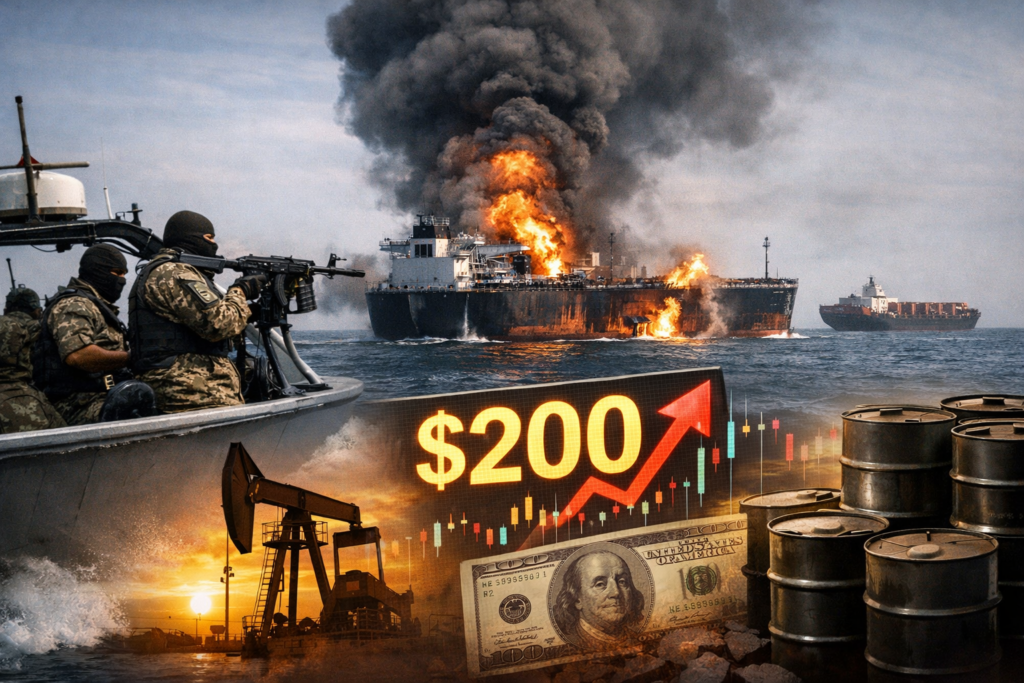
Which merchant ships were attacked in the Gulf on Wednesday and how many vessels have been hit since the war began?
Three merchant vessels were struck in Gulf waters on Wednesday. A Thai-flagged bulk carrier was set ablaze following an explosion, forcing the evacuation of its crew. Three people were reported missing and believed to be trapped in the engine room. A Japanese-flagged container ship and a Marshall Islands-flagged bulk carrier also sustained damage from projectiles fired by Iranian forces. Reuters could not independently verify a separate incident described by the Islamic Revolutionary Guard Corps involving what the corps described as a Liberian-flagged vessel. The strikes raised the total number of merchant ships hit since the war began to 14.
What is the IEA strategic reserve release and is 400 million barrels enough to offset the Hormuz blockade?
The International Energy Agency, an intergovernmental body composed of 32 major oil-consuming nations, unanimously agreed on Wednesday to release 400 million barrels from global emergency petroleum reserves. International Energy Agency Executive Director Fatih Birol, speaking from the agency’s headquarters in Paris, described the action as the largest such intervention in the organisation’s history and said it was aimed at alleviating the immediate impacts of market disruption. Birol made clear, however, that the fundamental solution to the energy crisis required the resumption of oil and gas transit through the Strait of Hormuz. The United States government swiftly endorsed the International Energy Agency’s recommendation. United States Interior Secretary Doug Burgum told CNBC that domestic oil companies would soon announce increased production in response to current price signals.
G7 energy ministers had the previous day stated their support in principle for proactive measures to address the energy situation, including the use of strategic reserves. Germany’s Economy and Energy Minister Katherina Reiche confirmed that the International Energy Agency had requested Germany release 2.64 million tons from its national strategic petroleum reserve and said Germany would comply with the request. Austria’s Economy Minister Wolfgang Hattmannsdorfer confirmed that Austria would release part of its emergency oil reserve and extend its national strategic gas reserve. The German government separately announced a domestic regulatory measure limiting fuel price increases at filling stations to once per day. Austria introduced a parallel measure restricting price increases at filling stations to three times per week.
Analysts have noted that while 400 million barrels is historically unprecedented as a single coordinated release, it would amount to approximately three weeks of pre-war throughput through the Strait of Hormuz. The International Energy Agency reported that export volumes of crude oil and refined petroleum products from the Gulf region are currently at less than ten percent of pre-war levels, a near-total collapse in throughput with immediate downstream consequences for refinery operations, transport fuel supply chains, and industrial energy costs across Asia, Europe, and North America.
What is the current state of oil prices and what do market movements signal about investor expectations for the war?
Oil prices surged briefly to nearly $120 a barrel on Monday following the intensification of hostilities. By Wednesday, prices had retreated to around $90 a barrel. Market observers attributed the decline to investor expectations that United States President Donald Trump would find a rapid diplomatic resolution to the conflict and that the Strait of Hormuz would reopen relatively soon. Trump told Axios in a telephone interview on Wednesday that there was practically nothing left to target in Iran and suggested the campaign could end at any moment of his choosing.
However, senior United States and Israeli officials indicated the war showed no signs of imminent conclusion. Israel’s Defence Minister Israel Katz stated on Wednesday that the military operation would continue without any time limit, until all objectives were fully achieved. Two separate senior Israeli officials told Reuters there was no sign that Washington was close to ending the campaign. A further senior Israeli official acknowledged to Reuters that Israeli leaders had privately accepted that Iran’s governing clerical system could survive the war.
What is the humanitarian and military situation on the ground in Iran, Lebanon, and across the Middle East?
More than 1,300 Iranian civilians have been killed since the commencement of air strikes on 28 February 2026, according to Iran’s United Nations Ambassador Amir Saeid Iravani. Scores of additional casualties have been reported in Lebanon following Israeli strikes. Iranian strikes on Israel have killed at least 11 people and two Israeli soldiers have died in Lebanon. The United States government has confirmed that seven American soldiers have been killed in the conflict and approximately 140 have been wounded.
The United States and Israel say they have struck more than 5,500 targets inside Iran since the war began, including more than 60 Iranian naval vessels. The Iranian military stated on Tuesday it had launched missiles at a United States base in northern Iraq, the United States Naval Forces Central Command headquarters in Bahrain, and targets in central Israel. Explosions were reported in Bahrain, and in Dubai, four people were wounded by two drones that crashed near the city’s airport.
In Tehran, large crowds gathered at Revolution Square on Wednesday for public funerals of senior Iranian military and political commanders killed in air strikes. Mourners carried caskets and displayed flags and images of Ayatollah Ali Khamenei, the supreme leader killed in the opening strikes, alongside portraits of his son and designated successor Mojtaba Khamenei. An Iranian official confirmed to Reuters that Mojtaba Khamenei had been lightly wounded in an early air strike that also killed his father, mother, wife, and a son. Mojtaba Khamenei has not made any public appearance or issued any direct public statement since his appointment as supreme leader. Tehran residents told Reuters that nightly air strikes had become routine, with hundreds of thousands of residents having fled to the countryside and the city experiencing air contamination from what residents described as black rain caused by smoke from burning oil infrastructure. Iran’s police chief Ahmadreza Radan warned on Wednesday that anyone taking to the streets in protest would be treated as an enemy rather than a demonstrator.
Key takeaways on what Iran’s oil warning and the IEA reserve release mean for global energy markets and the Middle East conflict
- Iran’s Islamic Revolutionary Guard Corps declared a total blockade of the Strait of Hormuz, stating no oil would be permitted to transit the waterway, as Iranian forces struck three additional merchant vessels on Wednesday, raising the total number of ships hit since the war began to 14.
- Ebrahim Zolfaqari, spokesperson for Iran’s military command, warned the world to prepare for crude oil prices of $200 a barrel, framing the oil price shock as a direct consequence of what Iran described as United States and Israeli destabilisation of regional security.
- The International Energy Agency unanimously agreed to release 400 million barrels from global strategic petroleum reserves, the largest coordinated reserve action in the organisation’s history, with endorsement from the United States and participation confirmed by Germany, Austria, and other member states.
- International Energy Agency Executive Director Fatih Birol stated that the most critical condition for stabilising global oil and gas flows remained the physical reopening of the Strait of Hormuz, noting that the reserve release could only partially offset disruption caused by the near-total closure of the waterway.
- Israel’s Defence Minister Israel Katz stated on Wednesday that the military campaign against Iran would continue without any time limit, while a senior Israeli official acknowledged that Israeli leaders had privately accepted that Iran’s governing clerical system could survive the war, complicating both the military and diplomatic outlook for the conflict.
Discover more from Business-News-Today.com
Subscribe to get the latest posts sent to your email.