


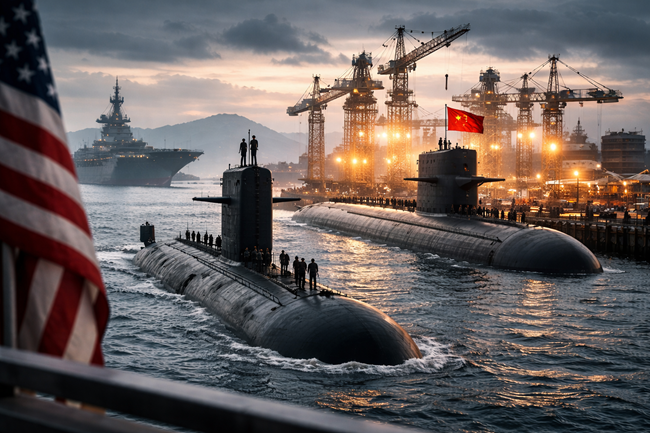
Senior United States Navy officials have warned that China’s People’s Liberation Army Navy is accelerating submarine production at a pace that could fundamentally alter the nuclear balance in the Indo-Pacific and extend Beijing’s capacity to threaten large portions of the United States mainland from waters close to China’s own coastline. The warnings, delivered in formal testimony before the United States-China Economic and Security Review Commission in early March 2026, represent some of the most detailed public assessments of China’s undersea nuclear modernization effort to date.
Rear Admiral Mike Brookes, director of United States Navy intelligence, stated in his testimony to the commission that the Chinese Navy has dramatically increased submarine production and could soon strike large portions of the United States. The testimony focused principally on two next-generation submarine classes — the Type 095 nuclear-powered guided-missile submarine and the Type 096 nuclear-powered ballistic-missile submarine — which United States Navy leaders describe as representing a generational leap in China’s undersea warfare capabilities.
Brookes wrote that the Type 096 ballistic-missile submarine is expected to be equipped with JL-4 submarine-launched ballistic missiles and could threaten large portions of the United States from waters that China can defend near its own coast. This assessment marks a significant escalation from China’s current posture. Brookes testified that the platform would allow Beijing to target large portions of the United States from protected waters, significantly enhancing its nuclear deterrent, and that this marks a step beyond China’s current submarines, which are largely limited to targeting portions of the United States from within the first island chain.
Brookes also testified that these submarines will incorporate substantial advancements in nuclear reactor design, sensor performance, weapons integration, and noise quieting technologies. He noted that China has dramatically increased domestic submarine production capacity through major shipyard investments, pushing nuclear submarine output above the previous pace of less than one nuclear-powered submarine per year.
How fast is China expanding its People’s Liberation Army Navy submarine force and what is the projected fleet size by 2035?
China’s submarine fleet is projected to reach roughly 70 boats by 2027 and could expand to as many as 80 by 2035, with approximately half expected to be nuclear-powered, marking a significant shift in the force’s composition. The People’s Liberation Army Navy currently operates more than 60 submarines, including roughly 50 diesel-electric boats, alongside a smaller but expanding fleet of nuclear-powered vessels.
During the years 2021 to 2025, China’s submarine building surpassed that of the United States in both numbers of submarines launched — 10 to 7 — and total tonnage — 79,000 tons to 55,500 tons, according to analysis by the International Institute for Strategic Studies, which drew on shipyard satellite imagery to estimate China’s construction activity. That trajectory represents a sharp reversal from the 2016 to 2020 period, when China added only three submarines to the United States Navy’s seven.
The expansion is anchored at the Bohai Shipbuilding Heavy Industry facility in Huludao, in northern China’s Liaoning Province. Beijing has significantly expanded the Huludao shipyard to accommodate its nuclear-powered submarine fleet growth. Bohai is the sole builder of all Chinese nuclear-powered submarines since its inception for that purpose under Project 09 in 1954, and the most consequential submarine-related development for the Chinese Navy over the last decade has been a rebalancing of capabilities from a large fleet of conventionally powered submarines toward new and more capable nuclear-powered designs.
What are China’s Type 095 and Type 096 submarines and when are they expected to enter service with the People’s Liberation Army Navy?
The Type 095 and Type 096 submarines are expected to enter service in the late 2020s and into the 2030s. The Type 095 is a nuclear-powered guided-missile attack submarine intended to replace and expand upon the current Shang-class fleet, while the Type 096 is a next-generation ballistic-missile submarine designed to carry longer-range and more accurate submarine-launched ballistic missiles than China’s current Jin-class boats.
Among China’s most capable current attack submarines is the Shang III-class, a nuclear-powered platform designed to conduct anti-ship and land-attack cruise-missile strikes while operating at reduced noise levels, with at least six of the expected eight Shang III boats having launched since 2022. Vice Admiral Richard Seif, commander of United States Navy submarine forces, described China’s modern nuclear-powered submarines, including the Shang III and follow-on Type 095, as increasingly capable and said they increase demands on United States and allied anti-submarine warfare forces and complicate conflict scenarios in contested waters.
A report from the Royal United Services Institute warns that China’s submarine fleet is rapidly closing the gap qualitatively, eroding the United States Navy’s technological edge, and that while China’s current Type 093 submarines are considered noisy by modern standards, the upcoming Type 095 will be much larger and quieter, drawing on advanced reactor designs.
What are JL-3 and JL-4 submarine-launched ballistic missiles and how do they compare with United States Navy Trident II capability?
China’s current ballistic-missile submarine fleet relies on the JL-3 submarine-launched ballistic missile. The JL-3 has an operational range exceeding 5,600 miles, with some estimates exceeding 6,200 miles. In contrast, the United States Navy’s Trident II D5 submarine-launched ballistic missile has a listed maximum range of approximately 7,456 miles, according to the Center for Strategic and International Studies Missile Threat database. The anticipated JL-4, expected to arm the Type 096 fleet, is assessed by United States Navy officials as carrying greater range and accuracy than the JL-3, allowing Beijing to conduct deterrent patrols from waters far closer to China’s own coast while still holding American territory at risk.
China maintains six Jin-class ballistic-missile submarines capable of carrying intercontinental ballistic missiles that could reach the United States from patrol areas deeper in the Pacific. The Type 096 is designed to supersede the Jin-class and substantially extend the geographic envelope from which China’s sea-based nuclear deterrent can operate.
How is China investing in seabed surveillance and unmanned underwater systems to counter United States Navy submarine operations in the Indo-Pacific?
The testimony before the United States-China Economic and Security Review Commission addressed not only submarine construction but also a broader transformation of China’s undersea warfare infrastructure. Seif said the United States will need more ready submarines, better undersea sensing and counter-sensing, faster deployment of unmanned undersea systems, and deeper munitions and payload capacity to address China’s growing undersea challenge.
Commission Chairman Randall Shriver said in his opening remarks that China is advancing a growing fleet of increasingly capable submarines, unmanned underwater vehicles, seabed sensors, and sophisticated oceanographic mapping programs. Retired Rear Admiral Mike Studeman, testifying separately, urged policymakers to view China as a broader maritime power and warned that Chinese underwater operations could extend farther afield over time, including toward United States home waters. He also highlighted risks to undersea infrastructure and raised counterintelligence concerns tied to maritime technology.
These investments in fixed and mobile underwater sensing networks are designed to complicate United States Navy submarine access to the western Pacific, extending what analysts describe as China’s anti-access and area-denial architecture beneath the sea surface.
What challenges is the United States Navy facing in its Virginia-class and Columbia-class submarine programs that affect competition with China?
The testimony from United States Navy officials included an explicit acknowledgment that America’s submarine industrial base faces significant constraints. Brookes contrasted China’s expansion with United States shipbuilding constraints, citing challenges in hiring and retaining workers and in maintaining delivery schedules for Virginia-class attack submarines and the Columbia-class ballistic-missile submarine program.
A Congressional Research Service report to Congress noted that the United States Navy is falling well behind its submarine-building goal of two Virginia-class attack boats per year, with United States shipyards delivering only 1.1 to 1.2 submarines per year since 2022. The Columbia-class ballistic-missile submarine program is also at least a year behind schedule, with the lead vessel, USS District of Columbia, not expected to be delivered to the Navy until 2028. Commission Chairman Randall Shriver warned that the United States will lose its underwater advantages if it fails to sustain them. The juxtaposition between China’s accelerating output and the United States’ production shortfalls has become a focal point of debate in Washington over naval procurement, workforce investment, and shipyard modernization policy.
Why does China’s ability to launch ballistic missiles from protected coastal waters represent a shift in Indo-Pacific nuclear deterrence dynamics?
The strategic significance of the Type 096 program lies not just in the submarine itself but in the geographic concept it enables. China’s current ballistic-missile submarines are assessed to require deep-water patrols in the central or western Pacific to reliably threaten United States territory, making them more exposed to United States Navy anti-submarine warfare operations. The Type 096, armed with JL-4 missiles, would allow Chinese ballistic-missile submarines to conduct patrols from waters inside or near the South China Sea and the Yellow Sea, areas where China has invested heavily in air defense, surface combatant presence, and seabed sensor networks.
United States naval commanders warn that Beijing’s undersea forces could credibly challenge American maritime dominance by 2040. China has used diesel submarines to extend its anti-access and area-denial line, designed to keep an opponent outside an area and limit their movements within it, according to analysts. The nuclear-powered ballistic-missile submarine program accelerates that logic into the strategic deterrence domain.
The broader context includes China’s ongoing development of a fully diversified nuclear triad. The Type 094 ballistic-missile submarines add to Beijing’s growing nuclear triad of land-based intercontinental ballistic missiles and bombers. United States officials assess the sea-based leg of that triad, because of its survivability and concealment advantages, as increasingly central to China’s long-term deterrence posture.
A 2025 report from the Australian Naval Institute warns that the rapidly modernizing Chinese Navy is taking bold steps to field a first-rate submarine force and may be on the cusp of significant expansion.
What China’s submarine expansion means for United States security, Indo-Pacific stability, and global nuclear deterrence
- Rear Admiral Mike Brookes testified before the United States-China Economic and Security Review Commission that China’s Type 096 ballistic-missile submarine, armed with the forthcoming JL-4 submarine-launched ballistic missile, will be capable of targeting large portions of the United States from protected waters near China’s coast, representing a significant advancement beyond China’s current Jin-class ballistic-missile submarines.
- China’s People’s Liberation Army Navy submarine fleet is projected to reach approximately 80 vessels by 2035, with roughly half nuclear-powered, up from more than 60 vessels today of which the majority are diesel-electric boats.
- Between 2021 and 2025, China launched more submarines in both number and tonnage than the United States, reversing a prior trend, while the United States shipbuilding industrial base continues to fall short of its own Virginia-class production targets and faces schedule delays in the Columbia-class ballistic-missile submarine program.
- Commission Chairman Randall Shriver warned that the United States will lose its undersea advantages if production, sensing, and unmanned systems capacity are not sustained and expanded, while Vice Admiral Richard Seif called for more ready submarines, faster unmanned undersea deployment, and improved undersea sensing and counter-sensing capabilities.
- United States naval commanders assessed that China’s undersea forces may credibly challenge American regional maritime dominance in the Indo-Pacific by 2040 if current trajectories continue.
Discover more from Business-News-Today.com
Subscribe to get the latest posts sent to your email.