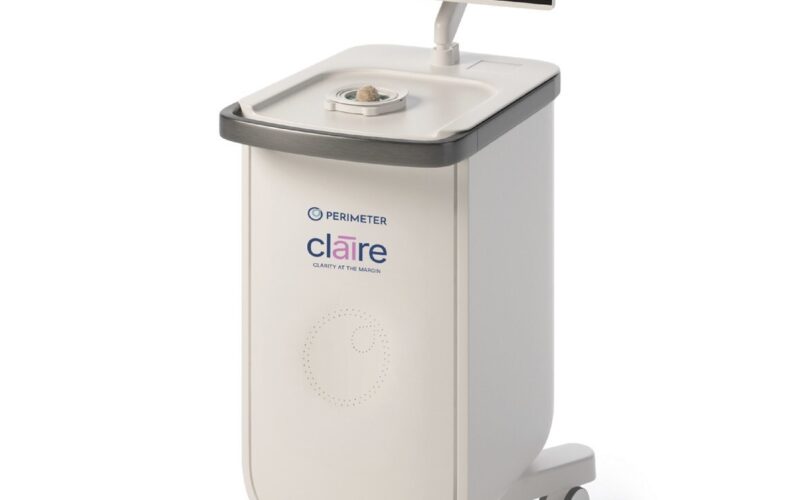
Perimeter Medical Imaging AI Inc. (TSXV: PINK) (OTCQX: PYNKF) has received U.S. Food and Drug Administration premarket approval for its Claire imaging platform, an artificial intelligence enabled system designed to help surgeons identify cancerous tissue during breast conserving surgery. The approval marks the first time an AI enabled imaging device has been cleared in the United States specifically for intraoperative margin assessment in breast cancer procedures. For the Toronto and Dallas based medical technology developer, the milestone represents both a regulatory breakthrough and the commercial launch point for a platform built around optical coherence tomography and machine learning. The company intends to begin a nationwide launch in the United States in the coming weeks, targeting hospitals performing hundreds of thousands of breast cancer surgeries annually.
The approval arrives at a moment when artificial intelligence is rapidly moving beyond diagnostic imaging and into direct clinical workflows. Intraoperative decision support represents one of the next frontiers for medical AI adoption, and the Claire system places Perimeter Medical Imaging AI directly within that emerging category.
Why does intraoperative margin assessment remain one of the most persistent problems in breast cancer surgery today?
Breast conserving surgery is widely used to treat early stage breast cancer, but the procedure presents a fundamental challenge. Surgeons must remove enough tissue to ensure all cancer cells are eliminated while preserving as much healthy tissue as possible. Determining whether the margins of removed tissue are cancer free often cannot be confirmed until days after surgery, once pathology analysis is complete.
Because of that delay, a significant number of patients must return for additional procedures. Contemporary studies show that roughly one in five breast conserving surgeries results in a re-operation due to residual cancer cells remaining in the surgical margin.
The clinical and economic implications are substantial. Re-operations create additional hospital costs, extend recovery times, increase surgical risk, and impose emotional stress on patients who must wait for pathology confirmation. Hospitals also face operational inefficiencies because repeat procedures consume operating room time and surgical resources.
For decades, surgeons have relied on physical examination and limited intraoperative pathology to estimate margin status. Those approaches are imperfect and often unavailable in smaller surgical centers. The result is a long-standing gap between the moment a tumor is removed and the moment surgeons know whether the procedure was successful.
How does Perimeter Medical Imaging AI’s Claire system attempt to solve the repeat surgery problem?
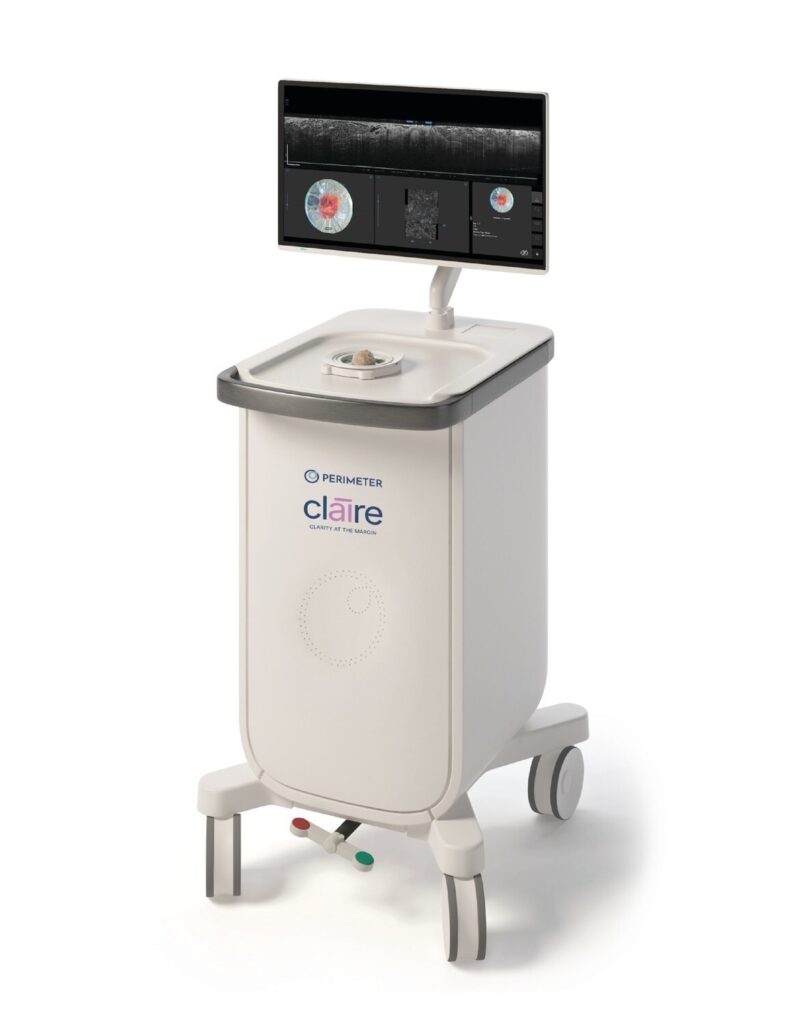
Claire integrates optical coherence tomography imaging with machine learning algorithms to analyze excised tissue margins during surgery. The technology captures high resolution cross sectional images of tissue in real time and allows surgeons to assess whether cancer cells may remain near the edge of removed tissue.
Optical coherence tomography is already used in several medical specialties because it produces microscopic level images without requiring physical tissue preparation. In this case, the imaging technology is paired with artificial intelligence trained on a proprietary dataset containing millions of breast tissue images.
The Claire system delivers imaging resolution significantly higher than conventional intraoperative tools such as X ray or ultrasound while scanning to a depth of approximately two millimeters. That depth corresponds closely with the clinically relevant margin width used in breast cancer surgery, making the technology potentially useful for real time surgical decision making.
Instead of waiting days for pathology results, surgeons can identify suspicious areas immediately and remove additional tissue if necessary before completing the procedure. If the system performs as expected in real world surgical settings, it could reduce the need for repeat surgeries and shorten the diagnostic feedback loop for both surgeons and patients.
What did clinical trial results reveal about Claire’s potential impact on surgical outcomes?
The pivotal trial supporting the regulatory approval demonstrated that the system achieved margin detection accuracy of 88.1 percent. More importantly, the trial showed a statistically significant reduction in the number of patients left with residual cancer compared with the standard of care alone.
Investigators described the results as demonstrating clear superiority relative to conventional intraoperative assessment methods. The study was presented at the American Society of Breast Surgeons meeting and represented one of the largest clinical evaluations of AI assisted surgical imaging to date.
The trial also illustrates a broader shift occurring across medical technology development. Regulatory agencies increasingly expect artificial intelligence products to demonstrate measurable clinical benefit rather than merely improved workflow efficiency. By tying the technology directly to surgical outcomes, Perimeter Medical Imaging AI positioned Claire as a clinical tool rather than simply a diagnostic aid.
The U.S. Food and Drug Administration also authorized a predetermined change control plan as part of the approval, allowing the company to implement future AI enhancements without requiring a full regulatory review each time the algorithm evolves.
That regulatory pathway reflects growing recognition that AI based systems improve continuously as they accumulate new clinical data.
How large is the commercial opportunity for AI driven intraoperative imaging platforms?
Perimeter Medical Imaging AI estimates that roughly 300,000 breast conserving surgeries occur annually in the United States alone.
If Claire were adopted broadly across major surgical centers, the platform could generate recurring revenue through hardware sales, software licensing, and data driven AI improvements. Each surgical procedure also generates additional imaging data that can be used to refine the underlying machine learning models.
This data feedback loop represents one of the most valuable aspects of the technology. Medical AI systems often struggle to access sufficiently large and diverse training datasets. By embedding the platform directly in surgical workflows, Perimeter Medical Imaging AI can continuously expand its image library and improve algorithm accuracy over time.
Management also sees the technology as a broader platform rather than a single product. Optical coherence tomography combined with AI could eventually be applied to additional cancer surgeries, biopsy procedures, and pathology workflows.
That possibility expands the addressable market beyond breast cancer into a wider range of oncology and surgical imaging applications.
Why are investors and industry observers paying attention to this approval?
Among the high profile supporters of Perimeter Medical Imaging AI is venture investor Chamath Palihapitiya, who has publicly described the Claire system as a meaningful example of how artificial intelligence can deliver measurable medical impact.
Investor attention reflects a broader trend in healthcare technology markets. Artificial intelligence adoption in medical imaging has already produced dozens of FDA cleared diagnostic tools, but relatively few systems have moved into direct clinical decision making during surgical procedures.
If Claire proves capable of reducing re-operation rates in routine clinical practice, it could demonstrate that AI systems can play a meaningful role in real time treatment decisions rather than simply assisting radiologists or pathologists.
That transition could open the door for a new category of surgical AI platforms.
Could AI assisted surgery become a major growth category for medical technology companies?
The medical technology industry is currently experiencing an inflection point in the integration of artificial intelligence across clinical workflows. Diagnostic imaging, digital pathology, and predictive analytics have seen the earliest wave of AI adoption.
The next phase appears increasingly focused on procedural and surgical decision support.
Operating rooms generate enormous volumes of data through imaging systems, sensors, and surgical instruments. AI tools capable of interpreting that information in real time could eventually help surgeons detect complications earlier, optimize surgical techniques, and improve outcomes.
Companies developing these technologies face several hurdles, including regulatory scrutiny, integration with hospital systems, and surgeon training requirements. However, the potential rewards are significant.
Hospitals are under growing pressure to improve surgical outcomes while reducing costs. Technologies that reduce repeat surgeries or shorten procedure times could quickly gain attention from both hospital administrators and healthcare payers.
What risks could affect the commercial rollout of Claire?
Despite the promise of the technology, several challenges remain before the platform can achieve widespread adoption.
Hospital procurement cycles for new surgical technologies are often slow, particularly when capital equipment purchases are required. Surgeons must also gain confidence in the system’s accuracy before integrating it into routine procedures.
Training and workflow integration will also play a critical role. Intraoperative tools must be intuitive and efficient because surgical environments leave little room for operational complexity.
Finally, reimbursement policies could influence adoption. Hospitals are more likely to invest in new technologies if they improve reimbursement outcomes or reduce long term treatment costs.
Perimeter Medical Imaging AI will therefore need to demonstrate that the platform not only improves clinical outcomes but also delivers measurable economic value for healthcare systems.
What does the Claire approval signal about the future of AI in surgery?
The approval represents an early indicator that artificial intelligence is beginning to move deeper into frontline medical care.
Rather than operating behind the scenes in data analysis pipelines, AI tools are starting to participate directly in clinical decisions. In surgical settings, that shift could reshape how procedures are performed, monitored, and evaluated.
For Perimeter Medical Imaging AI, the immediate focus will be on launching the Claire platform across U.S. surgical centers and generating real world clinical data that validates the system’s performance outside of clinical trials.
If those results mirror the trial outcomes, the company may find itself positioned at the center of a rapidly emerging market for AI enabled surgical imaging.
What are the key takeaways on what Perimeter Medical Imaging AI’s Claire approval means for cancer surgery and medical AI?
- Perimeter Medical Imaging AI secured U.S. Food and Drug Administration approval for Claire, the first AI enabled imaging device designed specifically for intraoperative breast cancer margin assessment.
- The technology combines optical coherence tomography imaging with machine learning trained on millions of breast tissue images to detect cancer during surgery.
- Approximately 20 percent of breast conserving surgeries currently require repeat procedures due to residual cancer, creating a major clinical and economic burden.
- Clinical trials showed Claire achieved margin detection accuracy above 88 percent and significantly reduced residual cancer compared with standard surgical assessment methods.
- The system targets a U.S. market of roughly 300,000 annual breast conserving surgeries and could generate recurring revenue through imaging platforms and AI software updates.
- Each surgical procedure performed using Claire expands the company’s proprietary dataset, strengthening the competitive advantage of its machine learning algorithms.
- The approval highlights a broader shift in medical technology as artificial intelligence moves from diagnostic assistance toward real time clinical decision support.
- Hospitals will likely evaluate the system based on its ability to reduce repeat surgeries, improve patient outcomes, and lower healthcare costs.
- Adoption will depend on surgeon confidence, hospital procurement cycles, and reimbursement frameworks for AI enabled surgical technologies.
- If real world data confirms clinical benefits, AI assisted intraoperative imaging could become a major new category within surgical technology markets.
Discover more from Business-News-Today.com
Subscribe to get the latest posts sent to your email.