




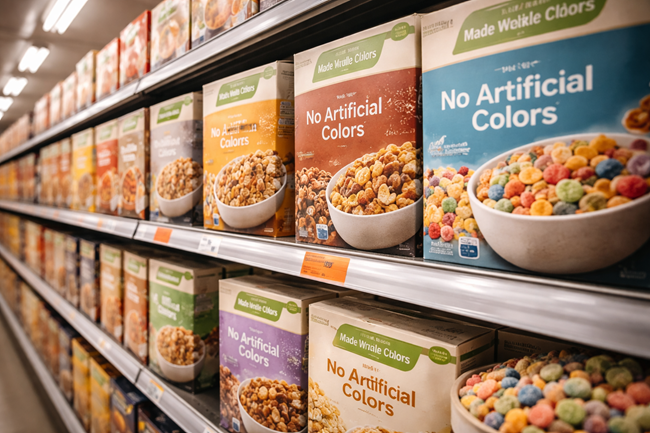
Target Corporation (NYSE: TGT) announced that by the end of May it will only carry cereals made without certified synthetic colors across its stores and digital platforms. The decision positions Target Corporation among the first national retailers to fully eliminate certified synthetic colors from its cereal assortment. Strategically, the move reinforces Target Corporation’s merchandising differentiation in grocery at a time when food retail margins and customer loyalty are under pressure.
This is not a packaging refresh. It is a structural assortment decision that alters supplier requirements, reformulation timelines, and competitive positioning inside one of the most visited aisles in American retail.
Why is Target Corporation removing certified synthetic colors from all cereals, and what does this signal about shifting grocery strategy?
The elimination of certified synthetic colors from 100 percent of cereal inventory is an example of retailer-led standard setting. Rather than waiting for federal regulatory shifts or manufacturer-driven reformulation cycles, Target Corporation is using its scale to define an ingredient threshold for a major packaged food category.
Cereal remains a high-frequency purchase, especially among households with children. It is also one of the most brand-sensitive segments in grocery. By standardizing around products without certified synthetic colors, Target Corporation is reshaping how both national brands and private labels compete for shelf space.
The company cited internal guest insights and sales-trend data indicating a sustained shift toward foods made without artificial additives. That data-backed framing matters. Retailers rarely move category-wide without demand signals. This suggests Target Corporation sees health-oriented assortment curation as a revenue driver, not just a reputational hedge.
The broader implication is that grocery differentiation is increasingly ingredient-based rather than purely price-based. In a category where discount retailers compete aggressively on cost, Target Corporation is leaning into curated health signaling to justify shopper loyalty and potentially higher basket sizes.
How does this cereal reformulation align with Target Corporation’s Good & Gather strategy and owned brand expansion?
The cereal decision builds directly on the standards established when Target Corporation launched Good & Gather in 2019. That owned food and beverage brand was positioned around products formulated without artificial flavors, artificial sweeteners, synthetic colors, or high-fructose corn syrup.
Good & Gather now spans more than 2,500 products. By aligning the cereal aisle with similar ingredient principles, Target Corporation is reducing friction between private label values and national brand offerings. In effect, it is normalizing the clean-label baseline across the category.
This has two competitive consequences.
First, it strengthens Target Corporation’s private label credibility. If national brands must reformulate to remain on shelf, owned brands no longer carry the burden of being the only “clean” option. Instead, Target Corporation becomes the gatekeeper that defines the acceptable standard.
Second, it increases supplier dependency on the retailer. Reformulating cereal recipes is not trivial. It involves sourcing adjustments, quality testing, regulatory compliance reviews, and packaging updates. Manufacturers that make these investments for Target Corporation will be more tightly integrated into its supply ecosystem.
Over time, that dynamic can enhance negotiating leverage.
What operational and supplier execution risks could emerge from a category-wide ingredient shift?
While the move is strategically coherent, execution risk should not be dismissed.
Cereal reformulation can alter flavor profiles, shelf stability, and visual appearance. Synthetic colors have historically been used to deliver bright, uniform product visuals that appeal to children. Replacing them with natural alternatives can introduce variability or cost increases.
Target Corporation stated it worked closely with national brand and owned brand partners to reformulate where needed while preserving quality and value. That phrasing signals collaborative planning rather than abrupt delisting. Still, maintaining price parity in a cost-sensitive category will require careful margin management.
There is also inventory risk. Transitioning 100 percent of cereal SKUs across a national footprint by the end of May compresses timelines. Any supplier lag could create temporary assortment gaps.
From a financial perspective, the risk is not existential. Cereal is meaningful but not dominant in overall grocery revenue. However, grocery traffic is foundational to cross-category spending. Any disruption in staple availability can have ripple effects on total basket performance.
Does this move reflect consumer demand acceleration or pre-emptive positioning ahead of regulatory change?
Certified synthetic colors remain legally permitted in the United States. Therefore, this decision is not compliance-driven.
Instead, it reflects consumer sentiment evolution. Health-conscious shopping behaviors have expanded beyond niche organic segments into mainstream family purchasing patterns. Parents increasingly scrutinize ingredient lists, especially for children’s foods.
Target Corporation is effectively moving ahead of potential regulatory tightening while also insulating itself from reputational exposure in case public scrutiny around artificial additives intensifies.
There is also a signaling component. Retailers that define stricter standards often attract a halo effect among health-oriented shoppers. That halo can extend beyond cereal into adjacent categories such as snacks, beverages, and baby food.
The strategic question is whether this is a single-aisle change or the first step in broader ingredient curation across packaged foods. If Target Corporation extends similar standards into candy, bakery, or beverages, the company would be actively shaping industry formulation norms.
How could national cereal brands be affected if retailer-driven ingredient standards expand?
National brands that rely on bright color positioning may face incremental reformulation costs not only for Target Corporation but potentially for other retailers that follow suit.
If this approach proves commercially successful, competitors such as Walmart Inc. and Kroger Co. may evaluate similar category-wide standards. Once multiple large retailers align, reformulation becomes a baseline industry requirement rather than a retailer-specific adjustment.
That dynamic compresses differentiation at the manufacturer level. Brands would need to compete more aggressively on taste, nutritional positioning, and price rather than visual novelty.
For private label competitors, the move is also instructive. Retailer-owned brands can often adapt faster because they operate within tighter supply networks. If reformulation becomes a recurring requirement across categories, private label agility could become a structural advantage.
What does this say about Target Corporation’s broader growth strategy in a margin-constrained retail environment?
Target Corporation has faced margin volatility in recent years due to inventory normalization, promotional intensity, and macroeconomic headwinds affecting discretionary spending.
Food and essentials, including grocery, have been more resilient traffic drivers than discretionary categories. However, grocery margins are structurally thinner.
By elevating ingredient standards and emphasizing curated wellness, Target Corporation is attempting to shift grocery from a pure traffic driver to a differentiation lever. The goal appears to be increasing loyalty and brand trust rather than merely competing on price.
For investors, the question is whether such curated health initiatives translate into measurable traffic growth, basket expansion, or improved owned brand penetration.
Target Corporation stock performance has been sensitive to comparable sales trends and margin guidance in recent quarters. While a cereal reformulation will not materially move earnings in isolation, it signals management’s willingness to use merchandising authority as a strategic growth tool rather than relying solely on cost discipline.
Institutional sentiment is likely to view this as a low-risk brand equity investment with moderate long-term upside if it strengthens repeat shopping behavior.
Could this cereal decision trigger a broader clean-label cascade across major U.S. retailers?
Retail is often imitative at scale. When one national chain redefines a category baseline, others monitor customer response closely.
If Target Corporation sees stable sales and positive customer engagement after the transition, competitors may follow. Over time, certified synthetic colors could become less common in mainstream cereal offerings even without regulatory mandates.
This is how private governance evolves in consumer markets. Retailers with scale act as quasi-standard setters, influencing upstream manufacturing practices.
The long-term effect may be subtle but meaningful. Reformulation investments that begin in cereal could spill into snacks, beverages, and other family-oriented food categories.
For manufacturers, this reinforces the importance of flexible formulation capabilities and ingredient sourcing resilience. For retailers, it underscores the growing role of merchandising authority as a competitive moat.
Key takeaways on what Target Corporation’s cereal reformulation means for retail strategy, suppliers, and investors
- Target Corporation is redefining ingredient standards in a high-traffic grocery category, signaling a shift toward retailer-led health governance
- The move reinforces the strategic positioning of Good & Gather and strengthens owned brand credibility
- Supplier reformulation investments increase integration and potentially enhance Target Corporation’s negotiating leverage
- Execution risk centers on taste preservation, cost control, and smooth inventory transition across a national footprint
- The decision reflects consumer health sentiment rather than regulatory pressure, positioning Target Corporation ahead of potential policy shifts
- If successful, competitors may adopt similar standards, accelerating clean-label normalization across U.S. cereal brands
- Private label agility could become a structural advantage if ingredient standards tighten across additional categories
- Financial impact is incremental in the short term but potentially meaningful for long-term brand equity and loyalty
- Investors are likely to interpret this as a measured brand-building initiative within a broader margin and traffic recovery strategy
Discover more from Business-News-Today.com
Subscribe to get the latest posts sent to your email.

