




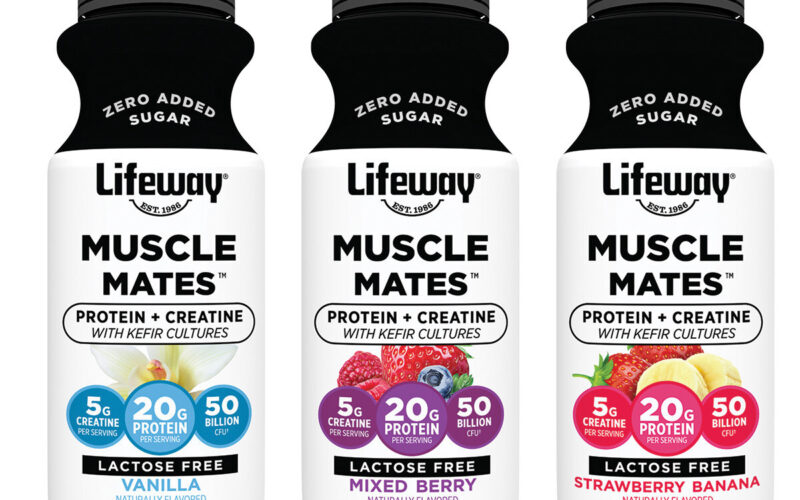
Lifeway Foods (Nasdaq: LWAY), the dominant U.S. supplier of kefir and fermented probiotic products, will unveil two new product lines at Natural Products Expo West 2026 in Anaheim, California: Muscle Mates, a protein-and-creatine functional beverage, and Probiotic Kefir Butter, a cultured butter range targeting the premium cooking segment. The dual launch marks a deliberate push beyond the brand’s established kefir base into two of the fastest-growing adjacencies in the functional food market, timed to coincide with the company’s 40th anniversary.
What does Lifeway Foods’ Muscle Mates creatine-probiotic launch mean for the competitive sports nutrition beverage market in 2026?
Muscle Mates is the more strategically aggressive of the two launches. The 8-ounce, lactose-free ready-to-drink beverage combines 20 grams of protein, 5 grams of creatine, and 12 live and active probiotic cultures in a single format positioned for pre-workout, post-workout, or general wellness consumption. That combination is notable because it attempts to bridge two product categories that have historically occupied separate shelf positions: the high-protein sports recovery segment, dominated by brands such as Fairlife, Core Power, and Premier Protein, and the functional probiotic beverage segment where Lifeway Foods has operated for four decades.
Creatine, long a staple of the sports supplement industry, has in recent years migrated into mainstream grocery as consumer awareness of its muscle recovery and cognitive benefits has grown beyond gym culture. Incorporating it into a dairy-based, probiotic beverage is not merely a formulation decision; it is a positioning signal. Lifeway Foods is telling the market that its manufacturing and fermentation expertise, built around kefir cultures, can serve as a platform for functional ingredient delivery rather than a single-product niche.
The execution risk here is real. Performance beverage is a crowded, promotional-spend-heavy category where brand recognition and retail placement are fiercely contested. Lifeway Foods, with its Nasdaq-listed small-cap profile, does not carry the marketing budget of a PepsiCo or Danone subsidiary. Distribution through grocery stores, fitness centers, and select retailers is the stated go-to-market plan, and the fitness channel in particular is a reasonable beachhead, since creatine buyers already frequent those environments and the probiotic angle offers meaningful differentiation from conventional protein shakes. Whether Lifeway Foods can sustain shelf presence beyond initial placement depends on repeat purchase rates and its ability to defend the product’s price point against commoditised protein competitors.

How does Lifeway Kefir Butter position the company within the growing premium and functional butter category?
Probiotic Kefir Butter represents a quieter but strategically coherent extension. Available in Unsalted, Sea Salt, and Honey Butter varieties, the product is positioned at the intersection of two durable consumer trends: demand for premium, artisanal-style butter and growing interest in the functional properties of fermented dairy. The butter market has undergone a meaningful premiumisation wave over the past several years, driven partly by the rehabilitation of dietary fat in mainstream nutritional discourse and partly by the success of European-style and cultured butter brands at the higher end of the grocery dairy case.
Lifeway Foods brings genuine credibility to this space. The company produces cultured butter through its Fresh Made subsidiary, which means the launch is not an entirely greenfield venture. Fresh Made has operated within dairy manufacturing for years, and leveraging that infrastructure to extend the Lifeway Foods brand into a consumer-facing cultured butter product carries lower execution risk than the Muscle Mates launch. The low-lactose positioning also extends the addressable audience to the estimated 65 percent of adults globally who experience some degree of lactose sensitivity, a factor that has proven commercially meaningful for Lifeway Foods’ kefir products.
The competitive set for premium cultured butter includes brands such as Kerrygold, Vermont Creamery, and Organic Valley, all of which have established retail presence and strong brand equity in natural and conventional grocery. Lifeway Foods’ differentiation rests on the probiotic cultures angle, which is genuinely novel in butter and may resonate with the brand’s existing consumer base. Whether that differentiation is sufficient to command a price premium and earn incremental shelf space in a category with well-entrenched incumbents remains an open question.
Why does the timing of these launches reflect a broader strategic inflection point for Lifeway Foods and the cultured dairy sector?
The 40th anniversary framing is not merely ceremonial. For investors and channel partners, it serves as a credibility anchor for a company attempting to reposition itself as a platform business rather than a single-category kefir supplier. President and CEO Julie Smolyansky cited the newly released Dietary Guidelines as a supportive tailwind, and that is worth examining. Federal dietary guidance that explicitly acknowledges the nutritional value of cultured dairy has meaningful downstream effects: it influences institutional procurement, school nutrition standards, and the degree to which category buyers at major grocery chains allocate promotional real estate to fermented dairy products.
The broader market context supports the ambition. The cultured dairy category, by Lifeway Foods’ own framing, is a multi-billion-dollar global market with projected growth to exceed $75 billion over the next decade. That trajectory is consistent with third-party market data showing accelerating demand for gut-health products, protein-fortified foods, and fermented ingredients across demographics. Lifeway Foods sits at a natural intersection of all three trends, and both new product lines are clearly engineered to capture that convergence.
The company’s geographic footprint, currently spanning the United States, Mexico, Ireland, South Africa, the United Arab Emirates, and France, also suggests that successful domestic product validation could accelerate international rollout. The performance beverage segment in particular has strong international demand, and a probiotic-creatine SKU with clean dairy credentials could travel well in markets where whey-based supplements face regulatory or consumer preference headwinds.
What are the capital allocation and investor implications of Lifeway Foods expanding into adjacent functional food categories?
For institutional investors and analysts following Lifeway Foods, the key question is whether category expansion enhances or dilutes the brand’s core equity. The kefir business has generated the company’s credibility and customer loyalty; extending too aggressively into unrelated segments risks confusing the consumer proposition and stretching limited marketing resources. That said, both Muscle Mates and Probiotic Kefir Butter are grounded in cultured dairy and probiotic expertise, which limits the strategic drift concern relative to, say, a move into plant-based beverages or supplement powders.
From a capital allocation perspective, the launches appear to be relatively asset-light given the existing fermentation and dairy manufacturing infrastructure. If Lifeway Foods is leveraging existing production capacity rather than building new lines, the incremental investment required to test these products in the market is modest relative to the potential revenue upside. The company’s scale, however, means that supply chain execution at national retail distribution will require careful management to avoid the stockout and quality consistency issues that have historically challenged small-cap food companies during rapid SKU expansion.
Lifeway Foods’ stock performance and institutional positioning will inevitably be influenced by how quickly Muscle Mates and Probiotic Kefir Butter achieve meaningful velocity in retail. The company has earned recognition from outlets including Forbes, Inc., and Time for its growth trajectory, and these launches will be watched as a test of whether Lifeway Foods can sustain that momentum in categories where it does not yet hold the dominant position it occupies in kefir.
Key takeaways on what Lifeway Foods’ Expo West 2026 launches mean for the company, its competitors, and the cultured dairy industry
- Lifeway Foods is explicitly repositioning itself as a functional dairy platform rather than a kefir-only brand, with both new products engineered to capture the convergence of protein demand, probiotic interest, and premium dairy growth.
- Muscle Mates enters a highly competitive performance beverage category where Lifeway Foods lacks the marketing spend of dominant players; distribution through fitness centers is a sensible but limited initial beachhead.
- The creatine inclusion in Muscle Mates is a genuine formulation differentiator in the probiotic beverage space, but it also invites direct comparison with sports nutrition incumbents who have far greater shelf presence and promotional budgets.
- Probiotic Kefir Butter carries lower execution risk than Muscle Mates given Lifeway Foods’ existing cultured butter manufacturing capability through its Fresh Made subsidiary.
- The premium butter category is premiumising, but Kerrygold, Vermont Creamery, and Organic Valley represent well-capitalised incumbents; Lifeway Foods’ probiotic angle is novel but unproven as a sustained price-premium driver.
- Federal Dietary Guidelines endorsing cultured dairy represent a structural tailwind that could shift institutional and retail buyer behaviour in Lifeway Foods’ favour across its entire product portfolio.
- Both launches appear consistent with asset-light expansion using existing fermentation infrastructure, which limits downside capital risk but also limits speed of scale.
- International markets, particularly those where dairy-based functional beverages are growing, represent a credible second-stage opportunity if domestic velocity data supports rollout.
- Lifeway Foods’ 40-year anniversary positions the brand authentically within the fermented foods movement, a consumer narrative that resonates with natural channel buyers and premium grocery gatekeepers.
- The strategic coherence of both launches is a positive signal; the execution risk lies in sustained retail placement, consumer repeat purchase, and the company’s ability to defend margin against category commoditisation.
Discover more from Business-News-Today.com
Subscribe to get the latest posts sent to your email.
