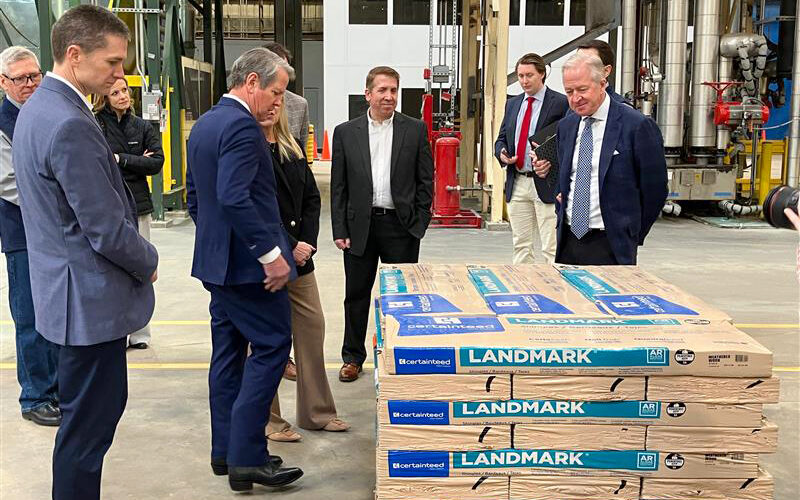
Saint-Gobain announced the completion of a more than $100 million expansion at its CertainTeed Roofing manufacturing facility in Peachtree City, Georgia, doubling production capacity at the site. The investment directly increases Saint-Gobain’s ability to supply roofing shingles into the fast-growing southeastern United States, a region facing structural housing shortages and rising climate-driven demand for resilient building materials.
The expansion marks a capital allocation decision that ties Saint-Gobain’s North American growth strategy to regionalized manufacturing, logistics resilience, and long-cycle housing demand rather than short-term construction volatility.
Why Saint-Gobain is committing over $100 million to regional roofing capacity in the southeastern United States now
Saint-Gobain’s decision to double roofing shingle capacity in Peachtree City reflects a calculated response to persistent housing undersupply across the United States, particularly in high-migration Sun Belt states. Estimates suggesting the need for millions of additional homes by the end of the decade frame roofing not as a discretionary product cycle but as a structural replacement and expansion category tied to population growth, insurance requirements, and climate resilience.
Georgia sits at the intersection of several favorable demand vectors. Inbound migration from higher-cost coastal states, expanding logistics and manufacturing employment corridors, and a construction market increasingly shaped by storm resilience standards have created a steady call for roofing products with predictable lead times and localized distribution. By expanding an existing facility rather than building greenfield capacity, Saint-Gobain reduces execution risk while accelerating time to market.
The move also reflects a broader strategic tilt toward North America as one of Saint-Gobain’s largest and most stable revenue contributors. Manufacturing closer to end markets lowers freight exposure, improves responsiveness to distributors, and mitigates cross-border supply chain disruptions that have reshaped capital investment logic since 2020.

How doubling capacity at the Peachtree City facility reshapes CertainTeed Roofing’s competitive position in the Southeast
For CertainTeed Roofing, the Peachtree City expansion strengthens its ability to serve contractors and distributors operating on compressed build schedules and insurance-driven reroofing timelines. Roofing demand in the Southeast is increasingly event-driven, with hurricanes, hail, and severe weather accelerating replacement cycles. Capacity availability and delivery reliability now carry as much weight as product specifications.
By doubling output at an established Georgia site, CertainTeed Roofing improves service density across neighboring states without relying on long-haul shipping from Midwest or Northeast plants. This matters in a market where freight costs and delivery delays can erode distributor loyalty and contractor margins.
The expansion also signals a defensive posture against regional competitors scaling up localized production. Roofing is not a winner-takes-all market, but regional capacity often determines share stability during demand spikes. CertainTeed Roofing’s expanded footprint reduces the risk of being capacity-constrained during peak storm seasons, a recurring problem for manufacturers with more centralized production models.
What advanced manufacturing and energy-efficient production mean for cost structure and execution risk
Saint-Gobain highlighted next-generation manufacturing technologies and smart sensors as part of the expansion, positioning the facility to operate with higher efficiency and tighter quality control. While such language often reads as promotional, the strategic relevance lies in operational discipline rather than novelty.
Energy-efficient production matters most in energy-intensive building materials where margins are sensitive to power costs and regulatory pressure. Georgia’s industrial energy profile, combined with modernized equipment, allows Saint-Gobain to balance output growth with cost predictability. Over time, this supports margin stability rather than aggressive price competition.
Execution risk remains non-trivial. Doubling capacity requires sustained demand, workforce stability, and disciplined maintenance cycles. However, expanding a long-operating plant reduces startup risk compared with greenfield projects, particularly in skilled manufacturing roles that are increasingly difficult to staff at scale.
How state and local incentives influence industrial investment decisions in construction materials
The project benefited from more than $5 million in state and local tax incentives spread over the next decade. While modest relative to total capital deployed, such incentives improve return profiles and signal alignment between manufacturers and regional economic planners.
For Georgia, the expansion reinforces its positioning as a manufacturing-friendly state that supports long-term industrial employers rather than short-cycle assembly operations. For Saint-Gobain, the incentives help offset upfront costs while anchoring employment continuity at one of the region’s largest industrial sites.
This public-private alignment is increasingly important as construction materials producers face tightening environmental scrutiny and rising expectations around local job creation. Incentives tied to existing sites also lower political and regulatory friction compared with new land development.
How this expansion fits into Saint-Gobain’s broader North American manufacturing strategy
The Peachtree City project does not stand alone. Saint-Gobain has recently completed or advanced multiple North American expansions across gypsum wallboard, roofing inputs, and distribution infrastructure. These moves collectively point to a strategy focused on scale, electrification, and regional redundancy.
Recent expansions in Florida and Quebec underscore a willingness to invest heavily in capacity where demand visibility is high and regulatory frameworks support modernization. The near-completion of a glass mat facility in North Carolina and a new distribution center in Texas further strengthen Southern market coverage, suggesting a deliberate corridor strategy rather than isolated site upgrades.
Together, these investments indicate that Saint-Gobain views North America not as a mature, low-growth market but as a platform for disciplined, infrastructure-backed expansion tied to housing renewal, climate adaptation, and renovation cycles.
What this investment signals about the U.S. housing backlog and materials supply outlook through 2030
Saint-Gobain’s capital commitment implicitly endorses the view that U.S. housing undersupply is not a transient issue. Roofing demand benefits from both new construction and replacement cycles, making it one of the more resilient building material segments during uneven economic periods.
As housing starts fluctuate with interest rates, reroofing driven by insurance claims, aging housing stock, and climate damage provides a stabilizing demand floor. Manufacturers with localized capacity are better positioned to capture this demand without sacrificing margins to logistics volatility.
If housing delivery continues to lag demographic needs, materials suppliers with ready capacity may gain pricing power during peak periods. Conversely, overcapacity risk appears limited given the phased nature of Saint-Gobain’s investments and its emphasis on modernizing existing assets rather than speculative expansion.
How institutional investors are likely to read Saint-Gobain’s rising North American capital spending and return discipline
Saint-Gobain is publicly listed and closely watched for its capital discipline and regional exposure balance. While the Peachtree City expansion is unlikely to move short-term earnings materially, it reinforces a narrative of long-horizon investment aligned with structural demand.
Institutional investors tend to favor manufacturers that invest counter-cyclically while maintaining balance sheet flexibility. The scale of this expansion suggests confidence without excess, particularly when viewed alongside Saint-Gobain’s diversified product mix and geographic footprint.
Market sentiment around construction materials remains cautious due to macro uncertainty, but targeted capacity additions tied to housing fundamentals are generally viewed more favorably than broad-based expansion bets. Over time, such investments may support valuation resilience rather than aggressive multiple expansion.
What happens next for CertainTeed Roofing and regional competitors as capacity comes online
The immediate effect will be increased supply availability across the Southeast, reducing lead times and improving distributor service levels. Competitors with thinner regional footprints may feel pressure to respond through incremental expansions, partnerships, or pricing adjustments.
Longer term, the competitive battlefield will shift toward operational reliability, storm response readiness, and integration with insurance-driven rebuild workflows. Capacity alone is not enough, but capacity at the right location increasingly determines who wins share during demand spikes.
For CertainTeed Roofing, execution consistency will matter more than announcement optics. Sustaining utilization, retaining skilled labor, and maintaining cost discipline will determine whether this expansion delivers its intended strategic return.
Key takeaways on what Saint-Gobain’s Georgia expansion means for the roofing industry and U.S. housing supply
- Saint-Gobain’s $100 million-plus expansion doubles roofing capacity in Georgia, strengthening supply into the fast-growing southeastern United States.
- The investment reflects confidence in long-term housing demand rather than short-term construction cycles.
- Localized manufacturing improves logistics resilience, service reliability, and margin stability for CertainTeed Roofing.
- Expansion at an existing facility reduces execution risk compared with greenfield projects.
- State and local incentives improve project economics while reinforcing Georgia’s manufacturing attractiveness.
- The move fits into a broader North American strategy focused on regional scale and modernization.
- Roofing demand benefits from both new construction and climate-driven replacement cycles.
- Competitors with centralized production may face pressure during peak storm-driven demand periods.
- For investors, the expansion signals disciplined capital deployment aligned with structural housing needs.
Discover more from Business-News-Today.com
Subscribe to get the latest posts sent to your email.