




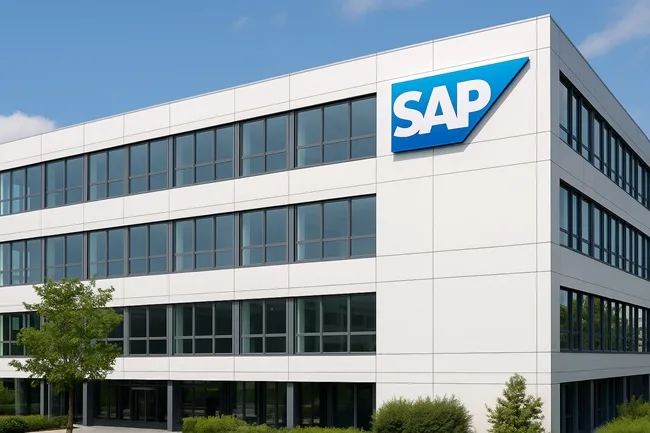
SAP SE (NYSE: SAP) ended fiscal year 2025 with a sharp acceleration in cloud profitability and cash generation, driven by surging cloud ERP adoption and disciplined cost transformation. The company reported full-year cloud revenue of €21.02 billion, up 23 percent year over year, alongside a 28 percent increase in non-IFRS operating profit to €10.42 billion. Free cash flow rose 95 percent to €8.24 billion, enabling SAP SE to authorize a new two-year €10 billion share repurchase program beginning February 2026.
Management framed these results as validation of SAP SE’s long-term cloud-first pivot, underscored by widespread integration of business AI across its ERP suite and strong adoption of RISE with SAP. With more than €77 billion in total cloud backlog and ongoing support for sovereign infrastructure initiatives in the European Union, SAP SE is projecting another year of double-digit cloud growth in 2026 and a reinforced role in regulated digital transformation markets.
What allowed SAP SE to outperform its 2025 profitability and cash flow targets?
SAP SE’s 2025 financial outperformance was anchored in both topline momentum and improved cost efficiency. Total cloud revenue rose by 23 percent on a reported basis and by 26 percent at constant currencies, with SAP Cloud ERP Suite revenue alone increasing 28 percent to €18.1 billion. The growth in cloud ERP was driven by bundled commercial packages such as RISE with SAP and adoption of business AI modules, which were embedded in nearly two-thirds of Q4 cloud order entries.
Current cloud backlog at year-end reached €21.05 billion, growing by 16 percent year over year and 25 percent at constant currencies. Total cloud backlog, which includes longer-term contractual commitments, hit €77.29 billion, up 30 percent at constant currencies. These forward indicators provided a strong foundation for both recurring revenue visibility and predictability.
On the margin side, non-IFRS cloud gross margin improved to 75 percent, up 1.7 percentage points year over year. Overall non-IFRS operating margin climbed to 28.3 percent, a gain of 4.5 points from 2024, reflecting the wind-down of the 2024 transformation program and operating leverage within high-growth SaaS and PaaS categories.
Free cash flow nearly doubled, reaching €8.24 billion, supported by €9.16 billion in operating cash flow, lower restructuring payouts, and leaner capex and share-based compensation.
Why is SAP SE prioritizing share repurchases over M&A or debt reduction?
The new €10 billion share buyback plan approved by the executive and supervisory boards builds on previous repurchase programs executed in 2020, 2022, and 2023 through 2025, which cumulatively returned around €8 billion to shareholders. Scheduled to run until the end of 2027, the new program signals confidence in SAP SE’s sustainable cash generation capacity.
The company’s capital position has also strengthened. Net liquidity rose to €3.38 billion from €1.70 billion a year earlier. Financial liabilities declined by more than €3 billion, dropping to €6.15 billion. Capital expenditures remained modest at €739 million, and treasury share repurchases in 2025 totaled €1.94 billion.
In this context, SAP SE appears to be optimizing for shareholder return rather than expansionary acquisition activity or further deleveraging. Dividend payments of €2.74 billion in 2025 reinforce the message that the company is prioritizing capital return while maintaining financial flexibility.
How is SAP SE managing its transition from on-premise licenses to cloud subscriptions?
SAP SE’s cloud-centric operating model continues to phase out legacy license and support revenue. Software license revenue declined 29 percent year over year to €990 million, while software support revenue fell 7 percent to €10.53 billion. The company warned that the pace of software support decline will accelerate in coming years as more clients complete their transitions to SAP Cloud ERP.
However, the company is increasingly offsetting these declines with cloud subscription growth. Cloud now represents 57 percent of total revenue, and predictable revenue reached 86 percent of the overall topline by year-end. The continued shift is likely to stabilize earnings and cash flow over time, but may pressure total revenue growth during the transition period.
Importantly, SAP SE’s cloud order entry in Q4 reflected increasing deal sizes. Orders greater than €5 million comprised 71 percent of total volume in Q4, up from 68 percent the prior year, suggesting strong traction among large enterprise customers undergoing end-to-end digital transformation.
What are the known risks and execution headwinds facing SAP SE?
Despite its strong results, SAP SE remains exposed to a range of structural and cyclical risks. Foreign exchange rates represent a near-term drag. At current spot rates, the company expects 2026 cloud revenue growth to be reduced by three percentage points, cloud and software revenue by 2.5 points, and non-IFRS operating profit by 3.5 points.
Litigation and compliance-related expense also remain material. In 2025, SAP SE incurred €174 million in Teradata litigation expenses and another €0.1 billion in costs tied to tax-related legal matters. These line items depressed reported IFRS operating profit, though they were excluded from non-IFRS metrics.
From a demand-side perspective, the decline in Net Promoter Score to 9 for 2025, below the target range of 12 to 16, underscores lingering challenges with legacy on-premise clients. In response, SAP SE will begin using a Cloud Customer Satisfaction score (Cloud CSAT) starting in 2026, aligned with its strategic focus on subscription-based relationships.
How are SAP SE’s AI integrations and sovereign cloud offerings shaping competitive dynamics?
SAP SE’s focus on embedding AI capabilities into core ERP workflows continues to shape its value proposition. The company reported that business AI features were included in two-thirds of all Q4 cloud order entries. These capabilities now span finance, supply chain, human capital, commerce, and transformation modules within SAP Cloud ERP.
Strategic partnerships also underpin SAP SE’s differentiation in the sovereign cloud and AI data infrastructure space. In November 2025, the company launched the EU AI Cloud initiative, offering a full-stack sovereign cloud platform deployable across its own data centers, trusted European infrastructure, or on-premises solutions.
Partnerships with Snowflake, Capgemini, Bleu, and Mistral AI further enhance SAP SE’s position in regulated markets. These moves support both compliance readiness and data residency for European governments and enterprises—a strategic wedge as U.S. hyperscalers face increasing scrutiny in the region.
Which customer segments and geographies drove SAP SE’s 2025 performance?
SAP SE’s cloud momentum was particularly strong in the Asia Pacific Japan and Europe, Middle East, and Africa regions, with standout results from Brazil, Germany, India, South Korea, and the United Kingdom. Cloud revenue performance in the United States and Canada remained solid but did not match EMEA growth rates.
Customer wins were diverse and global in scope. RISE with SAP adopters included adidas, BioNTech, Daimler Truck, Deloitte, and Électricité de France. Live go-lives on SAP S/4HANA Cloud included Lockheed Martin, Dexco, and Rolls-Royce SMR. The GROW with SAP pathway attracted customers such as KPMG, BSI, and Müller Holding.
These deployments reflect SAP SE’s ongoing traction across industrials, healthcare, public sector, and financial services verticals. The mix of greenfield ERP transitions and cloud-native expansions suggests a continued pipeline of cloud revenue growth through FY2026 and beyond.
How ambitious is SAP SE’s guidance for 2026 and what does it signal?
For fiscal 2026, SAP SE is targeting €25.8 billion to €26.2 billion in cloud revenue, implying 23 to 25 percent growth at constant currencies. Cloud and software revenue is expected to reach between €36.3 billion and €36.8 billion. Non-IFRS operating profit is projected to rise to €11.9 billion to €12.3 billion, and free cash flow is expected to reach €10 billion.
The company also expects total revenue growth to accelerate through 2027 and plans to cap expense growth at 80 to 90 percent of revenue expansion. These signals point to a renewed efficiency narrative, likely supported by automation, AI-driven internal tools, and the sunsetting of traditional support-heavy product lines.
At the same time, SAP SE is preparing for further declines in software support and maintaining conservative expectations around current cloud backlog growth, which is projected to decelerate slightly in 2026.
Key takeaways on what SAP SE’s FY2025 results and 2026 outlook mean for peers and the enterprise software industry
- SAP SE delivered FY2025 cloud revenue of €21.02 billion, up 23 percent, with Cloud ERP Suite contributing €18.12 billion.
- Free cash flow rose 95 percent to €8.24 billion, well above guidance and driven by higher margins and reduced restructuring costs.
- A new €10 billion share buyback program begins in February 2026, highlighting SAP’s confidence in its capital position.
- SAP’s FY2026 guidance includes up to €12.3 billion in non-IFRS operating profit and €10 billion in free cash flow.
- Software license and support revenue continued to decline, with SAP projecting an accelerated decline from 2026 onward.
- Cloud gross margin improved to 75 percent (non-IFRS), supporting long-term margin expansion amid cloud mix shift.
- Teradata litigation and tax litigation added over €200 million in 2025 operating expense drag, but were absorbed without derailing profitability.
- Cloud AI integration and full-stack sovereignty offerings are now central to SAP’s value proposition in regulated markets.
- Customer NPS dropped to 9 in FY2025, prompting a switch to cloud-specific satisfaction metrics starting 2026.
- SAP’s regional execution in Germany, India, and Brazil outperformed, while U.S. performance remained solid but more muted.
Discover more from Business-News-Today.com
Subscribe to get the latest posts sent to your email.


