



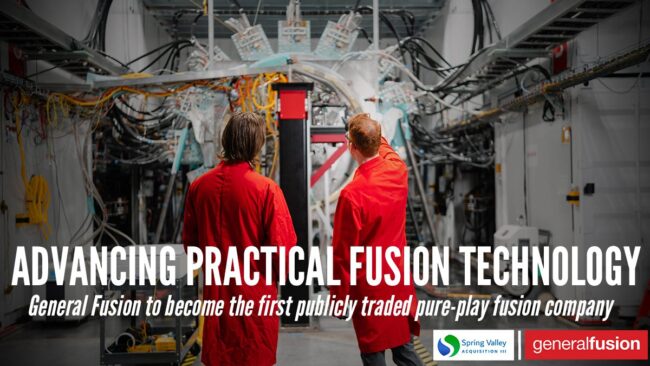
General Fusion Inc. and Spring Valley Acquisition Corp. III (NASDAQ: SVAC) have announced a definitive business combination that will take the Canadian fusion energy company public at a pro forma equity valuation of approximately $1 billion. The transaction will make General Fusion the world’s first publicly traded pure-play fusion company and inject over $300 million in gross proceeds, aimed primarily at advancing its LM26 magnetized target fusion demonstration program toward key commercial milestones.
What does the General Fusion–SVAC merger signal about institutional belief in near-term fusion readiness?
The merger marks a pivotal moment in the fusion sector’s shift from scientific frontier to market reality. While investor interest in fusion has grown steadily over the past five years, most projects have remained in private hands due to long timelines, high capital intensity, and uncertain regulatory pathways. By moving into the public markets, General Fusion is signaling a new level of maturity and accountability in fusion development. The company becomes the first to pursue a Nasdaq listing purely on the basis of fusion technology and its underlying commercial potential.
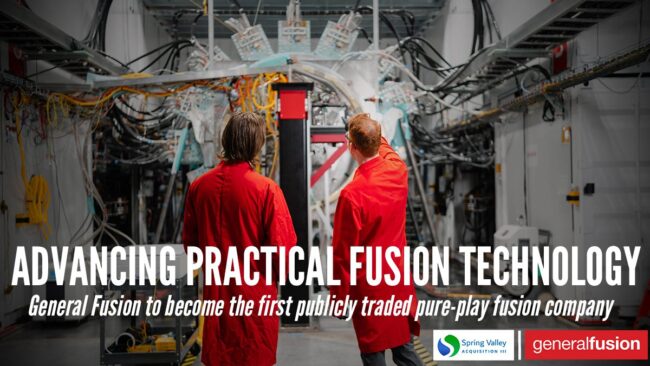
General Fusion’s patented magnetized target fusion (MTF) platform avoids several of the technical bottlenecks associated with tokamak-based and laser-based fusion approaches. Instead of relying on superconducting magnets or high-energy lasers, MTF uses mechanical pistons to compress plasma within a liquid lithium liner. This simplified architecture is designed to reduce capital costs, increase durability, and accelerate the pathway to grid-scale deployment.
The company’s flagship demonstration platform, Lawson Machine 26 or LM26, is already operational. It is engineered to mechanically compress plasma to key heating thresholds, including 1 keV and 10 keV, and ultimately aims to meet the Lawson criterion, the theoretical benchmark for achieving net energy gain from fusion reactions. The machine is currently functioning at 50 percent of commercial-scale diameter, with test campaigns underway to validate performance under increasingly aggressive energy conditions.
The proceeds from the SPAC merger include $105 million in oversubscribed PIPE financing and access to Spring Valley’s $230 million in trust capital, assuming no redemptions. These funds will be used to fully finance the continued development and operation of LM26, as well as to prepare for future commercial pilot projects. General Fusion has previously raised over $400 million from a global syndicate of venture capital firms, strategic partners, and government grants, giving it one of the strongest funding bases in the private fusion space.
How does this transaction expand the Spring Valley thesis in nuclear and decarbonization SPAC deals?
Spring Valley Acquisition Corp. III brings a deep pedigree in decarbonization-related investments and has previously completed high-profile transactions such as the NuScale Power public listing. Its upcoming deal with Eagle Energy Metals, a company focused on domestic uranium exploration and next-generation reactor development, further illustrates the firm’s focus on advanced nuclear energy platforms. By selecting General Fusion as its next merger partner, Spring Valley is consolidating its position at the intersection of capital markets and nuclear energy transformation.
Chris Sorrells, Chairman and Chief Executive Officer of Spring Valley Acquisition Corp. III, described the choice of General Fusion as straightforward due to the strength of its LM26 platform and its technical team. The transaction also reflects a deliberate pivot by Spring Valley toward technologies that offer energy security, scalability, and alignment with future electricity demand curves.
The broader Spring Valley team includes investors and operators with long track records in decarbonization, nuclear energy, and clean tech IPOs. Collectively, they have executed over 50 transactions in the sector and helped launch more than a dozen publicly traded energy companies. Their ability to assemble committed PIPE financing, despite a more cautious SPAC market, adds credibility to the transaction and reflects a measured belief in fusion’s commercial timeline.
Why General Fusion’s LM26 demonstration platform matters in the race to net energy gain
General Fusion’s LM26 is not just another experimental fusion device. It represents the first large-scale magnetized target fusion demonstration machine built at a commercially relevant scale. Its design compresses plasma using a liquid lithium liner, with the goal of achieving extreme temperatures and pressures that mimic those in the sun’s core. Importantly, the device is intended to validate the physics of net energy gain, not just demonstrate isolated scientific phenomena.
The company’s approach emphasizes mechanical simplicity, component reusability, and industrial scalability. If LM26 reaches the 10 keV milestone and shows progress toward meeting the Lawson criterion, General Fusion could emerge as the first fusion company with a viable roadmap to grid integration within the 2030s. The technology is designed to bypass many of the infrastructure and cost barriers faced by conventional nuclear plants, offering potential for lower regulatory hurdles and faster permitting in global energy markets.
LM26 is currently the only MTF platform operating at this scale. It complements other fusion development models such as the high-field tokamak pursued by Commonwealth Fusion Systems and the beam-driven field-reversed configurations favored by companies like TAE Technologies. The diversity of technical approaches across the sector is healthy, but General Fusion’s public listing places its methodology at the forefront of investor attention and scrutiny.
Could market fundamentals and geopolitical energy dynamics make fusion commercially viable by 2035?
The fusion narrative is being re-evaluated in light of rapidly shifting energy demand and supply dynamics. The International Energy Agency forecasts a 40 to 50 percent increase in global electricity demand by 2035, driven by electric mobility, digital infrastructure, electrified heating, and the proliferation of AI and data center loads. The United States Department of Energy projects that data center electricity consumption alone could double or even triple by 2028.
Fusion has the potential to meet this demand without the waste, fuel security concerns, or proliferation risks associated with conventional fission. A recent analysis by the International Atomic Energy Agency highlights that fusion could produce four times more energy per unit of fuel than fission and nearly four million times more than fossil fuels. It also generates less long-lived radioactive waste and can use abundant isotopes such as deuterium and tritium as fuel sources.
Additionally, fusion projects could benefit from a more favorable regulatory regime compared to fission. A 2025 version of Lazard’s Levelized Cost of Energy+ report suggests that fusion could ultimately deliver a cost of electricity competitive with renewable sources once capital amortization and waste disposal are factored in. While timelines remain uncertain, regulatory flexibility, sovereign incentives, and decarbonization mandates could push fusion from the laboratory into early commercial deployment sooner than expected.
What are the key risks and milestones General Fusion must now manage under public scrutiny?
Listing on a public exchange raises the bar for performance accountability, financial disclosure, and execution visibility. General Fusion will need to maintain a consistent cadence of technical updates on LM26, show evidence of plasma temperature and pressure gains, and detail its roadmap for pilot plant deployment. Missed milestones or prolonged silence on progress could invite investor skepticism and pressure the company’s valuation and capital access.
Leadership experience may help mitigate this risk. Chief Executive Officer Greg Twinney has previously helped lead companies such as Real Matters, Kobo, and Opalis through successful public listings and acquisitions. Chief Strategy Officer Megan Wilson brings deep operational and nuclear experience, having served in senior roles at Babcock & Wilcox and as a nuclear engineering officer in the United States Navy.
In addition to scientific execution, General Fusion will likely need to pursue strategic partnerships with government agencies, utilities, or industrial customers that can co-develop pilot facilities or underwrite early-stage offtake agreements. Intellectual property monetization or licensing could also provide interim revenue streams. With over 210 patents issued or pending, the company has a robust IP base that may appeal to sovereign partners and national laboratories.
The path ahead is difficult but no longer theoretical. For fusion to graduate from scientific aspiration to commercial asset class, companies like General Fusion must deliver results, navigate public markets, and build trust with investors and regulators.
What is the timeline and deal structure for the General Fusion–SVAC combination?
The proposed business combination is expected to close in mid-2026, subject to customary conditions, including regulatory clearance and shareholder approvals. Upon completion, the combined entity will retain the General Fusion name and list its common stock and warrants on Nasdaq under the ticker symbol GFUZ. The board of directors of both General Fusion and Spring Valley Acquisition Corp. III have unanimously approved the transaction.
The implied $1 billion pro forma equity value includes both the committed PIPE and the SPAC trust proceeds. The deal provides General Fusion with multi-year capital runway and the public market discipline needed to meet critical milestones. If successful, it could serve as a template for other deep tech and advanced energy startups looking to enter public markets through disciplined SPAC structures.
This transaction is not just a capital event. It is a signal that fusion energy, long considered a scientific moonshot, is entering an era of commercial acceleration and public accountability.
What this fusion SPAC means for the industry, competitors, and future of clean energy
- General Fusion will become the first publicly traded pure-play fusion energy company, creating a new category in public equity markets focused on fusion technology development.
- The company’s LM26 platform, if successful, could validate magnetized target fusion as a scalable, cost-effective pathway to clean baseload energy.
- Spring Valley Acquisition Corp. III is expanding its nuclear-focused SPAC track record, following its NuScale and Eagle Energy Metals transactions.
- Proceeds from the merger will fund LM26 operations and lay the groundwork for future commercial plant design, site planning, and potential pilot programs.
- Investor reception to the listing will influence capital access and valuation trajectories for other fusion startups currently reliant on private capital.
- The deal could help accelerate regulatory frameworks for fusion-specific permitting and commercialization pathways globally.
- Competitors such as Commonwealth Fusion Systems, Helion Energy, and TAE Technologies will now face increased pressure to show technical and fundraising progress.
- General Fusion must meet aggressive technical milestones in plasma heating and pressure if it is to retain investor confidence and justify public market access.
- Partnerships with sovereign energy agencies, utilities, or industrial offtakers could help de-risk the early commercial deployment phase.
- The listing provides a critical test case for whether fusion can make the jump from experimental science to infrastructure-grade technology within this decade.
Discover more from Business-News-Today.com
Subscribe to get the latest posts sent to your email.