Ørsted (CPH: ORSTED) has completed installation of all 66 wind turbines at its 920-megawatt Greater Changhua 2b and 4 offshore wind farms in Taiwan, achieving full mechanical build-out ahead of schedule. The project, located off the coast of Changhua County, now shifts to commissioning and grid integration, reinforcing Taiwan’s offshore wind leadership and Ørsted’s execution credibility in the Asia-Pacific market.
How does Ørsted’s Greater Changhua completion reshape offshore wind leadership in Asia-Pacific?
The completion of wind turbine installation at the Greater Changhua 2b and 4 offshore wind farms marks a significant turning point for Taiwan’s energy transition strategy and Ørsted’s regional expansion thesis. Spanning 920 megawatts and deploying 66 of Siemens Gamesa’s 14 MW SG 14-236 wind turbines, the project is not only the largest of its kind in Taiwan but also the first in Asia-Pacific to directly supply clean power under a corporate power purchase agreement (CPPA). That precedent sets up a new baseline for industrial decarbonisation models in energy-importing economies.
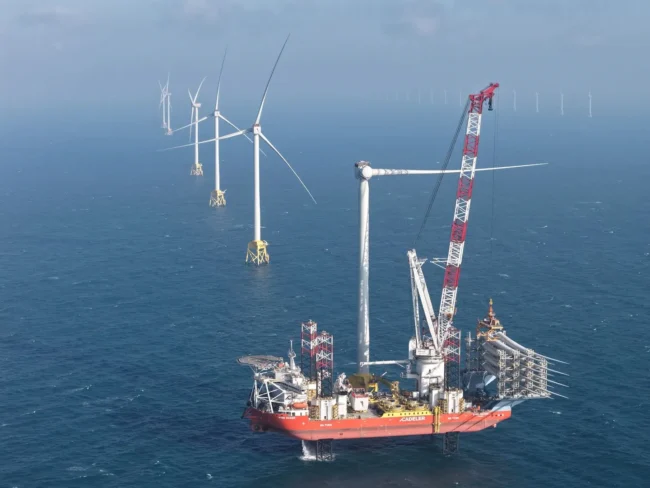
Offshore construction began in February 2025, with turbine installation launching two months later. Despite the notorious weather constraints in the Taiwan Strait and a compressed seasonal window, all turbines were installed within 275 days using Cadeler’s Wind Maker installation vessel. For Ørsted, this operational discipline affirms the group’s credibility in executing large-scale, multi-gigawatt portfolios under tight timelines. More importantly, the project reinforces Taiwan’s national strategy of becoming a regional offshore wind hub.
By integrating high-capacity turbines, non-piling foundations, and CPPA-backed offtake, the project signals what future-ready offshore wind infrastructure could look like in Asia—fast, scalable, and bankable.

What are the technical firsts at Greater Changhua and why do they matter for the offshore sector?
Greater Changhua 2b and 4 sets new technical benchmarks that position it among the most advanced offshore wind installations globally. It is the first project in the Asia-Pacific region to deploy suction bucket jacket foundations at scale, a technology that eliminates the need for pile driving. This innovation substantially reduces underwater noise pollution, a critical issue for marine biodiversity and regulatory compliance in shallow, ecologically sensitive waters.
It is also the first commercial wind farm to install Siemens Gamesa’s 14 MW turbines with 115-meter blades—the largest in commercial operation worldwide. The scale of these units enables greater energy yield per foundation, lowering levelised cost of energy (LCOE) and reducing logistics complexity in future builds. Fewer turbines for the same megawatt capacity translates to streamlined maintenance, lower operational expenditure, and a smaller physical footprint.
Combined with a sub-300-day installation timeline and zero lost-time injuries across over 130,000 offshore working hours, the project becomes a technical and operational case study in what Tier 1 execution should look like in constrained geographies.
How does this milestone align with Ørsted’s global construction pipeline and APAC ambitions?
From a portfolio lens, the Greater Changhua success further de-risks Ørsted’s global 8.1 gigawatt construction pipeline and strengthens the company’s positioning in the high-growth APAC corridor. Taiwan remains Ørsted’s anchor market in Asia, but the implications ripple outward.
With Japan, South Korea, and Vietnam accelerating their own offshore ambitions, successful large-scale builds in Taiwan provide Ørsted with a replicable blueprint for market entry and expansion. The combination of advanced turbine tech, high safety compliance, and efficient marine logistics coordination positions the company as a premium turnkey developer in a region hungry for energy diversification.
For investors tracking capital efficiency and risk-adjusted returns, Taiwan’s permitting environment, grid-readiness, and CPPA-friendly policy regime make it a natural proving ground before tackling higher-friction markets elsewhere in Asia.
What are the execution risks ahead before full commercial operation?
While turbine installation is complete, the project has not yet entered full commercial operation. The coming quarters will involve commissioning of the electrical system, offshore cable finalisation, and full testing of grid integration functionality. Ørsted expects Greater Changhua 2b and 4 to be fully operational by the third quarter of 2026.
Potential bottlenecks could emerge around cable terminations, SCADA integration, and grid synchronisation, especially given Taiwan’s evolving regulatory oversight of energy transmission and interconnection standards. Any delay in electrical system validation could push back revenue recognition and commercial start dates, although Ørsted’s prior track record in the region suggests strong risk mitigation protocols are in place.
How does this change the CPPA landscape and industrial decarbonisation pace in Asia?
Perhaps the most underappreciated aspect of Greater Changhua 2b and 4 is its CPPA structure, which enables Ørsted to directly supply power to a corporate customer rather than relying solely on government feed-in tariffs or grid PPA auctions. This model introduces pricing stability for both the developer and offtaker and aligns with the growing pressure on manufacturers and data center operators in Asia to decarbonise scope 2 emissions.
As large corporates face rising ESG disclosure mandates, CPPA-backed offshore wind becomes an attractive proposition. Taiwan’s clear CPPA framework—paired with grid availability and international developer interest—may make it the region’s first mover in large-scale industrial renewable contracting, similar to the role the Nordics played in Europe’s early CPPA market.
Other regional governments may observe how Ørsted’s model performs across revenue visibility, balancing costs, and regulatory harmonisation before adapting their own CPPA laws and auction formats.
What does this signal for offshore wind turbine innovation and supply chain resilience?
The Greater Changhua 2b and 4 rollout shows the wind sector’s continued march toward larger turbines and faster installation cycles, but it also highlights the strategic importance of regional supply chain development. As countries diversify away from Chinese suppliers in sensitive infrastructure sectors, Ørsted’s ability to execute using European turbine technology, installation vessels like Wind Maker, and modular foundations reflects a new era of dual-sourcing and geopolitical risk balancing.
It also raises questions about future-proofing against bottlenecks in nacelle, blade, and foundation manufacturing, particularly as more 14 MW-plus turbines become mainstream. The 275-day installation achievement may not be easily replicable without local port upgrades, skilled workforce pipelines, and regional component hubs.
If APAC governments aim to scale offshore wind to the multi-gigawatt level by 2030, Greater Changhua’s example will need to be matched by policy-led investment in turbine assembly yards, cabling capacity, and vessel ownership strategies.
What does Ørsted’s Changhua success mean for Asia’s wind sector?
- Ørsted completed wind turbine installation at the 920 MW Greater Changhua 2b and 4 offshore wind farms in Taiwan.
- The project used 66 Siemens Gamesa 14 MW SG 14-236 turbines, featuring the world’s longest 115-meter blades.
- First CPPA-backed offshore wind project in Asia-Pacific, reinforcing Taiwan’s leadership in industrial decarbonisation.
- Completed installation in just 275 days despite Taiwan Strait weather constraints, showcasing operational maturity.
- First project in the region to use suction bucket jacket foundations, significantly reducing underwater noise during build-out.
- Ørsted’s execution de-risks its 8.1 GW construction pipeline and sets the standard for offshore wind in APAC.
- Project is now entering final commissioning and cable works, with full commercial operation expected by Q3 2026.
- The CPPA structure offers a replicable model for other Asian markets transitioning away from feed-in tariffs.
- Demonstrates the rising importance of turbine scale, regional installation vessels, and cable/grid integration know-how.
- Highlights Ørsted’s role as a preferred developer for industrial-scale offshore projects in volatile regulatory environments.
Discover more from Business-News-Today.com
Subscribe to get the latest posts sent to your email.