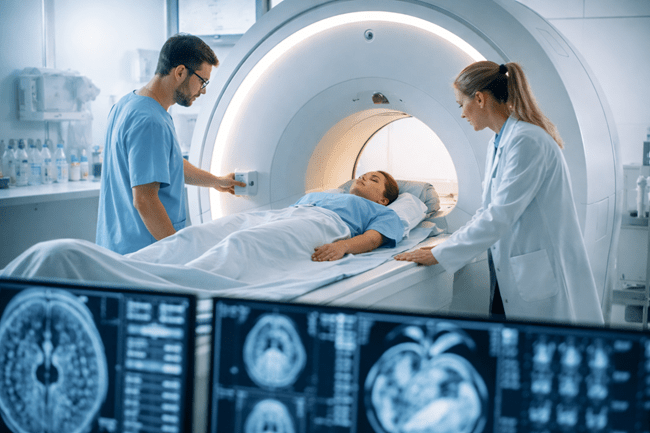
Vista AI, Inc. has secured $29.5 million in Series B funding to expand its FDA-cleared cardiac MRI automation platform into additional anatomies and remote scanning services. The round includes participation from health systems such as Cedars-Sinai, Intermountain Health, University of Utah Hospital System, Temple University/Fox Chase Cancer Center, and Tampa General Hospital, alongside returning investors including Khosla Ventures and Bold Brain Capital. This financing signals a growing convergence between operational strategy and venture investment within healthcare delivery systems.
As demand for MRI diagnostics continues to climb while radiology staffing remains critically constrained, Vista AI has positioned itself as a key enabler of workflow automation across distributed imaging networks. Its software platform reduces reliance on highly specialized technologists by automating the scan acquisition process, thereby standardizing image quality and increasing throughput in both academic and community care settings. The addition of remote scanning services further extends Vista AI’s ambition to decouple scan access from local expertise, opening the door for broader geographic equity in advanced imaging delivery.
This round reflects both operational validation and forward-looking platform potential. With Vista AI already reporting significant reductions in backlog and scan time at early adopter sites, the inclusion of hospital systems as strategic investors suggests that health providers now view automation not just as a technology choice, but as critical infrastructure for maintaining diagnostic standards under workforce pressure.
Why is Vista AI attracting direct investment from leading hospital systems?
Vista AI’s approach to radiology automation differs from traditional AI imaging startups by targeting the scan acquisition layer rather than post-processing or image interpretation. The company’s platform automates protocol selection, acquisition sequences, and scanner optimization steps typically performed by skilled technologists. Its FDA-cleared cardiac MRI application has already demonstrated the ability to increase scan capacity and reduce exam complexity across sites with varying levels of staffing and equipment.
Hospitals are now choosing to invest directly. Cedars-Sinai, Intermountain Health, and other participating systems are not only deploying the product but also embedding themselves into Vista AI’s long-term development roadmap. This signals that provider networks view automation as a necessity, not an option. With staffing gaps widening, and no immediate pipeline of technologists to fill the void, solutions that standardize imaging across skill levels are increasingly viewed as risk mitigation strategies rather than experimental pilots.
The strategic investment also aligns capital with operational goals. Health systems that invest in automation vendors have an incentive to drive internal adoption, reduce resistance to workflow changes, and influence product direction based on clinical needs. For Vista AI, this backing adds credibility and accelerates its ability to reach additional care sites through pre-established referral and deployment networks.
What makes Vista AI’s platform different from other radiology AI tools?
While many artificial intelligence companies in radiology focus on interpreting scans or highlighting clinical abnormalities, Vista AI’s strength lies in automating the front-end of the imaging process. The platform is integrated into the scanner operation workflow and guides technologists through consistent scan setup and execution, ensuring adherence to protocol without requiring deep cardiac MRI experience.
This sets Vista AI apart from firms focused on downstream diagnostic augmentation. By automating the scanning layer itself, the company addresses a structural constraint in radiology throughput that affects imaging quality, scheduling efficiency, and access equity. Where computer-aided detection tools support radiologists post-scan, Vista AI supports technologists during the scan, thereby influencing outcomes earlier in the imaging chain.
From a commercial standpoint, this gives Vista AI a broader deployment runway. The platform is vendor-agnostic, meaning it can operate across various MRI hardware brands without requiring full stack replacement or proprietary upgrades. This flexibility positions it as a software overlay that extends the utility of existing imaging fleets rather than competing with capital equipment vendors like Siemens Healthineers or GE HealthCare.
What early results support Vista AI’s expansion strategy?
Clinical and operational data from pilot deployments underscore Vista AI’s value proposition. At Brigham and Women’s Hospital, the platform enabled a 50 percent increase in cardiac MRI exam slots, eliminated a 28-day scheduling backlog, and allowed for next-day imaging availability without adding staff or equipment. This shift was achieved by automating the scan protocol and eliminating variability in technologist performance.
At Radiology Regional, a multi-site imaging provider in Southwest Florida, Vista AI reduced scan times by more than 50 percent. Perhaps more critically, it enabled technologists without prior cardiac MRI training to conduct exams with confidence and consistency. These outcomes suggest that Vista AI not only increases throughput, but also lowers the learning curve required to perform complex imaging, effectively expanding the pool of capable operators.
These results validate the company’s thesis that automation can standardize advanced imaging regardless of local expertise. By shifting more of the scan process into software, Vista AI helps close the access gap for advanced diagnostics in underserved or resource-constrained settings.
What new capabilities will this Series B funding support?
With the new $29.5 million capital infusion, Vista AI plans to expand its software platform beyond cardiac MRI to cover additional anatomies, including brain, prostate, and spine. These segments represent major volume areas in diagnostic imaging and could significantly broaden the company’s addressable market. However, each new application will require separate FDA clearance, and platform reliability must be revalidated for the unique scan parameters associated with each anatomical target.
Vista AI is also investing in its remote scanning services. This component allows imaging centers without cardiac MRI expertise to operate high-quality exams via remote guidance and support, effectively decoupling scan availability from geographic staffing constraints. If scaled successfully, this model could transform how regional hospitals and outpatient clinics deliver high-complexity exams.
Taken together, the expansion across anatomies and into remote operations moves Vista AI closer to building a unified platform for MRI workflow automation. It also increases competitive defensibility by positioning the company not as a single-use tool but as a comprehensive enabler of decentralized imaging delivery.
What are the risks to platform adoption and regulatory progress?
Despite its traction, Vista AI faces several execution challenges. The most immediate is regulatory. While the cardiac MRI solution is already FDA-cleared, each expansion into new anatomical areas will require additional clearances. These pathways can be lengthy and unpredictable, especially as imaging AI software is still evolving under new FDA review frameworks.
Technically, the ability to replicate automation accuracy across different anatomical scan types remains unproven at scale. Brain and spine MRI, for instance, introduce different imaging challenges compared to cardiac applications. Achieving consistent performance across such varied domains will test both the robustness of Vista AI’s machine learning models and its human-in-the-loop error handling.
Competitive dynamics also remain in play. Large scanner manufacturers may choose to bundle their own proprietary automation layers with hardware sales, eroding Vista AI’s vendor-agnostic advantage. Companies such as Philips, GE HealthCare, and Siemens Healthineers already offer automation features within their imaging ecosystems. While Vista AI sidesteps this by offering a standalone layer, pricing pressure or integration friction could slow adoption.
Internally, successful scaling will depend on Vista AI’s ability to integrate its solution into diverse hospital IT environments, from scheduling systems to radiology information systems. Workflow compatibility, training overhead, and clinical buy-in remain potential adoption barriers.
How Vista AI’s hospital-backed funding round could reshape automation in diagnostic imaging
The structure of this funding round carries implications beyond the company itself. With major provider networks acting as both investors and adopters, a feedback loop is forming between capital allocation and clinical deployment. If Vista AI succeeds, it could validate a model of automation-led care standardization in diagnostic imaging.
For investors like Khosla Ventures, the appeal lies in the platform’s positioning as a foundational layer in radiology infrastructure. As Bruce Armstrong noted, MRI is essential to modern diagnosis, but constrained by labor and complexity. Automation offers a pathway to scale diagnostics without scaling cost or staff. That proposition becomes even more compelling in a post-pandemic system still recalibrating around workforce shortages and procedural backlogs.
For health systems, the decision to invest directly is as much about operational resilience as financial return. Tools that reduce reliance on scarce personnel and expand access to specialized exams align with broader system goals around care equity, efficiency, and outcome consistency. Vista AI fits neatly into this intersection, which may explain why institutional healthcare capital is flowing toward automation platforms even amid a tighter funding environment.
Key takeaways on what this funding round means for Vista AI, MRI workflow automation, and the imaging industry
- Vista AI has raised $29.5 million in Series B funding with a hybrid investor base including Cedars-Sinai, Intermountain Health, and Khosla Ventures.
- The company automates cardiac MRI scanning workflows and plans to expand into brain, prostate, and spine imaging pending FDA clearances.
- Early adopters report significant gains in scan capacity, reduction in backlogs, and enabling of novice technologists for complex exams.
- Vista AI’s expansion into remote scanning services signals a push to decentralize advanced imaging access without expanding specialist headcount.
- The platform competes indirectly with scanner OEMs and directly with radiology staffing constraints, positioning it as a systems-level workflow tool.
- Strategic hospital investment reduces adoption risk and increases alignment between vendor success and provider operations.
- Future growth depends on regulatory approvals, cross-site IT integration, and maintaining clinical quality across multiple anatomies.
- If successful, Vista AI could emerge as foundational software infrastructure in a radiology sector struggling with labor shortages and throughput caps.
Share this:
Discover more from Business-News-Today.com
Subscribe to get the latest posts sent to your email.